




When a worker honey bee defends its hive, its sting delivers sharp pain through a biological system that keeps running long after the insect departs. While previous research examined honeybees trained to detect lung cancer by tracking chemical signatures, new research focuses on the mechanics of the sting itself [1]. Australian scientists from Macquarie University and the University of New South Wales recorded high-speed video showing how bee stings work as autonomous micropumps [2]. The tiny apparatus continues to drive into tissue and inject venom under its own power without any connection to the departed insect. These clear recordings show that the insect delivers fluid through coordinated moving parts rather than simple passive pressure [3].
How Bee Stings Work After Detachment
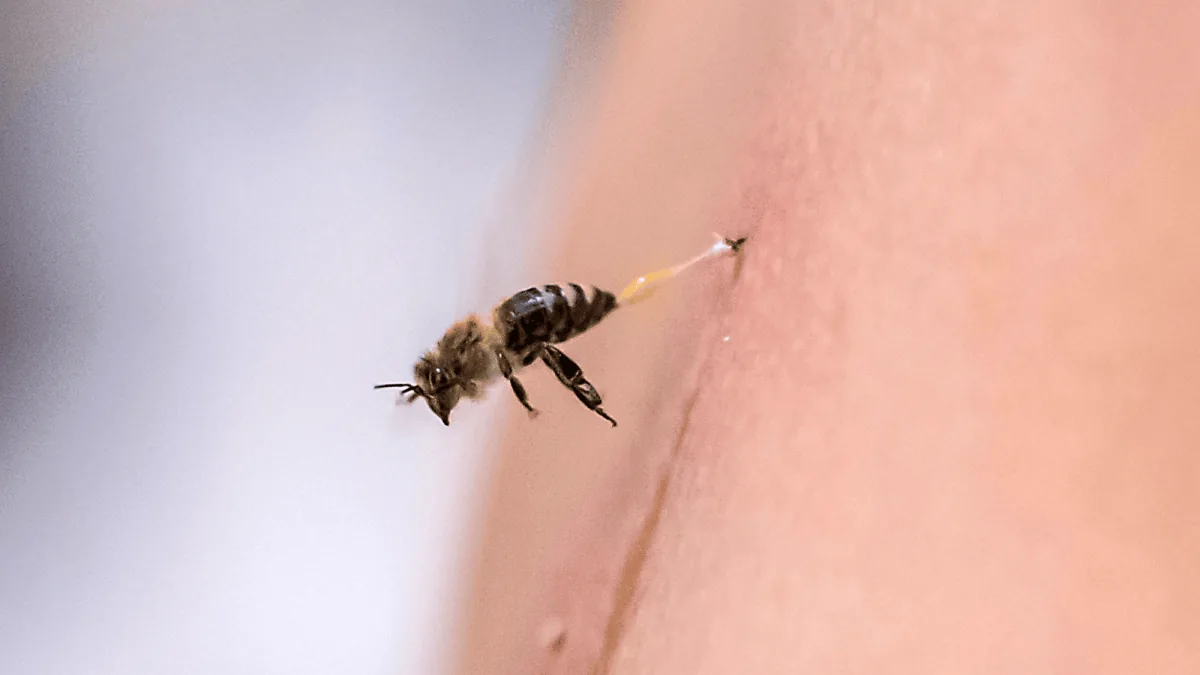
After a worker bee thrusts its stinger into a target, it flies away and leaves the entire apparatus behind in a process called autotomy. The detached unit does not stop moving once separated from the insect’s body. Instead, nerve clusters and small muscular bundles attached to the structure continue to contract rhythmically, pushing the pointed shaft deeper into the wound [2]. To observe this autonomous activity clearly, the research team from Macquarie University prompted bees to sting a transparent gel designed to mimic human skin [1]. High-speed video captured the independent action of the sting as it worked into the substrate without any remaining connection to the insect [3].
Observing how bee stings work in real time helps biologists understand how a detached organ maintains such persistent activity. The stinger itself measures only 2 millimeters, or about 0.08 inch, yet it contains several working parts that function together in tight coordination [2]. A venom sac feeds into a central pumping chamber that connects to moving lancets and sensory nerves [3]. Scientists previously struggled to observe these delicate parts in motion because the stinging event happens too quickly for conventional lenses. By combining high-speed imaging with artificial skin models, the researchers showed that the stinger operates as a self-contained double-piston micropump rather than a passive syringe [1].
Saw-Like Lancets Drive the Honey Bee Stinger Micropump
The drive of the sting relies on two sharp, pointed lancets that slide backward and forward along tracks. These interlocking guidance rails, known as the olistheter, permit smooth linear motion while preventing the sliding halves from separating during penetration [1]. Similar interlocking rail structures appear in other insect groups, as documented by A. F. Emeljanov in morphological studies of insect ovipositor anatomy [4]. In the honey bee (Apis mellifera), these lancets move back and forth in an alternating rhythm that closely mirrors the action of a reciprocating saw [3].
As the saw-like lancets move, microscopic backward-facing barbs on their outer edges catch against the surrounding tissue. When one lancet slides forward, its barbs anchor into the flesh, and this grip lets the opposing lancet pull itself deeper into the wound during the next stroke [2]. This alternating reciprocal motion generates the force needed to push the stinger deeper into the skin without assistance from the departed bee. At the same time, the sliding lancets drive the fluid mechanism that pushes venom forward through the central channel [1].
Detailed descriptions published in the Proceedings of the National Academy of Sciences show how each lancet connects to a mobile valve inside the primary bulb chamber. Because the lancets shift back and forward continuously, they provide both the penetration force and the motive power for fluid delivery [1]. This dual function removes the need for a separate motor so the tiny 2-millimeter organ performs two demanding tasks at once [3].
Collapsible Valves That Dynamic Shape Changes Create
Inside the bulb chamber, the stinger uses flexible valves that dynamically change shape during each stroke of the cycle. When a lancet moves downward, its attached valve inflates like a parachute, forming a seal against the chamber wall and acting as a piston to push venom toward the exit [1]. During the subsequent upstroke, the valve deflates and collapses against the lancet shaft. This collapse lowers drag so fresh venom from the sac refills the chamber without backward flow [2].
High-speed video recorded the moment when the two opposing valves cross paths in the middle of the pumping chamber. Dr. Fiorella Ramirez-Esquivel of Macquarie University explained how the flexible membranes handle this tight encounter: “Finally, and perhaps most dramatically, as the valves meet in the middle of the stroke, they change shape again to push past each other” [1]. Ramirez-Esquivel pointed out why this response matters: “This is a remarkable strategy to pump fluid since maintaining a seal is vital to effectively transmit pressure” [2]. By changing geometry continuously, the valves keep fluid moving forward without jamming [3].
Further examination showed that understanding how bee stings work at the microscopic scale reveals unexpected solutions to fluid control problems. The unique movement prevents backflow and keeps drag low, so tiny muscular contractions generate steady fluid output [1]. The valves switch from flat flaps to curved cups within milliseconds. This rapid transition shows that passive shape changes can guide complex hydraulic cycles in tiny living systems [2].


How Honey Bee Stingers Pump Venom Continuously
The coordinated action of opposing collapsible pistons allows the honey bee stinger to deliver an unbroken stream of venom. Because the two lancets pump in opposite directions, one piston drives fluid downward while the other retracts to refill the bulb [1]. Dr. Fiorella Ramirez-Esquivel said: “The unique geometry of the valves is the key; they act as collapsible pistons and—by pumping in opposite directions—they’re able to deliver a continuous flow of venom” [2]. This arrangement keeps venom flowing into the wound as the stinger continues its saw-like penetration [3].
Researchers knew about the chamber for generations without resolving how its parts moved. “We’ve known since as early as 1910 that the venom sac of a honey bee stinger empties into a chamber with little pumping elements called valves, but until now we didn’t know exactly how they work,” said Ramirez-Esquivel [1]. Earlier entomologists identified the basic cavities in 1910, but static microscopy could not reveal how soft valves flexed and sealed during active fluid delivery [2].
To test the fluid dynamics, the team used microCT scans to 3D-print a scaled-up robot of the chamber and lancets. This working model confirmed that the alternating geometry produces reliable flow [2]. The findings add to broader studies of hive biology, much like research on honeybees that do not insulate their colonies against cold naturally [1]. As Ramirez-Esquivel stated: “The double-piston design adds complexity, but it’s the key to the stinger being able to deliver venom continuously in a compact, autonomous unit” [3].

Do Bee Stingers Work Their Way Out?
Detached bee stingers do not work their way out of tissue on their own; instead, the barbed lancets steadily drive the apparatus deeper into skin while pumping venom. Because the backward-pointing barbs catch in the dermal layers, each stroke pushes the stinger further into the flesh rather than dislodging it [2]. The autonomic nerve center continues sending electrical pulses to the muscles for several minutes after detachment, meaning venom delivery increases if the stinger remains embedded [3].
Learning how bee stings work within skin layers explains why quick action matters during outdoor encounters. Unlike some foreign objects that skin tissue naturally pushes outward over time, the stinger actively resists expulsion. The saw-like reciprocating action locks the organ in place, so prompt manual removal helps limit the total dose of venom injected [1]. Because the venom sac continues emptying into the pumping chamber through the action of the collapsible valves, scraping the stinger away quickly halts the pumping cycle [2].
Can Bee Stings Work as Medicine in Healthcare?
While venom itself requires clinical caution, researchers show that the mechanics of bee stingers can inspire new micropumps to deliver medicine with minimal tissue damage. Dr. Fiorella Ramirez-Esquivel said: “If you’ve ever been stung by a bee, you’ll know it’s a very painful process, but now we’ve been able to identify all the working parts packed into the tiny stinger” [1]. By uncovering how the tiny 2-millimeter organ functions without bulky motors, engineers gain a biological blueprint for building smaller, more efficient drug delivery devices [3].
The Macquarie University and University of New South Wales authors conclude that these biological principles could help microfluidic technologies and minimally invasive surgical tools. Conventional micropumps often struggle to maintain tight seals while keeping fluid moving forward through microscopic channels [2]. Engineering models based on how bee stings work could soon assist biomedical designers who create autonomous medical devices that deliver precise liquid medication through fine needles with reduced patient discomfort [1].
- ACADEMIC JOURNAL Ramirez-Esquivel, F., Klose, C., Lee, H. C., Graco, Q., Narendra, A., & Ravi, S. (2026). The honey bee stinger: An unusual pump with collapsible double pistons. Proceedings of the National Academy of Sciences, 123(43). [Article Link]
- ONLINE NEWS Mestri, S., & Egan, R. (2026). High-speed video reveals how honey bee stingers keep pumping venom after detachment. Phys.org. [Article Link]
- ONLINE NEWS Baisas, L. (2026). Bee stingers work like saws to pump venom. Popular Science. [Article Link]
- ACADEMIC JOURNAL Emeljanov, A. F. (2024). New Data on the Olistheter Structure in Dragonflies and Damselflies (Odonata). Entomological Review, 104(5), 321-323. [Article Link]
APA 7: TWs Editor. (2026, October 13). How Honey Bee Stingers Work Like Saws to Pump Venom. PerEXP Teamworks. https://perexpteamworks.com/en/how-bee-stings-work-pump-venom/


