






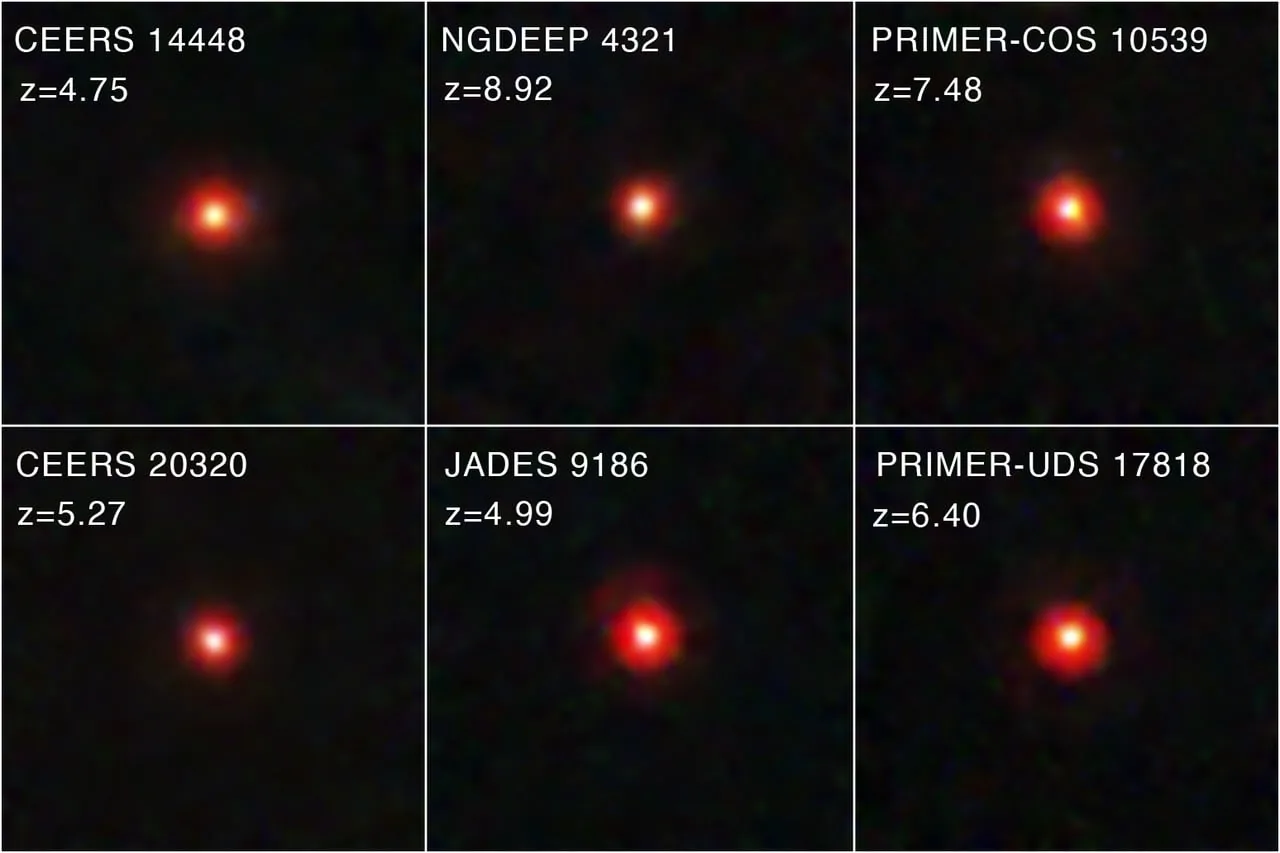
Could the mysterious little red dots spotted in the deepest corners of the universe solve one of modern astronomy’s greatest paradoxes? When the James Webb Space Telescope (JWST) began capturing the earliest cosmic epochs, astronomers repeatedly encountered compact, ruby-hued beacons that defied conventional classification across established astrophysical models. These tiny objects, formally cataloged as Little Red Dots (LRDs), exhibited properties of both active galactic nuclei and primordial stars. New cosmological simulations reveal that these structures represent overmassive black hole seeds growing dozens of times faster than modern astrophysics previously considered possible.
The Cosmic Enigma of Little Red Dots
Deep-field observations conducted with the James Webb Space Telescope opened an unprecedented portal into the infant universe. Among the most startling discoveries was a vast population of compact, intensely red point sources dating back to when the cosmos was less than 600 million years old [3]. Their faint yet persistent glow presented an immediate observational riddle for astrophysicists. Standard cosmological frameworks predicted that early galaxies should appear diffuse, populated primarily by young starburst clusters rather than dense, intensely luminous cores bathed in far-ultraviolet radiation [1, 2].
Astronomers initially lacked explanations for these mysterious objects. The empirical data defied standard cosmological timelines [2].
Initial hypotheses split the astronomical community into two distinct interpretive camps. Some researchers proposed that the little red dots represented young active galactic nuclei powered by intermediate-mass black holes, yet these objects generated virtually no detectable radio signals or X-ray emissions. Other astrophysicists argued that they might be enormous primordial stars composed purely of pristine hydrogen and helium. However, high-resolution spectral analyses revealed dramatic rotational Doppler shifts indicating rapid rotational velocities that would tear conventional superstar models apart, leaving the true nature of these objects completely unexplained [1, 2].
How Supercomputers Reconstructed the Early Universe
To resolve the physical standoff, a research team led by astrophysicist Sunmyon Chon at the Max Planck Institute for Astrophysics constructed elaborate cosmological simulations of the young universe to understand the physical nature of little red dots. The investigators deployed Japan’s ATERUI III supercomputer, operated at the National Astronomical Observatory of Japan under the auspices of the National Institutes of Natural Sciences [1, 3]. High-resolution numerical modeling allowed the team to track gravitational dynamics and gas thermodynamics across vast cosmic expanses without relying on speculative physics [1].
The multi-scale modeling architecture executed a progressive computational zoom. The code initiated calculations across the broad envelope of a forming proto-galaxy before systematically focusing inward toward individual, high-density clouds of gas. Supercomputers provided the critical breakthrough. This demanding approach mapped how local cosmic radiation fields influenced gas dynamics at sub-parsec scales. The team tracked environmental far-ultraviolet (radiation at wavelengths just beyond visible light emitted by active young galaxies) flux as neighbouring stellar systems ignited, measuring how intense photon bombardment altered the thermodynamic fate of surrounding matter [1, 3].
Temporal perspective formed a foundational pillar of this numerical investigation. Because electromagnetic radiation travels at a finite velocity through expanding spacetime, observing extremely distant objects allows astronomers to directly inspect ancient cosmic history across billions of light-years. A galaxy situated 11 billion light-years from Earth delivers photons that have journeyed across 11 billion years of cosmic expansion. The same physical principle applies to systems located 12 billion light-years away. Consequently, the simulations reconstructed volatile environmental conditions that existed in the young universe but have completely vanished today [1, 3].
Intense Radiation and Primordial Superstar Collapse
Under ordinary conditions in the contemporary universe, giant molecular clouds steadily fragment into thousands of smaller pockets that condense into individual stellar systems across vast galactic disks. In the turbulent infant cosmos, however, ubiquitous far-ultraviolet radiation radically reshaped normal fragmentation pathways [1, 3]. Energetic photons dissociated molecular hydrogen, stripping the gas clouds of their primary cooling agent. Deprived of the ability to cool and break apart, the massive reservoir remained cohesive under its own burgeoning gravity [1].
The numerical results showed that when nearby star-forming galaxies illuminate pristine primordial gas with intense radiation, normal stellar nurseries are prevented from forming inside the cloud. Without molecular cooling mechanisms to dissipate thermal energy, the cloud cannot break apart into clusters of low-mass stars. Instead, millions of solar masses of gas suffer continuous, monolithic gravitational collapse toward a single dense center. This catastrophic contraction gives birth to a solitary, supermassive star with a mass hundreds of thousands of times greater than the Sun. Such colossal stellar giants consume their nuclear fuel in a cosmic instant, burning through internal reserves before collapsing directly into an overmassive black hole seed [1, 2]. As surrounding matter plunges inward, the superstar’s core becomes gravitationally unstable, accelerating the inevitable transition toward a black hole.
Direct gravitational collapse generated black hole seeds with initial masses on the order of a million Suns. Traditional stellar-mass remnants, which begin with merely ten to one hundred solar masses, require billions of years of steady accretion to reach monstrous proportions. These newly simulated primordial seeds bypassed slow intermediate stages altogether. Gravity accelerated every subsequent phase. Born overmassive, the newborn singularities possessed sufficient gravitational pull to dominate their host proto-galaxies from their very inception [1, 2].


Overcoming the Eddington Limit via Super-Eddington Accretion
Once the massive seed black holes formed, their subsequent rate of mass accumulation became the deciding evolutionary factor. In classical astrophysics, infalling matter faces a strict physical boundary known as the Eddington Limit (the equilibrium threshold where outward radiation pressure counters inward gravitational collapse under general relativity). As gas plunges toward an event horizon, friction generates blistering thermal energy. The resulting outward radiation pressure blows surrounding gas away, choking off the black hole’s fuel supply and imposing a natural physical speed limit on its growth [1, 2].
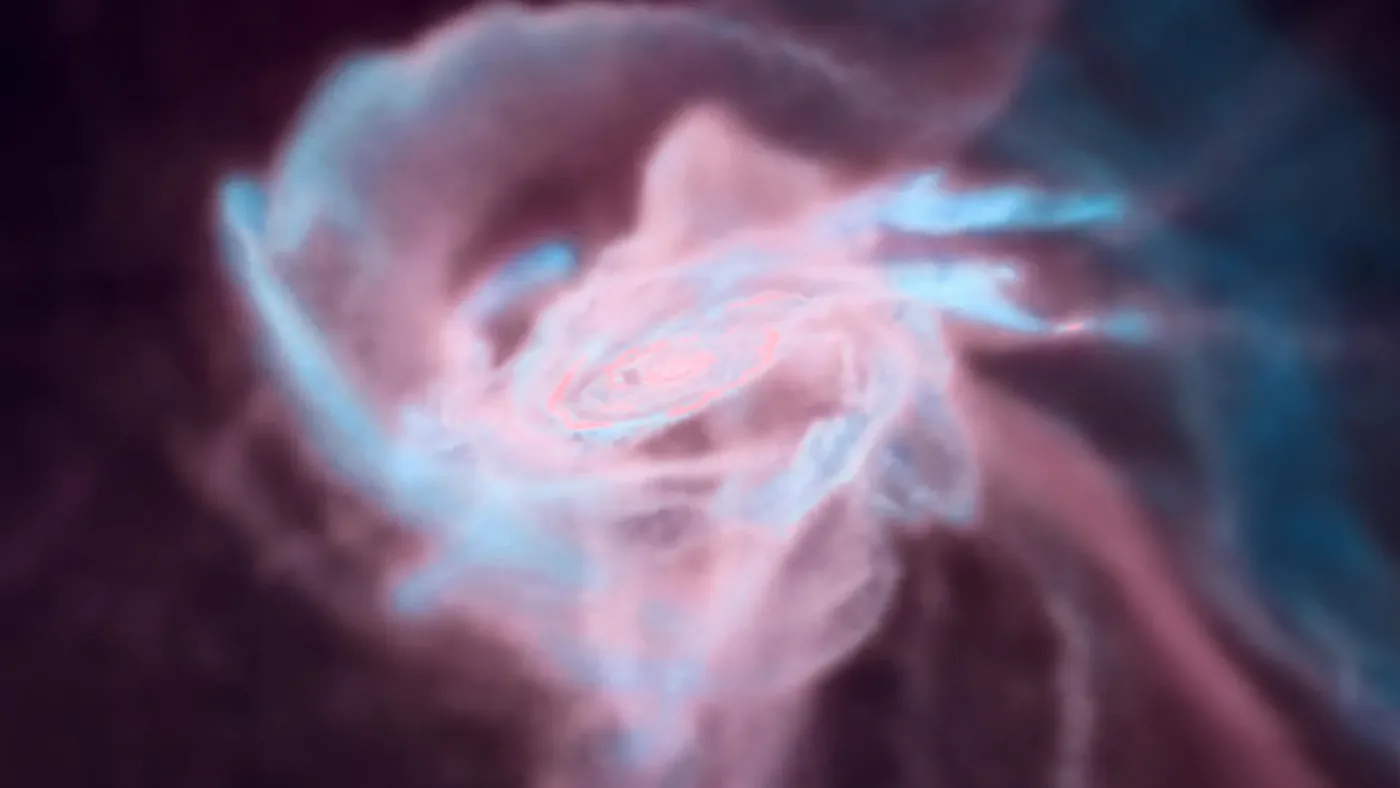
Early cosmic environments shattered this standard accretion barrier through sheer matter density. The ATERUI III simulations revealed that the newborn black hole seeds responsible for little red dots were rapidly enveloped by extraordinarily thick disks of dense gas. Dense gas changed everything. These opaque, toroidal envelopes acted as radiation traps, confining energetic photons within the inner accretion flow. Rather than dispersing the reservoir, intense environmental radiation combined with deep gravitational potentials to drive continuous, super-Eddington accretion rates, feeding the central singularity dozens of times faster than modern astrophysical systems permit [1, 2, 3].
Rapid accretion also resolves why early seed objects differ from later galactic engines. In later cosmological eras, massive compact objects often betray their presence through prominent spectral emission, as seen when astronomers study concealed supermassive black holes via radio signals penetrating thick dust clouds. In the primordial universe, the sheer column density of surrounding neutral gas absorbed energetic X-rays and quenched radio emission, effectively cloaking the voracious feeding process occurring within the seed core [1, 2].
Matching Simulated Spectra to Telescope Observations
How could astronomers verify whether simulated super-Eddington seeds match physical reality? The ultimate test of the numerical model lay in whether its synthetic outputs could match empirical data collected by the James Webb Space Telescope. When the research team generated spectral profiles from their simulated overmassive black holes, the computed light curves showed remarkable concordance with observed little red dots [1, 2]. The simulated spectra matched observations. The dense, rotating accretion envelopes naturally reproduced the prominent rotational Doppler shifts detected in real LRD spectra, simultaneously accounting for their compact, reddish appearances without invoking exotic new physics [1].
Understanding violent interactions between compact gravitational cores and surrounding matter provides broader context for astrophysical dynamics across cosmic history. Investigating how dense gas funnels into extreme gravitational fields parallels broader theoretical questions, including how the Sun would react to a black hole intrusion through severe tidal distortion and rapid mass capture. In both cosmological seeds and stellar encounters, intense gravitational fields convert infalling matter into dynamic, highly concentrated energy distributions governed by general relativity [1, 2].
While the supercomputer simulations offer an elegant hydrodynamic solution, complementary theoretical models continue to explore early cosmic structure. In an unreviewed arXiv preprint, researchers investigate whether small-scale clustering of primordial black holes could explain the high-redshift galaxy tension and the observed mass function of little red dots. This theoretical analysis represents an unreviewed preprint that has not undergone formal peer review. Evaluating both hydrodynamic super-Eddington accretion and primordial clustering models will help astronomers determine whether early black holes arose from baryonic gas collapse or primordial cosmological fluctuations [1, 4].
What Little Red Dots Mean for Galactic Evolution
Confirming that little red dots represent rapidly growing black hole seeds solves a longstanding puzzle that has vexed cosmologists for decades. Prior to the deployment of JWST, astronomers could not reconcile how supermassive black holes (quasars harboring billions of solar masses) could exist within the first billion years after the Big Bang [2, 3]. Standard growth models required far more time than the young universe could provide. The discovery of super-Eddington seed growth demonstrates that the cosmos possessed natural mechanisms to fast-track supermassive black hole formation [1, 2].
Compact red objects fundamentally bridge the evolutionary chasm between infant seed black holes and mature supermassive monsters. Rather than being rare anomalies or observational mirages, little red dots appear to be ubiquitous waypoints in early cosmic evolution. Cosmic history gained a missing link. Their enormous numbers in deep JWST surveys indicate that runaway black hole accretion was a widespread phenomenon that shaped proto-galactic environments, regulating star formation and driving the morphological development of the earliest galaxies across the cosmos [1, 3].
Future observational campaigns will probe even deeper into the cosmic dawn to verify whether earlier transitional stages exist. Upcoming spectroscopic surveys with next-generation observatories aim to map the exact transition from pristine superstar collapse to fully ignited quasars. The theoretical implications remain profound. For now, the little red dots have transformed from perplexing cosmological curiosities into crucial historical keystones, illuminating how the most monstrous gravitational titans in the universe first claimed their cosmic thrones [1, 2].
- ACADEMIC JOURNAL Chon, S., Hirano, S., Ishiyama, T., Chang, S., & Springel, V. (2026). Overmassive black holes and little red dots naturally form in simulations. Nature, 657(8132), 621–625. [Article Link]
- ONLINE NEWS Koberlein, B. (2026, September 17). Little Red Dots Are The Seeds of Quasars and Supermassive Black Holes. Universe Today. [Article Link]
- PRESS RELEASE National Institutes of Natural Sciences. (2026, September 17). JWST’s mysterious little red dots may be black holes growing at incredible speeds. ScienceDaily. [Article Link]
- PREPRINT arXiv. (2026). Small-Scale Clustering of Primordial Black Holes: The Little Red Dot Mass Function and the High-Redshift Galaxy Tension. arXiv:2609.09078 [astro-ph.CO]. [Article Link]
APA 7: TWs Editor. (2026, September 18). Simulations link early giant black holes to little red dots. PerEXP Teamworks. https://perexpteamworks.com/en/little-red-dots-early-black-holes/


