



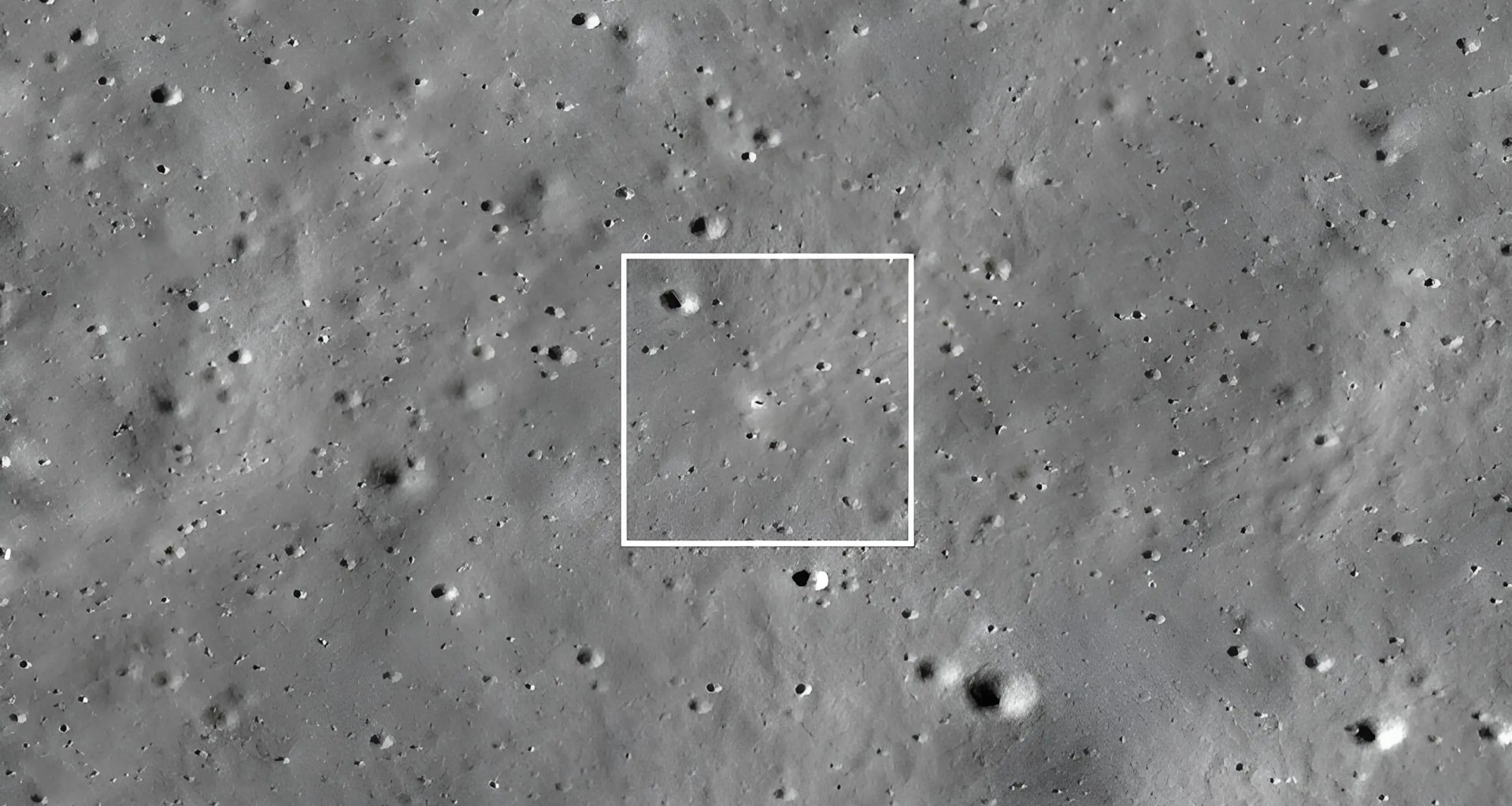
In a historic achievement on the lunar surface, a laser beam has been effectively transmitted and reflected between a NASA spacecraft orbiting the Moon and a compact device, comparable in size to an Oreo, positioned on ISRO’s (Indian Space Research Organization) Vikram lander. This breakthrough experiment not only marks the first instance of such laser communication on the Moon but also unveils a novel methodology for accurately determining targets on the lunar landscape.
The milestone occurred at 3 p.m. EST on December 12, 2023, when NASA’s Lunar Reconnaissance Orbiter (LRO) directed its laser altimeter instrument towards Vikram. Positioned near the Manzinus crater in the moon’s south pole region, Vikram was 62 miles (100 kilometers) away from LRO during the laser pulses transmission. The success of the experiment was confirmed when LRO detected reflected light from a minuscule NASA retroreflector aboard Vikram.
The technique employed, sending laser pulses towards an object and measuring the time it takes for the light to bounce back, is a well-established method for tracking the locations of Earth-orbiting satellites. However, applying this approach in reverse—sending laser pulses from a moving spacecraft to a stationary one to precisely determine its location—holds significant promise for lunar exploration. According to Xiaoli Sun, leader of the team at NASA’s Goddard Space Flight Center, the successful demonstration proves the capability to locate retroreflectors on the lunar surface from orbit. The next phase involves refining the technique to make it a routine practice for future missions utilizing these retroreflectors.

Measuring a mere 2 inches (5 centimeters) in width, NASA’s Laser Retroreflector Array, a diminutive yet powerful device, boasts eight quartz-corner-cube prisms arranged within a dome-shaped aluminum frame. Praised by scientists for its simplicity and durability, this retroreflector requires neither power nor maintenance and exhibits a lifespan that can extend for decades. Its unique configuration enables the retroreflector to efficiently reflect incoming light from any direction back to its source.
Retroreflectors, known for their versatility in scientific applications and exploration, have been a staple on the lunar surface since the Apollo era. The larger counterparts, resembling suitcase-size devices, previously demonstrated their utility by reflecting light back to Earth, revealing crucial information such as the moon’s gradual drift away from our planet at a rate of 1.5 inches (3.8 centimeters) annually.
This new generation of compact retroreflectors surpasses their predecessors in versatility. Utilized on the International Space Station, these minuscule devices serve as precision markers, contributing to the autonomous docking of cargo-delivery spacecraft. The adaptability of these tiny yet sophisticated instruments opens up a myriad of applications across various space missions and endeavors.

In the prospect of future lunar exploration, retroreflectors like NASA’s Laser Retroreflector Array could play pivotal roles, such as guiding Artemis astronauts during nighttime landings or marking spacecraft locations on the lunar surface for precise landing coordination. However, there are challenges to overcome before these retroreflectors can be effectively utilized.
A significant obstacle lies in the fact that, at present, NASA’s Lunar Reconnaissance Orbiter (LRO) is the sole lunar spacecraft equipped with a laser instrument—the LOLA altimeter. Despite operating for an impressive 13 years beyond its primary mission, LOLA wasn’t initially designed for the precise targeting required by retroreflectors. Since 2009, LOLA has primarily served to map the moon’s topography in preparation for surface missions.
Daniel Cremons, a NASA Goddard scientist collaborating with Xiaoli Sun, explains the difficulty in reconfiguring LOLA to consistently target the Oreo-sized retroreflector. LOLA’s method involves dispatching five laser beams toward the moon and measuring the time taken for each beam to bounce back, determining the surface elevation. However, the broad coverage of each beam (32 feet or 10 meters wide) and the sizable gaps between them pose challenges. It took eight attempts for LOLA to successfully contact Vikram’s retroreflector due to these limitations.
The current efforts highlight the need for advancements in laser instruments specifically tailored for targeting retroreflectors, paving the way for enhanced lunar navigation capabilities in future missions.
While altimeters excel at mapping lunar features like craters and rocks, their precision falls short when it comes to targeting retroreflectors with the required accuracy for consistent communication. Achieving pinpoint accuracy within one-hundredth of a degree, crucial for successful interactions with retroreflectors, necessitates a future laser system capable of slow and continuous coverage without gaps. Such a laser would be instrumental in unlocking the full potential of tiny retroreflectors.
Presently, the team overseeing NASA’s compact retroreflectors relies on the LRO’s laser altimeter to enhance the positional accuracy of surface targets, particularly lunar landers. Looking ahead, the plan is to deploy improved laser technologies to enable these retroreflectors to fulfill their intended functions seamlessly.
The deployment of NASA retroreflectors is anticipated on various upcoming moon landers, including JAXA’s (Japan Aerospace Exploration Agency) SLIM lander set to touch down on the moon on January 19, 2024. Additionally, private companies like Intuitive Machines are contributing to lunar exploration under NASA’s Commercial Lunar Payload Services (CLPS) initiative. Scheduled for a mid-February launch, Intuitive Machines’ spacecraft will carry six NASA payloads, including a retroreflector, exemplifying the collaborative efforts advancing lunar exploration capabilities.
Resources
- ONLINE NEWS Shekhtman, L. & NASA. (2024, January 19). Laser instrument on NASA’s LRO successfully pings Indian moon lander. Phys.org. [Phys.org]
Cite this page:
APA 7: TWs Editor. (2024, January 20). NASA’s LRO Detects Indian Moon Lander with Laser Instrument. PerEXP Teamworks. [News Link]


