






Scientists at the Max Planck Institute for Evolutionary Anthropology in Leipzig, Germany, have found an ancient genetic segment that alters brain shape in living people. The study, led by Hugo Zeberg and Svante Pääbo, shows that a specific Neanderthal brain variant reduces occipital lobe volume while lowering schizophrenia risk [1]. Early Homo sapiens acquired this archaic sequence when human groups met Neanderthals before the archaic species died out about 40,000 years ago [3]. It reshapes visual areas at the back of the skull, but it leaves general cognitive ability intact [4].
The Neanderthal Brain Variant in Living People
Fossil skulls show striking shape contrasts between early humans and ancient hominins. Neanderthal crania were noticeably elongated from front to back, whereas Homo sapiens crania display a rounded, globular contour [1]. Because soft brain tissue decays quickly after death, paleoanthropologists infer cortical dimensions by examining interior impressions preserved on ancient fossil crania. Fossilized endocasts suggested that Neanderthals possessed large occipital lobes, which sit at the back of the skull and process visual signals coming from the eyes [4].
Recent genetic studies connect these ancient bone traits to living human biology. Interbreeding between migrating Homo sapiens bands and Neanderthals introduced archaic alleles into non-African groups, leaving small DNA pieces that still shape hair textures and fat storage. Scientists have linked archaic DNA to metabolism as well as genetic adaptations that made Neanderthals early risers. Yet showing that ancient sequences govern living brain anatomy proved difficult because head growth involves thousands of coordinating genes [4].
To find clear anatomical links, Hugo Zeberg and Svante Pääbo analyzed four chromosomal sites previously tied to occipital volume in living people [1]. Three sites appear in sub-Saharan Africa, indicating deep ancestral origins that predated migrations into Europe. The fourth locus, located on chromosome 14 near DAAM1, exists only outside sub-Saharan Africa because it entered Homo sapiens through interbreeding with Neanderthals [1, 4]. The discovery gave Hugo Zeberg and Svante Pääbo an unexpected tool to study ancient brain evolution in living people [1].
Skull Endocasts and Occipital Shape
“Differences in the occipital region of the brain between Neanderthals and modern humans have long been inferred from the fossil record,” wrote anthropologists Hugo Zeberg and Svante Pääbo in PNAS. “Here, we show that a common genetic variant influencing occipital brain volume in present-day people was inherited from Neanderthals.” The occipital lobe contains the visual cortex, which turns raw sensory input from the eyes into sight. Knowing how ancient genes alter this lobe helps scientists map hominin divergence [1].
The brain volume data surprised the Max Planck Institute team.
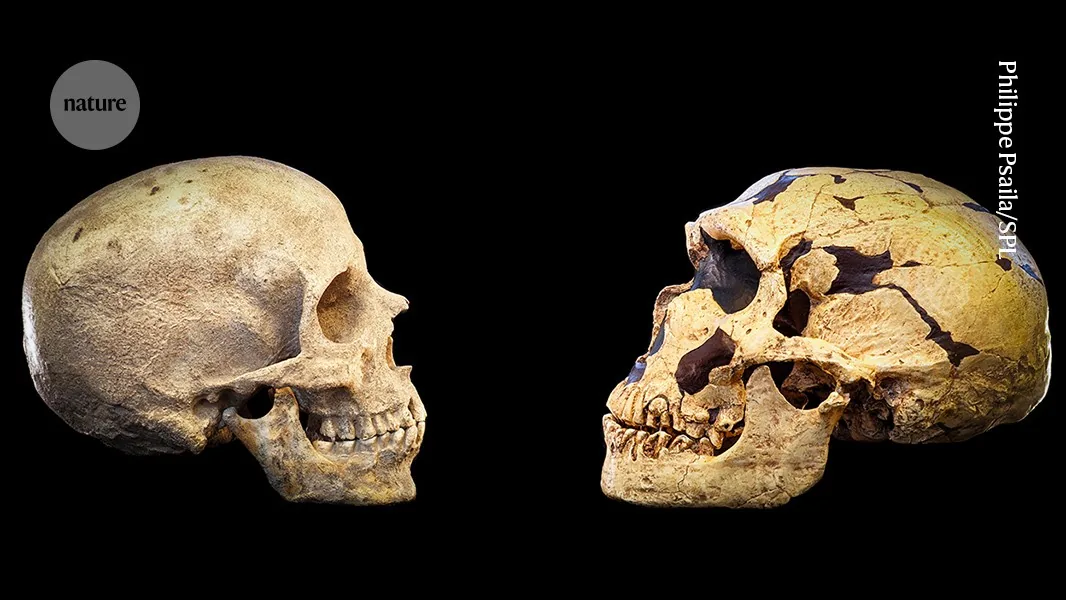
Although fossil endocasts suggest Neanderthals had larger occipital lobes than Homo sapiens, living people who carry the archaic variant actually have smaller occipital lobes [4]. Each copy of the inherited sequence reduces occipital lobe volume by about 0.85 cubic centimeters, with magnetic resonance imaging scans demonstrating that the volume loss centers specifically on the cuneus, a wedge-shaped subregion of the visual cortex [1, 3]. The cuneus showed a sharper volume loss than any other brain area linked to known gene variants [3].
Biologists note that the outcome seems puzzling at first glance, but a single gene variant cannot dictate whole organ size across different evolutionary lineages, especially when comparing elongated Neanderthal skulls with globular Homo sapiens crania [1]. Cranial dimensions depend on interactions among hundreds of developmental genes. Body weight and eye socket depth also alter cranial dimensions [4]. The tissue loss in living people shows that single inherited alleles produce distinct localized changes inside complex neural systems [1].
A Four-Letter Deletion Near DAAM1
At the molecular level, the variant consists of a tiny deletion of four DNA letters on chromosome 14 [4]. The deletion lies in transcription-factor recognition motifs next to DAAM1, a gene known to guide early brain growth [1]. First reported in genetic databases, the deletion alters how DAAM1 is expressed in developing nerve tissue [3]. Because regulatory motifs control gene output during embryonic life, even a four-letter deletion can create permanent anatomical shifts in adult brain regions across living human populations [1].
The strength of the trait drew notice from outside geneticists. “This is a very important variant,” said computational biologist Davide Marnetto at the University of Turin in Italy. “Its effect is really one of the most beautiful and strong that I’ve ever seen.” The volume drop of 0.85 cubic centimeters per allele is the largest anatomical effect on the cuneus yet documented by neuroimaging researchers. No other locus matched it [3].

Morphological clues also came from an unreviewed preprint led by Davide Marnetto and colleagues at the University of Turin. The authors evaluated 370 brain traits using magnetic resonance imaging in nearly 40,000 UK Biobank volunteers. While rare introgressed variants showed little detectable phenotypic impact, the common locus near DAAM1 stood out across several cortical traits. Davide Marnetto and his team saw opposing shape shifts in the cuneus and the nearby precuneus, confirming that the archaic deletion alters cortical folding [2].


The Neanderthal Brain Variant and Schizophrenia Risk
Beyond measuring brain volume, researchers asked whether structural changes affect mental health. Hugo Zeberg and Svante Pääbo examined clinical records from the Psychiatric Genomics Consortium [4]. Their statistical tests showed that carrying the Neanderthal brain variant correlates with a lower chance of developing schizophrenia. Each copy of the deletion lowers schizophrenia odds by roughly 5 percent, meaning people with two copies experience an almost 10 percent drop in disease risk [1].
The protective link belongs strictly to the DAAM1 locus rather than Neanderthal ancestry as a whole. When scientists measure total Neanderthal DNA across the genome, archaic ancestry does not lower psychiatric risk [1]. The protective signal appears only when people carry this specific chromosome 14 deletion [4]. Scientists suspect that altered DAAM1 expression during fetal brain development changes synaptic connections, though the exact cellular path linking the gene to psychiatric health remains unmapped [1].
Scientists do not yet know whether lower schizophrenia risk stems from smaller occipital volume or from an independent action of DAAM1 across other brain circuits. The occipital lobe handles visual signals, and schizophrenia often involves visual distortions [4]. Further laboratory tests must resolve this mechanism [1].
Ancient DNA from Five Neanderthals
Proving that people got this deletion from Neanderthals required testing ancient genomes. When two species split from an earlier ancestor, both can keep identical DNA without interbreeding [4]. To test this possibility, Hugo Zeberg and Svante Pääbo compared data from the 1000 Genomes Project against ancient hominin remains [3]. They checked sequenced DNA from five Neanderthals and two Denisovans. Denisovans carried neither copy. All five Neanderthal fossils had the four-letter deletion, while neither Denisovan genome carried it [1].
Final proof came from measuring the length of the surrounding DNA strand. Normal genetic recombination breaks inherited chromosomes into shorter pieces with each passing generation. If the deletion had come from a shared ancestor that lived hundreds of thousands of years ago, the surrounding DNA block would be very short. Instead, Hugo Zeberg found an intact sequence measuring 59.7 kilobases, or nearly 60,000 DNA letters long [3, 4]. “This is a piece of DNA that looks like it comes from Neanderthals,” said Zeberg in Nature [3].
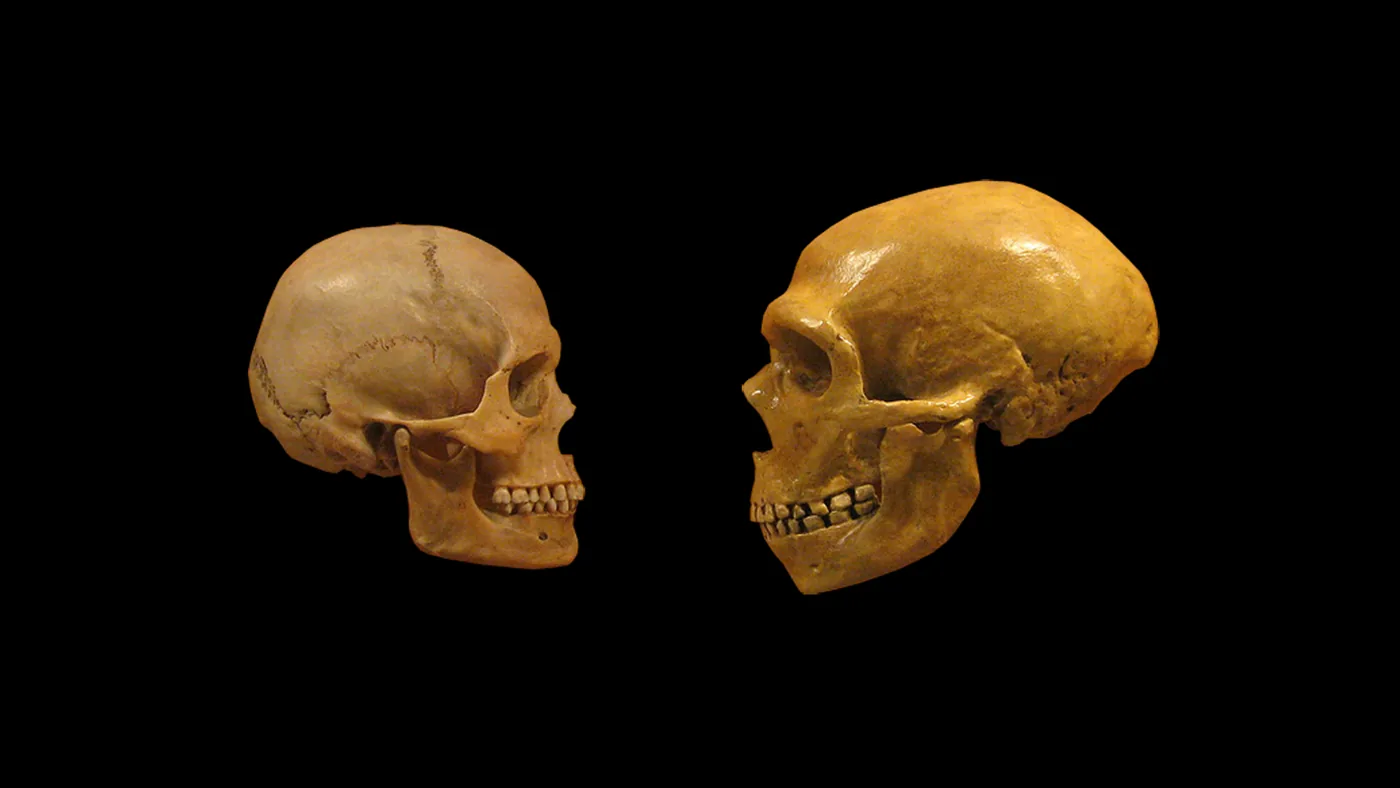
A DNA strand that long could only enter human genomes through interbreeding before Neanderthals disappeared. Ancient humans encountered Neanderthals after migrating from Africa, before the demise of our hominin cousins roughly 40,000 years ago. That genetic exchange left lasting traces in Europe and Asia while skipping sub-Saharan Africa [4]. Hugo Zeberg and Svante Pääbo proved that this piece of archaic code survived thousands of generations to alter occipital volume in living people across the globe [1].
Cognitive Ability Remains Intact
Whenever a gene variant reduces brain tissue, questions emerge about intelligence. In earlier eras, phrenologists believed that head volume directly determined intellectual power [4]. Modern neurobiology shows that synaptic connections, axonal insulation, and network wiring matter far more than crude tissue volume. To test whether the deletion harms intellect, Hugo Zeberg and Svante Pääbo tested participant files for educational attainment together with mental test scores [1].
Statistical analysis revealed no drop in mental performance among variant carriers. People carrying the four-letter deletion scored identically to non-carriers on general cognitive tests. Schooling records showed that the variant correlated with at most two weeks of difference in classroom education per allele against a 15-year average across formal study cohorts [1]. Shrinking occipital volume by 0.85 cubic centimeters does not harm memory, reasoning, or everyday thought. “These findings caution against equating the size of a brain region with cognitive abilities,” wrote Hugo Zeberg and Svante Pääbo in PNAS [4].
These findings reframe archaeological debates about Neanderthal ability. Popular culture long treated Neanderthals as crude brutes, partly because early scholars misread their elongated skull fossils [4]. Archaeological discoveries have since shown that Neanderthals made symbolic cave markings, used body ornaments, controlled fire, and showed engineering ingenuity before dying out amid climate changes and debates surrounding Neanderthal extinction. Cranial shape differences between Neanderthals and Homo sapiens did not mean lower intellect; instead, they reflected distinct evolutionary adaptations to vision, light levels, and eye socket size in Pleistocene environments [1]. Living people who carry this archaic code prove that ancient evolution reshaped human brain structures without reducing broader intellectual potential in daily life [4].
- ACADEMIC JOURNAL Zeberg, H., & Pääbo, S. (2026). A Neandertal-derived genetic variant reduces occipital brain volume in present-day humans. Proceedings of the National Academy of Sciences, 123(48). [Article Link]
- PREPRINT Zeloni, R., Amaolo, A., Morez Jacobs, A., Zapparoli, E., Akl, Y., Shafie, M., Huerta-Sanchez, E., Pizzagalli, F., Provero, P., Pagani, L., & Marnetto, D. (2026). Effects of introgressed Neanderthal alleles on present-day brain morphology. [Article Link]
- ACADEMIC JOURNAL Marshall, M. (2026). Genetic variant that reshaped the human brain was inherited from Neanderthals. Nature. [Article Link]
- ONLINE NEWS Starr, M. (2026). A Gene Inherited From Neanderthals Is Still Shaping Human Brains – And May Affect Schizophrenia Risk. ScienceAlert. [Article Link]
APA 7: PerEXP Teamworks. (2026, November 17). Neanderthal Brain Variant Reshaped Occipital Volume in Humans. PerEXP Teamworks. https://perexpteamworks.com/en/neanderthal-brain-variant-occipital-volume/


