




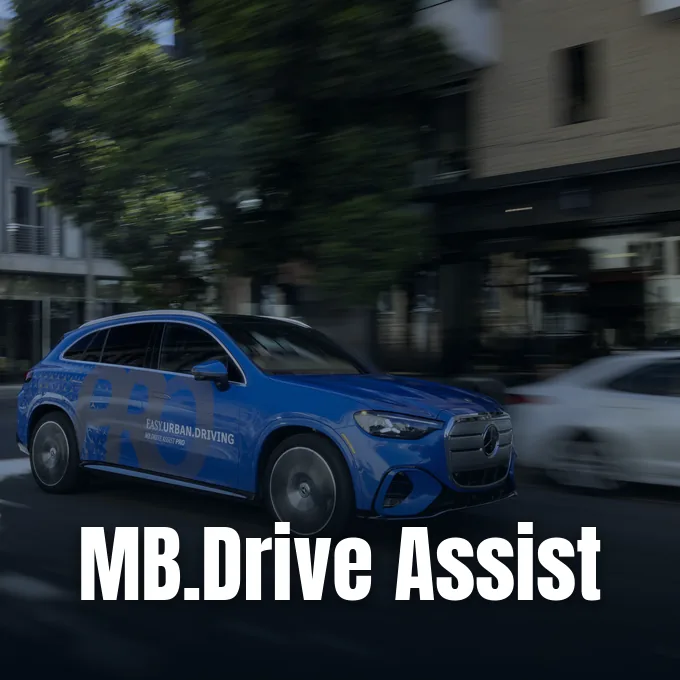
Mercedes-Benz announced plans to launch two partial automation features next year, introducing point-to-point city steering and hands-free highway cruising for eligible passenger cars. The urban driving system, called MB.Drive Assist Pro, navigates local roads, intersections, and congested traffic while requiring motorists to keep their hands on the wheel. Both additions position Mercedes-Benz against Tesla and its Full Self-Driving software, which currently leads the market in consumer hands-free technology [1]. An early access testing program begins for selected California drivers next month before a wider nationwide rollout in 2027 [2].
Testing MB.Drive Assist Pro on San Francisco Streets
Journalists tested MB.Drive Assist Pro through dense downtown neighborhoods in San Francisco earlier this month [1]. Driving a Mercedes-Benz GLC 400 through the Financial District and North Beach, testers observed the vehicle stopping at red lights, yielding right of way, and steering around stalled robotaxis [2].
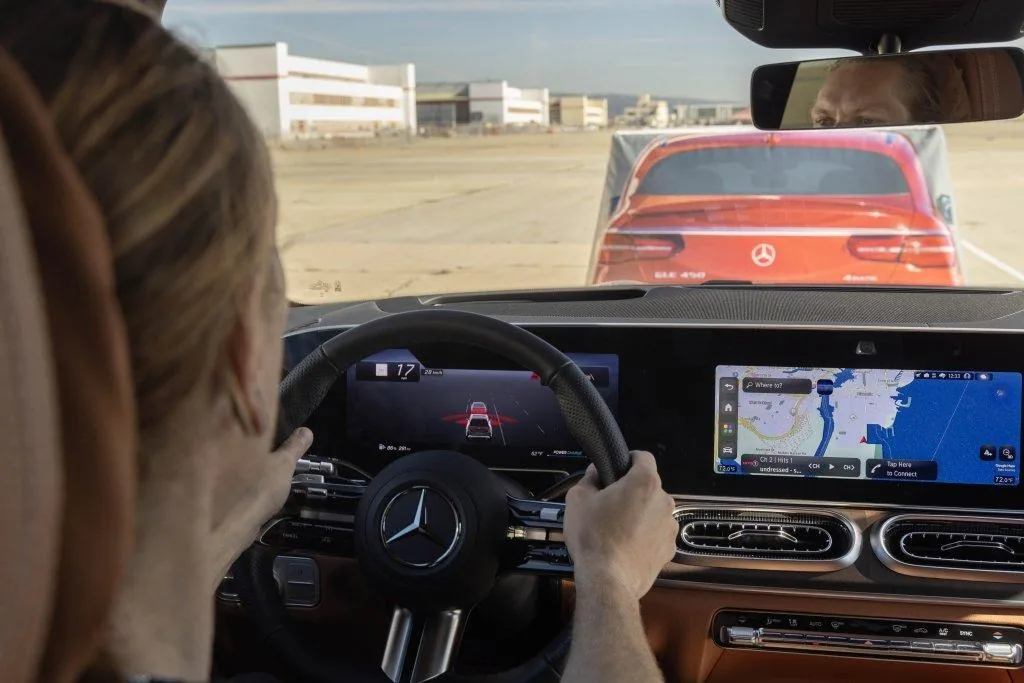
The point-to-point assist handles steering, braking, and throttle inputs on local streets, but it does not remove the human driver from legal responsibility [1]. During test drives, motorists had to take control in specific situations, such as tapping the brakes when a pedestrian prepared to cross in front of a turning vehicle. In another instance, a driver grabbed the steering wheel to guide the car around a large cargo truck unloading freight in the roadway. The vehicle also tended to come to a complete halt at every stop sign before slowly inching forward into the intersection [2].
Reviewers noted that the system navigated complex city conditions with steady lane positioning. Publication InsideEVs called it a “real challenger” to Tesla after completing a 25-minute test loop downtown. Reviewer Tim Stevens, writing for Endgadget, said the software guided the car past cyclists, jaywalkers, and unexpected U-turns “without issue” during demonstration runs. The technology handles highway exits, turn lanes, and street signals along programmed navigation paths, letting drivers monitor vehicle decisions rather than manually steering through heavy city traffic [1].
Hands-Free Driving on Highway Corridors
Mercedes-Benz is also bringing Hands-Free Highway Assist to United States freeways in spring 2027. The feature allows drivers to take their hands off the steering wheel on approved highways at speeds up to 85 mph, raising the previous 40 mph limit of Drive Pilot [1].
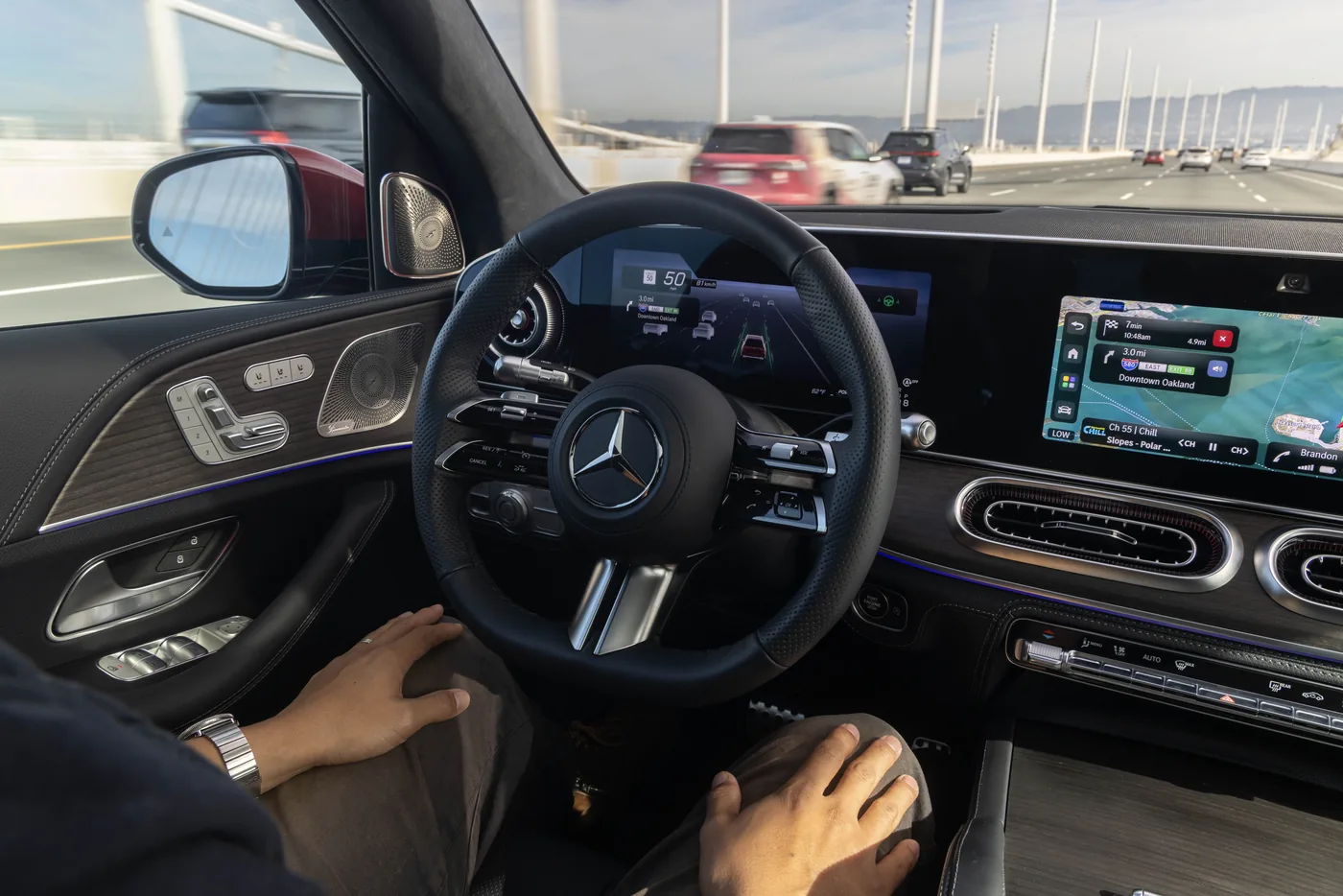
The highway system incorporates Proactive Lane Change Assist, which initiates lane changes to overtake slower vehicles or follow navigation routes toward upcoming exits [1]. During early media runs, testers drove a GLS 580 and an S 580e from Alameda across the Bay onto Interstate 880 at 65 mph. Drivers engaged the system by pressing the Resume button on the steering wheel or adjusting cruise control speed settings. The car changed lanes on its own when encountering slower traffic, though the system disengages near active highway construction zones, sharp curves, or freeway exit ramps [2].
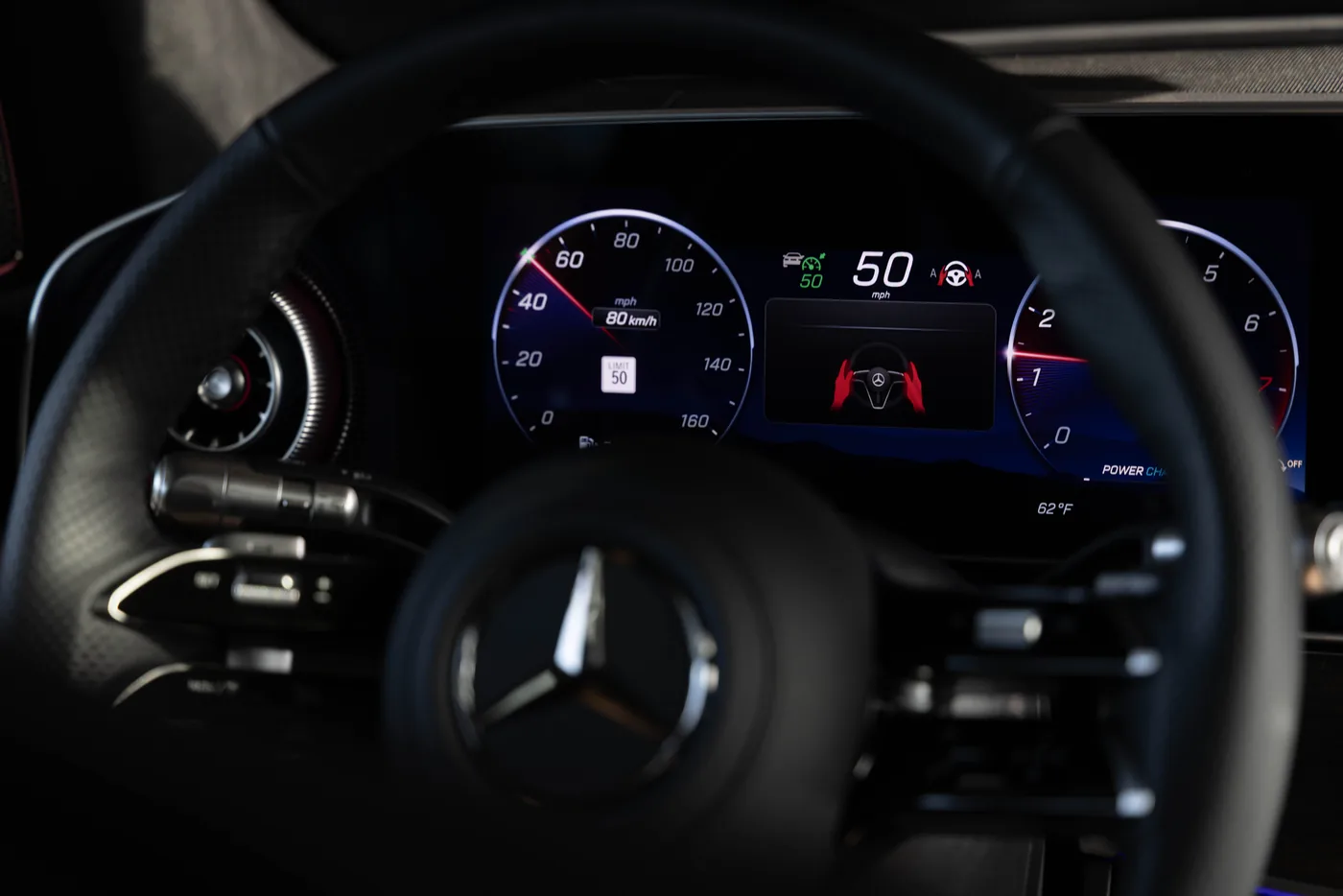
Drivers must watch the road continuously even when their hands are off the wheel [1]. An icon on the dashboard display shows a green steering wheel with gray hands and two letter As when the function is available. Once the car takes over active steering, the gray hands disappear from the cluster. If the car encounters an obstacle or leaves an approved freeway stretch, the steering wheel graphic turns red to signal an immediate handover [2].
Hardware and Nvidia Architecture Behind MB.Drive Assist Pro
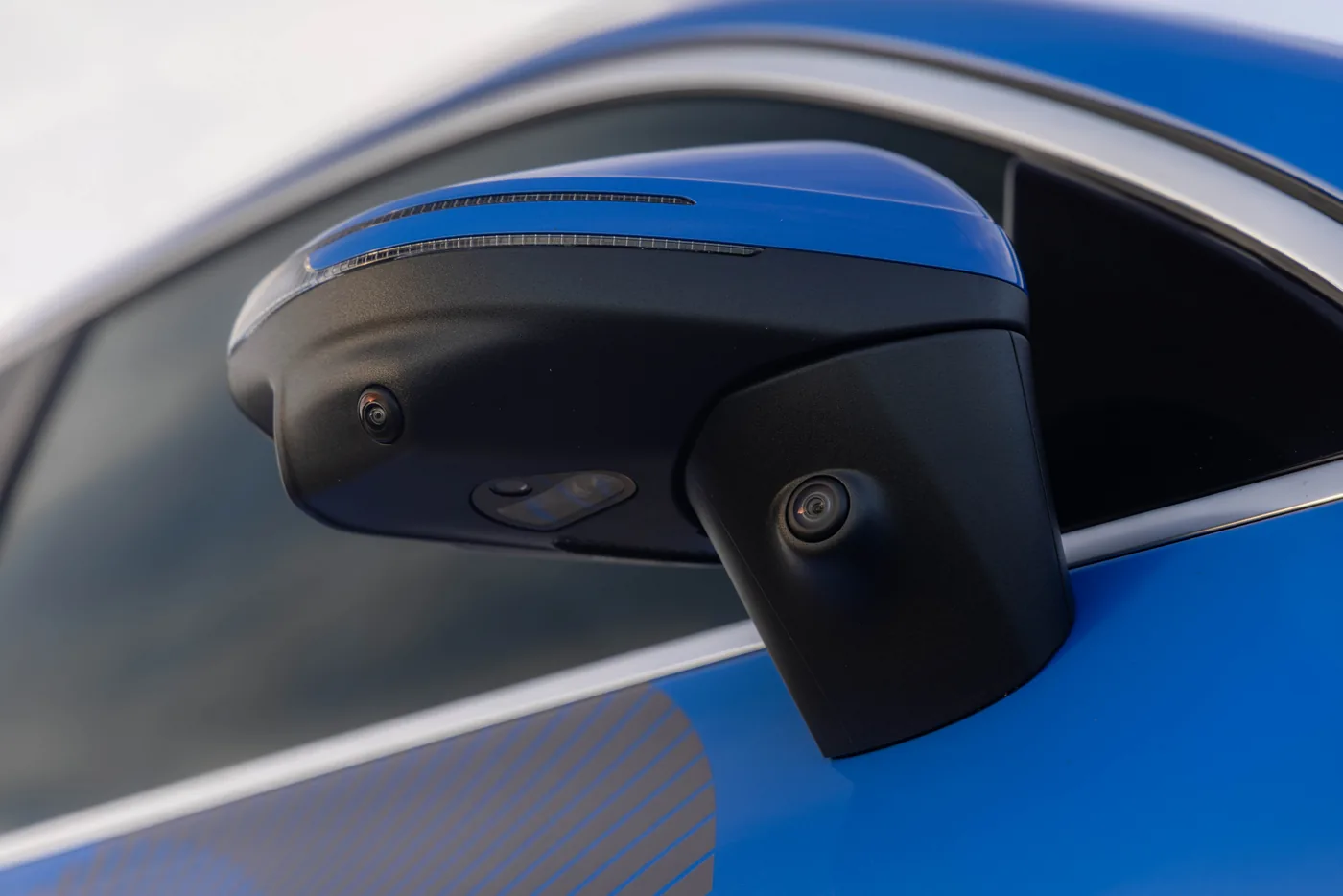
Both driving features rely on an extensive sensor suite built into the vehicle body. Mercedes-Benz equips vehicles running MB.Drive Assist Pro with 27 sensors, combining 10 cameras, 5 radar units, and 12 ultrasonic sensors placed around the bumpers, mirrors, and windshield [1], [2]. These inputs feed environmental data into an onboard computer capable of 254 TOPS, running on the new MB.OS software architecture. The computer processes camera feeds and sensor returns in real time to map surrounding traffic and pedestrians [1], [2].
The computing setup uses Nvidia’s Drive AV stack and Alpamayo software to evaluate complex traffic interactions and make driving choices. To maintain safety, Mercedes-Benz pairs machine learning decision models with a deterministic rule layer called Nvidia Halos [1],. Operating through Halos OS, this secondary software checks driving maneuvers against traffic laws, verifying that the vehicle stops at red signals and waits for intersections to clear before moving [2].
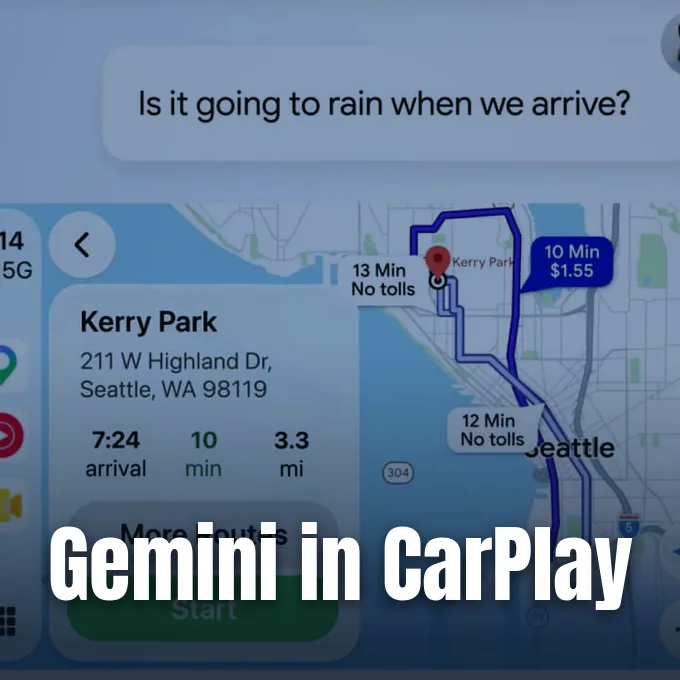
Automakers are changing how in-vehicle software interacts with mechanical controls as driving automation advances [2]. While digital updates such as Gemini CarPlay navigation in Google Maps provide conversational routing on dashboard screens, Mercedes-Benz links its operating software directly to steering and braking hardware. Integrating sensors with vehicle mechanics lets the car execute physical driving decisions rather than merely displaying route directions on an infotainment panel [1], [2].
Strategic Shift from Level 3 Autonomy
The introduction of these features marks a clear change in development strategy for Mercedes-Benz. The automaker previously focused on commercializing Drive Pilot, a Level 3 system with narrow operating parameters, but paused development in favor of wider Level 2 deployment [1].
By shifting to Level 2 driver assistance, Mercedes-Benz aims to deliver everyday utility that motorists can use across city streets and major highways [1],. Unlike fully driverless Level 4 robotaxi fleets operated by companies like Waymo and Zoox, Level 2 systems keep the human driver in command and legally liable for any driving errors. Competing systems from General Motors, Ford, and BMW—such as Super Cruise and BlueCruise—focus almost entirely on highway corridors rather than complex city navigation [2]. Tesla offers urban street navigation through its Full Self-Driving Supervised software, but Mercedes-Benz believes its blended sensor setup and deterministic safety guardrails can provide greater driving consistency on congested public roads [1], [2]. The company expects this supervised approach to encounter fewer regulatory hurdles than eyes-off systems while reaching a broader customer base [1].
Mercedes-Benz executives stressed that partial automation remains central to the automaker’s long-term vehicle portfolio. “We’ve clearly shown that the autonomous driving sector is an area that we will continue to develop and [be] involved in, and being one of the first companies to offer a system like you guys experienced today shows that we’re committed to be in that space and continue to grow,” Jason Hoff, CEO of Mercedes-Benz North America, said during a media roundtable [2].
Vehicle Availability and Subscription Rollout
The technology rollout begins through an invite-only early access program for selected California customers in December [1], [2]. A nationwide release across the United States will follow throughout 2027, with Hands-Free Highway Assist launching in the spring [1]. The point-to-point city driving system first debuted in China alongside the new CLA sedan in late 2025, and Mercedes-Benz plans to release the software in Germany as well [2].
Eligible vehicles for the 2027 launch include the 2026 CLA electric sedan, the 2027 CLA sedan, the 2027 GLC electric SUV, the 2027 GLE SUV and coupe, the 2027 GLS SUV, and the 2027 S-Class sedan [2]. Mercedes-Benz confirmed that more passenger models will arrive equipped with compatible sensors and processors starting in 2028 [1],. Buyers can specify the software when ordering a vehicle from the factory or unlock it digitally after purchase. The software will be delivered directly to the vehicle through over-the-air updates managed by the automaker’s connected vehicle network [2].
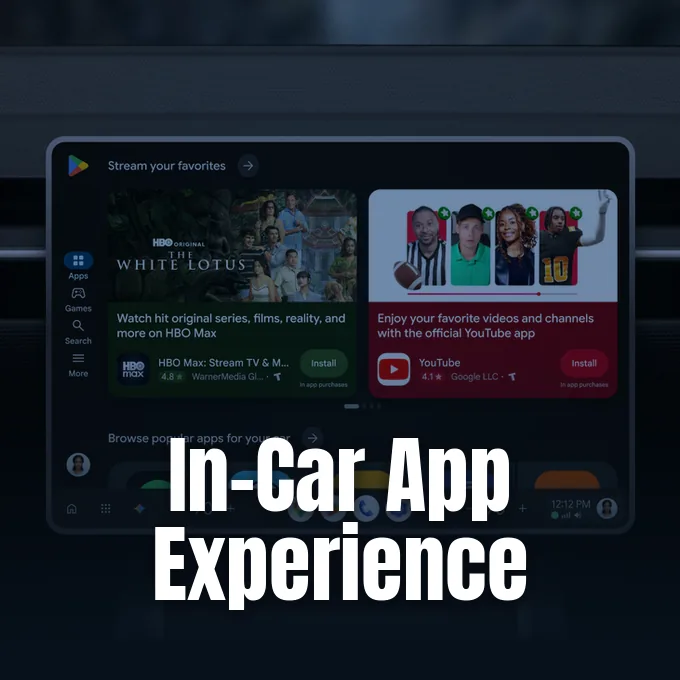
Mercedes-Benz has not published retail pricing for either driver assistance package yet. However, the company plans to sell access through flexible subscription terms, offering one-month, one-year, and three-year options through its online store [1], [2]. This software-defined approach aligns with broader auto industry trends, where connected vehicles receive feature upgrades similar to recent developments in in-car app platforms across passenger fleets. Subscription terms allow owners to test city driving assistance before committing to permanent ownership of the software [1], [2].
- ONLINE NEWS Hawkins, A. J. (2026, November 16). Mercedes-Benz takes on Tesla FSD with new point-to-point city driving assist. The Verge. [Article Link]
- ONLINE NEWS Al-Heeti, A. (2026, November 16). Mercedes’ New Point-to-Point Driver Assist Helped Me Overcome My Fear of Driving. CNET. [Article Link]


