





Microsoft unveiled the Surface Laptop Ultra on October 7 during a keynote presentation in San Francisco, introducing a high-end mobile workstation built around Nvidia’s RTX Spark hardware platform. The new machine starts at $2,599 and begins shipping on October 16 to developers and power users. While earlier Surface computers focused on low-power mobile work, this model is aimed at builders who need local artificial intelligence compute on a portable machine [4].
Surface Laptop Ultra Architecture and Nvidia RTX Spark Silicon
Nvidia Chief Executive Jensen Huang and Microsoft Chief Executive Satya Nadella appeared on stage together to present the new hardware architecture. Huang stated during the presentation that the companies had reshaped personal computing by placing heavy local processing into a laptop form factor. The machine runs on Nvidia’s Arm-based N1X platform, which pairs an 18-core central processor with an integrated 5,120-core Blackwell graphics unit in its base tier [5].
The platform relies on unified memory rather than separate system memory and video buffers, which lets the processor and graphics cores share the same high-speed data pool without moving data across a bus. Microsoft claims this setup pushes up to one petaflop of FP4 compute for machine learning workloads. In direct comparisons with Apple’s M5 Pro chip, Microsoft said the system delivers 2.1 times faster time to first token, 4.3 times faster image creation, and 6.2 times faster video generation [5].
The company describes this approach as hybrid intelligence, a framework where local software handles private data on the laptop while larger cloud models step in for heavy compute when requested. During the keynote, Microsoft employee Kayla Cinnamon put the laptop into airplane mode to show how local language models could summarize code repositories and edit project files without any active internet connection. Technalysis principal analyst Bob O’Donnell said, “I think it’s very obvious that no one wants to spend all this crazy money [on cloud AI].” That local focus explains why engineers want machines capable of running large models directly on a desk or during travel [1].
Memory Options and Hardware Pricing
The base configuration costs $2,599 and includes 24GB of unified memory with a 512GB solid-state drive. Microsoft also offers a higher tier with a 20-core processor and a 6,144-core graphics chip that starts at $3,699.99 when paired with 32GB of memory and a 1TB drive. Buyers can choose memory capacities of 24GB, 32GB, 48GB, 64GB, or 128GB depending on the size of the models they plan to load [2].
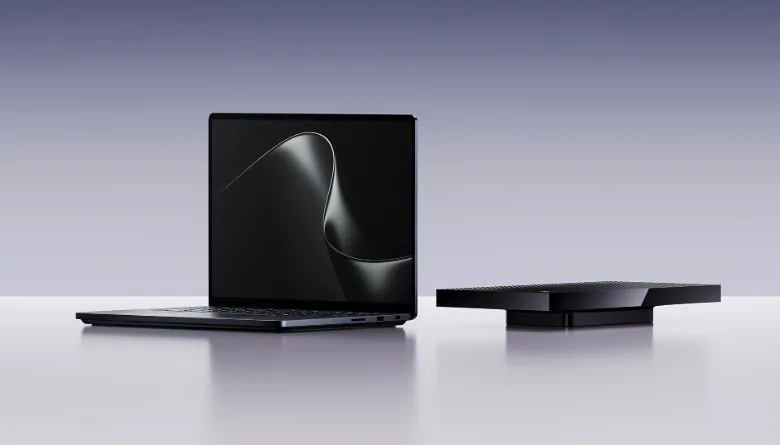
The top-tier build with the 20-core processor, 128GB of memory, and a 1TB drive climbs to $5,899 for buyers who need maximum local capacity. Microsoft also opened pre-orders for the Surface RTX Spark Dev Box at $5,999, a compact desktop unit with 128GB of memory and a 100-watt power envelope designed for developers who want to run models with more than 120 billion parameters [4].
Those prices are steep, but they undercut competing laptops that use the same Nvidia platform. The HP OmniBook X 14 starts at $2,999 and reaches $4,499 in higher configurations, while the 16-inch OmniBook Ultra begins at $3,199 and tops out near $4,999. Even so, the base tier’s 24GB pool won’t satisfy every researcher, so buyers who want to run denser quantized models will have to spend considerably more on memory upgrades [2].

Magnetic Connect Port and Chassis Design
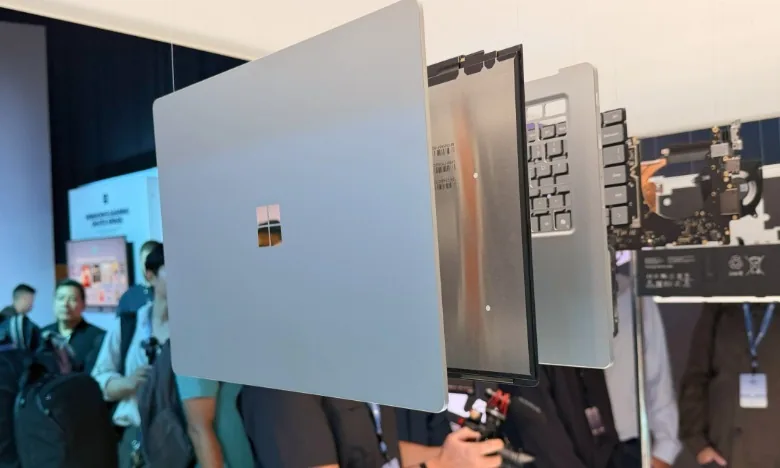
The Surface Laptop Ultra uses a gray aluminum chassis that measures 18 millimeters thick (about 0.7 inches) and weighs 4.5 pounds in hand. That weight makes it slightly lighter than Apple’s 16-inch MacBook Pro while providing a similar metal construction. Microsoft built screws into the base underneath the rubber feet, which lets technicians open the bottom panel and replace the solid-state drive after purchase [7].
On the right edge, Microsoft introduced a charging connector called Magnetic Connect that clips onto a standard USB-C port with magnets. Windows and Devices head Pavan Davuluri explained on stage that users can simply “bring the connector close, and it snaps right into place.” The magnetic plug detaches safely if someone trips on the wire, but because it sits over an ordinary port, the laptop can also charge through standard USB-C power cords [4].
The workstation carries a 15-inch PixelSense Ultra touch panel built with a 3:2 shape that reaches 2,000 nits of peak brightness when playing high dynamic range content. Microsoft added a haptic trackpad that’s 30 percent larger than trackpads on previous 15-inch Surface laptops, giving tactile buzzes when users align objects in creative apps. Port selection includes three USB-C ports, one USB-A jack, an HDMI output, a full-size SD card slot, and a 3.5mm audio jack [7].
Surface Laptop Ultra Specs for Gaming and Local AI
While Microsoft added Snapdragon X2 Plus chips to smaller Surface PCs for battery-friendly portable tasks, the Surface Laptop Ultra was built for sustained workstation performance. Microsoft claims the device has 2.5 times the thermal capacity of earlier Surface laptops and maintains over 99 percent of its maximum processing output when running on battery power alone. A bundled 140W power adapter feeds the system, though aviation enthusiast Jason Rabinowitz pointed out that many commercial airplane seats only supply 60 to 100 watts [1].
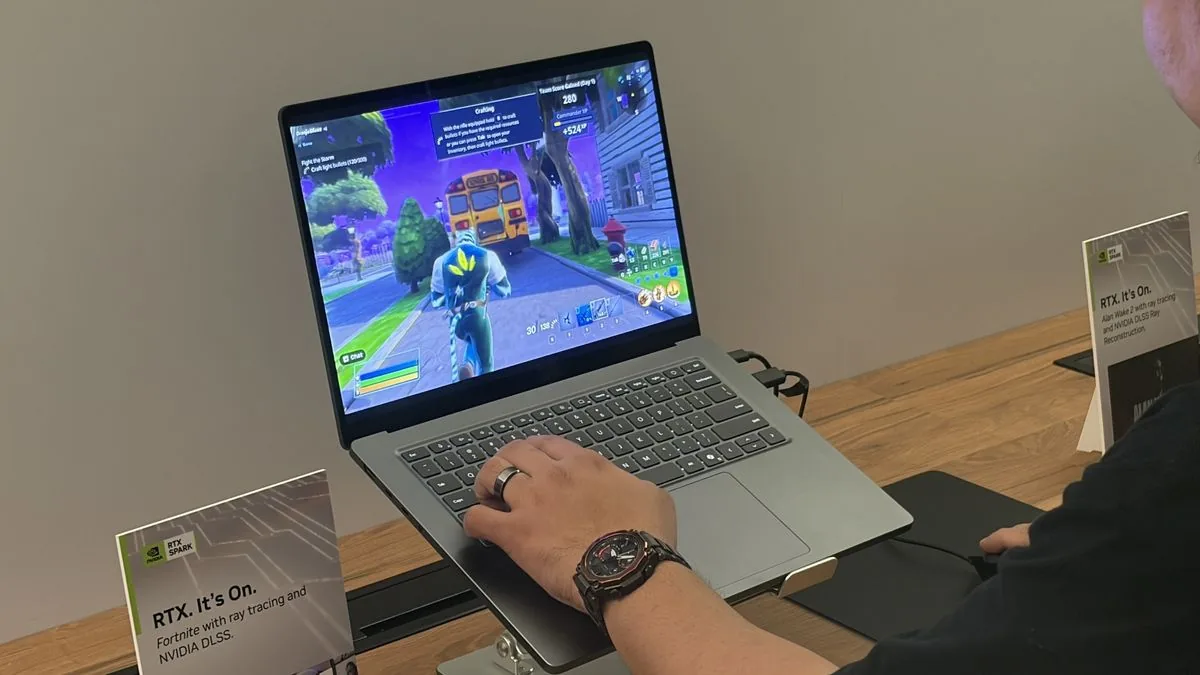
Aidan Pinero, an AI researcher and Master’s student at UCSC Silicon Valley who tested the hardware at the San Francisco gathering, said he wanted a Windows machine with 128GB of memory to match the large local setups his peers run on Apple laptops. Microsoft showed Gears of War: E-Day running at a smooth 60 frames each second while unplugged from the wall. The company noted that the upcoming Call of Duty title will arrive on the platform as well [3].
Windows Central writer Cale Hunt tested gaming alongside colleague Zac Bowden and reported that Indiana Jones and the Great Circle ran smoothly through Microsoft’s Prism emulation layer. That emulation layer translates traditional x86 game code so it can execute on Nvidia’s Arm cores without manual patches. Hunt cautioned that gamers shouldn’t buy this workstation purely for games, because buyers can get dedicated gaming machines for less money if they don’t need huge memory pools for AI work [6].

Windows 11 Updates for Autonomous Agents
Beyond hardware, Microsoft revealed several software updates coming to Windows 11 to help users control and isolate autonomous software agents. Windows executive Jacob Andreou demonstrated an automated workflow where a helper agent searched across folders for tax records, packaged the files into a single zip archive, and prepared an email draft to an accountant. Pavan Davuluri said, “We built it for developers and creators, pushing the limits of performance” [4].
Safety tools include Microsoft Execution Containers, a sandboxing system that lets administrators limit which folders and tools autonomous agents can touch on the operating system. Divya Venkataramu showed how the permissions system prevents background agents from viewing sensitive corporate files even when a logged-in user has permission to read them. Microsoft also confirmed that a native version of Meta’s Muse assistant will launch on Windows, alongside a quick-action search box on the taskbar [5].
To balance local and cloud workloads, Microsoft announced that its HydraFusion router will launch on October 15 for GitHub Copilot, VS Code, and command-line tools. Davuluri stated that Windows ML will support models like MAI Code 1.1 Flash, Nvidia Nemotron, and DeepSeek V4 Flash at 1.6-bit quantization using about 60GB of memory. It’s clear that the new hardware and software features are designed to work together as developers test whether local agentic tools can reliably replace cloud queries [5].
- ONLINE NEWS Hachman, M. (2026, October 7). The Surface Laptop Ultra is an AI monster with a laptop problem. PCWorld. [Article Link]
- ONLINE NEWS Khan, S. (2026, October 7). Microsoft Announces RTX Spark-Powered Surface Laptop Ultra, Starting At $2,599 And Shipping On October 16. Wccftech. [Article Link]
- ONLINE NEWS Hardawar, D. (2026, October 7). Surface Laptop Ultra hands-on: A beautiful beast powered by NVIDIA’s RTX Spark. Engadget. [Article Link]
- ONLINE NEWS Peters, J. (2026, October 7). Everything announced at Microsoft’s Surface Laptop Ultra event. The Verge. [Article Link]
- ONLINE NEWS Freedman, A. E. (2026, October 7). Microsoft and Nvidia launch Surface Laptop Ultra with RTX Spark starting at $2,599. Tom’s Hardware. [Article Link]
- ONLINE NEWS Hunt, C. (2026, October 7). The Surface Laptop Ultra has an RTX Blackwell GPU and runs games smoothly, so why am I telling PC gamers not to preorder it? Windows Central. [Article Link]
- ONLINE NEWS Rutherford, S. (2026, October 7). Here’s everything we know about Microsoft’s Surface Laptop Ultra. Engadget. [Article Link]


