




Tencent released Tencent Hy4 on November 4, bringing image analysis and direct software control to its flagship model about two months after an initial preview. The release establishes the system in second place among Chinese language models on the Artificial Analysis index, where it sits behind Moonshot AI’s Kimi K3.1 Pro [2]. While weights remain unreleased for now, Tencent said it will share full model weights and system cards in the coming days to support open AI development [1].
Vision and Computer Control in Tencent Hy4
The addition of vision tools marks the first time that Tencent’s flagship series can process visual data together with text inputs [1]. In one demonstration noted by The Decoder, the model parsed a 2.8-gigapixel aerial image of a harbor area, locating a two-meter piece of equipment on top of a warehouse roof without manual assistance [2].
Beyond looking at static pictures, the model operates software independently by interacting with both graphical user interfaces and command-line environments. Tencent trained the system on specialized design software, including Blender and computer-aided design tools, so it can schedule actions and finish complicated routines in different applications [1]. It doesn’t rely solely on rigid keyboard shortcuts, but instead navigates regular desktop menus just as an office worker does. This setup lets the software plan multi-step assignments that require switching between separate desktop windows during daily tasks. When tackling intricate desktop work, the program identifies necessary files, inputs parameters, and monitors ongoing progress across consecutive steps without needing human prompts at every stage.
Gaming was another target. Collaborating with the company’s Interactive Entertainment Group, developers connected Tencent Hy4 to major gaming engines such as Unreal Engine, Unity, and Godot to write logic, assemble complex environments, and build multiplayer features [1]. For the mobile title Honor of Kings, developers said the model manages setup tasks reliably and tracks down software bugs much faster than older releases [2].
Office and Financial Work
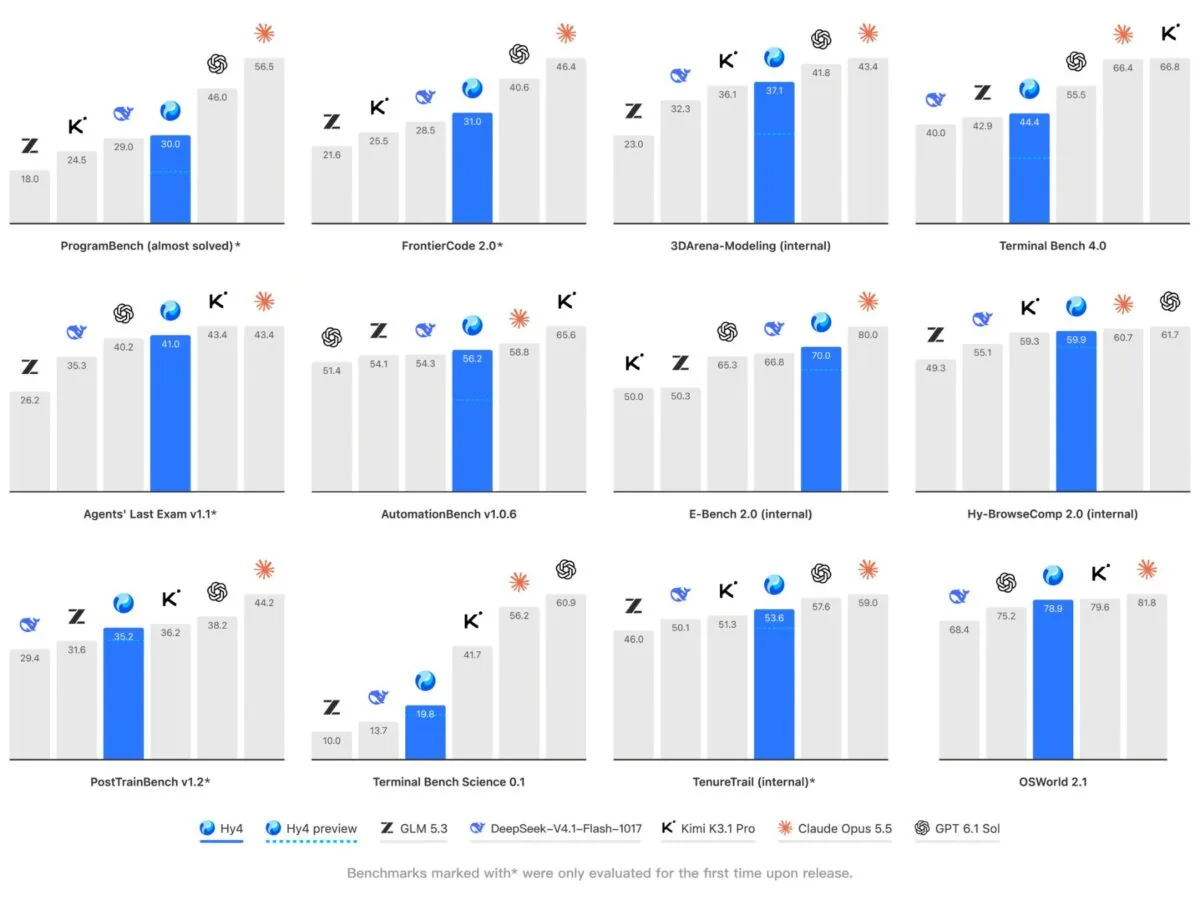
Office productivity serves as a central proving ground for the software, especially inside Tencent’s own workplace applications. On the WorkBuddy platform, the system achieved an average performance score of 83.18 and a 96.15 percent pass rate, leading nine out of twelve workplace scenarios tested in mainland China [1]. The software links with WeCom to pull relevant context directly from active chats, incoming emails, shared documents, calendars, and scheduled meetings. It tracks open deadlines and reminds workers about upcoming meetings that need prep work, while a new team collaboration feature called “Projects” will arrive with an upcoming update. The model also collaborates smoothly with human coworkers on standard Word, Excel, and PowerPoint files during real-time document editing [2].
Finance is another field where Tencent invested heavily during training. Partnering with Tencent Financial Technology, the team ran a blind evaluation that tested performance across 579 real-world financial tasks [1]. That trial involved 213 financial professionals, including 153 external experts, with roughly 70 percent possessing more than five years of direct market experience.
Hy4 earned an overall mark of 3.04 in that financial trial, topping DeepSeek-V4.1-Flash-1017 at 2.97, as well as Kimi K3.1 Pro and GLM-5.3, which each posted 2.68 [1]. Internal tests showed that revamped search tools lowered hallucination rates from 12.95 percent in the preview to 7.2 percent, while errors from unsupported assumptions fell from 23.1 percent to 5.6 percent. Partners saw progress too. Financial platform Comein said the model matched Claude Opus 5.5 on data queries, while agent platform Manus reported that it completed document tasks without stalling [2].

Independent Benchmark Results
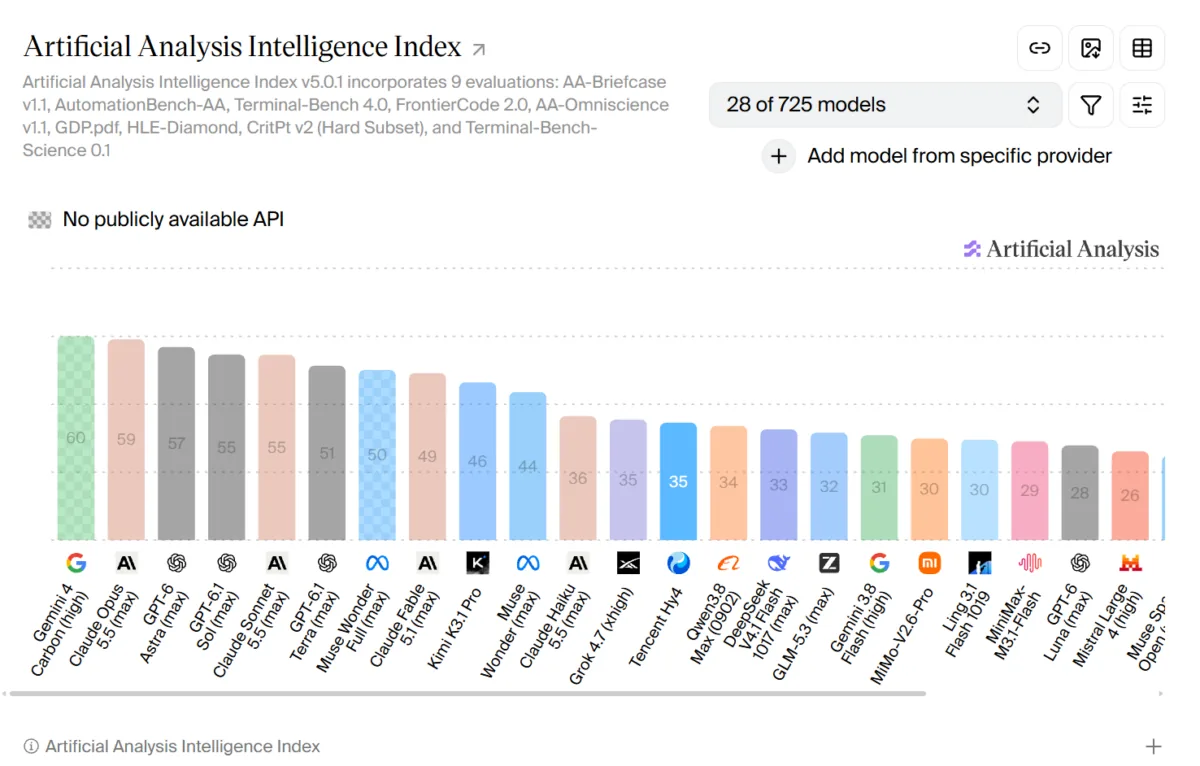
Outside testing paints a different picture. On the Artificial Analysis Intelligence Index, which evaluates coding, reasoning, and factual knowledge, the system scored 35 points [2]. That result places it five points above the benchmark median of 30, tying it with Grok 4.7.
While the score secures second place among Chinese models, Hy4 stays eleven points behind Moonshot AI’s Kimi K3.1 Pro, which leads the regional pack at 46 points. The results also change when web search is turned off. On the AA-Omniscience factual accuracy test, the model answered about half the questions correctly from training memory, but made up answers 89 percent of the time when it didn’t know the fact. The wider competition between Western AI labs and Chinese open weight models has grown tougher as evaluation teams build private test suites to prevent data contamination. After Artificial Analysis revamped its index in late October with private tests, the gap between open weights and top frontier models widened from 3 to 12 points [2].
Tencent acknowledged that its architecture still falls behind leading commercial options on demanding math problems, long coding repositories, and complex visual puzzles [1]. Benchmark comparisons published by The Decoder show Claude Opus 5.5 holding a wide lead over Hy4 on advanced mathematics, where Tencent’s system roughly ties with Anthropic’s smaller Haiku 5.5 model [2]. That gap illustrates the steep hill open-weight projects still climb on high-end reasoning tasks.

How Tencent Hy4 Trains Other Models
Internal labs put the software to work on model research. Working through an agent framework called Hyra 2.0, the system optimized pre-training infrastructure to speed up throughput for smaller internal models that share its underlying architecture [1].
Tencent also used the pipeline to train a custom version of Jev, a decision-making model originally developed by American startup TypeSafe AI, and the adapted version beat the original on several benchmark tests [2]. The system also handled broader scientific research tasks during evaluations spanning seven disciplines. In testing on the TenureTrail benchmark, which examined 123 executable tasks in physics, environmental modeling, and mathematics, the architecture executed complex academic workflows without human help [1]. Tencent used these experiments to build and open-source two foundational scientific tools: HyCell for single-cell biology representations and HyPDE for solving partial differential equations in physics. These assets provide reusable tools for academic researchers exploring biological data and physical modeling.
To keep these capabilities secure before publishing open weights, Tencent deliberately filtered out offensive hacking code during training, while security researchers at Xuanwu Lab and Keen Security Lab verified that the system posed no significant cyber hazards [1]. Internal experts also reviewed biological risks, concluding that while the model possesses solid baseline knowledge, its experimental design skills fall well below dangerous thresholds [2].

Planned Weights Release
Developers can access Tencent Hy4 today through Tencent Cloud TokenHub, the Yuanbao chatbot, and third-party API aggregators such as OpenRouter and Hermes [1]. Tencent kept pricing unchanged from the preview, charging roughly $0.90 per million input tokens and $2.70 per million output tokens, with cached inputs priced at $0.045.
To spur early adoption, Tencent made WorkBuddy and CodeBuddy free to use from November 4 through November 15, while offering a 50 percent discount on TokenHub through December 31, 2026 [1]. Engineering teams are also linking the model into popular consumer services, including the messaging app QQ, the reader app WeRead, and Tencent News. A lighter variant named Hy4 Flash will arrive later to cut inference costs further for high-volume deployments. These product rollouts build on steps Tencent took last July, when it published its earlier Hy3 model with 295 billion parameters under an Apache 2.0 open-source license [2].
The planned release of weights comes as regulatory authorities update AI export policies across China. In October, the country’s commerce and science ministries published a draft export control framework covering models that rank in the global top ten or exceed two trillion parameters [2]. The proposal includes an automatic fast-track review for open-source software, clearing a straightforward path for global release once Tencent wraps up its final checks.
- PRESS RELEASE Tencent. (2026, November 4). Tencent Launches Hy4, Joining the Ranks of the World’s Leading Open-Source AI Models. [Article Link]
- ONLINE NEWS Kemper, J. (2026, November 5). Tencent releases Hy4 with vision and computer use, claims second place among Chinese AI models. The Decoder. [Article Link]


