






Understanding what is a mutex begins with a core problem in parallel computing, where several threads read and write shared memory at the exact same time without coordination. A mutex, short for mutual exclusion lock, is a synchronization primitive that grants exclusive access to a protected code block to one thread at a time. When one thread takes the lock, every other thread must wait until the lock holder finishes its work and releases ownership back to the operating system runtime. Without this guard, conflicting writes corrupt memory and break program logic. This simple locking rule prevents race conditions, stops memory bugs, and keeps shared data structures valid across multi-threaded applications [10].
- What Is a Mutex in Computer Systems?
- The Problem of Race Conditions
- How a Mutex Lock Protects Shared Memory
- Four States of a Program Thread
- Hardware Primitives and Test-and-Set Instructions
- Software Algorithms for Mutual Exclusion
- Why Mutex Lock Ownership Differs From Semaphores
- Deadlocks, Starvation, and Recovery Trade-offs
What Is a Mutex in Computer Systems?
Dutch computer scientist Edsger W. Dijkstra first identified and solved the mutual exclusion problem in his 1965 paper, laying down the foundation for concurrent computing across modern systems. Dijkstra showed that without proper locking, parallel programs corrupt memory because machine instructions interleave at random intervals. Why do threads corrupt memory without locks? When two threads write to a single variable at once, their low-level machine steps overlap unpredictably. Dijkstra wrote that pure software logic could coordinate separate processes on a bare machine without custom hardware support, proving that mutual exclusion requires that no two processes can ever occupy a protected section at the same time [12].
In operating systems, a mutex is a binary lock with two states: locked and unlocked. A thread that wants a shared resource locks the mutex first. If another thread holds the lock, the caller halts. Dijkstra described this design in his 1965 paper titled Solution of a Problem in Concurrent Programming Control, presenting an algorithm for n processes [9].
Leslie Lamport spoke about Dijkstra’s work at the 1983 Principles of Distributed Computing conference, known as PODC. Selection committee members Hagit Attiya, Maurice Herlihy, and Nancy Lynch later honored Dijkstra’s distributed computing papers. Lamport said Dijkstra founded the field of concurrent algorithms by turning mutual exclusion into a rigorous science. Modern operating systems still rely on Dijkstra’s principles to protect shared tables, file handles, and thread pools in production environments [13].
The Problem of Race Conditions
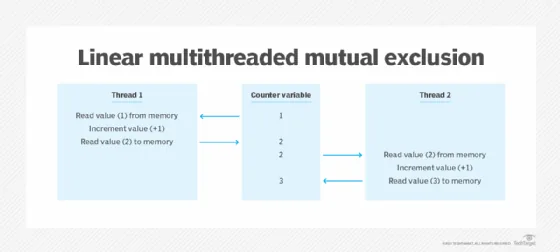
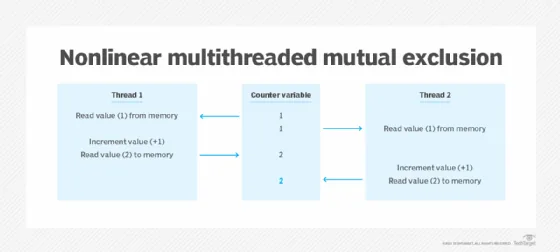
A race condition happens when program results depend on the relative timing or scheduling order of concurrent threads. A simple line like an integer counter increment looks like a single atomic action in high-level source code, but modern CPUs break that statement into three machine operations: loading the memory value into a CPU register, adding one to the register, and writing the updated register value back to RAM. If two threads run those steps together, both load the exact same old value into their private registers, calculate the same sum, and overwrite each other’s work. As a result, the final tally in memory is lower than expected [11].
George K. Thiruvathukal tested this race in multi-threaded programs at Loyola University Chicago using pthreads and POSIX thread attributes. In his test code, two threads each ran an increment loop for a variable named countPerThread set to 10000000 with chunk size 500. With two threads running, the final count should be twice countPerThread. Without a lock, the final count fell millions short because threads constantly overwrote each other in memory [1].
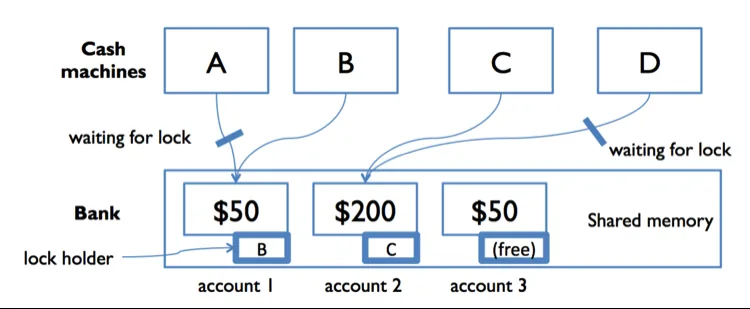
MIT course materials for 6.031 show how race conditions corrupt account balances in simulated cash machines. Two cash machines deposit money into an account starting with 200 dollars. Both machines read 200 dollars, compute 201 dollars, and write 201 back. One deposit is lost. The course states that mutual exclusion software must be safe from bugs, easy to understand, and ready for change. Communicating clearly with future programmers means making these locks explicit in shared memory code [3].
How a Mutex Lock Protects Shared Memory
To prevent threads from colliding, programmers put shared data writes into a guarded critical section. TechTarget author Robert Sheldon described this flow in Python using the threading module with ten threads. A thread calls the acquire method on a lock object before accessing data. It then frees the lock by calling release inside a finally block. This structure guarantees that the lock is released even when the protected code throws an unexpected exception. Without this defensive programming pattern, unhandled errors leave the mutex locked indefinitely in memory, blocking every subsequent thread that attempts to access that shared resource [10].
Word sizes change memory safety rules. Teaching notes at Loyola Marymount University explain that while single-word variables marked volatile in Java or C provide atomic reads, multi-word variables like long or double lack hardware atomicity. They need a mutex lock to stop threads from reading half-written values [2].

Manual locking causes bugs when code returns early. In C++ and OpenMP, Dr Michael Suess showed that scoped locking solves this bug. A guard object takes a lock in its constructor and releases it in its destructor. When code exits the block, the destructor runs and frees the lock automatically. Suess said scoped locking works cleanly across C++ and Fortran, whereas OpenMP critical directives cannot jump out of a protected code block with return statements [11].
Four States of a Program Thread
Formal concurrency models split thread execution into four distinct states that repeat in predictable order. James Aspnes at Yale University writes that a thread begins in the remainder state, doing general computation outside the guarded section. When it needs shared data, it enters the trying state and runs the entry protocol to claim the lock. Next, it enters the critical section to read or write shared state under exclusive control. When finished, it runs the exiting state to clear its lock and wake other threads, before returning to the remainder state to resume independent computation [4].
These states protect dynamic data structures like singly linked lists. Imagine two threads deleting items from a four-item list at the same time. Thread one deletes node two by pointing node one to node three. Thread two deletes node three by pointing node two to node four. Both steps finish, but node three stays in the list because node one still points to it. This race condition corrupts the list [12].
GeeksforGeeks uses a supermarket changing room to illustrate these four operational states. The changing room serves as the protected section. Boy A and Boy B represent competing concurrent processes. While Boy A tries on clothes inside, the door sign reads occupied, forcing Boy B to wait outside in the trying state until the room becomes vacant [6].


Hardware Primitives and Test-and-Set Instructions
On single-core CPUs, early systems achieved mutual exclusion by disabling interrupts while a thread was running inside its protected section. This stopped the OS scheduler from preempting the running thread before it finished its memory writes. But turning off interrupts causes big problems. System clocks drift because timer ticks are missed, hardware inputs stall, and a frozen thread halts the whole machine. Disabling interrupts also fails on multi-core systems, where separate CPU cores execute instructions at the same time regardless of local timer settings and memory flags [12].
Multi-core processors use atomic read-modify-write commands. The test-and-set command reads a memory bit and sets it to one in a single hardware step. If two cores run test-and-set at once, hardware arbitration gives zero to one core and one to the other. James Aspnes writes that while one test-and-set register provides deadlock-free mutual exclusion, avoiding thread lockout requires a ticket queue with first and last fields [4].
On x86 architectures, atomic primitives map to the assembly instruction cmpxchg with a bus lock prefix. Thiruvathukal showed that spin locks use this command to loop until a lock bit clears. Spin locks give fast response times for short waits, but waste CPU cycles during long stalls. When waits are long, operating systems suspend the thread and switch to other work [1].
Software Algorithms for Mutual Exclusion
Before hardware-supported atomic primitives spread across processors, computer scientists built software-only solutions. Peterson’s algorithm solves mutual exclusion for two processes using standard memory registers without custom hardware instructions. It combines two boolean flags with a shared turn variable. When process zero wants to enter the protected section, it sets its flag and generously gives the turn variable to process one. Process zero enters only when process one is not waiting or when the turn value returns to zero, which ensures that both processes cannot execute together [4].
For more than two threads, Leslie Lamport developed the bakery algorithm. It assigns numbered tickets to waiting processes like a deli counter. Each thread takes a ticket number higher than other active numbers and waits until its ticket is lowest in line. Researchers like Szymański and Taubenfeld proposed other software algorithms, but these methods need explicit memory fence instructions to run correctly on modern out-of-order processors [12].
Distributed systems lack shared memory and common physical clocks, so they use message passing. Lamport’s distributed mutual exclusion algorithm uses logical timestamps to order requests across independent computers. A node sends a timestamped request to all nodes, queues the request, and enters the guarded section once all replies arrive. The algorithm needs 3(N – 1) messages per request, making network delays a factor that local mutex locks avoid [15].
Why Mutex Lock Ownership Differs From Semaphores
Engineers often mix up mutexes and semaphores because both tools guard shared resources. The key difference is the ownership requirement built into every mutex. When a thread locks a mutex, it owns that lock. Only that same thread can unlock it. In contrast, a counting semaphore tracks resource tokens without ownership rules. Any thread can call signal to increment a semaphore, even if another thread called wait. At Loyola Marymount University, Ray showed that Java monitors give each object an internal lock through synchronized methods like deposit on an Account class to enforce single-thread access [2].
Scaler Topics authors Aditya Saxena and Naman Bhalla said binary semaphores lack this thread-ownership rule. Systems also use the readers-writer lock. This lock allows several threads to read shared data in parallel, but requires sole access during write steps [14].

Operating systems use locks to coordinate hardware devices. In a network printer spooler examined by TutorialsPoint, several users often submit print tasks at the exact same moment, which means the spooler must stream one document to the printer buffer without interruption. A mutex protects that spool buffer. Without exclusive locking, raw lines from separate users interleave on the physical paper and produce garbled text [7].
Deadlocks, Starvation, and Recovery Trade-offs
Locks bring trade-offs in large multi-core computers. Johann Blieberger and Bernd Burgstaller showed that locks hurt scalability because a failed task inside a critical section keeps holding its lock, blocking other tasks indefinitely. To prevent this, research in Ada 202x focuses on non-blocking synchronization. This model uses atomic read-modify-write steps so concurrent tasks make progress without waiting on locks. By eliminating locks, programs avoid lock-holding failures and scale cleanly across high-core processors [5].
Mutual exclusion is also a major security boundary. Security analysts at NHI Management Group warn that race conditions let attackers bypass permission checks. Frameworks like NIST SP 800-53 control SC-39 for process isolation and CIS Controls require locking around shared memory, session stores, and identity tokens to prevent unauthorized writes [8].
Concurrency locks introduce hazards. A classic deadlock occurs when two tasks each hold a lock while waiting for the other task to release a second lock, which freezes both threads in permanent inaction. Priority inversion happens when a low-priority thread holds a lock needed by a high-priority job. To prevent these system stalls, operating systems enforce fixed lock hierarchies, run priority inheritance protocols, and set timeout bounds so threads never sleep indefinitely [9].
- WEBSITE Thiruvathukal, G. K. (2026). Mutual Exclusion. Loyola University Chicago Computer Science Department. [Article Link]
- WEBSITE Ray, T. (n.d.). Mutual Exclusion. Loyola Marymount University. [Article Link]
- WEBSITE Miller, R. (2021). Reading 22: Mutual Exclusion. MIT OpenCourseWare. [Article Link]
- WEBSITE Aspnes, J. (2014). Mutual Exclusion. Yale University Department of Computer Science. [Article Link]
- BOOK CHAPTER Blieberger, J., & Burgstaller, B. (2018). Safe Non-blocking Synchronization in Ada 202x. In A. Casimiro & P. Ferreira (Eds.), Reliable Software Technologies – Ada-Europe 2018 (pp. 47-62). Springer, Cham. [Article Link]
- WEBSITE GeeksforGeeks. (2020). Mutual Exclusion in Synchronization. GeeksforGeeks. [Article Link]
- WEBSITE TutorialsPoint. (2026). Mutual Exclusion in Synchronization. TutorialsPoint. [Article Link]
- WEBSITE NHI Management Group. (2026). What Is Mutual Exclusion? Definition & Examples. NHI Management Group. [Article Link]
- WEBSITE PCPartsGeek. (2026). Mutex (Mutual Exclusion) – Definition & Detailed Explanation. PCPartsGeek. [Article Link]
- WEBSITE Sheldon, R. (2023). Mutual exclusion (mutex). TechTarget. [Article Link]
- WEBSITE Suess, M. (2006). Mutual Exclusion with Locks – an Introduction. Thinking Parallel. [Article Link]
- WEBSITE Wikipedia. (n.d.). Mutual exclusion. Wikimedia Foundation. [Article Link]
- CONFERENCE PAPER Lamport, L. (1984). 2002 PODC Influential Paper Award. ACM Symposium on Principles of Distributed Computing. [Article Link]
- WEBSITE Scaler Topics. (2022). What is a Mutual Exclusion in OS?. Scaler Topics. [Article Link]
- WEBSITE Wikipedia. (n.d.). Lamport’s distributed mutual exclusion algorithm. Wikimedia Foundation. [Article Link]
Cover image: Alberusal / Wikimedia Commons, CC BY-SA 4.0


