






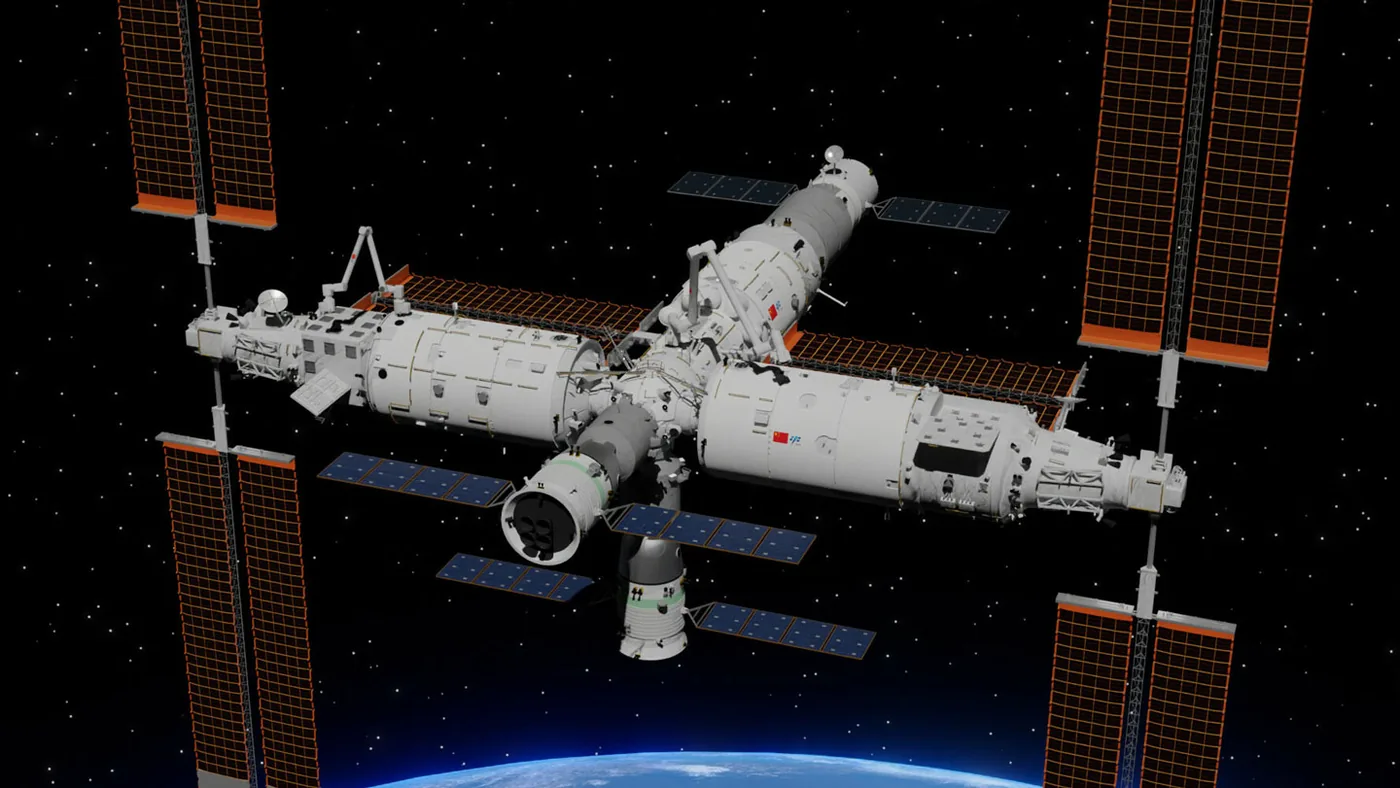
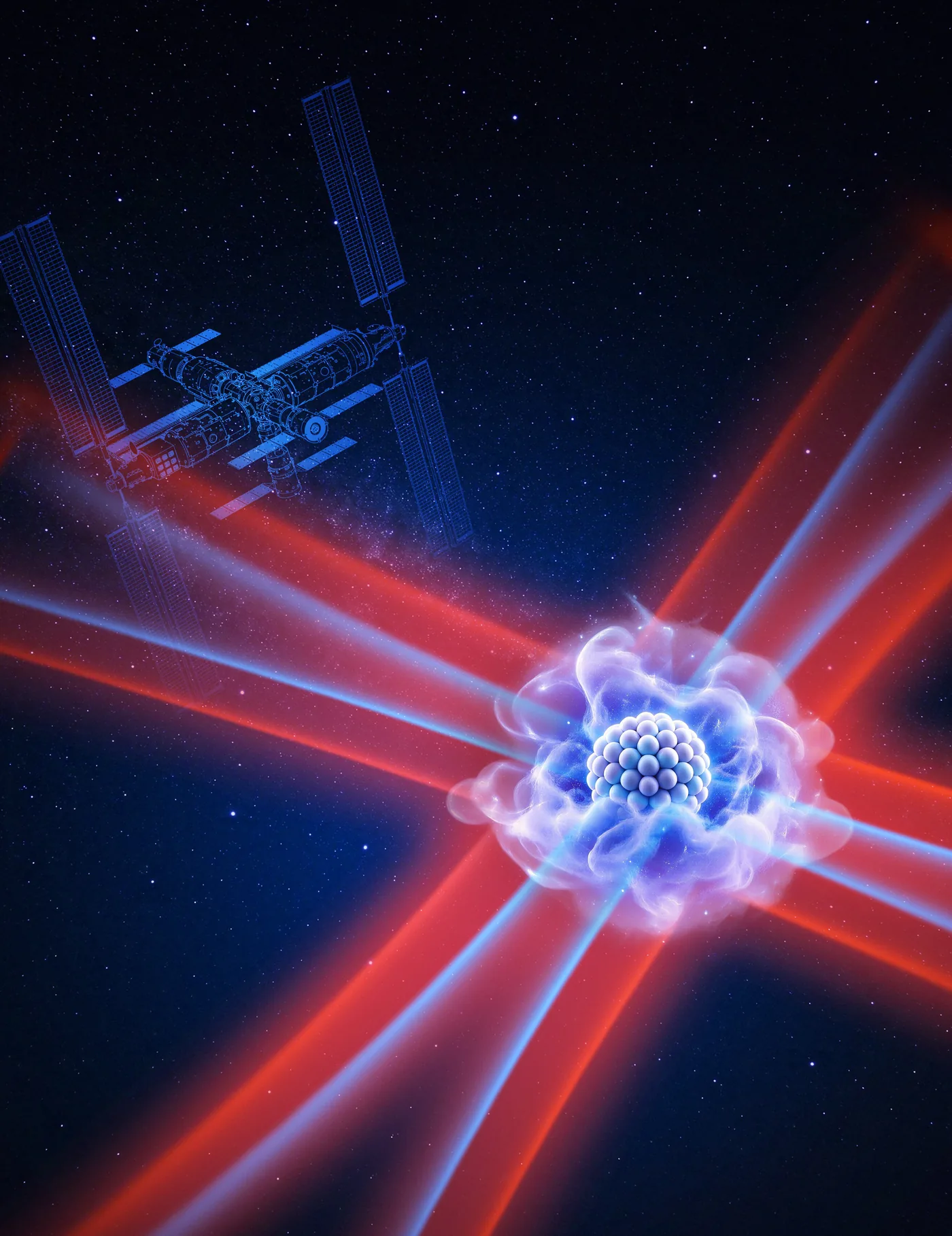
Chinese researchers aboard the Tiangong space station cooled a cloud of rubidium atoms to 9.7 picokelvin, setting a record for the lowest temperature measured in an orbital laboratory. The experiment used an optical dipole trap to produce an ultracold quantum gas just above absolute zero (−273.15° Celsius), where particles merge into a single matter wave known as a Bose-Einstein condensate [2]. A free expansion period lasting seven seconds confirmed that the atomic ensemble stayed stable without sagging against vacuum chamber walls [1].
Rubidium Condensate in Orbit
Lead author Wei Xiong and co-author X. Chen assembled the condensate inside Tiangong using 20,000 rubidium atoms. The team cooled the gas with laser beams and evaporative cooling, expelling high-energy particles [1]. A magnetic-field gradient assisted this early cooling step, yielding a cold cloud less sensitive to outside magnetic shifts [3].
At room temperature, gas particles move at hundreds of meters per second, colliding constantly and masking subtle quantum properties beneath kinetic disorder. Cooling atoms toward absolute zero curbs that thermal motion. Individual matter waves begin to overlap until atoms march in lockstep. In their report published in Science, the authors described Bose-Einstein condensates as “versatile platforms for quantum simulation” [1].
Because contact sensors cannot touch such fragile atomic ensembles without destroying them, physicists measure an equivalent temperature by recording how quickly the cloud expands once trapping lasers switch off. Slower expansion indicates lower kinetic energy. The team recorded an equivalent temperature of 9.7 picokelvin, with an uncertainty range spanning from 7.0 to 12.9 picokelvin [3]. Absolute zero lies barely ten trillionths of a kelvin away. Three-dimensional camera data confirmed that the atoms retained low kinetic velocities along each axis [1].
Why Microgravity Aids Atomic Trapping
Gravity imposes clear limits on ground-based cold atom experiments. On Earth, gravity pulls atom clouds down to the bottom of containment vessels. Researchers often apply magnetic levitation to stop that downward slide, but magnetic coils force atoms into identical spin orientations, restricting the range of observable quantum states [1].
The Tiangong space station bypasses this limit by circling Earth in sustained free fall. Weightlessness takes over. In orbit, rubidium particles float in the center of the vacuum chamber without colliding with solid container walls. Released from gravitational sag, scientists hold atomic clouds in gentle light fields that spare delicate quantum phases from distortion [1]. Emily Conover reported in Science News that orbital free fall enables researchers to chill dense atomic ensembles without the geometric stretching typical of terrestrial drop towers [2]. Extended observation windows let scientists track quantum behavior that normally fades before ground detectors can register it [1]. The cloud remains undisturbed long enough for cameras to document its natural spatial expansion [3].
Optical Dipole Trapping
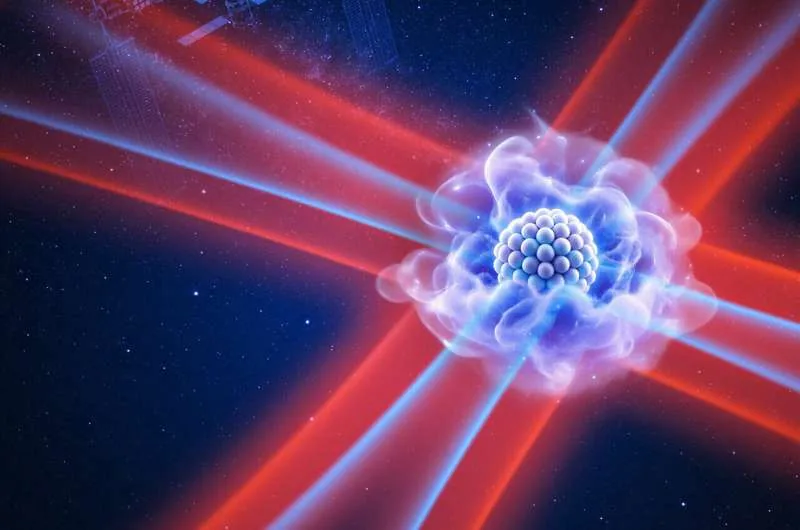
Magnetic chips offer compact designs. However, metallic chip surfaces block optical viewing lines and generate unwanted radiofrequency noise that can split atomic clouds. Xiong and co-author X. Chen turned instead to an optical dipole trap (ODT), directing intersecting laser beams to confine neutral rubidium particles through electrical polarization. Focused light produces a smooth potential well capable of trapping both magnetic and non-magnetic atoms without forcing their electron spins into uniform alignment. This clear optical geometry gives researchers direct camera angles from multiple vantage points, enabling precise absorption imaging of spreading matter waves in orbit [1].
After forming the first condensate, the researchers transferred the rubidium atoms into a wider optical trap to relax spatial confinement. The laser potential weakened. This drop allowed the atomic wavepacket to expand adiabatically and shed kinetic energy without losing particles. Kasal reported for Phys.org that easing laser confinement reduced atom velocities to tiny fractions of their original speeds while preserving cloud cohesion [1]. Because optical traps operate without magnetic resonance coils, physicists can reshape laser geometries and modify trap depths dynamically, allowing Xiong’s team to record expansion in three spatial dimensions without uneven heating or magnetic distortions [3]. Station maneuvers did not disrupt the cooling process [1].

Ultracold Quantum Gas Record
The resulting ultracold quantum gas reached an equivalent temperature four times lower than any previous experimental record. The cloud hovered barely above absolute zero [2]. The team observed free expansion over 7.0 seconds, tracking matter waves as they dispersed through the orbital chamber [1].
That seven-second interval represents a notable advance over earlier benchmarks. Previous tests inside terrestrial drop towers recorded free expansion times of only two seconds before falling capsules halted. Experiments aboard the International Space Station achieved one second of free evolution in magnetic traps. The Tiangong optical platform maintained atom tracking for seven full seconds, providing clear views of wavepacket behavior in weightlessness [1].
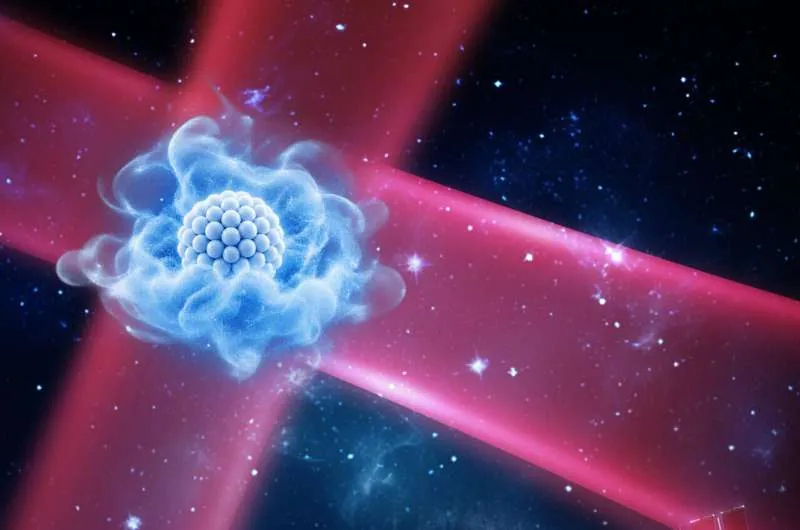
Long observation windows give researchers experimental clarity that brief drop tests cannot match. When particles move slowly, optical sensors record matter-wave fringes with high resolution before background collisions degrade the signal. Orbital laboratories offer quiet environments where sensitive instruments map subtle forces without surface vibrations. Space platforms also complement terrestrial observations, connecting orbital sensors with planetary records like studies where an ancient solar eclipse in China helped refine historical Earth rotation models. By keeping the cloud intact through seven seconds of free flight, the Tiangong experiment confirmed that laser-based traps maintain atomic stability over extended operational windows [3].
Ground and Space Comparisons
The 9.7 picokelvin result surpasses benchmarks set by ground facilities and earlier orbital missions. In 2021, C. Deppner and W. Herr achieved 38 picokelvin inside a terrestrial drop tower by applying matter-wave lens optics to a condensate of 101 thousand rubidium atoms (101 ± 37 thousand). Their study published in Physical Review Letters combined magnetic lensing with collective-mode oscillations, but tower height restricted free fall to two seconds [5]. In 2022, N. Gaaloul and co-authors published results from the Cold Atom Laboratory aboard the International Space Station in Nature Communications, using magnetic microchips and matter-wave lensing to reach 52 picokelvin with a one-second expansion window in low Earth orbit [4].
While the Cold Atom Laboratory demonstrated that orbit provides exceptional isolation for quantum matter, its magnetic trap constrained atom spin states. The Tiangong team bypassed that limit by pairing optical dipole traps with microgravity. Satellite research supports diverse global inquiries, including environmental work examining how reduced Bering Sea ice connects to regional climate patterns in East Asia. In atomic physics, achieving a seven-second expansion time proves that orbital optical traps can deliver colder gas ensembles and longer measurement baselines than terrestrial towers or magnetic orbital chips [1]. That success validates optical traps as viable tools for future deep-space exploration platforms [3].
Ultracold Quantum Gas Applications
Producing an ultracold quantum gas in orbit creates opportunities for precision metrology and tests of general relativity. The authors noted that future upgrades could deploy adjustable-volume optical traps to expand cloud capacity well beyond 20,000 atoms. Higher atom numbers yield stronger signal contrast, which is essential for building spaceborne atom Mach-Zehnder interferometers. In their paper, Xiong and colleagues wrote that “a second possible objective is the construction of a space-based atom Mach-Zehnder interferometer, with the potential to perform precision tests of fundamental principles, such as the equivalence principle” [1]. That concept posits that all objects fall at identical rates in a vacuum regardless of mass or composition [2].
Optical dipole traps also supply versatile testbeds for many-body quantum simulations. Researchers plan to use shaped laser beams to model one-dimensional quantum systems, observing the decay of Tomonaga-Luttinger liquid order in an orbital environment free from gravitational disturbances. The apparatus will also probe exotic states like Bose-glass and fractal Mott phases inside disordered optical lattices. In their report, the authors stated that the system “aims to enable quantum simulation for exploring low-temperature physics in the unique environment of space”. Robert Egan and Gaby Clark reviewed the experimental details for Phys.org, highlighting how space stations are becoming primary outposts for testing modern physics [1]. Orbital laboratories give scientists a practical path to observe quantum mechanics at its lowest energy scales [3].
- ONLINE NEWS Kasal, K. (2026, November 6). Scientists achieve record-breaking low temperature on China’s space station, paving the way for new physics experiments. Phys.org. [Article Link]
- ONLINE NEWS Conover, E. (2026, November 5). Record-low temperature created on China’s space station. Science News. [Article Link]
- ACADEMIC JOURNAL Xiong, W., Li, T., Jin, S., Huang, Q., Wang, B., Li, L., He, Y., Li, X., Chen, D., Song, T., Ji, J., Zhou, C., Lai, C., Zhang, Z., Tian, J., Guo, Y., Yao, H., Hou, X., Liu, L., & Chen, X. (2026). Quantum gases below 10 picokelvin in space. Science. [Article Link]
- ACADEMIC JOURNAL Gaaloul, N., Meister, M., Corgier, R., Pichery, A., Boegel, P., Herr, W., Ahlers, H., Charron, E., Williams, J. R., Thompson, R. J., Schleich, W. P., Rasel, E. M., & Bigelow, N. P. (2022). A space-based quantum gas laboratory at picokelvin energy scales. Nature Communications, 13(1). [Article Link]
- ACADEMIC JOURNAL Deppner, C., Herr, W., Cornelius, M., Stromberger, P., Sternke, T., Grzeschik, C., Grote, A., Rudolph, J., Herrmann, S., Krutzik, M., Wenzlawski, A., Corgier, R., Charron, E., Guéry-Odelin, D., Gaaloul, N., Lämmerzahl, C., Peters, A., Windpassinger, P., & Rasel, E. M. (2021). Collective-Mode Enhanced Matter-Wave Optics. Physical Review Letters, 127(10). [Article Link]
APA 7: PerEXP Teamworks. (2026, November 7). China Space Station Chills Ultracold Quantum Gas to Record Low. PerEXP Teamworks. https://perexpteamworks.com/en/ultracold-quantum-gas-china-space-station/


