



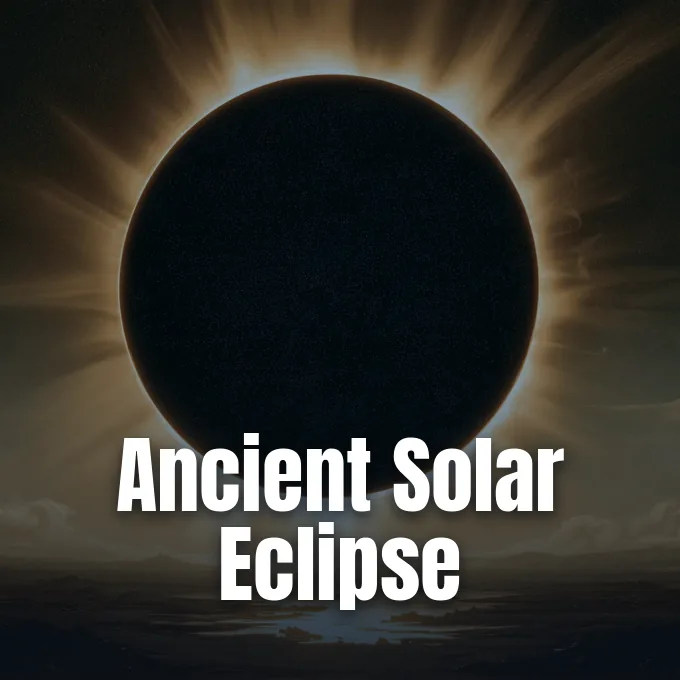
Astronomers and historians resolved an eight-kilometer error in the coordinates of ancient Qufu, allowing researchers to model an ancient solar eclipse recorded on July 17, 709 BCE. The revision aligns historical observations from the state of Lu with calculations of planetary spin, establishing that Earth rotated faster twenty-seven centuries ago. By matching the event to revised orbital models, an international research team led by Hisashi Hayakawa derived new constraints on the deceleration of Earth’s rotation and evaluated early historical descriptions of the solar corona [1].
Record of an Ancient Solar Eclipse
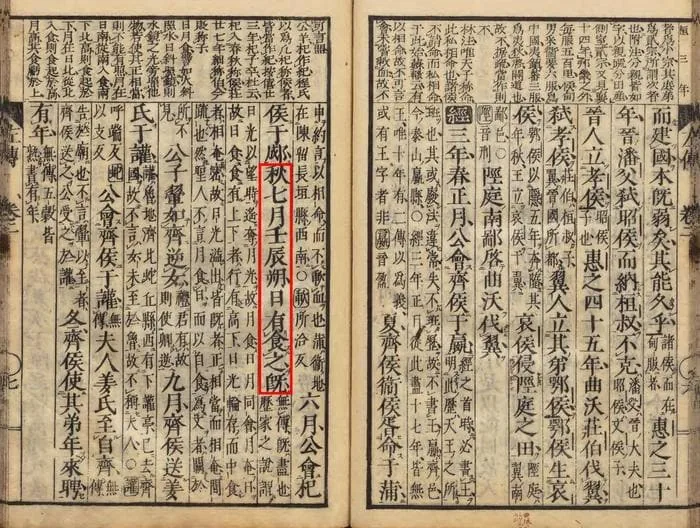
The earliest known datable written account explicitly describing a total solar eclipse comes from the Chunqiu (also known as the Spring and Autumn Annals). Compiled between 200 and 300 years after the event and traditionally associated with Confucius, the chronicle documents official state observations from the Lu Duchy. The historical text contains thirty-seven separate reports of solar eclipses, but only three of those entries explicitly describe totality. The earliest entry notes: “In fall, in the seventh month, on the rénchén day, the first day of the month, the Sun was totally eclipsed.” Observers at the Lu court treated daytime darkness as a significant state occurrence. That brief record survived for more than 2,700 years, offering modern astronomers a rare window into the ancient sky [2].
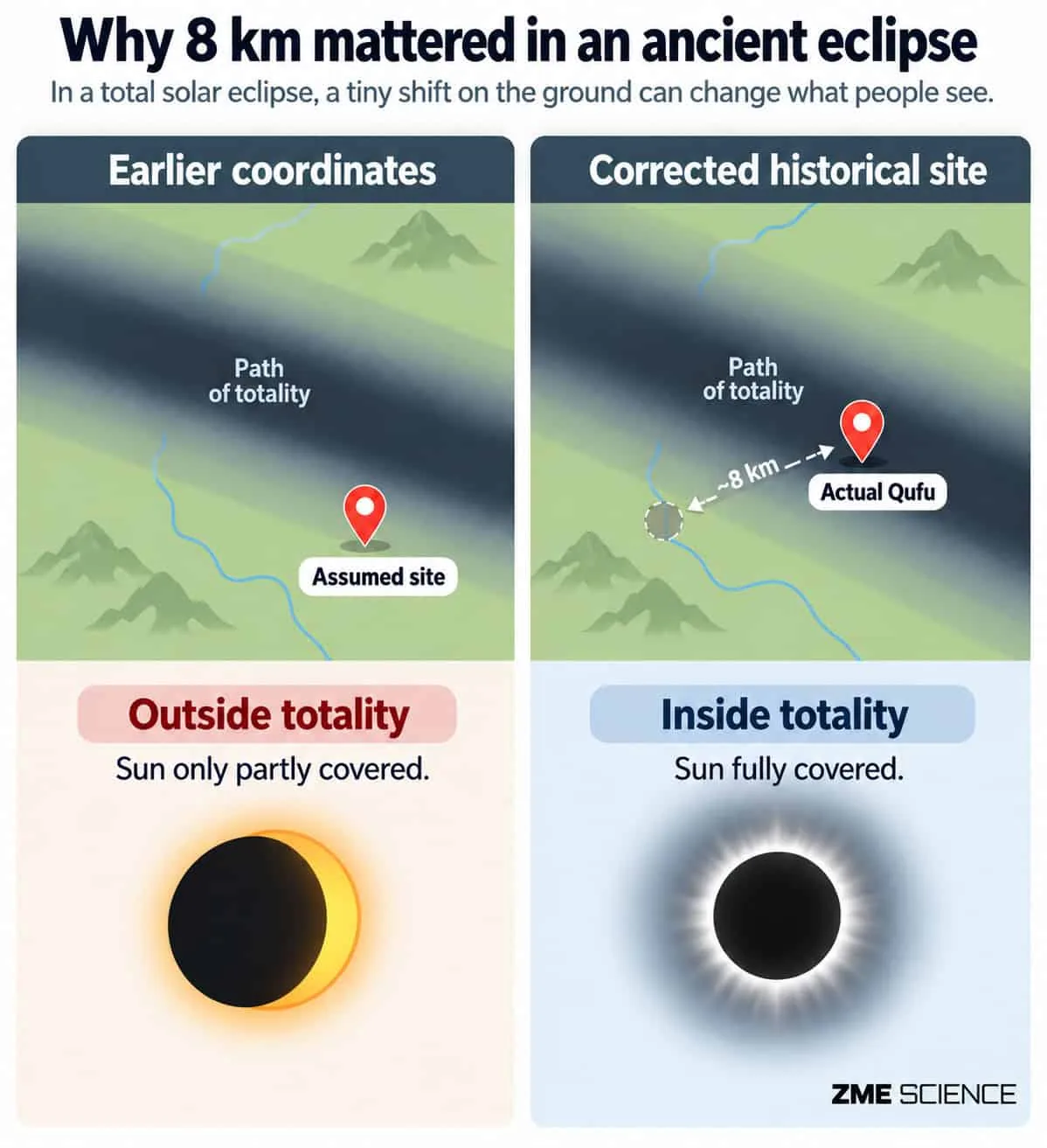
Modern astronomical retrodictions quickly produced an unexpected conflict. When researchers plotted the path of totality using established planetary ephemerides, Qufu appeared to sit outside the Moon’s umbra. According to those models, the Sun should have remained partially visible. Did court scribes exaggerate the darkness of the sky, or did modern calculations misplace the shadow? Resolving that contradiction required looking closely at ancient geography [3].
The Eight-Kilometer Coordinate Shift
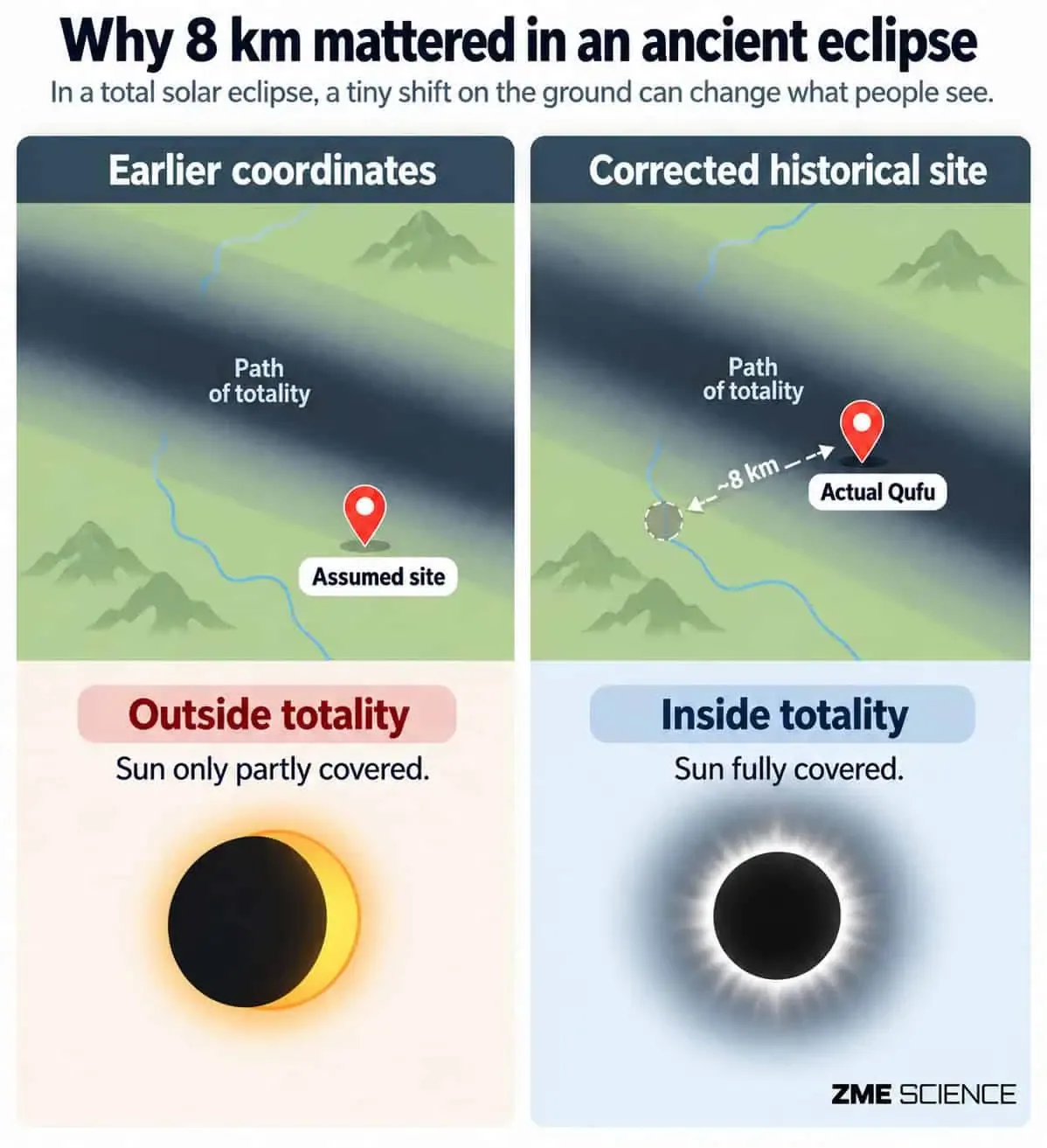
Reconstructing this ancient solar eclipse required pinpointing the exact court where ancient observers watched the sky. Hisashi Hayakawa, an assistant professor at Nagoya University holding doctorates in oriental history and solar physics, reexamined historical excavation reports with coauthors Mathew J. Owens, Meng Jin, Mitsuru Sôma, and Mike Lockwood. They discovered that earlier astronomical studies had mistakenly adopted geographic coordinates roughly eight kilometers away from the historical capital. Archaeological excavation data enabled the team to correct the position of ancient Qufu to N35°36′, E116°59′. That spatial adjustment aligned the historical capital with the actual territory governed by the ancient state of Lu [1].
That eight-kilometer shift solved the puzzle. During a total solar eclipse, the Moon’s umbra forms a narrow corridor over Earth’s surface. A small displacement of several kilometers easily separates complete solar coverage from partial illumination. Placing Qufu at its correct archaeological coordinates put the capital inside the shadow path, confirming the historical description of total darkness [2].
Why Ancient Dynasties Tracked Omens
The survival of this observation stems from the unique and prominent cultural role of astronomy in early imperial China. Successive ruling houses maintained official celestial watchers to monitor the sky under a political framework known as omenology. Court scholars believed that celestial phenomena mirrored the moral conduct of the ruler. If an emperor ruled unjustly, heaven produced eclipses, comets, or unexplained lights as explicit warnings. Scribes recorded unexpected celestial changes with extreme care because these records carried profound dynastic weight. Their meticulous daily accounts preserved datable celestial events that modern instruments can still analyze today [3].
Astronomers must distinguish between primary reports and later additions. The 709 BCE event in the Chunqiu remains a reliable baseline for totality, but a later addendum preserved in the Hanshu (Book of Han) was compiled seven centuries afterward. Hayakawa noted that while the eclipse itself is secure, centuries-old addenda require careful philological verification [1].

Revising Ancient Chinese Eclipse Calculations
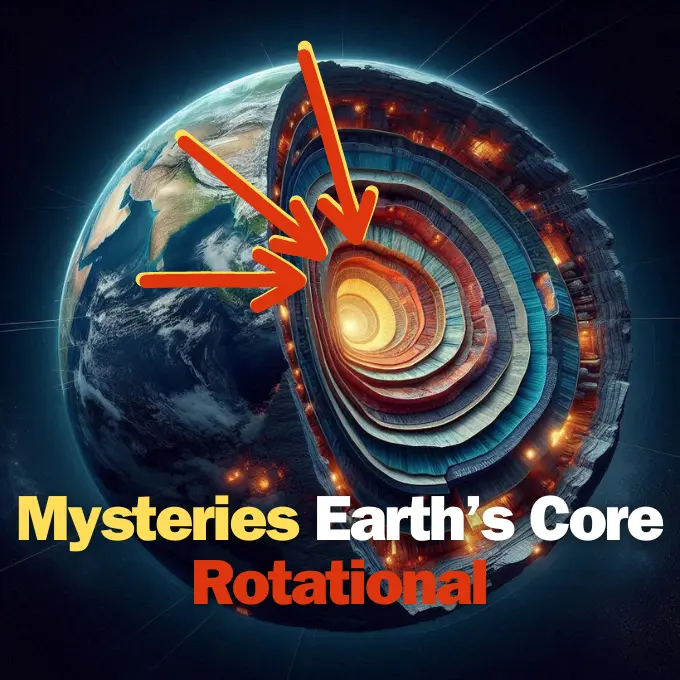
Our planet does not spin at an unchanging speed of twenty-four hours per day. Over geological eras, gravitational interactions with the Moon exert steady tidal drag on global oceans, gradually bleeding orbital energy from the planetary system and slowing Earth’s rotation. Deep geophysical mechanisms also play a part. Magma circulation in the mantle, shifts in continental ice sheets, and rotational changes in the inner core of Earth create minor fluctuations in planetary angular momentum over centuries. Deep-time geological records reveal the cumulative magnitude of these rotational changes. During the Jurassic period 200 million years ago, a terrestrial day lasted roughly 23 hours, resulting in an annual calendar of approximately 380 to 385 days [2].
Because Earth spun faster twenty-seven centuries ago, researchers use ancient eclipses to measure delta T (ΔT), the cumulative difference between Earth’s rotational time and uniform atomic time. By recalculating the shadow path using Qufu’s corrected coordinates, the team revised the ΔT constraint for the ancient Chinese eclipse of 709 BCE to between 20,264 and 21,204 seconds. That revision challenges previous spline curves and reshapes rotational estimates spanning the eighth and sixth centuries BCE [1].
Coauthor Mitsuru Sôma of the National Astronomical Observatory of Japan noted the broader value of the finding for historical astronomy. “This new dataset fixes coordinate errors in previous Earth rotation studies,” Sôma said. “Additionally, it improves the accuracy of dating and reconstructing historical astronomical events.” Such precise astronomical calibration helps astrophysicists map the gradual and long-term slowing of Earth’s spin across recorded human history [3].

Traces of the Solar Corona
Beyond documenting Earth’s rotation, the Chinese records preserve rare evidence concerning the Sun itself. The later addendum in the Hanshu describes the eclipsed Sun as “completely yellow above and below.” Astronomers have long suspected that this passage refers to the K-corona, the Sun’s outer atmosphere that remains concealed by the brilliant solar disk during normal daylight. During totality, however, this faint outer envelope becomes visible to the unaided eye [2].
Hayakawa’s team simulated the orientation of the solar rotation axis during the 709 BCE event to examine whether the description matched physical coronal geometry. Their simulation confirmed that the yellowish structure aligned with expected coronal streamers emerging above and below the solar poles. During total eclipses, these structured plasma features channel fast solar wind streams into interplanetary space. If the Han chronicle preserves an authentic sighting from Lu observers, it stands as one of the oldest surviving written descriptions of coronal structures in human history [1].
Dr. Meng Jin of the Lockheed Martin Solar and Astrophysics Laboratory explained the power of combining historical archives with astrophysics. “Some of our ancestors were very skilled observers,” Jin said. “When we combine their careful records with modern computational methods and historical evidence, we can potentially find new information about our planet and our star from thousands of years ago.” [3]
Tree Rings and Grand Minima
To evaluate whether prominent coronal structures were realistic in 709 BCE, researchers compared the historical text with solar activity models reconstructed from tree rings and ice cores. Photosynthesizing trees absorb carbon dioxide from the atmosphere, capturing minute traces of radioactive carbon-14 within their annual growth rings. Cosmic rays striking nitrogen atoms in the upper atmosphere generate carbon-14, but active solar magnetic fields deflect these incoming particles. When solar magnetic output rises, atmospheric carbon-14 production drops, leaving an enduring measurable record of past solar cycles [3].
Tree ring data shows that the Sun had recently emerged from a prolonged quiet phase known as the Homer Grand Minimum (also called the Neo Assyrian Grand Minimum), which persisted from roughly 808 to 717 BCE. During grand minima, sunspots become exceedingly scarce, and the Sun’s regular eleven-year activity cycle weakens substantially. The eclipse of 709 BCE occurred eight years after that quiet period ended. Radiocarbon records indicate that the Sun had successfully resumed its regular magnetic cycle and was likely near the peak of its eleven-year cycle. That magnetic configuration would naturally produce the extended coronal streamers described in the ancient Chinese chronicles [1].
Study coauthor Mathew Owens, a professor of space physics at the University of Reading, explained the significance of that agreement. “This unique historical addendum for the possible solar coronal structure is critical for providing a spot reference on solar activity reconstructions from tree rings and ice cores, as well as providing independent validation of solar activity models,” Owens said. Ancient court records and nuclear physics thereby corroborate the same solar history [3].
- ACADEMIC JOURNAL Hayakawa, H., Owens, M. J., Jin, M., Sôma, M., & Lockwood, M. (2025). Analyses of the Ancient Chinese Report on the Total Solar Eclipse in 709 BCE: Implications for the Contemporaneous Earth’s Rotation Speed and Solar Cycles. The Astrophysical Journal Letters, 995(1), L1. [Article Link]
- ONLINE NEWS Andrei, M. (2026, October 27). A 2,700-Year-Old Chinese Eclipse Record Is Helping Scientists Reconstruct the Earth’s Rotation. ZME Science. [Article Link]
- ONLINE NEWS Nagoya University. (2026, October 26). A 2,700-year-old solar eclipse just revealed something surprising about Earth. ScienceDaily. [Article Link]
APA 7: PerEXP Teamworks. (2026, October 28). Ancient Solar Eclipse in China Refines Past Earth Rotation. PerEXP Teamworks. https://perexpteamworks.com/en/ancient-solar-eclipse-earth-rotation/


