





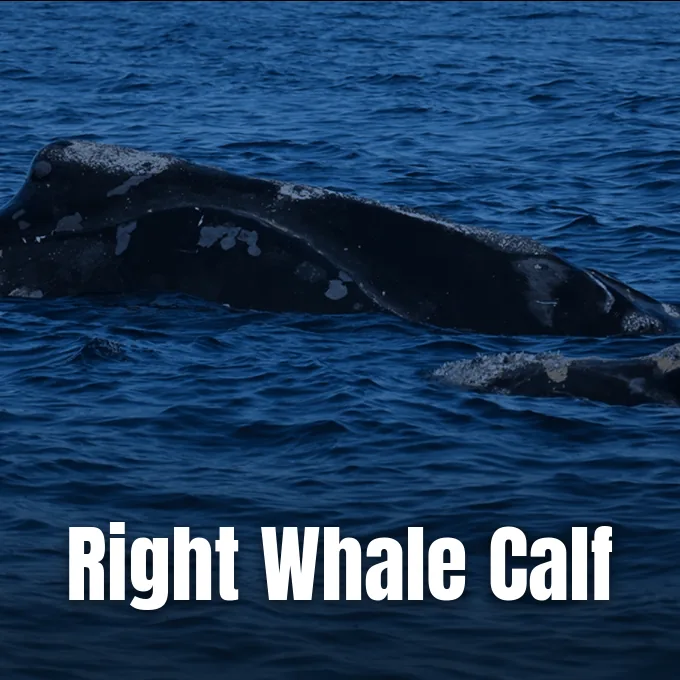
Scientists studying marine mammals off the coast of eastern Canada identified an unknown right whale calf swimming beside its mother near Anticosti Island. Researchers with the New England Aquarium in Boston confirmed the calf after matching field photographs with sighting logs in early November 2026. The young baleen whale slipped past coastal survey crews during its first months of life. Its late arrival brings the total count of calves from the birthing season to 24 [1, 3].
Unseen Right Whale Calf Spotted off Anticosti Island
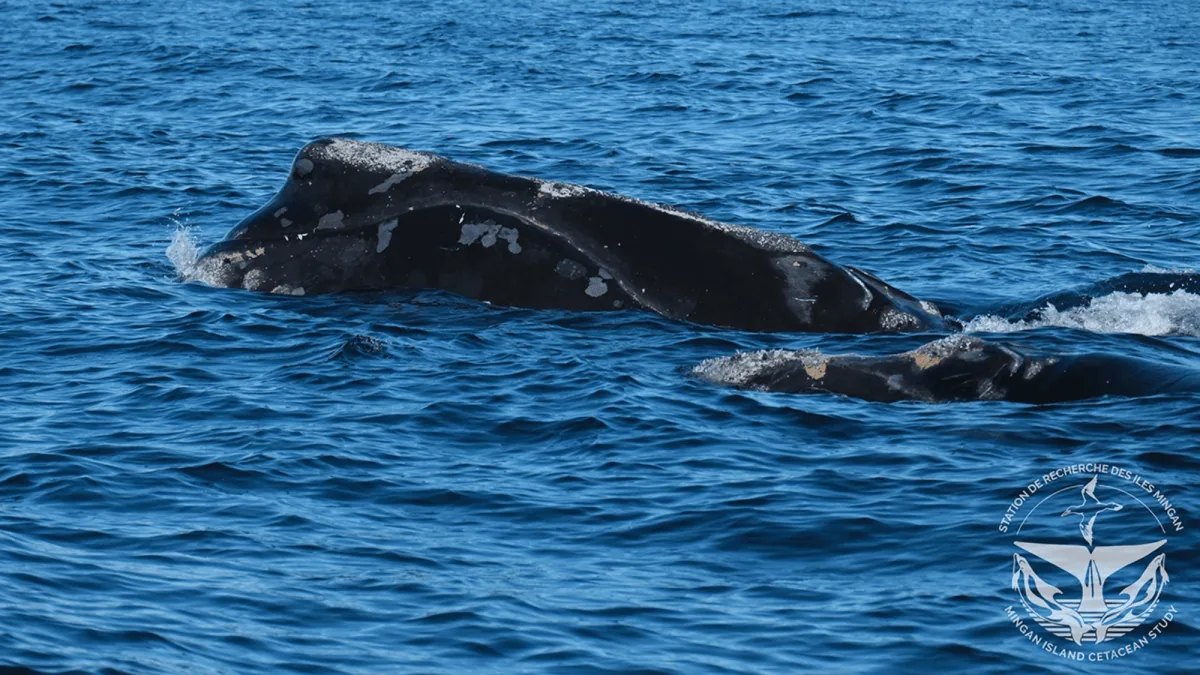
Field biologists from the Minigan Island Cetacean Study captured the first images of the pair on Sept. 25 near Anticosti Island in Quebec. The Canadian researchers sent their photographs to the Anderson Cabot Centre for Ocean Life at the New England Aquarium. That facility curates the North Atlantic Right Whale Catalogue, comparing skin markings to identify individual animals [3].
Photographic comparisons showed that the companion was a previously unseen right whale calf born during the 2025–2026 calving cycle. Amy Warren, a scientist at the Anderson Cabot Centre, said the mother had been seen briefly in calving grounds off the southeastern United States in February 2026. But the mother slipped away before monitoring teams could photograph the calf [3]. Survey teams look for pairs in southern waters from November through April, when females give birth before heading north toward summer feeding bays [2]. “This is an exciting discovery for us so late in the year,” Warren said after matching data confirmed the identity of the calf. The sighting confirmed that the young animal had survived its first long migration without being logged by coastal tracking teams [3].
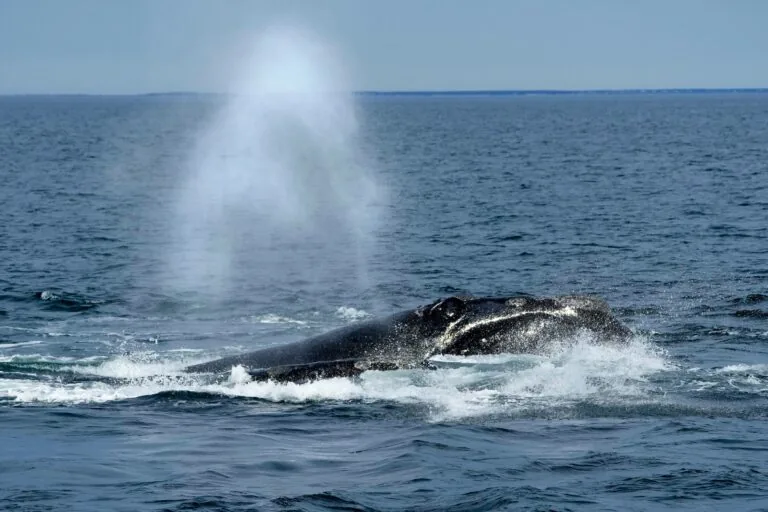
How Silt Evaded Coastal Survey Teams
The mother whale is a cataloged female called Silt, who is at least 38 years old and was first seen by researchers in 1988. Survey teams run aerial flights and boat patrols along the Atlantic coastline to find calves. But Silt swam north without being seen by observers during the spring or summer [2, 3].
“Silt managed to fly under the radar of survey teams during the spring and summer,” the New England Aquarium explained in a statement [2]. Her success in avoiding detection along heavily watched coastlines surprised biologists, but it also offered hope that she was protecting her offspring from boats and gear. “The fact that Silt managed to keep this calf away from the many, many, many survey efforts that were happening along the coast is both impressive and a little concerning, but hopefully that means she was keeping her calf away from the dangers in the ocean,” Warren said. Silt has now raised six known calves over four decades [2, 3]. Cetologists want to follow the calf into the coming season to verify that it stays healthy [3].
Heavy Scars Trace Decades of Ocean Hazards
Decades of swimming through busy shipping lanes have marked Silt’s body. She survived at least five fishing gear entanglement events, leaving heavy scars on her head and tail flukes. Fishing gear and vessel strikes cause most human-related injuries for right whales along eastern North America. Calves face high risk because they stay close to the surface and move slowly [2, 3].
Other whales in Silt’s direct family died after encountering those ocean hazards. In 2022, one of her calves became trapped in a fishing net and died. Her very first calf died after being struck by a boat. Silt is a mother of six, a grandmother of three, and a great-grandmother to a calf born in 2026, but her family losses show how dangerous coastal waters stay for young calves. Cetologists hope this new offspring avoids the fishing ropes and boat hulls that killed its older siblings. Researchers plan to track the mother and calf as they prepare for the journey south when winter temperatures drop in Canadian feeding bays [2, 3].


Why Right Whale Calf Counts Matter in 2026
The discovery of Silt’s calf raised the count for the 2025–2026 birthing season to 24 mother-calf pairs [1, 3]. Biologists welcomed the news because 24 pairs is the highest count documented in 17 years. Finding a healthy right whale calf late in the year shows that mature females can still give birth and raise calves despite heavy pressures [1, 3].
Warren said that while 24 calves brings hope, researchers look at the numbers within longer trends. “Generally speaking, it’s better than it was 40 years ago,” Warren said. “Not as good as it was 10 years ago… It’s been kind of flat for a few years in terms of numbers, which is neither good nor bad. We’ve been seeing a decline since 2010, and so the fact that we’re not still on that decline is promising, but we’d like to see more of an increase”. Right whales face calving intervals of several years, meaning that high birth counts in a single year must continue if the species is to recover [2, 3].
Other Veteran Mothers Documented This Season
With six calves, Silt ranks fourth for the most offspring among mothers giving birth in 2026. Her success mirrors several other older females who calved during the same cycle. Cetologists note that population survival depends on these mature breeders. Females can reproduce for decades if they avoid lethal net entanglements and ship strikes [3].
Monitoring teams logged multiple older mothers in southern coastal waters. Thirty-year-old Tripelago was seen with her sixth calf in Carolina. Forty-four-year-old Slalom was spotted near Daytona Beach with her seventh calf. In Georgia, the Clearwater Marine Aquarium team logged Magic, also 44, with her seventh calf, as well as Juno, between 40 and 60 years old, with her ninth. A Carolina team also documented Mantis, over 40 years old, with her eighth calf. These older females carry a large share of the breeding effort for the species, proving that older right whales remain productive when they survive human threats in coastal corridors [3].
Slow Population Growth for Eubalaena Glacialis
The North Atlantic right whale (Eubalaena glacialis) stays on the IUCN Red List under the endangered category. The total population stands at an estimated 384 individuals [2, 3]. That 2024 estimate is a 2.1 percent gain over 2023 [2]. Canada began a recovery plan in 2014 under the Species at Risk Act, after listing the whale as endangered in 2005 [3].
Heather Pettis, a senior scientist at the Anderson Cabot Centre, offered a cautious view on the population numbers. “The population increase is really good news, and so far, what we’ve seen in 2025 is also good news,” Pettis told Popular Science. But she said the population remains very small. “We’re talking about a population of 384 individual whales—that’s still incredibly low,” Pettis said. “Yes, we’re seeing increases. They’re small, and we still are seeing injuries to animals from human activities. And so, you know, I say that we’re cautiously optimistic”. Keeping every right whale calf safe from boat strikes and nets is necessary if the slow recovery is to last into future calving seasons [2, 3].
- ONLINE NEWS Whittle, P. (2026). Scientists discovered an unknown baby right whale off Canada. Mongabay. [Article Link]
- ONLINE NEWS Bassi, M. (2026, November 6). Baby whale surprises scientists. Popular Science. [Article Link]
- ONLINE NEWS Rowe, D. J. (2026, November 3). Critically endangered mother and calf whale seen in waters off Quebec. CTVNews. [Article Link]
APA 7: PerEXP Teamworks. (2026, November 7). New England Aquarium Identifies Unknown Right Whale Calf. PerEXP Teamworks. https://perexpteamworks.com/en/right-whale-calf-quebec-discovery/


