



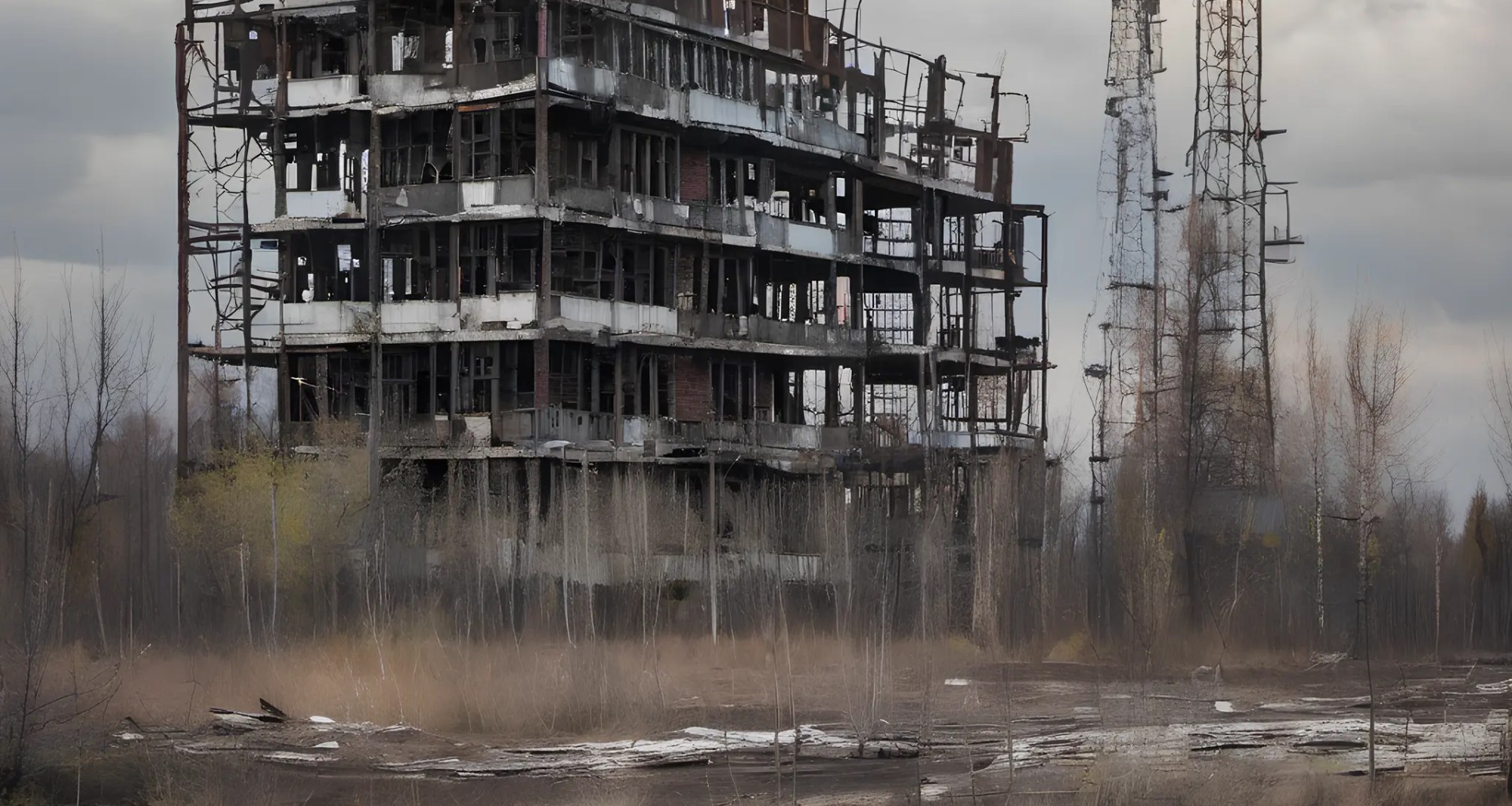
In early 2022, ecologist Bohdan Prots was set to embark on an ambitious project to restore ecosystems around the Chornobyl nuclear power plant in northern Ukraine. The plan was to recreate lost wetlands to rewild the area and mitigate the risks of wildfires spreading radioactivity. The first step involved surveying wildlife in the thickets of pines, birch, black alder, and willow trees.
However, in February, the project came to an abrupt halt when Russia invaded and occupied the Chornobyl region. The area, approximately 100 kilometers north of Kyiv, became a war zone, forcing hundreds of researchers and workers to evacuate. When Prots returned in April, armed soldiers guarded the route to his study site, marked with Ukrainian landmines. Prots, acknowledging the unexpected challenges, expressed the necessity of conservation work even in such conditions.
The war has taken a toll on Ukraine, impacting research nationwide, with particularly stark consequences for science in the Chornobyl region. The exclusion zone, mostly devoid of people since the 1986 nuclear disaster, had been a focal point for extensive research. Over 30 years, Soviet, Ukrainian, and international researchers had accumulated radiation and ecological datasets, turning the area into a unique natural laboratory to study the long-term effects of radiation and the changes in ecosystems left undisturbed.
The invasion shattered ongoing research efforts in the Chornobyl region, with scientists evacuating, data collection disrupted, and labs looted by Russian soldiers. Although Ukraine regained control within five weeks, the exclusion zone, situated on a strategically important route from Belarus to Kyiv, suffered prolonged environmental damage and military fortification. Timothy Mousseau, an ecologist with extensive Chornobyl studies, notes that scientific activity has come to a near standstill, and the area has been severely affected.
As the war approaches its third year, some researchers are finding innovative ways to resume their studies, despite the challenging circumstances and altered environment. Scientists at the Frankfurt Zoological Society in Germany, for instance, are analyzing footage from camera traps placed in the Chornobyl Biosphere Reserve, a protected area for wildlife research covering two-thirds of the exclusion zone. The aim is to assess the war’s impact on animal behavior using this unexpected experiment, according to Denys Vyshnevskyi, head of the reserve’s science department.
Science zone
The explosion of Chornobyl’s reactor 4 on April 26, 1986, within the Soviet Union, led to a catastrophic event. The resulting fire released radioactive isotopes that contaminated an extensive area of 155,000 square kilometers in Ukraine, Belarus, and Russia. The contamination caused spikes in radioactivity as far away as Canada and Japan. In response, authorities evacuated an area of 4,760 square kilometers, with approximately 2,600 square kilometers in northern Ukraine designated as the Chornobyl exclusion zone and the remaining portion in Belarus. Access to the reactor and heavily contaminated areas remained tightly controlled, and over 3,000 workers, involved in various roles such as building a protective sarcophagus around the reactor, acting as guards, firefighters, or tour guides for international tourists, were part of the ongoing efforts in the region.
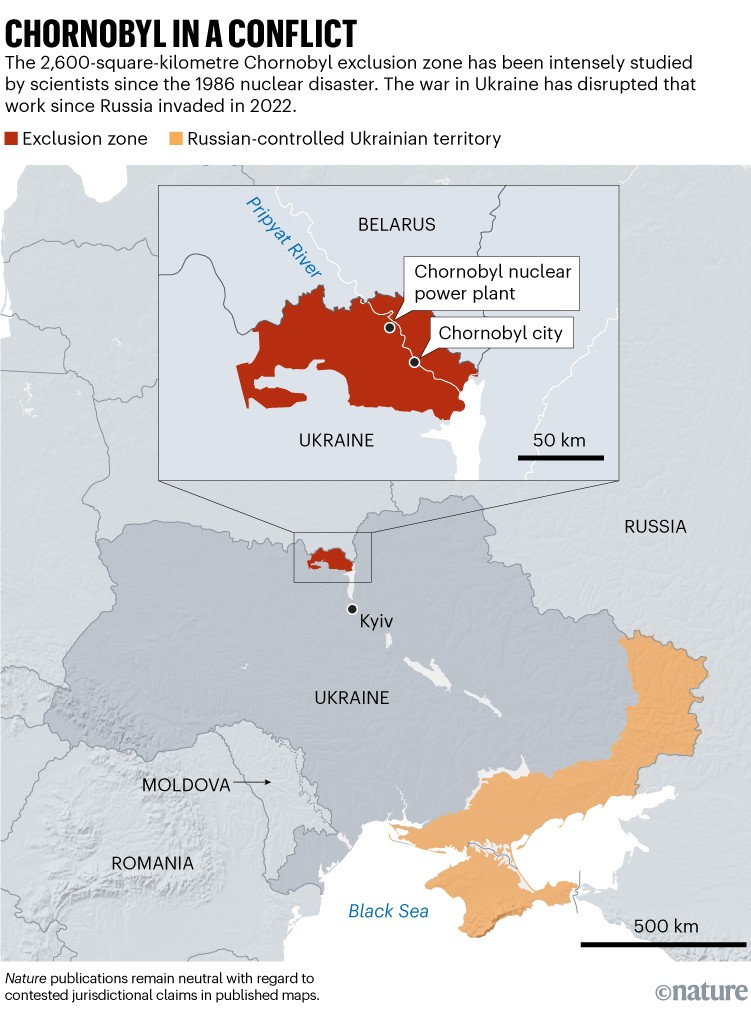
The Chornobyl accident presented a unique opportunity to conduct extensive research on the effects of radiation. Since Ukraine gained independence in 1991, the exclusion zone has hosted a cluster of research institutes, supported by Ukrainian authorities and collaborations with international universities. Monitoring sites for air, water, and soil are distributed throughout the zone, forming decades-long datasets on the decay, dispersion, and impact of radionuclides.
These datasets reveal varying concentrations of radiation across the zone, ranging from hazardous to low levels. The spatial distribution mirrors the wind direction immediately after the explosion, with a concentrated band of high radiation extending west of the reactor along the path of the radioactive plume. Studies on the long-term effects of radiation exposure on wildlife have yielded conflicting results, with some indicating declines in insect and spider abundance, while others show subtle effects on ecosystems.
The enduring datasets are the foundation of Chornobyl’s status as a globally significant laboratory, contributing to research on groundwater safety. In 2022, data spanning 35 years of groundwater monitoring demonstrated that radionuclide levels are no longer hazardous in much of the zone, except for a few remaining hotspots near the reactor. Moreover, research conducted in the exclusion zone has informed the development of nuclear power plants, influenced global nuclear emergency planning, and contributed to responses to nuclear accidents like the one at Fukushima in 2011. Mike Wood, an ecologist at the University of Salford, underscores that Chornobyl’s impact is not only local but extends globally.
Predicting the future with early indicators
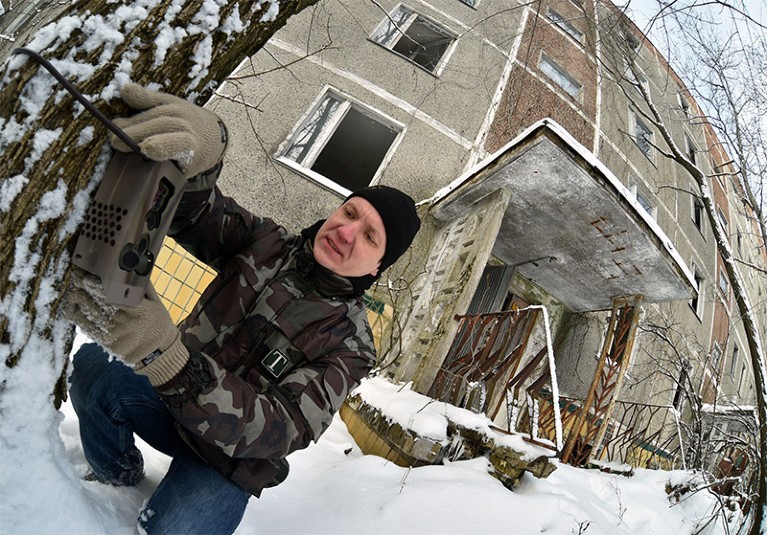
Scientists working in Chornobyl detected early signs of Russia’s impending invasion about four months before the conflict began. Researchers, including Timothy Mousseau, were using motion-activated cameras to monitor wildlife movement in the exclusion zone. Some of these cameras captured images of Russian troops making incursions across the border. Upon discovering this, the team promptly alerted authorities. However, Mousseau could only disclose this information publicly in May.
When the Russian army invaded on February 24, 2022, it swiftly captured the exclusion zone. Sergii Paskevych, deputy director of research at the Institute for Safety Problems of Nuclear Power Plants (ISP NPP) in Kyiv, was in the Chornobyl area that night. Amid fear and confusion, Paskevych and his colleagues decided to evacuate, leaving everything behind. As they left at 6 a.m., they witnessed Ukrainian troops arriving and placing explosives under bridges, which were later destroyed. Paskevych realized the severity of the situation, acknowledging that it was not a simulation but a real war.
During Russia’s brief occupation of the Chornobyl exclusion zone, their forces engaged in looting and vandalizing research labs and facilities. In Chornobyl town, for instance, servers were destroyed, and hard drives were stolen from Ecocentre, a laboratory leading radiation monitoring across the zone, as reported by Gennady Laptev, a radiological monitoring expert at the Ukrainian Hydrometeorological Institute in Kyiv.
This disruptive episode significantly impacted the continuity of long-term data collection in the region, and there are concerns among researchers that historical data may have been permanently lost due to the theft of computers and destruction of records. The disruption also affected wildlife studies, as researchers faced challenges accessing field sites and retrieving camera traps, some of which ceased to function when their batteries depleted.
The gradual comeback of something
On March 31, 2022, Ukraine declared the recovery of control over the exclusion zone, initiating a slow and hesitant return to research activities in the aftermath of the Chernobyl disaster. However, this resurgence faces considerable challenges, with Valery Kashparov, director of the Ukrainian Institute of Agricultural Radiology, highlighting the harsh reality of conducting work amid rocket attacks in Kyiv.
A predominant issue hindering scientific efforts is the severe shortage of personnel. Despite scientists being exempt from mandatory military service, individuals like Paskevych have volunteered to join the military. The Institute for Safety Problems of Nuclear Power Plants (ISP NPP) now operates with a minimal essential workforce, assessing safety risks amidst the ongoing conflict. External collaborators find it challenging to return due to institutional hesitancy about fieldwork in conflict zones.
Accessing research sites within the Chornobyl exclusion zone proves to be a major obstacle. While approximately half of the zone is accessible to scientists, one-third remains under strict military control, especially areas near the Belarusian border. Beyond military presence, the landscape is marred by landmines and tight army control, aimed at preventing a potential Russian invasion from Belarus.
Sharing the exclusion zone with the military introduces risks, as incidents involving the apprehension of researchers by Ukrainian soldiers indicate. Researchers have adapted by providing advance notice of their movements to avoid such encounters. Some Ukrainian researchers have cautiously ventured into the forests, aiming to reinstate ecological monitoring systems. Despite the surprise expressed by soldiers encountering scientists in the midst of a war zone, these efforts are crucial for understanding the impact on wildlife.
For researchers like Vyshnevskyi, the current focus lies in assessing the environmental damage resulting from the occupation. Collaborating with Ukraine’s environment ministry, Chornobyl researchers contribute to tracking military activities causing environmental harm, with citizens reporting thousands of instances, estimating substantial economic damage. The return of international researchers is anticipated to involve the repetition of previous studies, such as wildlife tracking, to quantify the changes in the zone over time. Understanding the evolving conditions will be essential for comprehending the long-term ecological consequences of the conflict.
The role of wetlands
Prots is among the scientists endeavoring to resume their work in the vicinity of the nuclear power plant located in Polesia, Europe’s largest inland wetland wilderness. However, the historical backdrop reveals that long before the establishment of the power plant, the Soviet Union extensively drained large areas of this region for agricultural purposes, a practice initiated in the 1920s.
In recent years, exacerbated by the combination of drier land conditions and the effects of climate change, wildfires have ravaged the forests surrounding Chornobyl. Research conducted in the aftermath of the 2020 fires indicates that the radionuclides released during the blazes pose minimal threats to individuals beyond the exclusion zone. Nevertheless, local scientists express a need for further investigation. Their concerns revolve around the potential impact of future fires on ecosystems, the release of carbon from peatlands, and the intricate challenge of studying and eventually reopening the zone due to the redistribution of radionuclides caused by such events. The delicate balance between environmental stability and the ongoing threat of wildfires in the Chornobyl region remains a focal point for these researchers.
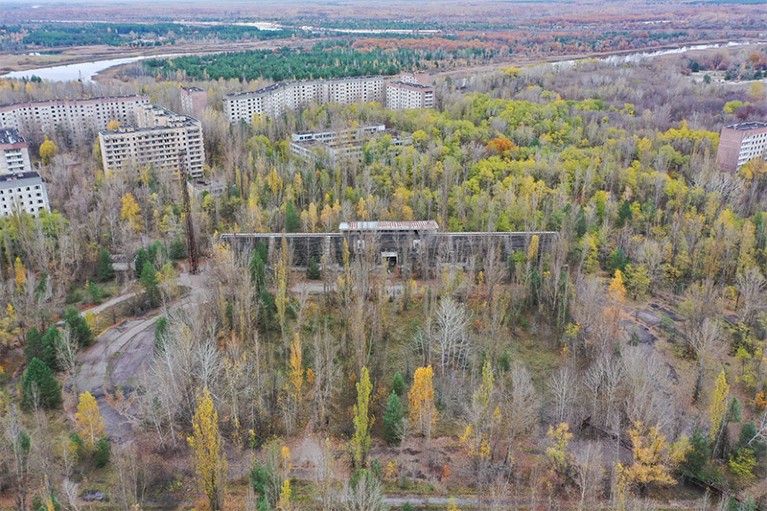
Prots is investigating the potential benefits of reintroducing wetlands to the Chornobyl region to mitigate risks such as wildfires and aid in the restoration of ecosystems. Building on a wetland conservation and restoration project in the Carpathian mountain forests of western Ukraine since 2007, Prots has been funded by the Whitley Fund for Nature, a UK conservation charity, since 2021. His research aims to determine whether rewilding can effectively and affordably prevent wildfires in collaboration with an international coalition, including Smith and Laptev.
Prior to the conflict, Prots had finalized plans for a pilot project set to begin in 2022. The project involved clearing silt and debris from the aging network of canals and sluice gates, utilizing the water to flood an 8-square-kilometer area of former swampland near the Pripyat River. The objective was to create conditions conducive to attracting the Eurasian beaver, a species whose dam-building activities can support wetland ecosystems in the long term. The pilot project intended to observe the effects of restored wetlands on wildlife and meticulously monitor radionuclides to prevent dangerous runoff into surrounding areas. If successful, the approach could be scaled up to restore wetlands across the Chornobyl exclusion zone.
Surprisingly, amidst the ongoing conflict, Prots’ proposal has garnered fresh interest from firefighters seeking solutions to combat increasingly frequent wildfires. Additionally, Ukraine’s military sees the potential strategic value of swamps as natural defenses against Russian troops. Recognizing the importance of natural habitats in border areas, Prots emphasizes the potential for significant gains in the ongoing conflict through the restoration of moist wetlands.
In theory, Prots’ project could commence once Ukraine’s military is able to allocate the services of a ‘sapper’ to clear explosive-laden tracks that were placed to impede Russian troop advances. However, the team’s initial hope to start the project during the summer was dashed as the sappers were redirected to other critical areas, particularly in the aftermath of Ukraine’s counteroffensive, which encountered heavily mined Russian lines.
The future: What lies ahead and how to prepare?
As the conflict in Ukraine shows no signs of resolution, concerns among researchers mount regarding the potential permanent damage to scientific endeavors at Chornobyl. Some fear that the recovery of scientific activities to pre-war levels may prove elusive, with doubts about the return of scientists who left the country. Sergey Gashchak, deputy director of science at the Chornobyl Center’s International Radioecology Laboratory, highlights existing challenges, including inadequate funding from the Ukrainian government and a sustained decline in science education. The war has, in his words, essentially “killed” science in the region, leaving projects stagnant due to a lack of funding and a dwindling pool of qualified scientists.
While some researchers express optimism that data collection and studies can resume, there is a growing concern about the duration of the hiatus. Germán Orizaola, a zoologist at the University of Oviedo, Spain, specializing in amphibians in Chornobyl, notes that a shorter interruption may not have significant ecological consequences. However, he worries about the lasting impact of disrupted international collaborations, exacerbated by both the war and the COVID-19 pandemic. The reduction in foreign funding, a crucial support source, is particularly worrisome for researchers like Orizaola, who emphasize that critical financial resources are not reaching Ukraine.
Regardless of when the conflict concludes, visible scars in the Chornobyl region are expected to endure. Along the Ukraine–Belarusian border, a 100-meter-wide strip of vegetation has been cleared, forming a division within the forest. Researchers, including Prots, highlight the presence of explosives in these zones, regularly triggered by animals during their visits. There is growing apprehension among scientists that this deforested strip might become a lasting barrier, reminiscent of the old Iron Curtain with barbed wire. The unfolding reality, as described by Prots, is a completely new and challenging landscape that researchers face in the aftermath of the conflict.
Resources
- JOURNAL Ponsford, M. P. (2023). Research in Chornobyl zone restarts amid ravages of war. Nature, 624(7991), 244–246. [Nature]
- JOURNAL Møller, A. P., & Mousseau, T. A. (2009). Reduced abundance of insects and spiders linked to radiation at Chernobyl 20 years after the accident. Biology Letters, 5(3), 356–359. [Biology Letters]
- JOURNAL Beresford, N. A., Scott, E. M., & Copplestone, D. (2020). Field effects studies in the Chernobyl Exclusion Zone: Lessons to be learnt. Journal of Environmental Radioactivity, 211, 105893. [Journal of Environmental Radioactivity]
- JOURNAL Bugaï, D., Киреев, С. И., Hoque, M. A., Kubko, Y., & Smith, J. T. (2022). Natural attenuation processes control groundwater contamination in the Chernobyl exclusion zone: evidence from 35 years of radiological monitoring. Scientific Reports, 12(1). [Scientific Reports]
- JOURNAL Beresford, N. A., Barnett, C., Gashchak, S., Kashparov, V., Kirieiev, S., Levchuk, S., Morozova, V., Smith, J., & Wood, M. D. (2021). Wildfires in the Chornobyl exclusion zone—Risks and consequences. Integrated Environmental Assessment and Management, 17(6), 1141–1150. [Integrated Environmental Assessment and Management]
- JOURNAL Angelstam, P., Yamelynets, T., Elbakidze, M., Prots, B., & Manton, M. (2017). Gap analysis as a basis for strategic spatial planning of green infrastructure: a case study in the Ukrainian Carpathians. Ecoscience, 24(1–2), 41–58. [Ecoscience]
Cite this page:
APA 7: TWs Editor. (2023, December 15). War-Torn Chornobyl Zone Resumes Scientific Exploration. PerEXP Teamworks. [News Link]


