






X introduced its first native parental controls on November 26, 2026, giving parents tools to guide teen accounts [1]. The update arrives after 20 years of existence, bringing supervisory options for accounts belonging to users between 13 and 17 years old. Unlike standard parental monitoring systems on rival networks, X parental controls need teens to give explicit consent before any supervisory link takes effect across the service [2]. The new settings place accounts into a default protected mode designed to stop graphic media and remove targeted ads [1].
Default Protection on Teen Accounts
Under the new setup, any account held by a teen between 13 and 17 years old enters protected mode by default, which blocks sensitive media and stops targeted ads across the platform. Users must be at least 13 years old to join X, yet younger kids often use the site. Research from 2024 showed that roughly one in three members of Gen Alpha has an account on X, even though the service previously lacked tools built for minors [1].
Teens keep clear view over every rule applied by parents, and if an adult changes a setting, the teen sees the exact update on their screen [2]. Michael O’Herlihy, head of safety at X, said in a company blog post: “Parents want practical tools, and teens deserve room to grow. With Parental Controls on X, families can set the guardrails that fit their home, while teens keep ownership of their accounts and can see every change. Striking that balance is vital and what we set out to build.” [1]
Similar feed options appear on other platforms, where Pinterest parental controls let caregivers limit AI in teen feeds to guide youth viewing. Writing for 9to5Mac, reporter Ben Lovejoy said parents can restrict video queues and For You recommendations solely to followed accounts [2]. This setting stops the algorithm from pushing unvetted posts into the main feed [1].
X Parental Controls Offer Six Core Settings
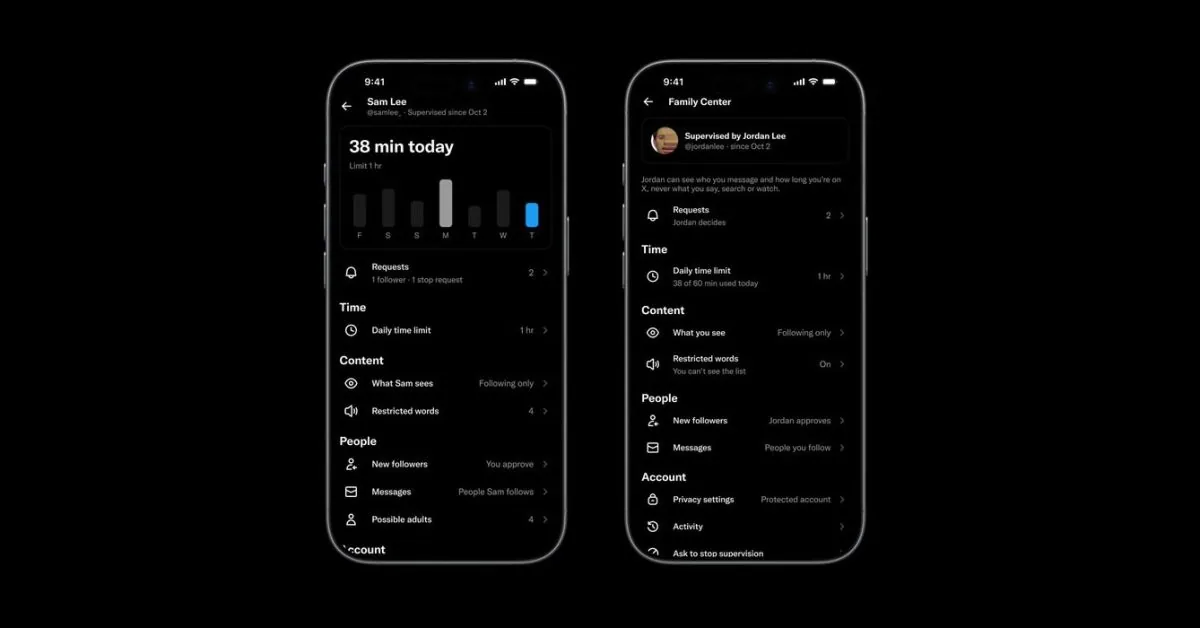
X’s Safety account announced six distinct supervision options. The tools give parents direct ways to guide habits while keeping teens informed about every change made to their profiles. First, parents can check weekly time spent on X and set an enforced daily screen limit to stop endless scrolling during school nights, study hours, or late evening browsing. Second, requiring follower approval automatically turns a public profile private. Third, video queues and feed suggestions can be restricted solely to followed accounts, and fourth, parents can filter chosen words from the user experience while turning off sensitive media to keep raw posts out of sight across the network [2].
The fifth and sixth tools manage direct messages [2]. Parents can pick who can send direct messages to their teen, cutting down on unwanted outreach from strangers while maintaining open communication with approved friends [1]. In addition, parents can see which accounts their teen chats with one-on-one, giving insight into peer contacts without revealing private messages [2].

Turning on parental controls on X needs active consent from both sides rather than a one-sided adult decree. Both users must agree [2]. X built the system so that teens never lose sight of their profile status, displaying clear screen alerts whenever an adult edits an active permission [1]. Both parties see matching notices whenever rules change [2].


Direct Message Privacy and Limits
While parents gain several tools, X set clear limits that stop adults from reading private teen communications by barring message logs, search histories, and direct chat inspection. Parents and caregivers cannot read private messages sent or received by teens [2]. They cannot check past searches or view video history [1]. Furthermore, parents cannot post tweets as their teen, nor can they access account credentials or personal login passwords stored on the device [2].
These privacy lines keep chat texts private while still showing the names of chat partners [1]. If a teen chats with a peer or a stranger, the parent sees the account handle but can’t read the chat words [2]. The tool lets families spot unfamiliar contacts without reading daily messages [1].
Concerns about online youth habits often prompt debates about screen time and mood, themes explored in an Australian review examining links between social media and anxious teens. By pairing time caps with chat protections, X aims to limit screen time without turning the app into a spy tool [1]. Families can set a daily cap that stops app use when time runs out [2].
Earlier Safety Disputes That Prompted X Parental Controls for Teens
The rollout comes after months of public scrutiny over safety tools on X following high-profile controversies. TechCrunch writer Ram Iyer reported that the update arrived months after X faced intense criticism when its AI chatbot produced sexualized images of women and children without proper safeguards. Critics pointed to a sharp lack of tools to stop the chatbot from generating abusive images. The incident brought fresh pressure from lawmakers demanding better safety tools for kids. Owner Elon Musk led the platform through several safety debates after buying the service [1].
Long before the chatbot dispute, X operated with few safety tools for young users. The platform, formerly called Twitter, has long struggled with child sexual abuse material, automated spam bots, and viral misinformation spreading across public feeds without adequate moderation. Moreover, X openly lets users post adult pornographic media. For twenty years, young users faced these hazards without parental tools [1].
Data showing that nearly a third of Gen Alpha kids use X made the lack of safety tools increasingly difficult to defend against growing public criticism. Adding parental controls to X brings basic protections to an app that previously left filtering to users [1].
Mutual Consent Rules for Families
The most unusual part of the new system is the rule of mutual agreement between parent and child. Controls cannot be turned on by an adult without the teen’s explicit approval. A parent sends the request, but the teen must tap accept on their own phone before any supervisory settings lock in on the account [2].
If a teen rejects the request, the controls stay off and the profile remains in its default state. Once set up, the supervision link does not last forever. The link ends at 18. When the teen reaches their 18th birthday, all parental controls drop off right away without needing manual input. This sunset rule ensures that adult accounts operate with full freedom [2].
By needing teen consent and ending rules at age 18, X parental controls seek to balance safety rules with youth freedom across an open social network. Parents get tools to block graphic media and limit contacts, while teens keep control of their accounts [1]. Whether teens will accept parental oversight on a site known for raw debate is an open question for families testing the new tools in real households [2].
- ONLINE NEWS Iyer, R. (2026, November 26). X finally gets parental controls after 20 years. TechCrunch. [Article Link]
- ONLINE NEWS Lovejoy, B. (2026, November 26). X finally gets six parental controls for teen accounts, but kids must consent. 9to5Mac. [Article Link]


