





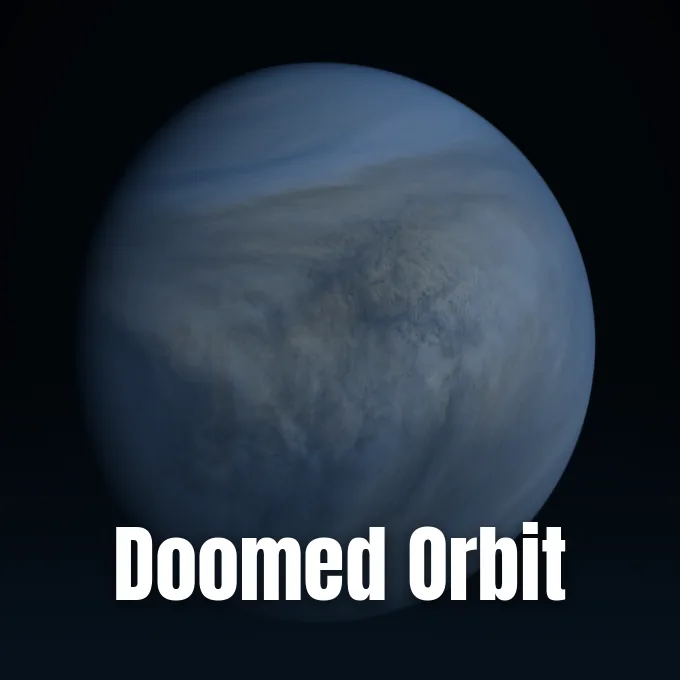
The absence of a Venus moon stands among the most persistent puzzles in planetary science. Venus shares nearly the same mass and size as Earth, yet while our world has a natural satellite, its twin remains solitary. Why did two rocky planets of similar mass diverge so completely? In a new paper published by The Astrophysical Journal, planetary astrophysicist Stephen Kane from the University of California, Riverside shows that any moon around Venus was doomed from the start. Ordinary gravitational tides dictated that fate. [1, 2]
The Longstanding Mystery of Venus Moons
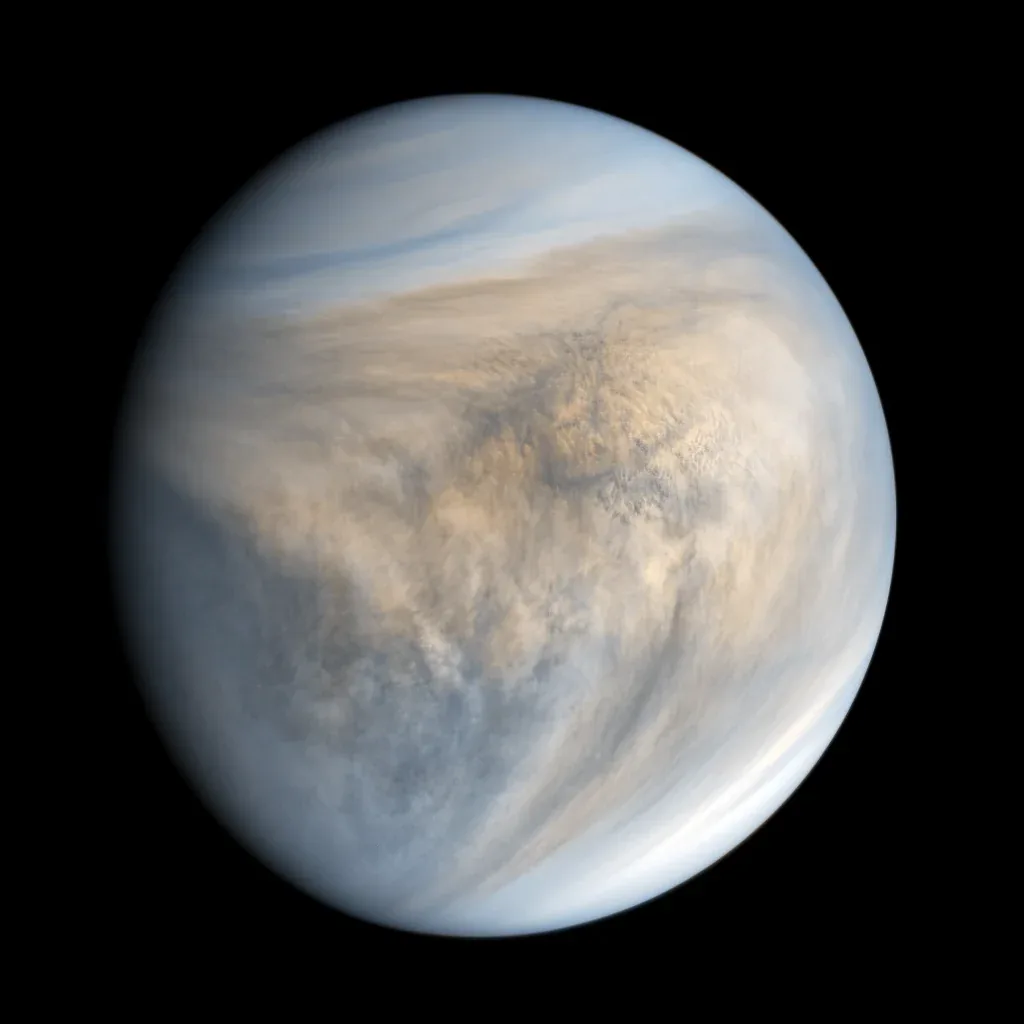
Venus and Earth formed from similar rocky reservoirs in the inner solar system. Observers frequently describe Venus as Earth’s mysterious sister planet because both worlds share comparable mass and diameter. Yet one bizarre mechanical property sets Venus apart: an incredibly slow 243-day retrograde rotation (spinning clockwise on its axis, contrary to most planets). That slow spin reshaped everything. It completely altered the gravitational environment surrounding the planet across cosmic timescales. [1, 3]
For decades, researchers debated whether collisions stripped away satellites or whether Venus simply never formed one. Stephen Kane, discussing the findings with Bruce Dorminey of Universe Today, points to ordinary orbital mechanics instead. Kane explains that the lack of a moon reflects ordinary tidal physics rather than an exotic catastrophe [2]. Tidal forces between the planet, a hypothetical moon, and the Sun determined the outcome. The physical mechanism was simple. The math holds. [1, 2]
Timing proved decisive. Under ordinary tidal interactions, any natural satellite formed around a slowly rotating planet faces inescapable inward decay. [1, 2]
How a Venus Moon Spirals Inward
To investigate this slow gravitational tug-of-war between a planet and a moon over billions of years, Kane and his colleagues at the University of California, Riverside built a specialized computer model tracking gravitational tides between Venus, a hypothetical moon, and the Sun across cosmic epochs [1]. The team ran individual simulations that systematically varied Venus’s initial spin, the moon’s mass, Venus’ orbital eccentricity (the departure of an orbit from circularity), and the viscoelastic properties of Venus’s interior [1, 3]. Across those extensive numerical simulations, survival proved exceptionally rare. The model shows that a moon survives only under a narrow set of conditions: a fast-spinning early Venus and a moon no heavier than our own Moon. [1]
Tidal friction governs how natural satellites migrate over geological timescales. On Earth, rapid planetary rotation pushes the oceanic tidal bulge ahead of the Moon, transferring angular momentum that gradually pushes our Moon away from Earth by a few centimeters a year [1, 2]. Around a slowly rotating body like Venus, the physical geometry reverses completely. Because the planet rotates slower than the moon orbits, the tidal bulge raised on the planet lags behind the satellite, acting like a constant gravitational brake that continuously drains orbital energy over countless millions of orbital circuits. The moon falls inward. [1, 2]
The consequences of this gravitational braking are cumulative. Instead of drifting outward into distant space, any ancient Venus moon was pulled steadily closer to the planet. Kane’s team calculated that this inward spiral would tear the moon apart within the first billion years or so of the moon’s formation [1, 3]. Destruction was swift. The satellite could not survive into the modern epoch. [1]
The Roche Limit as Orbital Deal Breaker
As an inward-spiraling satellite approaches its host planet, it encounters a physical boundary known as the Roche limit (the distance below which a planet’s tidal gravity becomes stronger than a moon’s own gravity holding it together). Inside that boundary, tidal gravity pulls the moon apart into debris [1, 2]. Kane notes that this process mirrors the tidal physics that gives Saturn its rings [1]. Rather than crashing as a whole sphere, the disrupted satellite fractures into a broad ring of rubble. [1, 3]
Kane and his colleagues calculate that limit at about 2.85 Venus radii, which is roughly 17,000 km from the planet’s center [1]. Any moon driven inward past that 17,000 km boundary cannot survive. Inside the Roche limit, the planet’s tidal gravity overcomes the moon’s structural cohesion. The resulting debris ring spirals inward and eventually rains down onto the planet. [1, 2]
The disruption of an ancient natural satellite fundamentally transforms a terrestrial planet’s long-term environmental evolution. When massive fragments from a disrupted moon descend into the primordial atmosphere, they deliver immense kinetic energy and distinct chemical material directly into the crust and atmospheric reservoir over extended periods of time [1]. This steady bombardment alters surface rock, pulverizes topographies, and introduces volatile materials that actively influence atmospheric chemistry across global planetary scales. Planetary scientists consider such gravitational events when modeling how Venus evolved into its modern state. [1, 2]


Gyroscopic Stabilization and Planetary Climate
Beyond orbital dynamics, natural satellites influence planetary climate over long timescales. Kane explains that a large moon acts like a gyroscopic stabilizer, keeping a planet’s tilt steady over long timescales [1, 2]. That stability matters. Without a massive satellite, a planet’s tilt can wander chaotically, causing dramatic swings in climate across geological eras [1].
Extreme swings in axial tilt disrupt planetary environments. If a rocky planet experiences chaotic tilt variations, polar regions endure extreme shifts between intense starlight and prolonged darkness [1]. Stability vanishes. Losing a moon removes one source of long-term climate stability. Kane notes that while atmospheric greenhouse effects shaped modern Venus, the absence of a stabilizing moon removed an important buffer against climatic instability during its early history. [1, 2]
Earth and Venus followed divergent paths. Both worlds formed with similar mass in the inner solar system, but subtle differences in initial spin decided whether their satellites migrated outward into stability or spiraled inward to destruction. Venus illustrates what happens when a rocky planet lands on the wrong side of the rotational spin boundary. [1, 2]
Can NASA’s DAVINCI Mission Detect Past Debris?
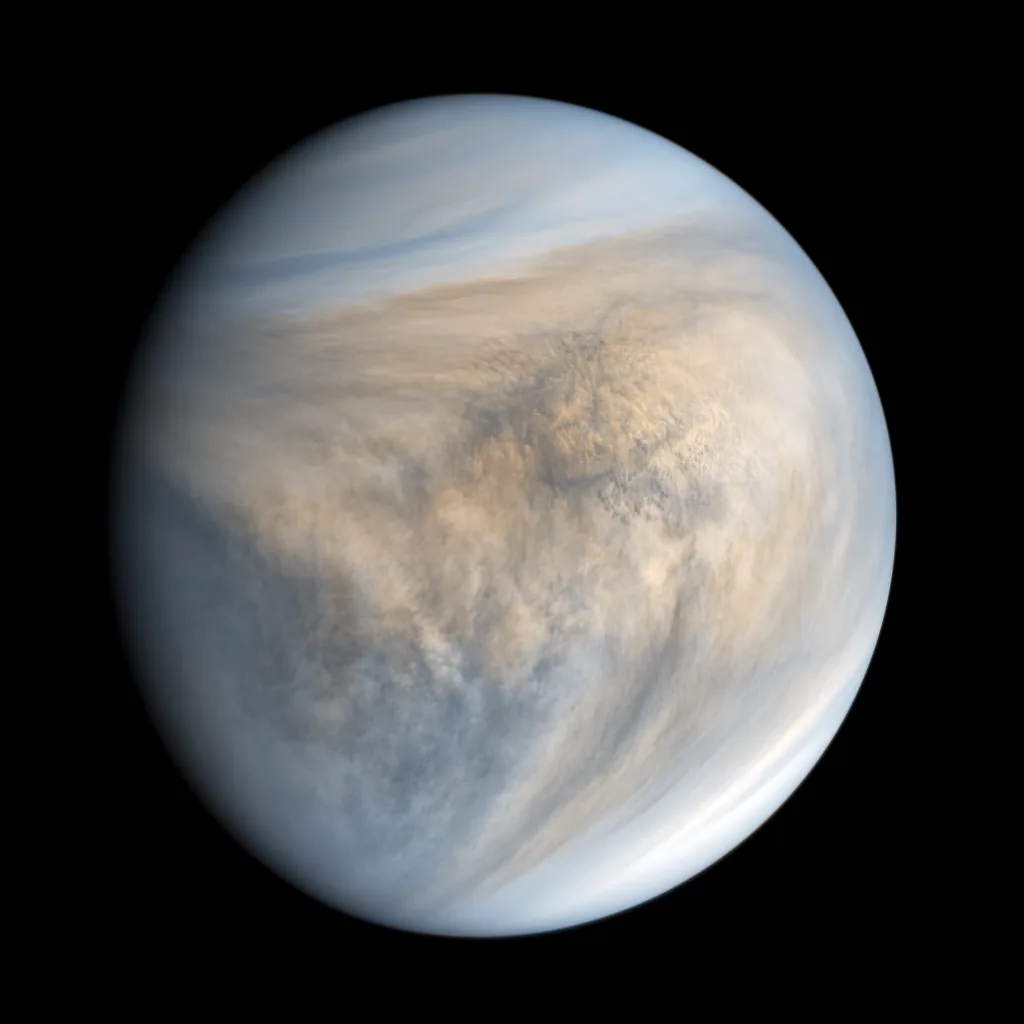
Testing events from the solar system’s early history requires direct atmospheric measurements. NASA’s planned DAVINCI mission, scheduled for launch to Venus by the end of this decade, could possibly find in situ atmospheric evidence of a destroyed Venus moon [1, 2]. During its descent through the atmosphere, DAVINCI is designed to conduct sensitive in situ measurements (direct chemical sampling carried out inside the atmosphere itself), recording atmospheric abundances down toward the surface. DAVINCI may provide answers. [1]
If an ancient Venus moon was destroyed and its material fell onto the planet, it could have altered the chemistry of the surface and atmosphere [1]. Kane points out that noble gas abundances and isotopic ratios (ratios between atomic isotopes of noble gases) serve as sensitive tracers of past impacts [1, 2]. Noble gas abundances could preserve the chemical fingerprint of a disrupted moon. These tracers could confirm whether lunar debris entered the atmosphere billions of years ago. [1]
Disentangling an ancient lunar signature remains challenging. In their study, Kane and his colleagues acknowledge that separating the signal of a disrupted moon from subsequent volcanic outgassing and atmospheric escape presents a substantial challenge [1, 2]. Volcanic resurfacing could mask the chemical signal. Still, DAVINCI’s descent data will offer the first direct opportunity to search for evidence of a lost moon. [1, 2]
What Earth’s Spin Reveals About Planetary Evolution
The fate of a hypothetical Venus moon highlights the unusual history of our own planet. Earth formed spinning fast enough that the Moon migrates outward and continues on that trajectory today [1, 2]. Recent studies on the Moon’s formation and estimated age show how early conditions shaped that bond. Kane points out that our large, stabilizing Moon was not guaranteed by a big impact alone; it also depended on Earth ending up with the right spin. [1]
If Earth had formed spinning significantly more slowly, tidal forces would have driven the Moon inward to destruction instead [1, 2]. Earth’s rapid spin saved our Moon from gravitational destruction. That rotational boundary may explain why Earth maintained climate stability while Venus followed a different evolutionary branch. Spin velocity proved crucial. [1]
These findings extend to planets orbiting other stars. Kane’s work predicts that extrasolar Venus-like worlds (rocky planets that orbit close to their stars and spin slowly) should generically be moonless too [1, 2]. That testable prediction guides upcoming space telescopes. As astronomers evaluate distant rocky worlds, a planet’s slow rotation may be a key factor in assessing its habitability. [1]
- ACADEMIC JOURNAL Kane, S. R., et al. (2026). Modeling the tidal evolution of a hypothetical Venusian moon. The Astrophysical Journal. arXiv:2608.25036. [Article Link]
- ONLINE NEWS Dorminey, B. (2026, September 12). Venus moon would have been doomed from the start, says new paper. Universe Today. [Article Link]
- ONLINE NEWS Knowridge Science Report. (2026, September 12). Venus moon would have been doomed from the start. Knowridge Science Report. [Article Link]
- WEBSITE Universe Today. (2026, September 12). Venus telescopic observation image [Photograph]. Universe Today. [Article Link]
- WEBSITE Knowridge Science Report. (2026, September 12). Artist concept of a doomed Venus moon [Photograph]. Knowridge Science Report. [Article Link]
APA 7: TWs Editor. (2026, September 13). Why an ancient Venus moon would be doomed, study suggests. PerEXP Teamworks. https://perexpteamworks.com/en/venus-moon-would-have-been-doomed-from-the-start-s/


