



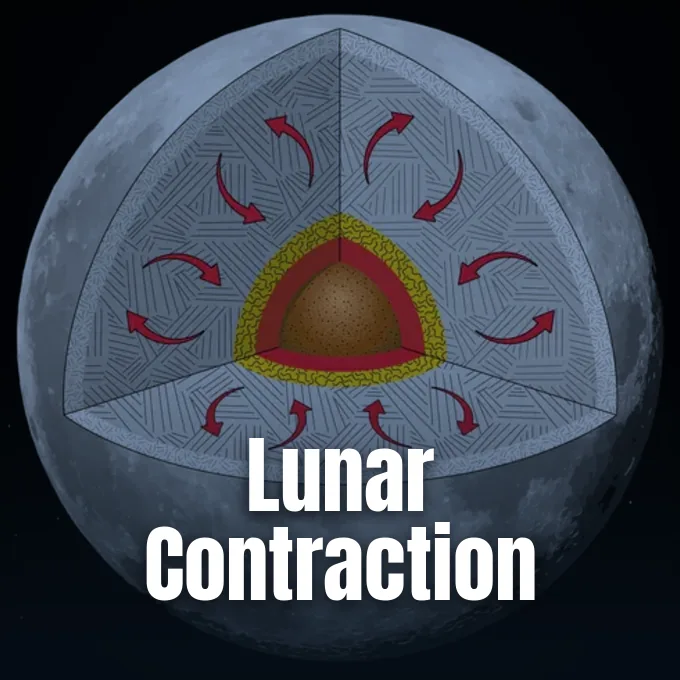
Our Moon is gradually shrinking as its deep interior cools, leaving thousands of fresh fractures and thrust faults scattered over the surface. New measurements published in The Planetary Science Journal reveal that ongoing lunar contraction has reduced the Moon’s radius by about 45 meters over the past several hundred million years [1]. Researchers at the Smithsonian’s National Air and Space Museum analyzed high-resolution orbital imagery to calculate how fast this shrinkage happens [2]. Their findings clarify how a cooling celestial body deforms without plate tectonics, while also pointing to seismic risks for future astronaut landing sites [3].
Thermal History from Ancient Impacts
The Moon formed roughly 4.5 billion years ago when a massive object collided with the young Earth [3]. That violent collision left behind a molten world that has spent billions of years slowly radiating its internal heat away into space. During its earliest geological stages, heat produced by radioactive decay kept parts of the crust warm and even drove modest expansion. Linear graben and long trenches formed as rock pulled apart under extensional stress. For example, the Rima Cauchy straight rille in the Sea of Tranquility (Mare Tranquillitatis) stretches roughly 170 kilometers as a remnant of that ancient extensional epoch [2]. Earlier work analyzing how scientists revised the Moon’s age helped establish a timeline for these early thermal phases.
Over billions of years, that internal radioactive heat source dwindled and the crust transitioned to a compressional regime [2]. Geological evidence suggests this shift occurred roughly 3.6 billion years ago, ending the epoch of extensional rifting. As rock layers cooled, they began pushing against one another instead of pulling apart [1]. Yet the Moon did not begin wrinkling all at once. Because the outer shell was thick enough to retain warmth for a long time, pronounced crustal breaking waited until relatively recent geological history. The widespread thrust faults visible on the surface today are young features, dating back only about 300 to 400 million years [2].

How Lunar Contraction Fractures the Crust
Because the Moon has cooled over hundreds of millions of years, its crustal rock has squeezed inward and buckled upward under compressional stress. This steady lunar contraction forces brittle surface crust to break along thrust faults, where one section of rock slips over an adjacent section to create steep, step-like ridges called lobate scarps [1]. Images collected by NASA’s Lunar Reconnaissance Orbiter (LRO) revealed that these features form a vast network across the globe [2]. Earlier surveys demonstrated how the lunar orbiter spotted rare craters across diverse regional terrains, but the sheer abundance of contraction scarps surprised investigators who mapped them in detail.
“The number of these young faults revealed in LROC images is much greater than I ever imagined,” Watters said. “As the interior of the moon continues to cool and contract, it is expected that the growth of existing faults and formation of new faults continues today.” [2]
The orbiter has monitored the Moon from a near-polar orbit since launching in 2009, mapping more than 98% of the surface in 100-meter resolution [2]. Its primary imaging suite, the Lunar Reconnaissance Orbiter Camera (LROC), includes a Wide Angle Camera and two Narrow Angle Cameras capable of resolving half-meter ground details. Planetary geologist Thomas Watters and his team at the Center for Earth and Planetary Studies examined thousands of Narrow Angle Camera frames to map these structural scarps [1]. Their catalog shows that young faults cut across highland plains and polar craters, proving that cooling stresses remain active today [3].
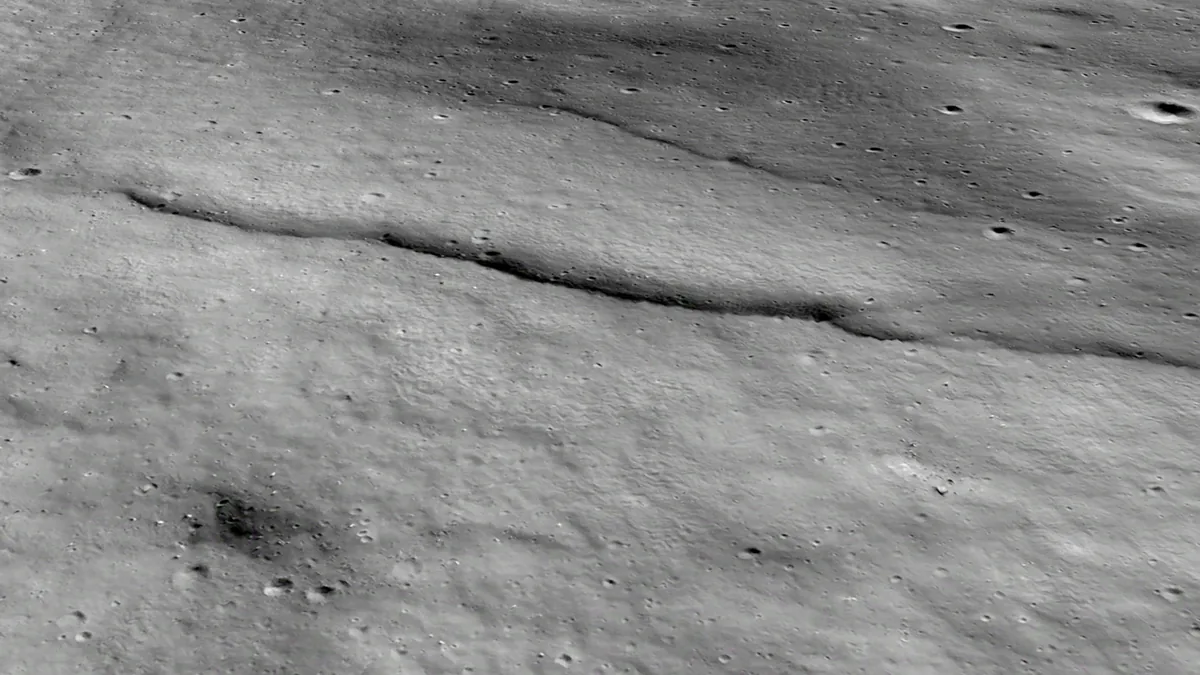
Highland Scarps and Small Mare Ridges
Orbital surveys show that lunar cooling creates two distinct varieties of compressional landforms depending on local rock composition [1]. The most prominent are lobate thrust fault scarps, which appear primarily in the lunar highlands. These scarps rise tens of meters above surrounding terrain and bend across hills in winding paths [2]. In dark volcanic plains known as maria, compressional forces produce narrow ridges termed small mare ridges (SMRs). While basaltic maria contain more than 2,000 small mare ridges, the brighter highland regions host over 8,900 lobate scarps [3].
Watters and his co-authors evaluated stereo digital elevation models for several major highland landforms, including the Pitiscus scarp, Fowler scarp, Morozov scarp, and Mouchez scarp [2]. Their mathematical modeling compared the fractional areal strain generated in maria against the strain observed throughout highland crust. The analysis determined that highland thrust fault scarps account for almost all the late-stage radius reduction, whereas small mare ridges contribute very little to the global total [1]. If thrust faulting had been occurring at its current intensity for billions of years, these scarps would have grown into giant cliffs similar to the huge ridges seen on Mars and Mercury [2].


Crustal Thickness Differences
Tectonic activity on the Moon operates on fundamentally different physical principles than the familiar continental drift seen on Earth. Our home planet features roughly 15 major tectonic plates that slide over a semi-fluid mantle, creating earthquakes where plates grind past one another. The Moon has no tectonic plates at all. It is a single-plate body whose outer shell forms an unbroken spherical lid. When global cooling shrinks that single shell, compressional strain cannot vent along plate boundaries. Stresses instead accumulate until brittle rock fractures internally, scattering faults across both hemispheres [3].
The new study combined LROC fault distributions with crustal thickness maps generated by NASA’s Gravity Recovery and Interior Laboratory (GRAIL) mission [2]. The authors found that regions with fewer faults consistently coincide with areas of thicker crust. In the Moon’s early history, a thicker crust acted as a thermal blanket, insulating hot rock deep below and slowing the pace of cooling and fracturing. Thinner crust cooled faster and cracked sooner under compressional stress [3]. This contrast explains why fault scarps cluster unevenly instead of blanketing every quadrant of the lunar surface in equal measure.
Measuring Lunar Contraction Rates
By measuring the dimensions and fault geometry of thousands of lobate scarps, the research team calculated the total strain experienced by the Moon. They estimated that the fractional areal contractional strain ranges from roughly 0.0048% to 0.0053% [1]. That tiny percentage translates into an overall radial contraction of about 42 to 46 meters (around 148 feet) over the last 400 to 800 million years [3]. Watters and co-researchers M. E. Banks, C. A. Nypaver, and M. S. Robinson noted that this radial loss corresponds to an isotropic compressional stress of roughly 4 megapascals in the crust [1].
Assuming uniform shrinkage over the past 400 million years, the Moon contracts radially at a rate of 6 to 11 centimeters per million years. That movement works out to roughly 0.1 micrometers, or 0.0001 millimeters, every single year. By contrast, Earth’s tectonic plates shift by an average of about 1.5 centimeters per year, driven by interior mantle convection and heat loss [2]. While 0.1 micrometers per year sounds negligible to everyday human observation, the cumulative stress builds up enormous mechanical strain in cold, brittle lunar rock that does not easily deform without breaking [1].
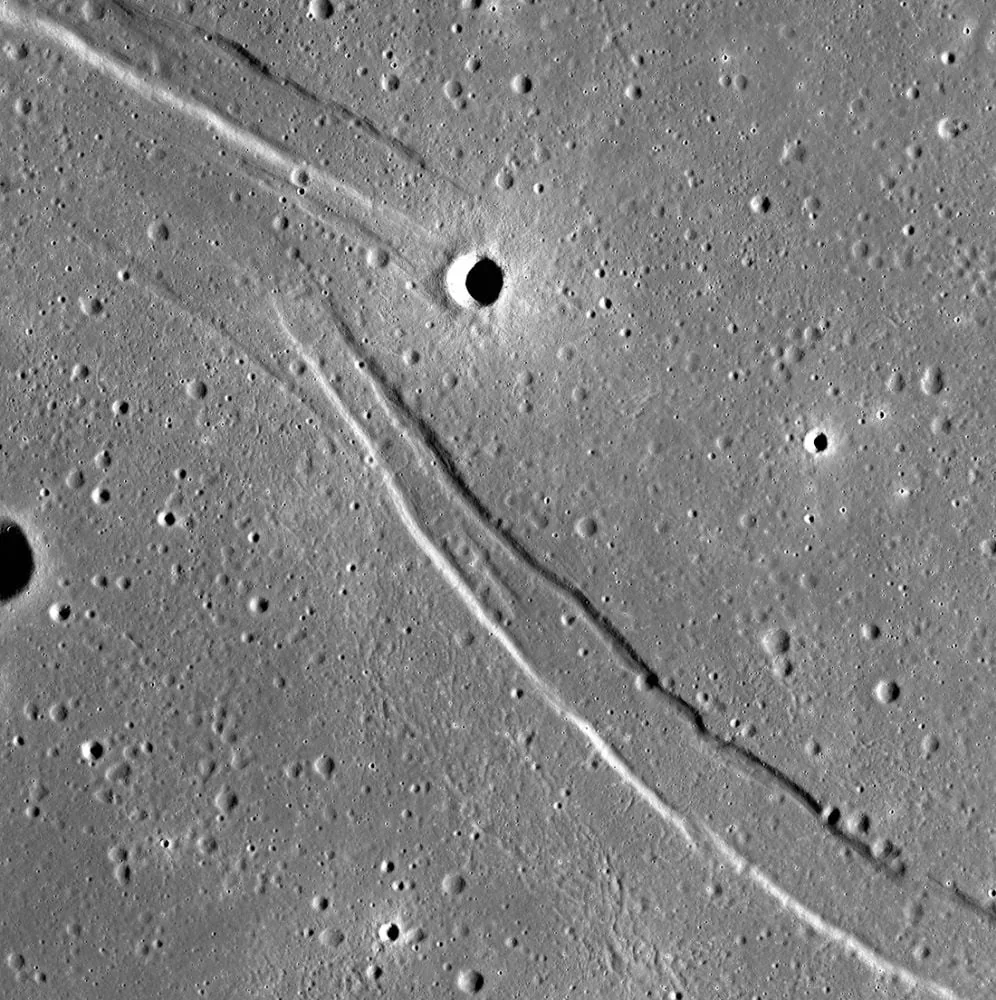
Seismic Hazards for Surface Landings
Understanding ongoing contraction has practical implications for human spaceflight because active faulting causes moonquakes. Seismometers left on the lunar surface during the Apollo 12 mission documented dozens of shallow moonquakes (SMQs) that produced shaking for minutes at a time [2]. Unlike earthquakes on Earth, which usually subside in seconds as water and porous rock dampen seismic waves, the dry and rigid lunar crust rings like a bell during a quake. Compressional stress drops calculated from fault scarps match the energy released by these shallow events, suggesting that active fault slips trigger the quakes [1].
Orbital cameras have also spotted fresh boulder tracks and recent landslides near lobate scarps. Comparisons of temporal image pairs captured years apart by LROC show that slope failures occurred in geologically recent times, most likely triggered by strong ground shaking along nearby thrust faults. Surface tremors could also complicate planning for permanent outposts, compounding challenges explored in studies on lunar water supply limits over coming decades. Because future Artemis missions plan to land astronauts near the south pole, where lobate scarps are common, researchers argue that establishing a modern Lunar Geophysical Network will be essential to monitor ground shaking before building permanent base camps [2].
- ACADEMIC JOURNAL Watters, T. R., Banks, M. E., Nypaver, C. A., & Robinson, M. S. (2026). Thrust Faulting and the Late-stage Contraction of the Moon. The Planetary Science Journal, 7(10), 239. [Article Link]
- ONLINE NEWS Gough, E. (2026, October 20). The Moon is Still Shrinking as it Cools. That Could Create a Hazard for Lunar Mission. Universe Today. [Article Link]
- ONLINE NEWS Gohd, C. (2026, October 19). The moon is shrinking. 10,000 cracks on the lunar surface reveal by how much. Space.com. [Article Link]
APA 7: PerEXP Teamworks. (2026, October 21). Smithsonian Study Measures Lunar Contraction Rate from Faults. PerEXP Teamworks. https://perexpteamworks.com/en/lunar-contraction-rate-faults/


