



Burger King Japan said on Thursday that an outsider accessed a server managing its mobile app, exposing 11.18 million customer records. The Burger King breach took place between October 2 and October 7, though security staff didn’t spot the intruder until October 13 [3]. Leaked files held names, emails, and birth dates, but company managers said the compromised system never stored credit card numbers [1].
Timeline of the Intrusion
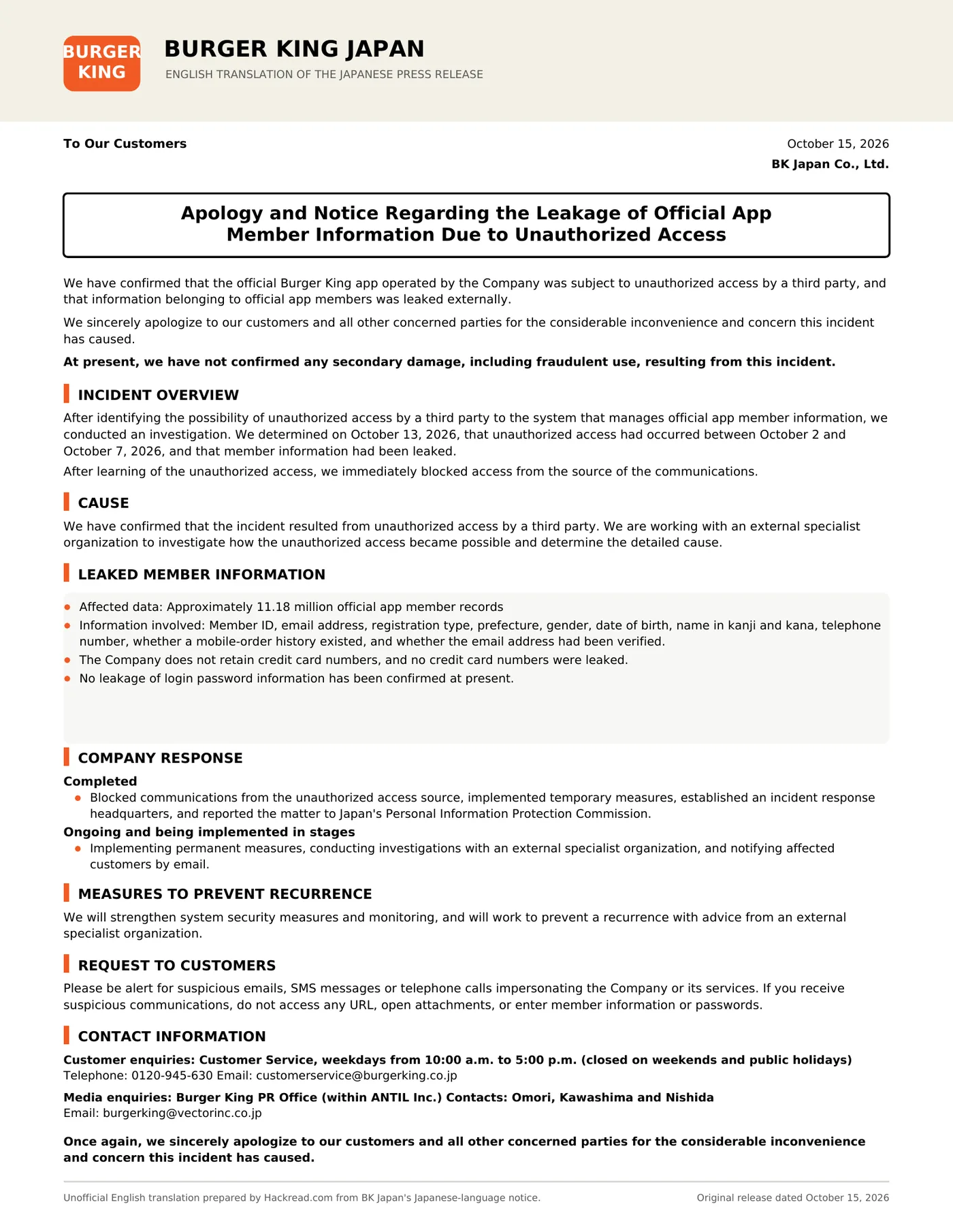
The chain’s local operating firm, BK Japan Holdings Co., Ltd., disclosed the hack after wrapping up an internal review on October 13 [1]. Network logs showed an intruder stayed inside the member system for six days, sneaking in on Friday, October 2, and leaving on Wednesday, October 7 [3].
System engineers cut off connections from the source network as soon as they spotted the intrusion, and company heads formed a crisis team while reporting the case to Japan’s Personal Information Protection Commission [2]. Outside security specialists were brought in to find the entry path [3]. Investigators haven’t found any exploited software flaw or confirmed whether stolen logins helped the attacker slip inside [5].
Burger King began in 1953 in Florida and grew into a global fast-food brand running nearly 20,000 restaurants worldwide, including 350 locations in Japan [1]. Global investment group Goldman Sachs Alternatives owns BK Japan Holdings, which oversees store expansion, digital menus, and app services across the country [2]. Many fast-food lovers often ask how many Burger King branches operate in Japan, and that network of 350 stores drove millions of downloads for the chain’s mobile app. The Burger King breach came to light only after internal staff noticed odd network traffic on the member server, prompting urgent checks of all app files. BK Japan apologized to patrons for the trouble caused by the incident [1].
Data Stolen from the App
The stolen files held private data from 11.18 million records belonging to mobile app members [1]. Each file held a member ID, registration type, email address, phone number, gender, date of birth, and the diner’s full name written in both kanji and kana scripts. Leaked rows also showed each user’s home prefecture [3]. Company notices made clear that the headline count tracks account files rather than single diners, meaning users who signed up more than once made extra entries in the leaked records [5].
Intruders also took system markers showing whether users had verified their email addresses and whether they had ever ordered food on their phones. That ordering flag merely tracks whether an account has an order history. It doesn’t show what diners ate, how much cash they spent, or which menu items they picked [2]. Meal choices stayed private and hidden from the attacker [4].
Payment card data stayed safe [2]. BK Japan said credit card numbers weren’t stored on the app server and were never reached by the intruders [3]. Investigators haven’t found any password leaks or secondary fraudulent use of customer accounts [1].


Why the Burger King Breach Threatens Diners
BK Japan began sending warning emails to app members following the disclosure [3]. The company urged diners to distrust incoming phone calls, texts, or emails claiming to come from Burger King. Managers told customers not to click web links, open cold attachments, or enter passwords on strange forms [1]. Official staff won’t ask users for account logins or one-time verification codes during support calls [3].
Security experts warned that stolen contact data gives online scammers what they need to build clever follow-up schemes. Ensar Seker, chief information security officer at cybersecurity firm SOCRadar, told Hackread that the real danger starts after data leaves company servers. “The risk extends beyond the initial breach. Names, dates of birth, email addresses and phone numbers can help criminals make fraudulent messages feel credible,” Seker said. He warned that a scammer could pose as Burger King support, cite the recent incident, and steer a diner toward a fake page designed to steal logins or bank data [4].
Seker said that knowing whether a diner used mobile ordering helps scammers tailor their fake messages. A similar threat emerged when fintech company Revolut experienced a user data leak, prompting scammers to craft deceptive security alerts. He urged companies to guard profile directories just as strictly as login passwords and payment records. Prior efforts to counter such schemes saw Microsoft and Japan complete a phishing network takedown targeting credential harvesting gangs [4].
Linking the Burger King Breach to Other Attacks
The incident lands during a tough period for customer databases in Japan. Earlier in October, restaurant group Monogatari Corporation revealed that hackers stole 10,788,963 member records from its Yakiniku King app, leaking data from nearly all of its 10,808,784 signed-up diners. Similar data leaks hit railway operator JR East, retail chain Bookoff Group Holdings, Skyticket parent firm Adventure, and karaoke supplier Daiichi Kosho, with potential exposures running from 6.09 million up to 14.64 million files apiece [2].
The cyber wave also swept through car-sharing service Times Car, motorcycle maker Yamaha Motor Co., broker Daiwa Securities, publisher Nikkei, telecom giant KDDI, cloud firm IDC Frontier, taxi firm Nihon Kotsu, tech provider Sakura Internet, and rail lines run by Keio and Tokyo Metro [5]. Travel agency H.I.S. Co. said customer passport data leaked late last year (a breach discovered in February). The recent incident follows another massive exposure in the country, where the Gyazo data breach exposed 23.6 million records earlier in the year [6].
While the Burger King breach rattled app users, payment data stayed out of reach. The fast-food chain isn’t new to cyber trouble, as hackers claimed to leak files from a French Burger King franchise earlier this year. Customer profile directories have become top prizes for online extortion gangs [2].
Staffing Gaps in Japanese Security
The rise in corporate data leaks points to changing tactics among online criminals [5]. Yutaka Sejiyama, a researcher at IT security firm Macnica’s Security Research Center, has logged 119 cybersecurity incidents involving data theft in Japan this year [1]. Web and application weaknesses accounted for roughly six suspected incidents each month early in 2026, but that figure climbed to 23 monthly cases after July. Sejiyama said attackers now use artificial intelligence to spot weaknesses unique to each company setup, carrying out attacks at speeds that beat human defenders [5].
Defensive tools often stumble once an outsider gains valid network logins. The Blue Report 2026, which tested digital defenses across 338 million simulated attacks in production setups, found that automated shields stopped only 37% of attacker actions once intruders held valid keys. When threat actors probe application interfaces and access controls, basic defenses fail if monitoring tools don’t spot unusual traffic [1]. Sejiyama warned that automated AI kits also lower skill hurdles for novice hackers [5].
Deep staffing shortages make these security gaps hard to fix. A survey by the Japan Users Association of Information Systems covering more than 950 firms found that 19.7% suffered data leaks caused by human error or insider missteps. The study showed that 78.4% of businesses making 100 billion to 1 trillion yen in yearly sales lacked enough digital security staff, compared with 74.5% among enterprises taking in more than 1 trillion yen. Digital Transformation Minister Furukawa Toshiharu called on corporate chiefs to patch system bugs, while urging citizens to turn on multifactor authentication and stop reusing passwords [5].
- ONLINE NEWS Gatlan, S. (2026, October 16). Burger King Japan data breach exposes 11 million customer records. BleepingComputer. [Article Link]
- ONLINE NEWS Ramirez, S., & Lee, R. A. (2026, October 16). Burger King Japan says breach may affect 11.18M accounts. SQ Magazine. [Article Link]
- ONLINE NEWS Ćemanović, A. (2026, October 16). Burger King Japan data breach exposes 11.18 million app member records. CyberInsider. [Article Link]
- ONLINE NEWS Ahmed, D. (2026, October 16). Burger King Japan data breach affects 11.18 million app members. Hackread. [Article Link]
- ONLINE NEWS Guha Majumder, B. (2026, October 16). Burger King Japan hack exposes 11.18 million records as AI-fueled cyberattacks surge. International Business Times. [Article Link]
- ONLINE NEWS Kyodo News. (2026, October 15). Burger King’s Japan operator says 11.18 mil. customer records exposed. Japan Wire. [Article Link]


