






Can increased polar snowfall compensate for the warming Southern Ocean melting continental ice? Recent glaciological research published in Nature Geoscience reveals that Antarctica ice loss remains irreversibly locked in for the remainder of the twenty-first century. Vulnerable coastal communities worldwide face accelerating sea-level hazards regardless of aggressive carbon mitigation. The study indicates that floating ice shelves continue thinning even if global temperature anomalies stay within the 1.5 degrees Celsius threshold set by the 2015 Paris climate agreement [1].
Is Antarctica Ice Melting?
Yes, the Antarctic ice sheet is losing mass continuously as warm seawater erodes floating shelf margins from beneath [5].
Coastal glaciers accelerate without shelf protection. Approximately one billion people live across global coastal zones, with roughly 100 million individuals residing within one meter (3.3 feet) of mean sea level. The ice sheet holds enough frozen water to raise global sea level by about 190 feet (58 meters). When peripheral ice shelves thin, resistive buttressing forces vanish and inland ice streams slide seaward at accelerated velocities as Antarctica ice loss expands [4].
Scientists long debated whether Antarctic mass balance would remain positive or negative across the coming decades because warmer atmospheric conditions transport substantially more moisture across the high polar plateau. While higher air temperatures trigger increased precipitation across polar latitudes, parallel investigations tracking intense snowfall events under climate change demonstrate that regional atmospheric moisture capacity cannot offset marine melting dynamics along exposed continental edges where deep currents operate. Circumpolar ocean currents deliver vast reservoirs of thermal energy directly beneath deep marine glaciers, eroding grounding lines far faster than snow can replenish ice reservoirs. Satellite altimetry and surface elevation data verify that ongoing Antarctica ice loss accelerates as coastal discharge completely eclipses inland snowfall accumulation across every major marine-based drainage basin [1].

Why Antarctica Ice Loss Outpaces Snowfall
Fundamental atmospheric physics dictates that warmer air holds substantially more moisture, generating heavier winter snowfall across Antarctica’s elevated inland continental plateaus. Some earlier climate projections suggested this extra precipitation would outpace ocean melting, leading to a net gain in continental ice mass. However, extensive modeling by Yucheng Lin and Robert Kopp demonstrates that marine thermal forcing dominates the overall mass balance equation as Antarctica ice loss mounts [1]. Deep ocean currents circulate into sub-ice cavities, melting ice shelves from below at rates that inland snowfall simply cannot equal [4].
Glaciologists identify this structural breakdown through a sequence known as cascading uncertainty (a modeling challenge where slight variances in initial oceanic warming assumptions compound into divergent ice sheet forecasts). Greenhouse gas emissions from power plants, vehicles, and industry determine how rapidly circumpolar waters warm. When warming waters dissolve basal shelf ice, inland glaciers encounter less physical friction against underlying bedrock formations. Glaciers accelerate toward the ocean. Detailed records from rapidly retreating Antarctic glacier observations confirm that structural thinning at the grounding line fundamentally destabilizes entire tributary networks [5].
Research teams historically struggled to achieve consensus because differing mathematical assumptions regarding shelf fracture mechanics produced contradictory long-term projections. Each computational model operated under separate parameters for basal sliding friction, oceanic cavity circulation, and atmospheric moisture delivery. Antarctica ice loss consistently emerged as the dominant outcome whenever simulations incorporated realistic sub-shelf melt rates [1]. Sub-surface marine heat consistently overpowers atmospheric snowfall additions across every tested climate scenario [3].
Modeling the Antarctic Ice Sheet
Supercomputers ran simulations for days. Evaluating every possible permutation of polar ice behavior and atmospheric emissions required unprecedented computational infrastructure that single research institutions could rarely maintain. To bypass this bottleneck, the international research team utilized simulation archives from the Ice Sheet Model Intercomparison Project, or ISMIP6, published in The Cryosphere to analyze decades of numerical projections [2]. These archives provided an extensive empirical foundation covering varied basal sliding conditions and atmospheric warming trajectories [4].
Data scientists trained a physics-informed machine learning system on the ISMIP6 archive to replicate complex ice sheet physics without traditional computational delays. The machine learning architecture evaluated mathematical relationships in fractions of a second, matching the accuracy of supercomputing clusters that previously required multiple days per individual simulation run. This processing speed enabled the investigators to test millions of parametric combinations, systematically assessing more than twenty distinct physical assumptions regarding ice dynamics and ocean interactions [1].
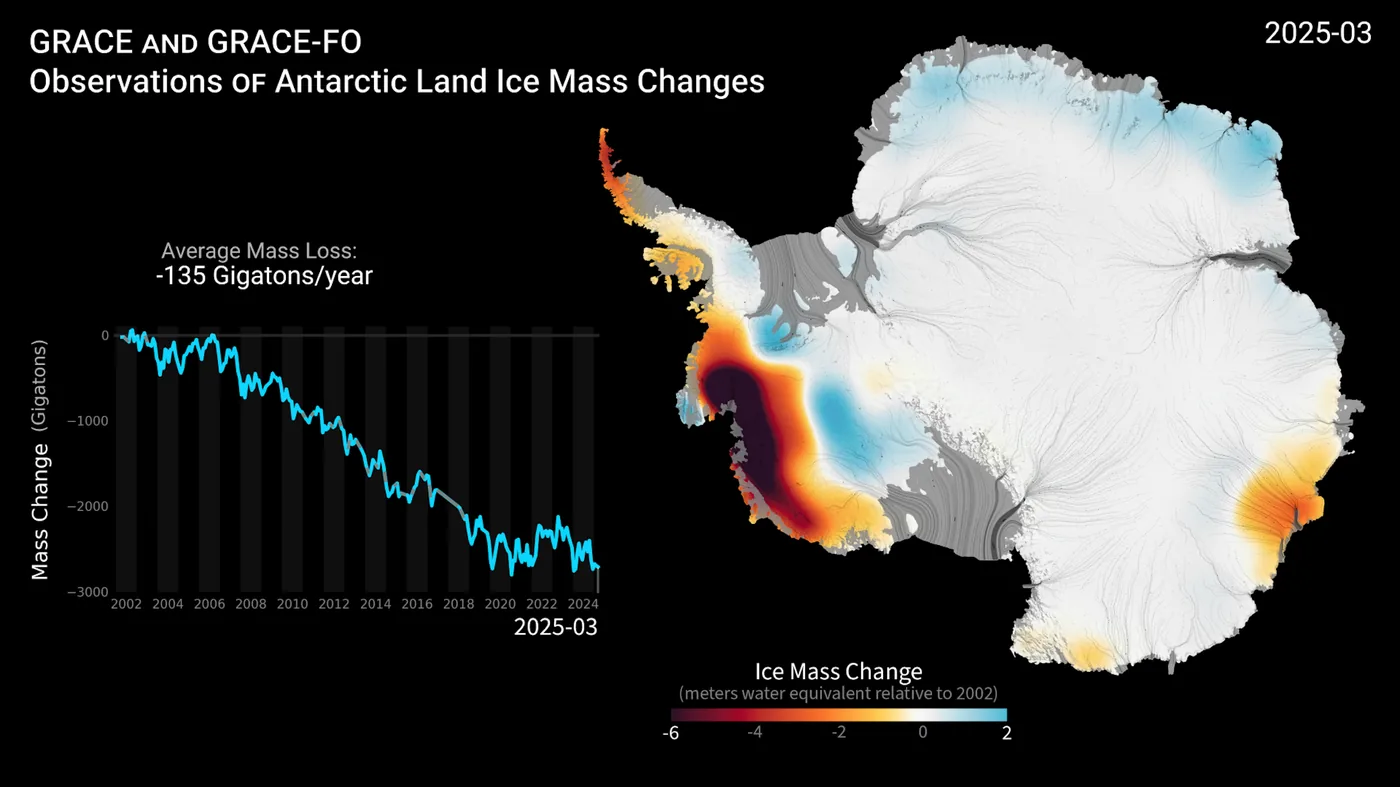
Of more than twenty physical parameters evaluated across the simulation suite, three variables proved decisive in projecting future sea-level contributions. Investigators identified ice shelf sensitivity to warming seawater, basal friction over bedrock, and localized ocean-atmosphere warming rates as the principal factors controlling volumetric discharge. Resolving how rapidly glaciers slide over subterranean topography remains critical for refining regional projections. The machine learning approach eliminated implausible parameter sets by rigorously comparing simulated trajectories against modern observational baselines [1].


Gravity Satellites Expose Locked Melt Trajectories
Satellites weighed ice from polar orbit. Since 2002, NASA’s Grace satellite mission has monitored Earth’s gravitational variations to detect minute changes in polar ice mass distribution over time [5]. Gravitational data revealed that Antarctica steadily shed mass despite seasonal snowfall fluctuations across the high interior plateau. The scientific team used this uninterrupted satellite record as a definitive filter to judge the plausibility of their machine learning simulations [1].
Only matching gravity scenarios survived. Out of hundreds of thousands of simulated futures, the researchers retained exclusively those models that accurately reproduced the gravitational mass changes measured by NASA instruments since 2002 [4]. This strict calibration eliminated overly optimistic simulations that predicted substantial ice accumulation from atmospheric moisture. Every surviving scenario demonstrated that the Antarctic ice sheet loses more volume to ocean melting than it receives from regional snowfall through the year 2100 [1].

The verified model ensemble confirmed that committed Antarctica ice loss persists even under immediate, aggressive decarbonization pathways. Even when simulations strictly restricted global warming to 1.5 degrees Celsius (2.7 degrees Fahrenheit) above pre-industrial levels, deep marine thermal inertia ensured continuing ice shelf attrition. As lead author Yucheng Lin emphasized, “Antarctica will lose more ice than it gains” across this century under every realistic scenario [1]. Melting ice shelves trigger irreversible glacier drawdown, meaning international climate goals cannot completely prevent sea-level contributions from the frozen continent [5].
What if Antarctica Ice Melts?
Global sea levels will rise dramatically if Antarctica ice loss discharges substantial glacier volume into the world ocean [1]. Under a very high greenhouse gas emissions trajectory, runaway shelf collapse could contribute up to 10 inches (25 centimeters) of global sea-level rise from Antarctica alone by the year 2100. That threshold flooded ten million homes. Low-lying coastal cities from Southeast Asia to the Atlantic seaboard would experience permanent inundation along densely populated shorelines [4].
Antarctic melting compounds existing sea-level contributions from the melting Greenland ice sheet, contracting mountain glaciers, and the thermal expansion of warming ocean water. When ocean temperatures increase, water naturally expands, multiplying the physical volume displaced by melting polar ice. Marine ecosystems experience parallel disruptions, directly affecting sensitive polar organisms and migratory species such as Adélie penguins relying on seasonal ice stability along fragile continental shelf margins. Unchecked thermal forcing threatens to destabilize interconnected oceanic circulation systems across the Southern Hemisphere [5].

A rapid domino effect characterizes extreme emission scenarios where warming seawater undermines structural ice shelf margins. Thinning ice shelves fracture under increased gravitational stress, triggering rapid structural collapse that allows interior glacial streams to dump massive ice volumes into open ocean water. Each structural failure accelerates the velocity of subsequent glacier flow toward the sea. Preventing this runaway collapse represents the single most effective intervention available to coastal urban planners seeking manageable adaptation timelines [1].
Limiting Future Emissions Protects Global Coasts
Near-term emission cuts matter most. Every avoided ton of atmospheric greenhouse gas directly curtails the magnitude and velocity of Antarctic ice discharge. While baseline Antarctica ice loss for the twenty-first century is already committed, long-term global sea-level trajectories across subsequent centuries depend entirely on near-term greenhouse gas emission reductions [1]. Aggressive mitigation preserves critical shelf buttressing, ensuring that glacier discharge rates remain predictable rather than exponential. Coastal communities gain vital decades to design, fund, and construct defensive flood barriers [4].
Current ice sheet models still contain unresolved physical processes that future computational frameworks must address. For instance, the existing simulations do not fully capture how deep crevasses propagate through flexing ice shelves, nor do they account for evolving subglacial hydrological networks that route pressurized water beneath continental bedrock formations toward the grounding lines. Notably, the preliminary research synthesis by Yucheng Lin and Robert Kopp was shared in an unreviewed preprint prior to formal publication, though its core mathematical findings have now achieved peer-reviewed status in Nature Geoscience with full multi-model verification [1, 3]. Advancing subglacial observation networks and remote sensor arrays will prove essential as vulnerable coastal populations confront unavoidable sea-level adjustments over the coming century [4].
Mitigation decisions made during this decade will determine coastal geography for centuries to come. Co-author Robert Kopp stressed that the enduring benefits of carbon reduction will provide positive global dividends that “lasts for hundreds of years” well beyond modern planning horizons [4]. Although extra polar snowfall cannot reverse existing ocean warming trends, curbing fossil fuel emissions prevents catastrophic ice shelf disintegration across vulnerable sectors of the continent. Municipal planners and coastal engineers must now incorporate locked-in Antarctic ice loss into long-term infrastructure designs while nations accelerate decarbonization efforts [1].
- ACADEMIC JOURNAL Lin, Y., Zhang, X., Golledge, N. R., Kopp, R. E., Church, J. A., Jin, Y., Zhao, C., & Stokes, C. R. (2026). Committed Antarctic Ice Sheet mass loss by the end of the twenty-first century. Nature Geoscience. [Article Link]
- ACADEMIC JOURNAL Seroussi, H., Nowicki, S., Payne, A. J., Goelzer, H., Lipscomb, W. H., Abe-Ouchi, A., Calov, R., Cullather, R., Dumas, C., Galton-Fenzi, B. K., Gladstone, R., Golledge, N. R., Gregory, J. M., Greve, R., Hattermann, T., & Larour, E. (2020). ISMIP6 Antarctica: a multi-model ensemble of the Antarctic ice sheet evolution over the 21st century. The Cryosphere, 14(9), 3033-3070. [Article Link]
- PREPRINT Lin, Y., & Kopp, R. (2026). Antarctica’s ice loss is locked in, and extra snowfall won’t save it – that’s bad news for low-lying coastal areas elsewhere. [Article Link]
- ONLINE NEWS Lin, Y., & Kopp, R. (2026, September 30). Antarctica’s ice loss is locked in, and extra snowfall won’t save it – that’s bad news for low-lying coastal areas elsewhere. The Conversation. [Article Link]
- ONLINE NEWS Lin, Y., & Kopp, R. (2026, September 30). Antarctica’s ice loss is locked in, and extra snowfall won’t save it—low-lying coastal areas elsewhere to suffer. Phys.org. [Article Link]
APA 7: PerEXP Teamworks. (2026, October 1). Extra Snowfall Cannot Prevent Locked Antarctica Ice Loss. PerEXP Teamworks.


