



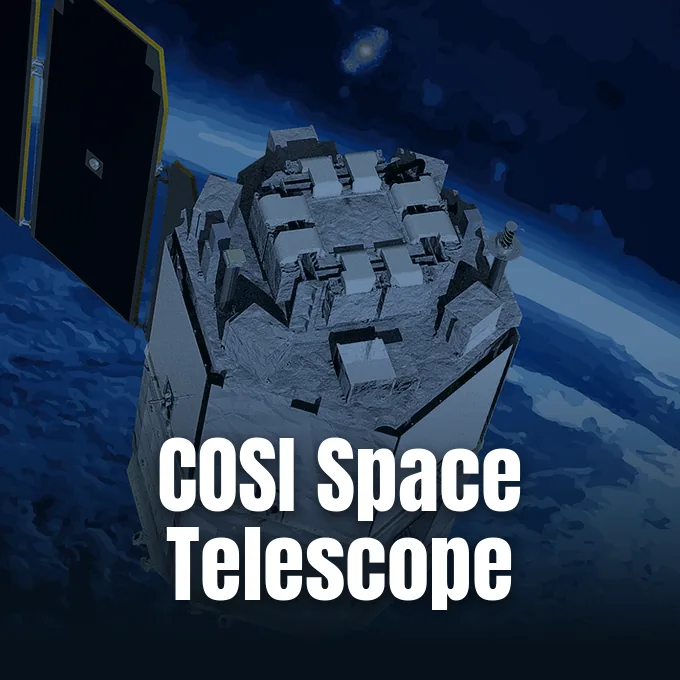
Can an advanced orbital observatory untangle the five-decade mystery of matter and antimatter in the Milky Way? The COSI space telescope (Compton Spectrometer and Imager) is engineered to achieve that goal by tracking high-energy gamma rays across our galaxy. Bridging atomic physics with stellar evolution, the instrument explores energetic cosmic furnaces. Teams from NASA and the University of California, Berkeley reached a major milestone on July 8, 2026, when mechanical engineers completed lifting the core detector assembly for integration [1].
Why the COSI Space Telescope Matters
Gamma-ray photons carry energetic signatures up to millions of times greater than visible light. Can an orbital surveyor uncover where new elements are born across our galaxy? Selected as an Astrophysics Small Explorer satellite mission, the COSI space telescope targets soft gamma rays spanning between 0.2 and 5 million electron volts (MeV). NASA Science writers Jeanette Kazmierczak and Barb Mattson explained that these energetic thresholds allow astronomers to observe atomic nuclei as they interact, fuse, and disintegrate across extreme interstellar environments. Instruments detect nuclear reactions. Goddard Space Flight Center astrophysicists and Northrop Grumman Systems Corporation engineers designed the instrument to isolate radioactive decay lines and particle collisions. Tracking these energetic nuclear signatures remains fundamentally essential for mapping the life cycles of massive stars across the Milky Way [2].
Strategic mission roadmaps demonstrate how specialized space observatories complement broad sky surveys. Targeted instruments capture localized nuclear physics. Readers can examine NASA Cosmic Origins space observatory planning to trace how future orbital platforms prioritize distinct scientific objectives under the Cosmic Origins framework. Mirage News highlighted how the COSI space telescope addresses critical observational gaps left by past surveys by providing unprecedented spectral resolution across dynamic high-energy environments. Spacecraft instruments operate continuously. Space Sciences Laboratory researchers confirm that by surveying the sky continuously, the spacecraft will alert the wider astronomical community to transient events across the Milky Way [3].

Assembly Progress at Space Sciences Laboratory
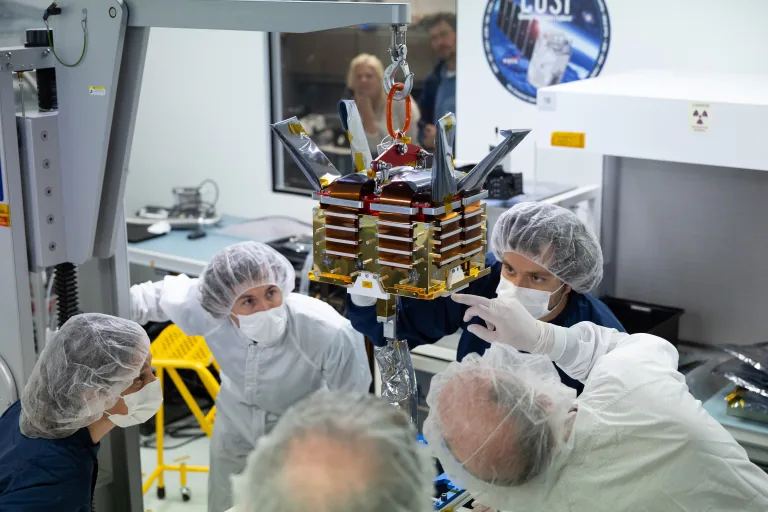
Assembly operations inside the University of California, Berkeley’s Space Sciences Laboratory entered a pivotal phase when mechanical engineers and project managers gathered around the test bench to lift the core detector assembly. Recorded in a cleanroom image captured on July 8, 2026, by Alan Toth, the delicate operation required lifting the detector box vertically from an assembly table using precision rigging. Berkeley Space Sciences Laboratory cleanroom protocols safeguarded the equipment. Four gleaming pieces of silver material positioned across the top surface of the enclosure protect fragile flex circuits (specialized flexible printed circuits carrying sensor signals). These circuits channel subtle detection signals directly from internal germanium detectors into external readout electronics. Cleanroom conditions protected custom circuitry from microscopic contaminants as Independent Space News reported [1].
Building such a compact yet robust gamma-ray spectrometer demands extensive inter-agency cooperation. The project unites teams from the University of California, San Diego, the Naval Research Laboratory, and NASA’s Goddard Space Flight Center. Key aerospace partners include Northrop Grumman Systems Corporation, which provides spacecraft systems engineering, and Space Dynamics Laboratory. International participation comes through the Italian Space Agency and multiple research institutes. Independent aerospace journalist Mevlut Zor noted in AeroHaber that each contributor delivers specialized sub-assemblies calibrated for environmental testing before spaceflight integration [4].
Laboratory integration marks an essential milestone. Berkeley Space Sciences Laboratory engineers must verify every electrical connection before closing the shielding container for environmental shake trials [5].
Chasing Galactic Positrons and Annihilation Signals
Where do the antimatter particles pervading our galactic core originate? Since the 1970s, gamma-ray detectors have registered an unexplained diffuse glow at exactly 0.5 MeV streaming from near the center of the Milky Way. NASA Science contributors Jeanette Kazmierczak and Barb Mattson noted that this discrete spectral emission occurs when electrons collide with their antimatter twins, positrons, annihilating in mutual destruction and converting their combined mass into twin gamma-ray photons. The signal remains an enduring mystery. While Space Sciences Laboratory astrophysicists understand the fundamental physics behind positron annihilation, the dominant astrophysical source injecting positrons into the inner galactic bulge has remained unresolved for decades [2].
Multiple theoretical mechanisms compete to explain this pervasive antimatter fog. Hypotheses range from radioactive debris expelled by massive stellar explosions to microquasars, pulsars, and speculative dark matter scenarios. Similar wide-scale mapping efforts, such as eROSITA dark matter mapping observations, emphasize how high-resolution spatial surveys differentiate diffuse backgrounds from discrete point sources. Goddard Space Flight Center teams confirm that the COSI space telescope will map this 0.5 MeV glow across wide swathes of the sky with sufficient angular precision to determine whether positrons cluster around star-forming sectors or follow older stellar populations. These spatial distributions provide researchers with the statistical constraints needed to isolate true positron engines across the Milky Way [6].


Tracing Heavy Element Formation in Supernovae
Stellar nucleosynthesis transforms simple hydrogen and helium into the complex elements that build rocky planets and living organisms. When massive stars reach the end of their lives, supernova explosions forge fresh atomic nuclei and fling them violently into the interstellar medium. Supernova explosions forge heavy elements. Because many newly synthesized isotopes are radioactive, they emit characteristic gamma-ray lines at precise energy thresholds (discrete spectral fingerprints of atomic decay) as their atomic nuclei decay toward stability. Observing these sharp spectral lines provides direct empirical evidence of ongoing nucleosynthesis processes across our galaxy. Space Sciences Laboratory physicists emphasize that comparing light emitted by different isotopes allows astrophysicists to reconstruct thermodynamic conditions governing stellar explosions throughout the Milky Way [2].
Earlier missions laid the groundwork for nuclear gamma-ray spectroscopy, notably the COMPTEL collaboration involving European and American research institutions. The COMPTEL collaboration constructed an all-sky map at 1.8 MeV, tracing radioactive decay across galactic spiral arms. Goddard Space Flight Center collaborators and Northrop Grumman Systems Corporation specialists designed the COSI space telescope to operate across the 0.2 to 5 MeV energy range with superior energy resolution, allowing scientists to compare emissions from differing isotopes to refine models of stellar core collapse. Massive stars evolve dynamically. Mirage News reported that these measurements reveal how stellar winds disperse enriched material long before terminal detonation occurs, clarifying how successive generations of stars inherited heavier elements across cosmic history [7].
Gamma-Ray Polarization and Cosmic Black Holes
Beyond recording photon arrival times and energies, modern astrophysics relies on polarization to probe the hidden architecture of extreme environments. Polarization measurements describe the preferred spatial orientation of oscillating electric fields within arriving light rays. Goddard Space Flight Center researchers explain that measuring gamma-ray polarization allows astronomers to deduce the geometry of accretion disks and magnetic field alignments surrounding supermassive black holes at the centers of distant galaxies. The COSI space telescope is engineered to perform dedicated gamma-ray polarization measurements of active galactic nuclei. Extreme gravitational fields warp surrounding spacetime, leaving unmistakable polarization signatures across escaping radiation that reveal the inner structures of relativistic outflows escaping energetic galactic cores across the Milky Way [2].
These diagnostic capabilities extend to stellar-mass black holes, rapidly spinning neutron stars, and transient gamma-ray bursts across deep space. Naval Research Laboratory scientists and Space Dynamics Laboratory engineers designed the instrument to measure precisely how high-energy photons scatter via Compton interactions inside its specialized germanium detector array, calculating polarization fractions and angles with extraordinary statistical fidelity. Energetic astrophysical jets remain debated. Detailed polarization observations reveal whether energetic outflows are launched by collimated magnetic fields or hydrodynamic expansion mechanisms. Berkeley Space Sciences Laboratory teams confirmed that the detector readout assembly maintains the microsecond timing accuracy required for these delicate scattering calculations across the Milky Way [8].
Multimessenger Science and High-Altitude Balloon Heritage
Multimessenger astronomy combines electromagnetic observations with gravitational waves and subatomic neutrinos to reconstruct cataclysmic cosmic collisions. When compact objects such as binary neutron stars collide, they generate gravitational ripples through spacetime along with short gamma-ray bursts. Goddard Space Flight Center transient networks rely on orbital alerts. The wide instantaneous field of view of the COSI space telescope allows it to rapidly detect and localize these brief bursts across the sky. Cosmic collisions require fast alerts. Independent Space News noted that rapid orbital localization enables ground-based observatories and space telescopes to conduct follow-up studies before fading afterglows vanish across the Milky Way [2].
Theoretical frameworks exploring compact-object mergers highlight the necessity of coordinated time-domain surveillance. A recent 3.5-meter segmented-mirror robotic space telescope white paper preprint focused on compact-object Time-Domain Science emphasizes that rapid multi-wavelength tracking provides crucial constraints on heavy-element yields and relativistic outflow dynamics. It should be noted that this white paper is an unreviewed preprint that has not undergone peer review by an academic journal. Nevertheless, these theoretical models demonstrate why rapid transient detection in the soft gamma-ray band remains vital for multimessenger physics across the Milky Way [9].
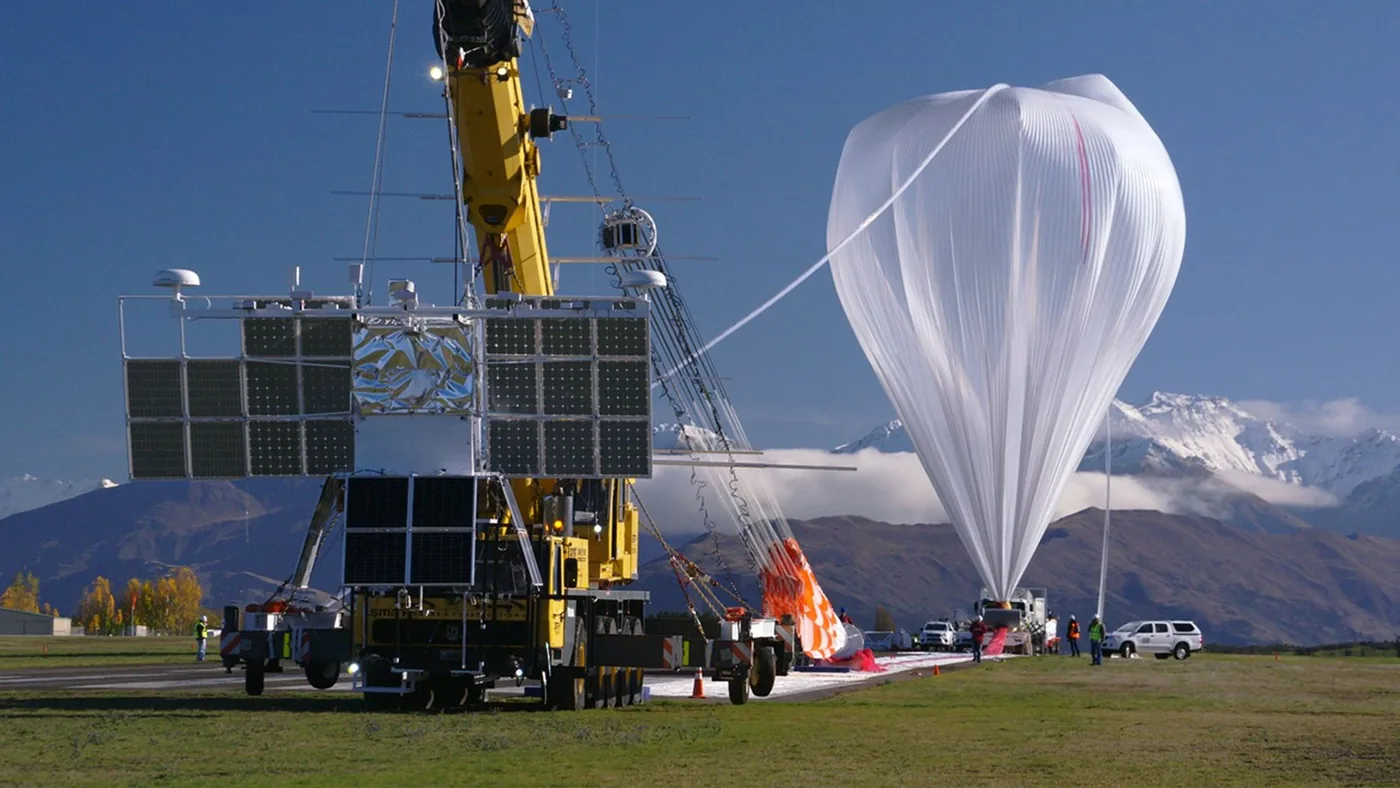
The satellite architecture represents the culmination of two decades of suborbital technology development. Before building spaceflight hardware, scientific teams tested prototype versions of the Compton Spectrometer and Imager aboard stratospheric balloons. Early suborbital flights proved the concept. The decisive test flight launched from Wanaka Airport in New Zealand on Tuesday, May 17, 2016. Flown aboard a NASA super pressure balloon engineered for long flights, that prototype validated core detector concepts. Today, Berkeley Space Sciences Laboratory engineers and Northrop Grumman Systems Corporation are translating that suborbital heritage into spaceflight hardware across our galaxy [2].
- PRESS RELEASE HQ Web Team. (2026, September 18). COSI telescope comes together. NASA. [Article Link]
- WEBSITE Kazmierczak, J., & Mattson, B. (2023, June 16). COSI: Compton Spectrometer and Imager. NASA Science. [Article Link]
- ONLINE NEWS Mirage News. (2026, September 18). COSI telescope comes together. Mirage News. [Article Link]
- ONLINE NEWS Zor, M. (2026, September 18). COSI telescope comes together. AeroHaber. [Article Link]
- ONLINE NEWS Independent Space News. (2026, September 18). COSI telescope comes together. Independent Space News. [Article Link]
- ONLINE NEWS PressBee. (2026, September 18). COSI telescope comes together. PressBee. [Article Link]
- ONLINE NEWS VibeWire Magazine. (2026, September 18). COSI telescope comes together. VibeWire Magazine. [Article Link]
- ONLINE NEWS A Teller of Tales. (2026, September 18). COSI telescope comes together. atelleroftales.com. [Article Link]
- PREPRINT arXiv Collaboration. (2026, September). 3.5-meter segmented-mirror robotic space telescope mission white paper V. Key scientific mission: Compact-object time-domain science. arXiv. [Article Link]
APA 7: TWs Editor. (2026, September 18). How the COSI space telescope unlocks cosmic antimatter. PerEXP Teamworks. https://perexpteamworks.com/en/cosi-space-telescope-antimatter-origins/


