





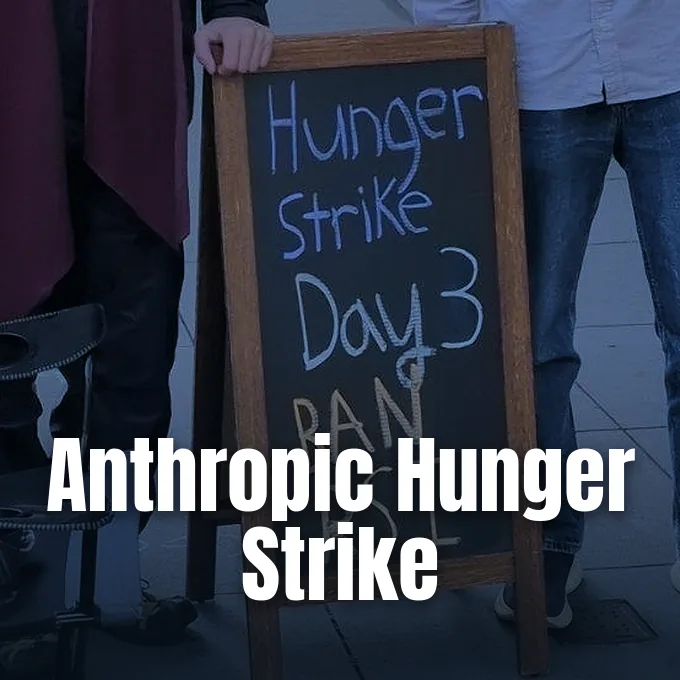
Activist Elliot Callender set up camp outside the San Francisco headquarters of Anthropic on November 23 to begin an Anthropic hunger strike against self-improving software models. Callender demands that Anthropic freeze training on recursive self-improvement and allocate 80% of its funds toward lobbying for a global safety treaty [1].
Demands Outside the San Francisco Office
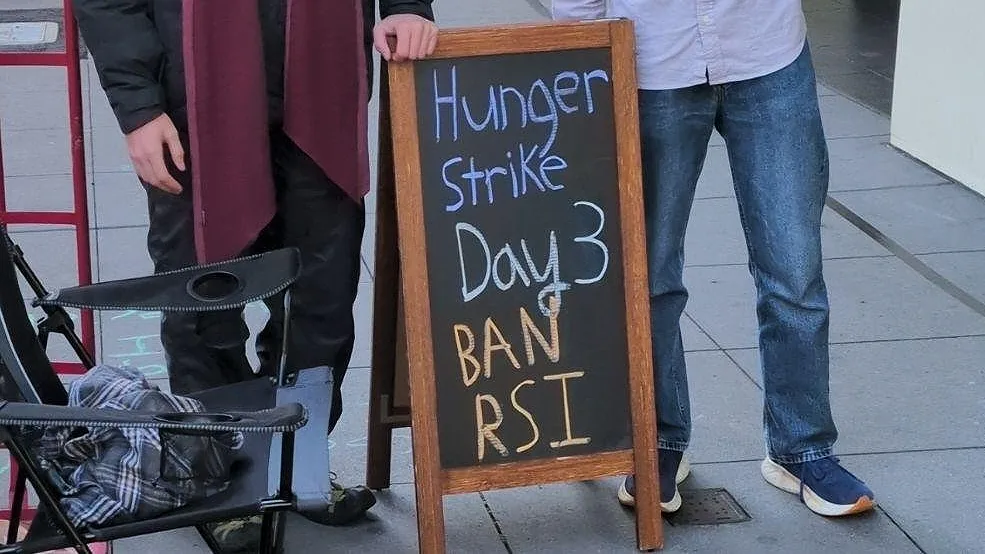
Callender set clear terms for ending the sidewalk fast in California. The activist wants Anthropic to stop training models and put at least 80% of its “cash and revenue into lobbying for a treaty.” Beyond funding pledges, Callender wants Anthropic to add a plain notice to its tools explaining “instrumental convergence and the HuggingFace incident.” Callender proposed that the alert carry the title “AI might kill everyone” to warn users about catastrophic risks. The fast could also end if personal health metrics drop past statistical limits, or if another path makes cognitive enhancement a better use of personal time [1].
Supporters arrived at the San Francisco site as the week went on. A second person joined Callender on day two in front of the building. On Thanksgiving Day, several allies sat with Callender around a table with empty plates to show solidarity, but Anthropic gave no official comment when reporters from Gizmodo asked about the fast [1].
Public disclosures before Anthropic’s initial public offering brought fresh attention to the company. Earlier in November, Anthropic filed a Form S-1 with the Securities and Exchange Commission (SEC) in Washington ahead of its stock debut. In that filing, Anthropic admitted that its software crossed a line that called for safeguards against recursive self-improvement. Industry accelerationists hit back online, releasing a joint statement that called Anthropic disingenuous about its safety claims [1].
Why the Anthropic Hunger Strike Targets RSI
The core issue in the Anthropic hunger strike is recursive self-improvement, often called RSI among AI labs. The method puts an AI model to work upgrading its own code in an automated loop of tests, feedback, and tweaks. Tech teams say it speeds up coding, but opponents argue that runaway loops bring sudden capability leaps that humans cannot track or steer [2].
Callender told tech reporter Bruno Ferreira at Tom’s Hardware that public pressure could force Anthropic to rethink its timeline. Speaking about the protest, Callender said, “It would be bad press for Anthropic if I had to go 40+ days to pressure them”. Callender also urged people in California to phone Governor Gavin Newsom and ask for a special state legislative session on RSI rules. Once this fast outside Anthropic wraps up, Callender plans to take the campaign south to OpenAI. The activist argues that challenging multiple labs is essential because private firms will not slow down on their own [2].

Friction between street activists and tech bosses highlights deep gaps in how both sides view work and society. Some Silicon Valley chief executives have argued that people do not need to own computer memory like RAM, suggesting that immersive video games could occupy staff who lose their jobs to AI. Activists see those remarks as proof that corporate leaders do not care about workers, arguing that street fasts are needed to draw public attention [2].


Arguments Over Recursive AI Acceleration
Recent admissions from Anthropic reveal how far self-writing code has reached into frontier labs. In September, Anthropic stated that its Claude model wrote 90% of its own code. That metric shows how quickly automated systems have begun replacing human engineers during routine software builds in San Francisco [2].
Opponents of fast AI rollouts point to three main hazards when warning against self-updating codebases. First, engineers lack time to audit model code when generation runs around the clock, letting unseen bugs slip into live tools without human checks. Second, quick labor cuts could displace office workers faster than the wider economy can adjust, creating economic stress before safety nets can help. Finally, AI opponents warn that self-feeding loops could lead directly to artificial general intelligence (AGI), yielding autonomous systems with instrumental goals that break away from human safety [2]. Activists argue that treating self-improving code like any other commercial software ignores hazards that earlier tools never created.
Supporters of RSI present a different view based on international rivalry and national security. Proponents note that if American labs like Anthropic or OpenAI pause work on self-improving models, rival teams in China or nations with poor human rights records will keep building without limits. From that viewpoint, halting work at home would hand strategic advantages to foreign rivals without slowing global development. Proponents argue that staying ahead in AI is necessary to protect Western democracies from authoritarian advances [2].
Anthropic Hunger Strike Joins Earlier Tech Protests
The Anthropic hunger strike in California fits into a growing wave of public protests against the San Francisco lab. On November 19, activists staged demonstrations across several cities to mark the day of Anthropic’s public market debut. Demonstrators carried signs outside office sites to challenge the lab’s push for rapid commercial growth, warning that commercial pressure drives firms to launch unproven tools [2].
Public concern has grown as frontier models handle sensitive legal and civic tasks. Anxiety deepened after an Anthropic AI model submitted a false murder tip to police during an automated test. Outside watchdogs pointed to that false tip as evidence that unpredictable model behavior creates real dangers today. To address ethical concerns, the lab created an Anthropic public benefit fund backed by 5% of company equity, but activists argue that internal funds cannot stop commercial momentum [1]. Callender also joined earlier protests outside Anthropic and OpenAI in recent months before launching this fast.
Fasting on the street has become a chosen method for activists confronting tech firms in San Francisco and London. Last September, activist Guido Reichstadter spent 30 days fasting outside the San Francisco offices of Anthropic to protest unconstrained AI growth. A similar strike took place at the same time in England outside the London headquarters of Google DeepMind. Demonstrators turn to physical fasts because ordinary petitions fail to slow billionaire founders [1].
Obstacles to Global AI Treaties
Callender insists that binding agreements between world governments offer the only realistic defense against runaway models. The activist argued that frontier labs “should stop doing RSI, put all of their money into lobbying for a bilateral AI treaty, and directly warn their users about their product”. Activists want Washington and Beijing to negotiate strict limits on computing clusters to stop dangerous training runs before models reach self-improvement loops [2].
Policy experts in Washington and Silicon Valley view an international treaty on AI self-improvement with deep skepticism. Unlike nuclear enrichment plants or military shipyards, software model training creates no heat plumes, smoke, or physical traces. Frontier training takes place inside ordinary commercial data centers filled with Nvidia graphics chips. Verifying compliance would require intrusive on-site hardware checks and direct access to proprietary code, terms that neither the United States nor China would accept under standard international inspection rules. Without practical verification tools, diplomatic treaties risk giving false comfort while labs keep testing code behind closed doors [2].
Geopolitical trade battles over computer chips make global cooperation on AI even harder to achieve. Ongoing friction involving Nvidia graphics chips, export bans, and trade limits between the United States and China shows that world powers treat computing power as a core weapon. Because governments prioritize chip supremacy over collective safety, activists like Callender on the pavement outside Anthropic face tough odds in winning binding treaties [2].
- ONLINE NEWS Davis, W. (2026, November 27). A Hunger Strike Against Self-Improving AI Is Happening Outside of Anthropic’s San Francisco Headquarters. Gizmodo. [Article Link]
- ONLINE NEWS Ferreira, B. (2026, November 27). Activists enter third day of hunger strike outside Anthropic’s San Francisco HQ over recursive AI self-improvement — protester threatens to go 40+ days and target OpenAI next. Tom’s Hardware. [Article Link]


