



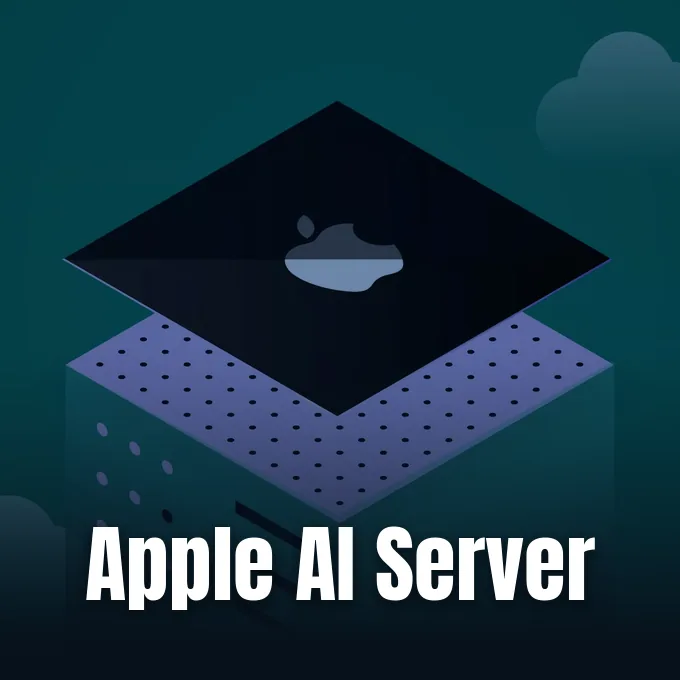
Enterprise data centers could soon host an official Apple AI server as hardware teams prepare a return to commercial server racks. Could high-density unified memory allow Apple to challenge entrenched data center vendors? Reporting indicates the initiative pairs future M8 Ultra processors with high-speed Nvidia networking to handle intensive model inference. The project reportedly targets a commercial debut in 2029. [1, 2, 5]
Designing an Apple AI Server for Data Centers
According to reporting from The Information, hardware teams inside Apple are actively developing an enterprise-grade rack server engineered around future M8 Ultra processors to satisfy burgeoning demand for large-scale artificial intelligence compute workloads across modern corporate facilities. The Information first revealed the roadmap. Apple has not confirmed pricing. Engineers are currently evaluating two hardware configurations, including a baseline chassis housing two M8 Ultra system-on-chips and an expanded enclosure carrying four interconnected processors. Because Apple introduced the M6 chip in August, the proposed server architecture sits several silicon generations beyond hardware currently available on retail shelves. [1, 2, 5]
John Ternus, who directed Apple’s hardware engineering division before succeeding Tim Cook as chief executive officer on September 1, reportedly endorsed the server development effort during its inception approximately twelve months ago when artificial intelligence demand accelerated. John Ternus backed the project. Ars Technica and TechRepublic noted that Apple discontinued the rackmount Xserve in January 2011, leaving enterprise administrators without native macOS rack equipment for over a decade. While the historic Xserve handled generic network operations, Matthias Bastian reports for THE DECODER that the prospective server focuses strictly on artificial intelligence inference (executing already-trained machine learning models for corporate clients and government institutions). [1, 4, 5]
The project could still change. Skye Jacobs reports for TechSpot that Apple might alter specifications or shelve the enterprise initiative entirely before 2029. [2]

Enterprise Demand and Mac Studio Deployments
Surging commercial demand for desktop Apple silicon provided the strategic foundation for an Apple AI server rack system. To power autonomous agent experiments, artificial intelligence laboratory OpenAI acquired tens of thousands of Mac mini and Mac Studio desktop systems specifically for reinforcement-learning workloads where algorithmic agents iteratively optimize decision policies through repetitive trial and error. Anthropic similarly rented clusters of Mac mini systems through Amazon Web Services to support external development teams. These institutional acquisitions demonstrated that M-series processors appeal directly to machine learning engineers beyond traditional consumer multimedia tasks. [1, 2, 5]
Heavy enterprise procurement quickly strained retail inventory channels. Retail supplies depleted rapidly. The Verge reported that persistent enterprise purchases triggered widespread shortages across Mac mini and Mac Studio supply pipelines. Matthias Bastian reports for THE DECODER that Apple’s Mac revenue surged nearly 29 percent during the previous quarter to reach $10.4 billion. [1, 5]
Deploying dense clusters of desktop enclosures inside industrial server rooms introduces persistent operational challenges, because workstation chassis lack the standardized slide rails, optimized airflow channels, redundant power distribution, and hot-swappable cooling modules required by standard enterprise infrastructure. Workstation designs complicate rack maintenance. Furthermore, enterprise administrators require thorough deployment documentation, direct engineering agreements, long-term service commitments, and specialized software enhancements for Apple’s open-source MLX machine learning framework. [1, 2]

Evaluating Nvidia NVLink Fusion for Multi-Chip Scaling
Interconnecting multiple processing units inside a shared enclosure remains Apple’s primary hardware design hurdle. Apple currently relies on proprietary UltraFusion interconnects to bridge dual chips across consumer logic boards. Anton Shilov reports for Tom’s Hardware that internal interconnect technologies become prohibitively expensive and sluggish when scaled outward across commercial server clusters. To resolve these fabric limitations, Apple is evaluating Nvidia NVLink Fusion technology to unite two or four M8 Ultra processors into a unified computational domain. [1, 2, 3]
NVLink Fusion represents an integrated platform combining dedicated switching hardware, protocol stacks, and specialized interconnect chiplets designed to facilitate high-speed processor clustering. Modern high-performance Apple silicon processors like the M Pro and M Ultra lines are manufactured as intricate system-in-packages uniting central processing and graphics chiplets through advanced TSMC SoIC-mH packaging that facilitates exceptionally high-density interconnect routing. Architectural questions remain regarding packaging. Anton Shilov notes that Nvidia originally created NVLink to scale accelerator performance before developing NVLink-C2C (a coherent chip-to-chip interface for connecting central processors and graphics accelerators). Shilov questions whether Apple will deploy an NVLink Fusion chiplet directly alongside its neural processing silicon or reconstruct processor packaging to expose discrete accelerators. [2, 3]

Memory bandwidth highlights both the distinctive promise and the architectural boundaries of an Apple AI server implementation. Apple’s M5 Ultra provides an informative baseline, delivering up to 512GB of unified memory alongside 1.2TB/s of memory bandwidth (a shared architecture where CPU and GPU cores access one memory pool without duplicating model weights across separate buses). Although 512GB exceeds standard accelerator capacities, TechRepublic reports that 1.2TB/s trails significantly behind the 4.8TB/s bandwidth rating Nvidia specifies for its dedicated H200 data-center processor. [1, 2]
Rethinking Decades of Corporate Rivalry
Adopting Nvidia networking for an Apple AI server represents a dramatic historical pivot for two technology titans with a contentious corporate relationship. Hostilities between the two hardware giants originated during the early 2000s when Steve Jobs directly accused Nvidia of infringing graphics patents belonging to Pixar, prompting Nvidia leadership to counter that the graphics chipmaker owned superior intellectual property portfolios. Steve Jobs led the charge. Subsequent disagreements over mobile graphics chip integration further widened the divide between executive leadership teams in Cupertino and Santa Clara. [3]
The partnership fractured completely during the notorious Bumpgate hardware controversy (a packaging defect that caused widespread chip failures across notebook lines). During the notorious hardware controversy of 2007 and 2008, Nvidia shipped defective graphic processing units containing packaging materials that cracked under ordinary thermal stress, yet the supplier initially refused to acknowledge the defect and resisted reimbursing hardware partners for warranty expenses. Partners faced steep repair costs. Apple gradually phased out Nvidia components, continuing to use select Nvidia chips until 2014 or 2015 before transitioning entirely to AMD Radeon graphics and eventually debuting custom Apple silicon. [3]

Pragmatism appears to guide executive strategy today. Apple already relies heavily on Nvidia compute infrastructure to operate its commercial online services. Apple’s Machine Learning Research division has confirmed that AFM 3 Cloud Pro runs on Nvidia graphics processors in Google Cloud, while backend processing for the newest Siri artificial intelligence features operates on Nvidia Blackwell clusters in Google Cloud facilities. Licensing NVLink networking for an in-house server would deepen this pragmatic supply relationship without requiring Apple to surrender silicon control. [1, 2, 3]
Networking Standards and Infrastructure Hurdles
Selecting Nvidia proprietary technology would prove noteworthy because Apple belongs to the UALink Consortium (an open industry standard supporting interconnects for up to 1,024 accelerators). The industry alliance develops open-standard UALink accelerator interconnections designed to link up to 1,024 accelerators in enterprise clusters. Standard UALink switches will arrive before 2029. Why would Apple consider proprietary NVLink Fusion over open standards? Anton Shilov observes for Tom’s Hardware that Apple may desire a comprehensive turnkey datacenter package, combining NVLink scale-up clustering with Nvidia Spectrum-X Ethernet or Quantum-X InfiniBand scale-out switches. [3]
External component supply conditions present another operational obstacle for an Apple AI server rollout. Surging artificial intelligence data-center construction has driven global memory shortages and inflated component pricing across the technology sector, creating severe cost pressures that mirror broader hardware memory constraints observed throughout modern electronics manufacturing. Memory pricing has escalated sharply. Because an M8 Ultra server requires massive memory allocations per node, component procurement could restrict enterprise profit margins as Apple Intelligence infrastructure expands. [1, 2]
Finally, Apple must determine whether the hardware will serve external clients or remain confined to internal infrastructure. Apple previously built proprietary servers to handle Private Cloud Compute requests for iPhone intelligence features, but declined external partner requests to access those machines. Apple declined that access. Bringing a commercial Apple AI server to enterprise buyers in 2029 would require long-term software maintenance, active developer engagement, and regular improvements to its MLX machine learning tools. Whether Apple enters public enterprise channels or keeps the silicon for Private Cloud Compute, the roadmap signals that Apple silicon is expanding from desktop workstations into industrial data centers. [1, 2, 5]
- ONLINE NEWS TechRepublic Staff. (2026, September 17). Apple Reportedly Plans M8 Ultra AI Server for 2029. TechRepublic. [Article Link]
- ONLINE NEWS Jacobs, S. (2026, September 17). Apple could return to the server market with M8 Ultra hardware and Nvidia networking. TechSpot. [Article Link]
- ONLINE NEWS Shilov, A. (2026, September 17). Apple eyes Nvidia NVLink to power its new custom M8 Ultra AI servers. Tom’s Hardware. [Article Link]
- ONLINE NEWS Ars Technica Staff. (2026, September 17). Apple reportedly building server packed with M-series Ultra chips for AI. Ars Technica. [Article Link]
- ONLINE NEWS Bastian, M. (2026, September 16). Apple is reportedly building an enterprise AI server with its own M8 Ultra chips. THE DECODER. [Article Link]


2 comments