





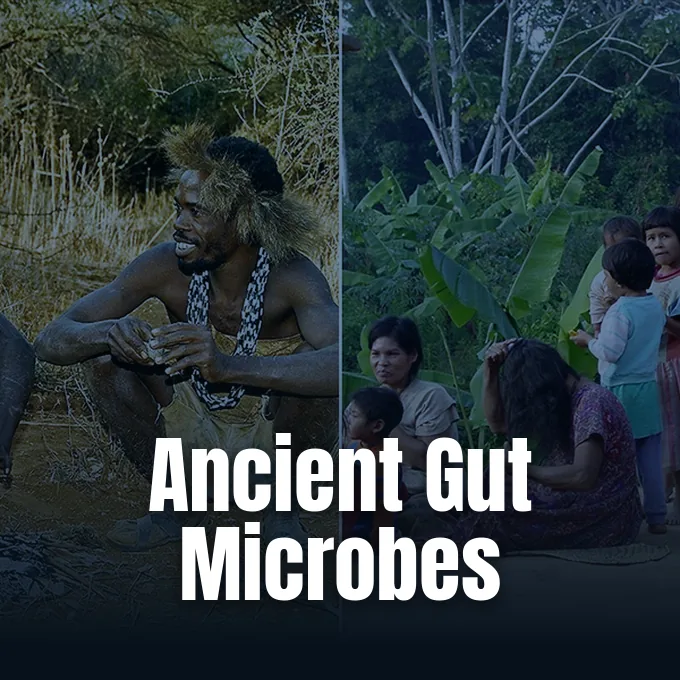
For tens of thousands of years, migrating human groups carried living communities of bacteria through every stage of their travels across continents. A genomic study published in the journal Nature shows that Hadza People in Tanzania and Tsimane People in the Bolivian Amazon share hundreds of ancestral bacterial strains [1]. By tracking mutation rates across shared bacterial species, researchers discovered that traveling gut microbes diverged in step with prehistoric human journeys out of Africa [2]. In modern industrialized cities, most of these ancestral microbial partners have vanished [3].
Shared Species in Hadza and Tsimané Populations
The Hadza People of Tanzania represent one of the last remaining forager groups in Africa, gathering wild tubers while hunting impala and porcupine across the savannah. Half a world away in the Bolivian Amazon, the Tsimane People live as indigenous farmers, growing plantains, manioc root, and corn while hunting forest peccary [4]. These populations separated tens of thousands of years ago during early global dispersals. Yet researchers led by Stanford University found that both groups still host an unexpectedly similar community of intestinal bacteria [3].
Metagenomic sequencing previously revealed that an average Hadza individual harbors about 750 bacterial species in their intestine, compared with just 250 species found in a typical Californian resident [3]. In the new study, researchers from the Stanford University Medical Center completed the first deep genomic census of stool samples collected through the Tsimane Health and Life History Project, identifying approximately 1,400 microbial species among the Bolivian volunteers [4]. When comparing the two groups, the scientists discovered that the Tsimane People shared 1,231 of those bacterial species with the Hadza People, accounting for nearly 90% of all species observed in the Bolivian population. “We were really surprised to see that the vast majority of the species in the Tsimane’s microbiome correspond with the Hadza’s,” said senior author Justin Sonnenburg, a professor of microbiology and immunology at Stanford University [3].

Why Is the Human Gut Microbiome Important?
Intestinal bacteria perform key metabolic tasks by breaking down complex plant fiber, synthesizing vitamins, and training human immune defenses to fight harmful pathogens [3]. Trillions of bacteria and fungi inhabit the digestive tract, working as an active metabolic organ that co-evolved with our species over millennia. When these microbial communities lose balance, the host suffers from metabolic inflammation. In clinical studies, such as prior research on infection prediction in liver transplantation, intestinal microbial balance proved to be a key factor in predicting patient survival and organ stability [4].
The composition of this inner ecosystem depends on the steady inflow of dietary nutrients entering the lower digestive tract. In a recent preprint hosted on bioRxiv that has not yet undergone formal peer review, biophysicist Jonas Cremer modeled how over thirty nutritional compounds reach the human colon, tracking digestive flows of carbohydrates, dietary proteins, mucus, bile acids, and electrolytes. Supported in part by the Betty Moore Foundation and the National Science Foundation, Cremer found that microbial growth is carbon-limited for most individuals, while nitrogen remains plentiful thanks to host urea recycling in the gut. Diets rich in varied foraged and farmed plant fibers provide the continuous carbon supply that keeps these ancestral bacteria thriving [6].
How Did Ancient Gut Microbes Travel With Humans?
Ancient gut microbes traveled around the world by passing down from parents to infants through thousands of unbroken generations as human families explored new lands [3]. When prehistoric human groups left Africa and ventured into Asia and South America, their internal bacteria came along inside their digestive systems. Because mothers naturally transmit intestinal strains to their babies during birth, nursing, and daily contact, these microscopic organisms formed intimate traveling partnerships that outlasted continental separations [1]. Researchers wanted to know whether these shared bugs had stayed with humans since before the ancestors of the Hadza People and Tsimane People parted ways [4].
Tracing microbial evolutionary history is difficult because bacteria do not merely inherit DNA from parent cells when they divide. They also swap genes with unrelated strains through horizontal gene transfer, which can blur ancestral relationships over time. To untangle this web, senior co-author Benjamin Good, an assistant professor of applied physics at Stanford University, searched for independent genomic signatures that could separate shared ancient ancestry from recent genetic exchanges. His group at Stanford University looked specifically at mutation rates in vertically inherited DNA segments, where genetic changes accumulate at a steady pace like clock ticks [3]. These molecular clocks confirmed that shared strains diverged tens of thousands of years ago in tandem with the prehistoric human migrations that populated South America [2].


Deep Genetic Dating Points to Out-of-Africa Migrations
The molecular clock analysis confirmed that genetic splits between Hadza People and Tsimane People bacterial strains match the timeline of major human dispersals out of Africa and into South America [3]. The genetic divergence between strains of the same microbial species pointed back tens of thousands of years into human prehistory [1]. That timeline matches when human groups crossed from Asia into North America and migrated into South America, showing that these bacteria did not jump into human bodies from local soil or animals after people settled in Bolivia [4]. “We see evidence that these bacteria were present in the ancestors of both the Tsimane and the Hadza, and presumably the ancestors of all of us,” Good said [3].
Michael Gurven, a distinguished professor of anthropology at Santa Barbara and co-director of the Tsimane Health and Life History Project, explained that this finding reframes how scientists view traditional microbiomes. “What’s amazing is that Tsimané and Hadza share so many of the same endangered bacterial species in their guts, not because they both live in rural areas with low access to antibiotics — but because they’ve been carrying these same species for hundreds of generations,” Gurven said [4]. The investigation from Santa Barbara and Stanford University shows that these resident bacteria represent an ancient biological inheritance that accompanied human migrations around the globe [3].
What Vanished From Industrialized Gut Microbes?
About 60% of the bacterial species shared between the Hadza People and Tsimane People are now rare or completely missing in people living in industrialized societies [3]. While non-industrialized groups maintain hundreds of ancestral bacterial lineages, urban populations in North America have experienced a profound loss of microbial diversity [4]. Modern lifestyle factors, including antibiotic use, cesarean deliveries, and sanitized indoor environments, have severed the transmission chains that once preserved these organisms across generations [3]. In addition, diets heavy in processed fats and refined sugars starve bacteria that rely on varied plant fiber [4].
This fast loss of intestinal partners over just a few generations creates a deep mismatch with our own genome, which evolved with these bacteria over hundreds of millennia [3]. Medical researchers connect this loss of gut biodiversity to the surge in autoimmune illnesses, asthma, type 2 diabetes, and obesity among urban populations in North America. As discussed in our exploration of how your stomach affects mental health, biochemical signals from intestinal microbes also shape neurobiology and immune regulation [4]. “If these microbes hosted by the Hadza and Tsimane really are part of our evolutionary biology, then those of us in industrialized countries are missing a huge part of what our human genome has potentially adapted to over a vast time period,” Sonnenburg said [3].
Ancient Stool Samples Reveal Millennia of Microbial Loss
Physical evidence from archaeological coprolites directly supports the conclusion that ancestral humans carried microbial strains that modern city dwellers have lost. In a 2021 study published in Nature, Marsha Wibowo and a team of researchers reconstructed 498 medium- and high-quality microbial genomes from eight authenticated palaeofaeces samples dating between 1,000 and 2,000 years old from Mexico and the southwestern USA. Archaeological sites like Boomerang Shelter and West Cave yielded remarkably well-preserved coprolites with human intestinal DNA. Among the 181 genomes with the strongest proof of ancient human gut origin, 39% represented novel species-level genome bins that had never been documented in reference databases [5].
Wibowo and colleagues from the Peabody Institute network showed that the ancient palaeofaeces samples clustered closely with non-industrial populations like the Mazahua Community in Central Mexico rather than modern urban groups. The ancient samples were enriched in VANISH taxa, including Spirochaetaceae and the spirochaete Treponema succinifaciens, while lacking the antibiotic-resistance genes common in industrialized guts. By contrast, urban microbiomes are dominated by BloSSUM taxa like Bacteroidaceae [5]. As industrial habits spread, preserving the remaining biodiversity in communities like the Tsimane People has become an urgent health priority. “With rapid changes in diet and access to medicines, Tsimané microbiomes could soon lose their diversity,” Gurven said. “And the impacts of that loss could harm their immunity and health [4].”
- ACADEMIC JOURNAL Schlebusch, C. M., & Vukovikj, M. (2026). Gut microbes that trace ancient human journeys. Nature. [Article Link]
- ACADEMIC JOURNAL Carter, M. M., Liu, Z., Olm, M. R., Martin, M., Sprockett, D. D., Ghadermazi, P., Trumble, B. C., Kaplan, H., Stieglitz, J., Rodriguez, D. E., Relman, D. A., Sonnenburg, E. D., Gurven, M., Good, B. H., & Sonnenburg, J. L. (2026). Prehistoric global migration of vanishing gut microbes with humans. Nature. [Article Link]
- ONLINE NEWS Stanford University Medical Center. (2026). Gut bacteria reveal ancient ties to human migrations across continents, genetic analysis suggests. Phys.org. [Article Link]
- ONLINE NEWS Fernandez, S. (2026). Microbiome Study Shows Ancient Gut Links Between Africa and South America. Noozhawk. [Article Link]
- ACADEMIC JOURNAL Wibowo, M. C., Yang, Z., Borry, M., Hübner, A., Huang, K. D., Tierney, B. T., Zimmerman, S., Barajas-Olmos, F., Contreras-Cubas, C., García-Ortiz, H., Martínez-Hernández, A., Luber, J. M., Kirstahler, P., Blohm, T., Smiley, F. E., Arnold, R., Ballal, S. A., Pamp, S. J., Russ, J.,. Warinner, C. (2021). Reconstruction of ancient microbial genomes from the human gut. Nature, 594(7862), 234-239. [Article Link]
- PREPRINT Cremer, J. (2026). Quantifying the Resource Landscape That Shapes the Human Gut Microbiome. bioRxiv. [Article Link]
- ONLINE NEWS Trendmast. (2026). Gut microbes that trace ancient human journeys. Trendmast. [Article Link]
- PREPRINT Garrison, E., & Marth, G. (2012). Haplotype-based variant detection from short-read sequencing. arXiv:1207.3907. [Article Link]
APA 7: PerEXP Teamworks. (2026). Ancient Human Migrations Left Lasting Traces in Gut Microbes.


