






Apple updated its official Apple Store app today to support the foldable iPhone Duo, adapting the retail storefront to the company’s newest hardware format. The release fills out both the inner and outer screens across all orientations, closing a conspicuous gap after Apple announced that more than 200,000 third-party programs had already adapted to the dual-screen device. The software update also coincides with the arrival of genuine replacement parts on the Self Service Repair catalog, giving customers direct access to tools and manuals while hinge hardware faces fresh online scrutiny.
New Layouts in the Apple Store App
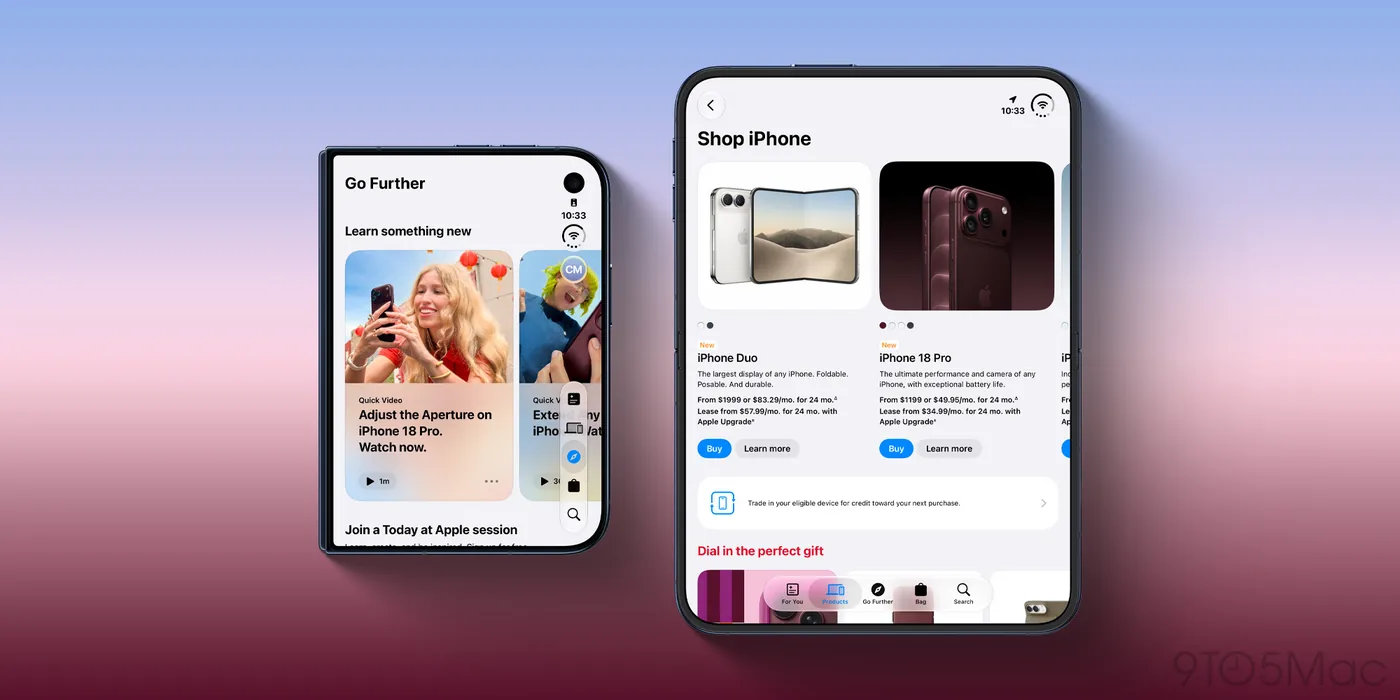
The updated build delivers an interface rebuilt from the ground up for the physical dimensions of the new hardware. Inside the Apple Store app, retail listings and product showcases now expand to fill the full width of both the folding inner panel and the exterior cover screen. Apple placed vertical navigation controls directly within the status bar to keep browsing fluid when holding the phone upright in one hand. At the bottom of the interface, shoppers encounter a unified tab bar that streamlines checkout and account management, paired with a revised icon design first spotted by Everything-Apple [4]. The visual tweaks ensure that catalog images scale cleanly without awkward letterboxing on either display.
Behind the scenes, the App Store began showcasing screenshots of Apple’s built-in software running on the foldable hardware in landscape view. Both Joe Rossignol of MacRumors and Chance Miller of 9to5Mac pointed out that the storefront was an odd omission among first-party tools. Most bundled iOS utilities had already received dedicated interface revisions before launch day [2].
Third-party developers moved quickly to embrace the dual-screen design during early autumn trials. The rapid pace of adoption mirrored the momentum tracked during the initial milestone of 100,000 adapted applications, which took only ten additional days to double in total volume. Early testers can now download the refreshed storefront directly from the App Store without needing separate configuration profiles [4].
Why the Apple Store App Waited
The timing of the software release ties closely to seasonal commercial planning. Apple prepares to launch its annual Black Friday shopping promotions over the coming days, making a reliable purchasing interface necessary for new foldable hardware buyers in major regional markets. Customers shopping on an iPhone Duo previously had to navigate stretched mobile views or resort to browser sessions to order gear. Delivering a customized layout ensures that shoppers can browse seasonal gift guides without visual distortion [4].
Apple revealed yesterday that more than 200,000 apps on the App Store now offer customized layouts for the device. That figure arrived only ten days after the company confirmed passing the 100,000 threshold, illustrating how fast external creators reworked their software. Addressing the pace of updates, Apple said in an official statement to MacRumors: “The response to iPhone Duo from early users has been incredibly positive, and we are seeing exciting things from developers who are rapidly updating their apps…” The company used the milestone to show strong developer enthusiasm, even as early adopters raised questions about hardware durability along the center crease. Passing 200,000 compatible titles gives the foldable platform a solid software foundation heading into its first major holiday shopping season, proving that mobile developers are taking the new dual-screen form factor seriously [2].
Adapting software for a folding screen requires testing layout behavior across two display sizes. When users unfold the device, apps must transition smoothly from single-column phone interfaces to wide dual-panel workspaces. The revised storefront shows how navigation headers adjust when the hinge opens [2].


Official Parts and Repair Tools
Hardware support expanded further today as Apple opened orders for genuine replacement parts and specialized rental kits. Marcus Mendes of 9to5Mac reported that the iPhone Duo is now part of the company’s Self Service Repair Store. Apple first introduced the DIY repair program in 2022 to give owners and independent shops access to factory components. The catalog recently added parts for the iPhone 18 Pro, iPhone 18 Pro Max, Mac Studio, and Mac mini before welcoming the foldable model to the roster [5].
Technicians can purchase individual components to address internal failures or exterior damage. The available inventory includes the Back Glass, both batteries, Bottom Speaker, Camera, Cover layer, Enclosure, and FaceTime Camera. Apple also sells the Inner Display, Inner Display Assembly, Input/Output Board, Logic Board, Main Microphone, Outer Display, Outer Front Camera, Taptic Engine, Top Speaker, TouchID and Camera Control, USB-C Connector, and Volume Buttons. Offering the inner assembly separately is an important step for repairing cracked folding panels. Buyers can order exact parts matched to individual device serial numbers to complete repairs at home [5].
Beyond raw components, the repair catalog provides the specialized tools needed to service delicate folding hinges. Customers can buy or rent adhesive cutters, suction cups, nylon probes, adhesive removal tools, torque drivers, and screws. Apple published step-by-step repair manuals on the day the iPhone Duo launched last month. Those guides explain how to safely replace the logic board and folding screen assemblies without damaging adjacent ribbon cables [5].

Display Cracks and Early User Feedback
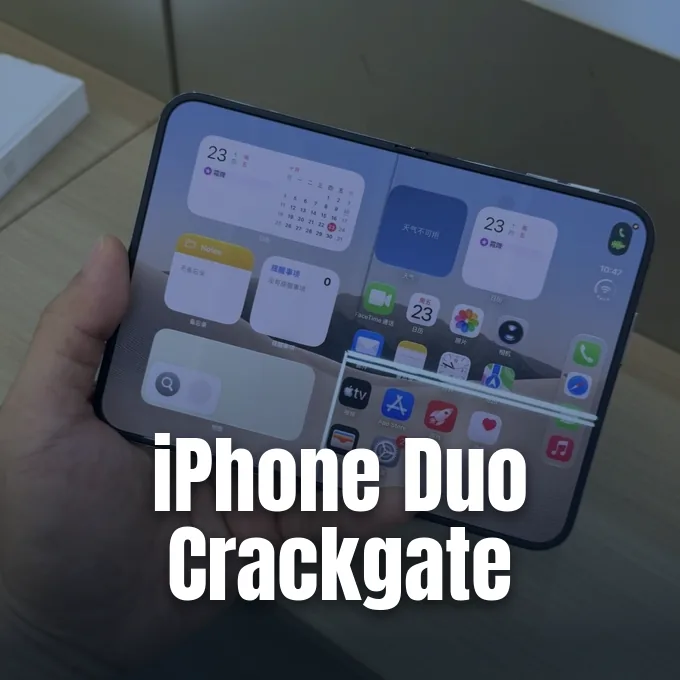
The availability of replacement screens arrives as some early adopters encounter physical panel failures. Discussions on the Reddit and MacRumors forums show several users reporting sudden screen cracks along the center hinge line. Most affected owners describe seeing a bright line of static pixels running vertically across one side of the panel. These fractures appear without drops, typically during normal opening and closing motions [2].
One iPhone Duo owner in Australia said his screen broke after opening the phone fewer than 20 times. The user reported that the device suffered no physical drops or external impacts before the folding glass fractured. Similar structural vulnerabilities were analyzed in earlier hardware teardowns of snapped hinge links, highlighting the mechanical stress concentrated along folding joints. Those teardowns showed how internal pressure can crack delicate substrate layers over repeated cycles. When tiny hinge components encounter uneven torque, the stress transfers directly into the display glass and creates hairline fractures [2].
Apple acknowledged the screen issues in a statement to MacRumors, confirming that a small number of units are affected. While the company is offering replacement devices to impacted customers, it hasn’t provided a technical explanation for the cracks. The lack of detailed engineering diagnostics leaves buyers wondering whether the fault stems from assembly tolerances or supplier manufacturing variance [2].

Fine M-Tec Dispute over Metal Plates
The dispute over hinge durability soon reached Apple’s international supply chain. Tim Hardwick of MacRumors and reports from AppleInsider revealed that Korean supplier Fine M-Tec faced pressure after addressing the display failures. Fine M-Tec reportedly manufactures the internal metal support plates that sit beneath the iPhone Duo’s folding screen. An image of a sheared-off hinge mechanism shared by CuriousHagi on YouTube highlighted how mechanical wear affects those internal plates [1].
On October 26, Fine M-Tec posted a public statement on its website titled “Our official position on the customer’s new product quality issue”. The supplier stated: “The quality issues that are known to have occurred in some products recently are not caused by quality defects in the parts we supply.” Fine M-Tec said it published the notice to counter malicious claims from suspected short sellers, warning that it would take legal action against unsubstantiated rumors [3].
By November 4, the defensive statement had disappeared from Fine M-Tec’s website. Korean business outlet DealSite reported that industry sources pointed to direct pressure from Apple to pull down the post. In a follow-up editorial, The Elec journalist Kim Geon said a supplier representative asked him to remove an article about the incident because Apple objected to the public denial. Apple hasn’t commented on the silencing claims, but the rapid rollout of the Apple Store app and official repair parts shows the company focusing on consumer support as scrutiny continues [3].
- ONLINE NEWS AppleInsider. (2026, November 17). Apple is accused of ordering iPhone Duo supplier to stop denying hinge faults. [Article Link]
- ONLINE NEWS Rossignol, J. (2026, November 17). Apple Store App Now Optimized for iPhone Duo. MacRumors. [Article Link]
- ONLINE NEWS Hardwick, T. (2026, November 17). Apple Accused of Silencing iPhone Duo Supplier Over ‘Crackgate’ Issue. MacRumors. [Article Link]
- ONLINE NEWS Miller, C. (2026, November 17). Apple Store app now optimized for iPhone Duo. 9to5Mac. [Article Link]
- ONLINE NEWS Mendes, M. (2026, November 17). Apple now selling iPhone Duo replacement parts and tools. 9to5Mac. [Article Link]


