





Mysterious magnetic switchbacks in the solar wind have puzzled astrophysicists since interplanetary spacecraft first detected these sharp, S-shaped magnetic kinks folding back on themselves as solar plasma streams travel outward from the Sun into deep space. Data from the European Space Agency spacecraft Solar Orbiter now reveals their origin. By sampling charged particles halfway between Earth and the Sun, researchers identified the solar process that launches these structures into interplanetary space [2].
- What Are Magnetic Switchbacks in the Solar Wind?
- How Solar Orbiter Traced Heavy Ions to Surface Loops
- What Causes Magnetic Switchbacks to Form Near the Sun?
- How Waves and Turbulence Guide the Escaped Plasma
- How Does Solar Orbiter Study the Solar Wind?
- Why Tracing Magnetic Switchbacks Matters for Space Weather
What Are Magnetic Switchbacks in the Solar Wind?
Magnetic switchbacks are sudden, large reversals in the solar wind magnetic field where lines bend back toward the Sun before resuming their path into space, pulling solar plasma along dynamic field lines that twist and fold on their journey through the solar system. The Sun continuously releases this outflow of plasma [2]. For years, Parker Solar Probe tracked these kinks near the Sun, but how they formed remained an open question in space science [1].
Sensors on Solar Orbiter track energetic electrons to evaluate the magnetic structure of each kink. This measurement reveals whether a reversal marks a true polarity flip. In these switchbacks, suprathermal electrons with energies from 60 eV to 1,000 eV travel away from the Sun along the field lines, showing that the underlying sector polarity remains unchanged while a fast solar wind buffets Earth’s field [1].
In 2022, the European Space Agency reported that Solar Orbiter had confirmed the S-shaped geometry of a switchback from remote imaging observations. Earlier models had predicted this shape, but researchers had never seen it in direct imagery. Lead author Jesse Coburn of CNRS/LPP in France said: “Solar Orbiter flew through a very large switchback. Because of this, we were able to sample rarely observed particles there that have tell-tale fingerprints of their origin” [2].
How Solar Orbiter Traced Heavy Ions to Surface Loops
Solar Orbiter recorded detailed in situ observations on 2 March 2022 while flying at a distance of 0.55 AU, which places the spacecraft approximately halfway between Earth and the Sun [1]. The spacecraft relies on its Solar Wind Analyser, or SWA [2]. During a 6-h period, the instruments detected five distinct switchback intervals, with the largest event lasting from 20:25:00 to 21:55:00 UTC, allowing researchers to sample particles that carry signatures of where the plasma was heated and accelerated before escaping into deep space [1].
Inside the main switchback, researchers measured a marked change in heavy ion charge states. Ratios of O7+/O6+, C6+/C4+, and C6+/C5+ rose sharply during the event. Helium dropped relative to protons. Heavy ion temperatures stayed higher than expected from mass ratios alone, matching a super-mass proportionality where oxygen ions were sixteen times hotter than protons in the surrounding stream [1].
This specific chemical signature revealed where the gas originated [2]. Oxygen and carbon ions in high charge states require hot coronal environments to form, conditions found only in closed magnetic loops anchored to the solar disk, much like structures studied when aurora-like radio signals above sunspots appear [1].
What Causes Magnetic Switchbacks to Form Near the Sun?
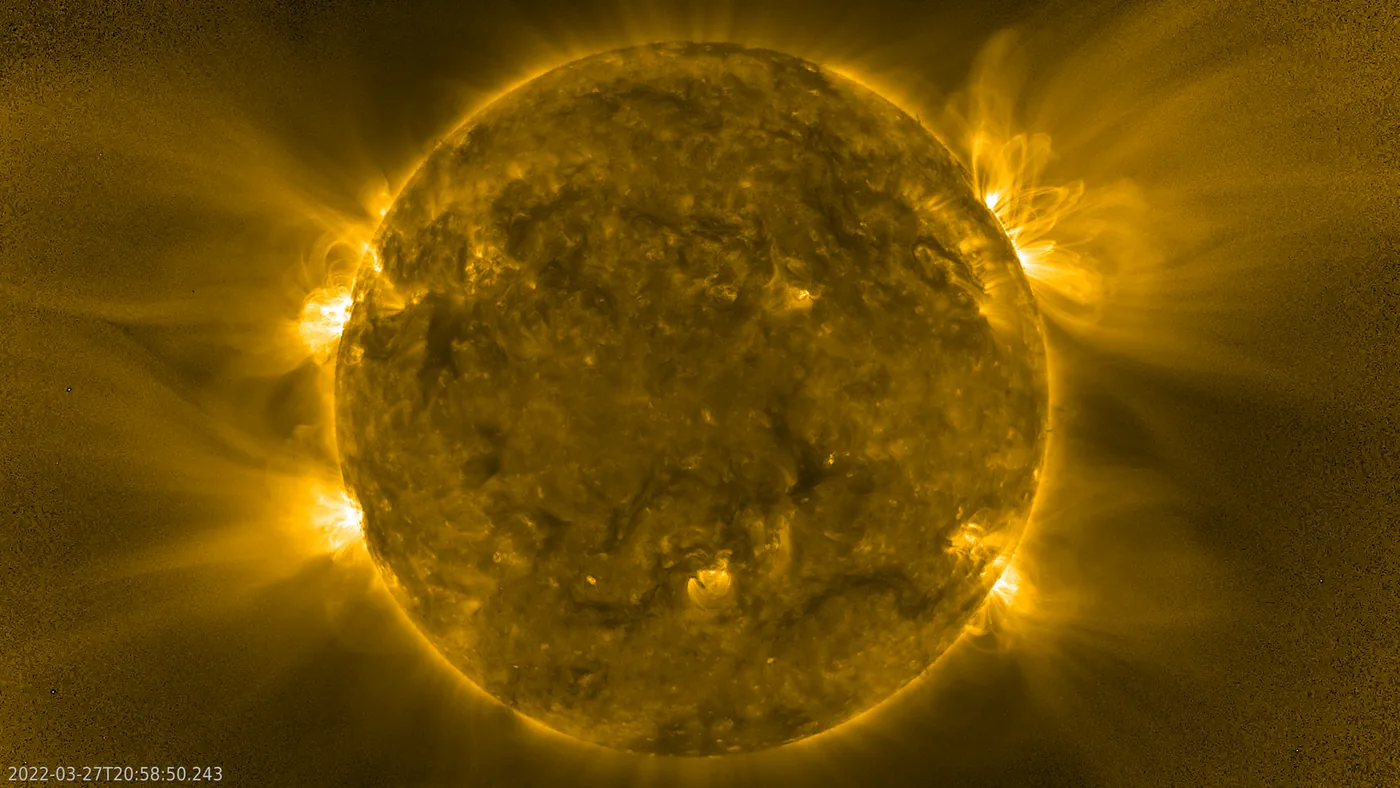
Interchange reconnection between closed magnetic loops and open field lines causes magnetic switchbacks to form near the solar surface. The Sun has two main magnetic field configurations. Open field lines stretch into space like highways, allowing charged particles to escape freely, whereas closed loops trap hot plasma near the surface. Jesse Coburn said: “The specific mix of particles detected by Solar Orbiter is the smoking gun for a formation process known as ‘interchange reconnection’” [2].
When an open magnetic highway engages with a closed loop, the field lines crowd together, snap open, and reconnect in a new pattern. This interaction releases trapped loop plasma. The newly released gas then escapes along the open magnetic path directly into the solar wind [2].
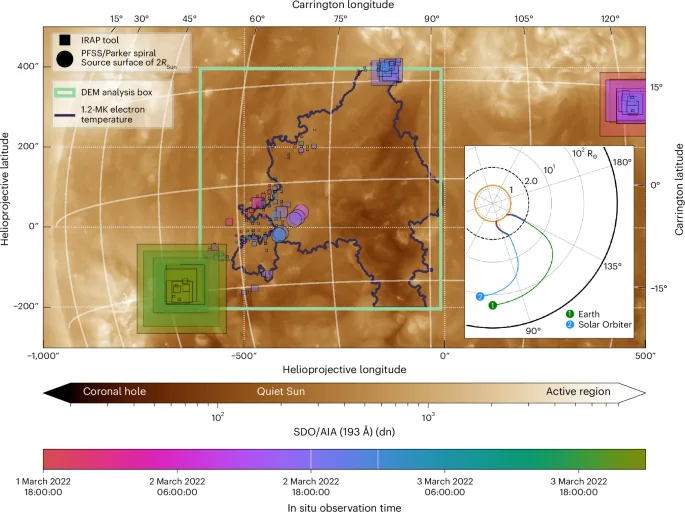
To pinpoint the exact source region, the team linked Solar Orbiter measurements to data from NASA’s Solar Dynamics Observatory (or SDO) [2]. SDO’s Atmospheric Imaging Assembly recorded emission in the 193-Å wavelength band, dominated by iron ions. Using differential emission measure analysis, the researchers determined that the source region had an electron temperature of 1.2 × 10⁶ K in the low corona at 1.06 RSun. Their semi-empirical coronal model traced the magnetic footpoints to the boundary of a coronal hole, confirming that open field lines engaged with hot closed loops and guided the newly released solar wind plasma into interplanetary space [1].


How Waves and Turbulence Guide the Escaped Plasma
The discovery solves a long debate in solar physics [2]. One theory argued that interchange reconnection generates the kinks, while another proposed that waves and turbulence produce the bends as plasma travels through interplanetary space [1]. Stephanie Yardley of Northumbria University in the UK said: “Excitingly, we also see signs of these, but likely only after the switchback heads out into space” [2].
After leaving the solar atmosphere, magnetic kinks enter a different environment. Yardley said: “Once the switchback has left the Sun, waves and turbulence take over and govern how it moves” [2]. In situ measurements from Solar Orbiter show that proton bulk velocity and magnetic fluctuations inside the structure match an outward-propagating Alfvén wave. The relative speed differences between heavy ions and protons remained below the local radial Alfvén speed throughout the passage [1].
The research reconciles both theories by showing that they operate at different stages of a switchback’s life. Interchange reconnection at coronal loops generates the initial S-shaped magnetic kink, but waves and turbulence govern the structure as it journeys through the solar system [2]. Footpoint calculations using source surface heights of 2.0 RSun and 2.5 RSun with a modeling tool developed by IRAP confirmed that the sampled field lines connected to the coronal hole boundary. This two-stage model explains how magnetic kinks maintain their identity while propagating across millions of kilometers of space, providing a unified physical explanation for both in situ spacecraft observations and solar coronal imaging data [1].
How Does Solar Orbiter Study the Solar Wind?
Solar Orbiter studies the solar wind by pairing in situ particle sensors with high-resolution telescopes that image the solar surface [2]. Operating from an orbit that brings the spacecraft within 0.55 AU of the Sun allows its instruments to connect local plasma measurements with visible solar features. This combined design offers scientists a practical method for tracing energetic cosmic ray electrons and solar wind ions back to their sources [1].
The Solar Wind Analyser suite measures electrons, protons, and heavy ions. By measuring minor ions such as carbon and oxygen, SWA detects chemical clues that freeze into the plasma close to the Sun, preserving an indelible record of coronal conditions as the wind travels into deep space [1].
No other spacecraft carries both the close orbital reach and the instrument payload needed to make these connections. While Parker Solar Probe flies closer to the Sun, Solar Orbiter carries telescopes that can look straight at the solar disk while measuring surrounding plasma. That dual capability allowed the team to match in situ particle samples with specific magnetic loops on the Sun [2].
Why Tracing Magnetic Switchbacks Matters for Space Weather
Understanding how magnetic switchbacks form helps scientists explain how the Sun heats its outer corona and drives the solar wind. The corona reaches temperatures exceeding one million degrees. By showing how magnetic reconnection releases energy from closed loops into open highways, the new study provides direct evidence for one of the main coronal heating processes in the solar atmosphere [1].
The solar wind connects the Sun to Earth, and magnetic disturbances can trigger severe geomagnetic storms that threaten satellites and ground systems. Daniel Müller, ESA Project Scientist for Solar Orbiter, said: “As humans on Earth – and in space – our lives are entangled with what’s happening on our star”. Müller added: “The more we know, the better we can prepare for solar storms to protect our space-based infrastructure and technology” [2].
Mapping the solar origin of magnetic switchbacks provides a foundation for reading the history of solar plasma wherever spacecraft encounter it [2]. As researchers analyze more data from Solar Orbiter and Parker Solar Probe, these particle fingerprints will help build accurate models of the solar magnetic field [1]. Tracing these magnetic structures from the solar surface into deep space brings scientists closer to forecasting the turbulent solar wind before it reaches our planet [2].
- ACADEMIC JOURNAL Coburn, J. T., Yardley, S. L., Ngampoopun, N., Dewey, R., Rivera, Y. J., De Marco, R., Verscharen, D., Owen, C. J., Suen, G. H. H., Alterman, B., Baker, D., Fazakerley, A., Galvin, A. B., He, J., Horbury, T. S., Hou, C., Ioannou, C., Kistler, L. M., Lepri, S. T.,. Rouillard, A. P. (2026). On the coronal origin of magnetic switchbacks in the solar wind. Nature Astronomy. [Article Link]
- PRESS RELEASE European Space Agency. (2026, October 8). Solar Orbiter tracks origin of mysterious magnetic switchbacks. [Article Link]
APA 7: TWs Editor. (2026, October 9). How Solar Orbiter Traced Magnetic Switchbacks to the Sun. PerEXP Teamworks. https://perexpteamworks.com/en/magnetic-switchbacks-solar-orbiter-origin/


