





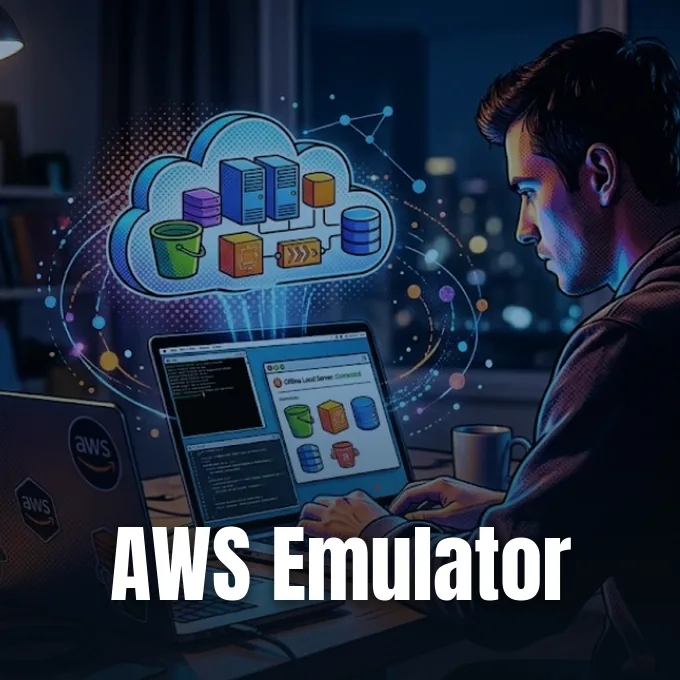
Amazon Web Services launched AWS Emulator on November 11, 2026, giving developers a free tool to test cloud applications on their own computers. The software simulates over 200 cloud services locally without charging an extra service fee, so teams can run tests without waiting for cloud deployments [1]. AWS said its engineering staff did not write or review a single line of code in the project, because autonomous artificial intelligence agents created the full software suite from published interface models [2].
Local Architecture of AWS Emulator
The utility listens on a local address at 127.0.0.1:9297, which means other computers on a network can’t reach the endpoint. When it starts up, it generates local credentials, a configuration file, and a cryptographic certificate inside the ~/.aws/emulator/9297/ directory on the host machine. The generated access key identifiers begin with the prefix EMULATOR, and the utility assigns all local actions to a single account numbered 000000000000. It rejects incoming requests that carry different credentials. Developers redirect the AWS Command Line Interface and official software development kits to the local socket by setting environment variables like AWS_ENDPOINT_URL in their shell scripts, allowing existing test suites to talk to the local daemon without changing application code [1].
Distribution packages differ by operating system. Linux users can install the tool from RPM or Debian packages, which place the aws-emulator binary in /usr/bin/. On macOS and Windows, developers build an image using a short Dockerfile, since AWS doesn’t publish a pre-built container. It asks that every incoming call use Signature Version 4 [1].
The local loop simplifies how software engineers build with automated coding assistants like AWS Kiro and Claude Code. Instead of waiting for remote infrastructure during each test pass, an agent can spin up resources, verify behavior, and adjust code on the fly. In one test run, a developer asked Kiro to build an Amazon DynamoDB table with a string key, write an item, and read the data back using local environment variables. The agent finished the entire exchange against localhost without touching a live cloud region, proving that complex infrastructure tasks can execute on a single machine in seconds [1].
Autonomous Agents Behind the Code
AWS Senior Principal Engineer Matt Goldberg designed the project after reading research about AI agents that built a C compiler from scratch. He drew inspiration from Alf, a Paxos-based distributed locking service built over 20 years ago that still supports core cloud platforms like Amazon S3 and DynamoDB. Swami Sivasubramanian said his team spent months building a Java virtual machine simulation by hand when they first developed Alf [2].
Goldberg wanted to see if modern software models could recreate cloud APIs from formal specifications without human intervention. He fed public Smithy API models into AWS Kiro as the target definition and treated the live cloud environment as the ground truth. The agent produced a working replica of Amazon Simple Queue Service within 15 minutes. That speed convinced engineering leaders to assemble dozens of autonomous agents running on Amazon Bedrock AgentCore Runtime Instances to reconstruct hundreds of additional APIs across the company’s catalog, creating a fully automated software production line. The system used live cloud endpoints to verify that generated responses matched production service output [2].
The team split the autonomous models into three separate groups that collaborate through AWS CodePipeline and AWS CodeCommit. The first group builds fidelity test suites from API specifications, while the second team runs those tests against the emulator to flag behavioral bugs. The third agent group writes code patches, and an adversarial security agent evaluates every change before release [2].

Measuring Cloud Fidelity and Coverage
Cloud emulators fail if their responses drift away from real service behavior, so AWS tracks compatibility through structured fidelity tests. A fidelity test is a small program that runs an SDK workflow against live AWS infrastructure, recording status codes, response bodies, and error details. To pass, the local tool must return the exact same payload and error message that the cloud produces. The company publishes test results as k of n ratios in its documentation, showing how many tests pass for each supported service so that engineers can evaluate coverage before starting work. These public benchmarks update as new features arrive [1].
When an application calls an operation that the emulator hasn’t built yet, the server returns an HTTP 501 (Not Implemented) status code so test jobs fail promptly. That design stops automated test runners from hanging on unhandled endpoints [1]. Known functional discrepancies appear in an open tracking list titled “things-that-do-not-work” so teams know what works before writing tests [2].

Amazon Web Services released the software under a Creative Commons CC0 public-domain dedication license, publishing the complete commit history with the codebase [2]. With enterprise adoption expanding through products such as ChatGPT Enterprise in AWS Marketplace, developer demand for fast local validation continues to rise. Todd Bishop reported for GeekWire on Techmeme that AWS sees the lack of human-written code as an asset rather than a liability [3]. Sivasubramanian said agent-driven iteration allows the tool to keep pace with cloud API updates much better than manual maintenance ever could, ensuring that local testing environments reflect current production capabilities [2].
Using AWS Emulator in Test Workflows
Beyond running as a standalone server, the tool provides an embedded mode for testing software written in Rust. Developers add the aws-emulator-embedded crate to the dev-dependencies section of their Cargo.toml manifest and start the emulator directly inside their test code. Because the embedded instance links directly into the AWS SDK client rather than making calls over a local network port, each test worker runs with its own private memory state. That complete separation means that multiple integration tests can execute at the same time without sharing tables, buckets, or queues, which stops test jobs from overwriting one another and speeds up automated test runs. The Rust crate delivers private test environments without spinning up background network processes [1].
Standalone instances offer diagnostic utilities to help test harnesses confirm that the daemon is ready to receive requests. The process exposes a health check endpoint at /__admin/health on port 9297 so continuous integration runners can pause until the server answers. It writes diagnostic logs as JSON lines, and developers can turn telemetry off in their local settings [1].

Offline testing eliminates cloud bills and network latency during early development cycles. Earlier reporting on cloud metrics during Amazon Prime Day showed the vast scale of production infrastructure, making local emulation an appealing option for daily developer iteration. Engineers can run hundreds of test suites against simulated services without creating temporary cloud stacks or managing sandbox accounts. That saves money and gives developers quick feedback whenever they make changes to application code, while keeping development environments disconnected from remote internet connections. Teams can run full integration suites while traveling or during network outages [2].
Security Limits and Changing Engineering Roles
AWS warned that security remains a shared responsibility and urged developers not to rely on the emulator for security validation. The local package doesn’t evaluate AWS Identity and Access Management policies or resource-based rules the way real cloud regions do. As a result, an API call that real cloud permissions would block might succeed when tested against the local daemon [1].
The software also carries functional constraints during its initial release period. Each instance acts as a single account under ID 000000000000, so it can’t simulate interactions between multiple accounts or across separate geographic regions. Service parity also differs across the catalog, meaning teams should review the official fidelity documentation before assuming an API is supported. AWS advises teams to treat local testing as a fast first step while keeping remote cloud tests for final deployment checks, because security configurations and fine-grained access policies must be confirmed on real cloud infrastructure before shipping to users. Local tests catch logic bugs, but production deployments still demand full cloud validation [1].
Swami Sivasubramanian said the arrival of automated development tools points to a broader change in the software engineering profession. With AI agents writing and debugging code, human developers are becoming “systems orchestrators” who set boundaries, architect test specifications, and design guardrails. He said automated verification tools created by AI will help teams keep pace with software production [2].
- WEBSITE Amazon Web Services. (2026, November 11). Test your applications against AWS locally with AWS Emulator. AWS News Blog. [Article Link]
- ONLINE NEWS Wheatley, M. (2026, November 11). Amazon’s open-source AWS Emulator lets developers validate their code locally, without the cloud. SiliconANGLE. [Article Link]
- ONLINE NEWS Bishop, T. (2026, November 11). AWS releases AWS Emulator, a free tool that simulates 200+ of its services locally. GeekWire via Techmeme. [Article Link]


