





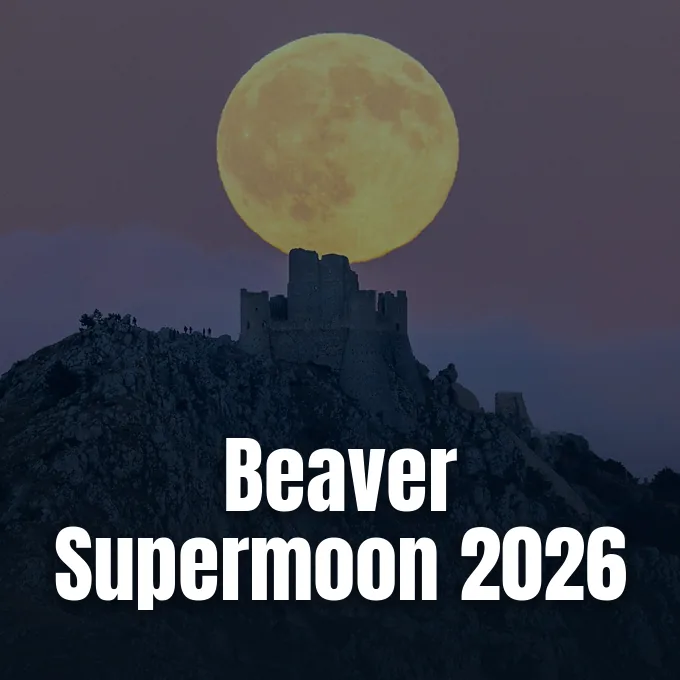
November’s night sky welcomes Beaver Moon 2026 as Earth’s satellite reaches peak crest illumination opposite the sun on November 24. While the moon turns full below the horizon for North American observers, dusk offers optimal views as the bright lunar disk climbs into the eastern sky. The display inaugurates a series of close orbital encounters that will illuminate late autumn nights [3].
Why Beaver Moon 2026 Bears Its Seasonal Name
Traditional lunar names originated from regional seasonal markers rather than formal astronomical catalogs. In North America, The Old Farmer’s Almanac recorded that early colonial settlers and indigenous communities called this event the Beaver Moon because local beavers worked actively through November building dams and securing winter lodges before freezing temperatures sealed northern waterways [2]. Writer John Jardine Goss of EarthSky said that colonial records and tribal traditions also preserved alternate titles such as the Frost Moon, the Snow Moon, and the Digging Moon, each marking the final window for forest foraging before winter [3].
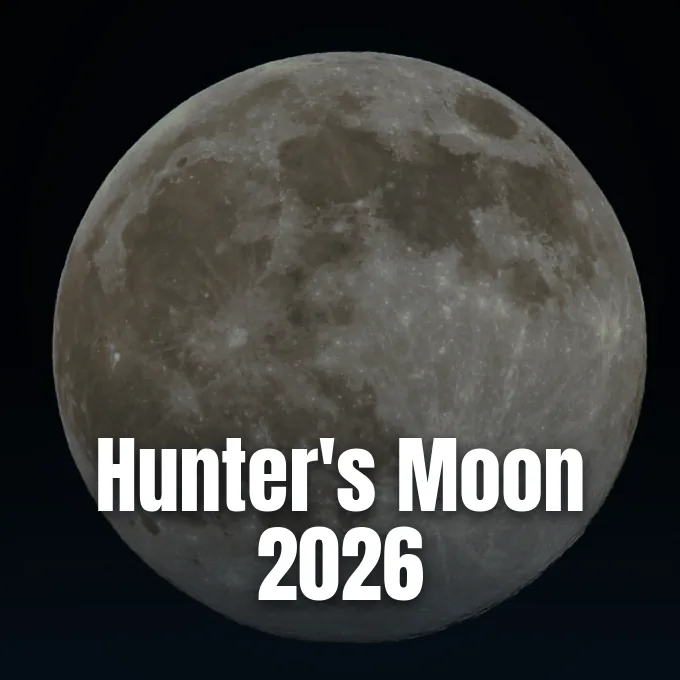
Cultural naming systems often reflected local environmental changes across indigenous territories. Live Science writer Jamie Carter highlighted records from the Center for Native American Studies showing that Anishinaabeg communities called this seasonal event Baashkaakodin Giizis, translating directly to the Freezing Moon. Autumn calendar rules determined whether November opened with a Beaver Moon or an earlier marker. When a full moon falls before November 7, astronomers and almanacs designate it as the hunter’s moon, linking the season to autumnal food storage. Observers tracking this seasonal transition can read our guide to the Hunter’s Moon of October 2026 to see how lunar cycles shift across seasons. Beaver Moon 2026 now assumes its place in the sky as waterways freeze and temperatures drop in northern regions [4].
Orbital Mechanics of a Perigee Supermoon
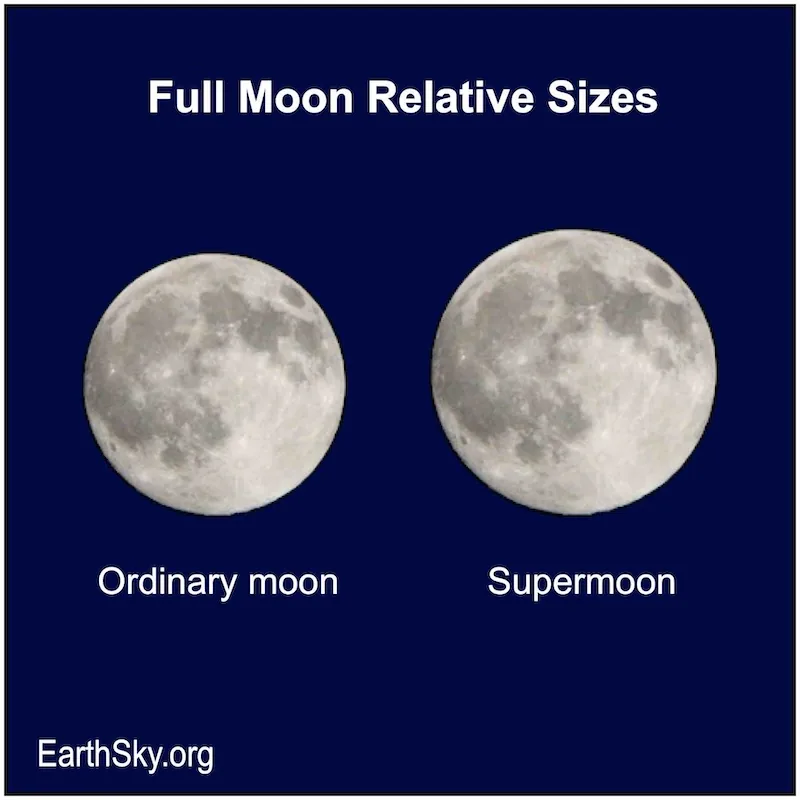
The moon follows an elliptical path around Earth rather than a perfect circle. Because of this 27-day orbital geometry, the physical distance separating Earth from its natural satellite fluctuates constantly between its closest orbital point at perigee and its most distant reach at apogee. When a full moon crests within 90% of perigee, astronomers define the apparition as an astronomical supermoon. During this close swing, the physical gap separating Earth from the moon narrows by thousands of miles compared to standard orbital positions [2].
Astronomer John Jardine Goss reported in EarthSky that the November 2026 lunar perigee occurs at 21:00 UTC on November 25, approximately 30 hours after full illumination peaks. At perigee, the moon sits roughly 223,000 miles (about 359,000 kilometers) from Earth. Mean orbital separation spans 238,900 miles (384,472 kilometers). In contrast, a typical full moon sits 17,000 miles farther away at approximately 240,000 miles (about 386,000 kilometers). This orbital approach pulls the moon near enough to expand its visible disk and exert stronger gravitational pull on terrestrial ocean basins [3].
Why Is Beaver Moon 2026 So Bright?
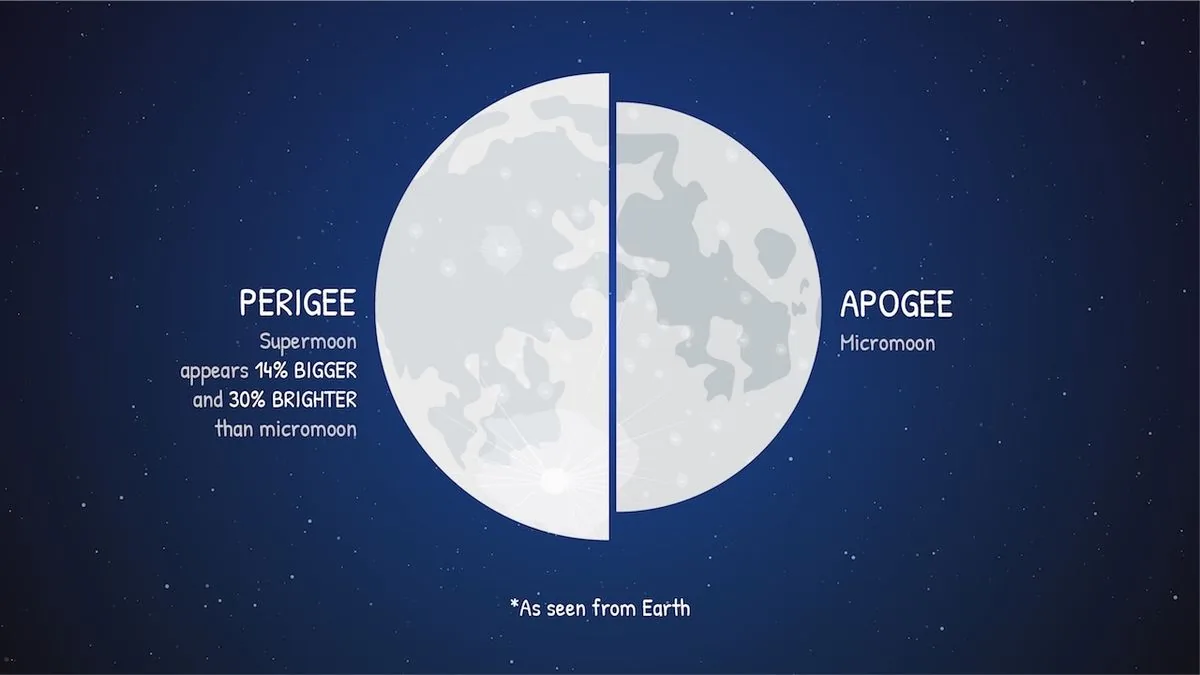
The noticeable radiance of a perigee full moon stems directly from geometry and proximity. Compared to an average-sized full moon, a supermoon appears roughly 8% wider in diameter and shines with approximately 16% greater brightness. When contrasted with a micromoon, which represents the most distant full moon of the year near apogee, the difference becomes even more pronounced. A perigee moon can appear up to 14% larger in disk area and shine up to 30% brighter than its apogee counterpart, delivering a flood of light that easily washes out fainter background stars [3].
Despite this brilliant display, lunar soil has low reflectivity matching dark asphalt on Earth. Because the sun outshines the full moon by more than 400,000 times while illuminating an entire lunar hemisphere facing Earth, reflected light produces an intense nocturnal glow even though the surface retains very little incoming solar radiation. If lunar ground reflected light like fresh snow, night skies would shine over five times brighter. Coastal regions also encounter elevated ocean swells called king tides, which precede and accompany perigee alignments by several days [3].
Observing the Lunar Disk in Taurus
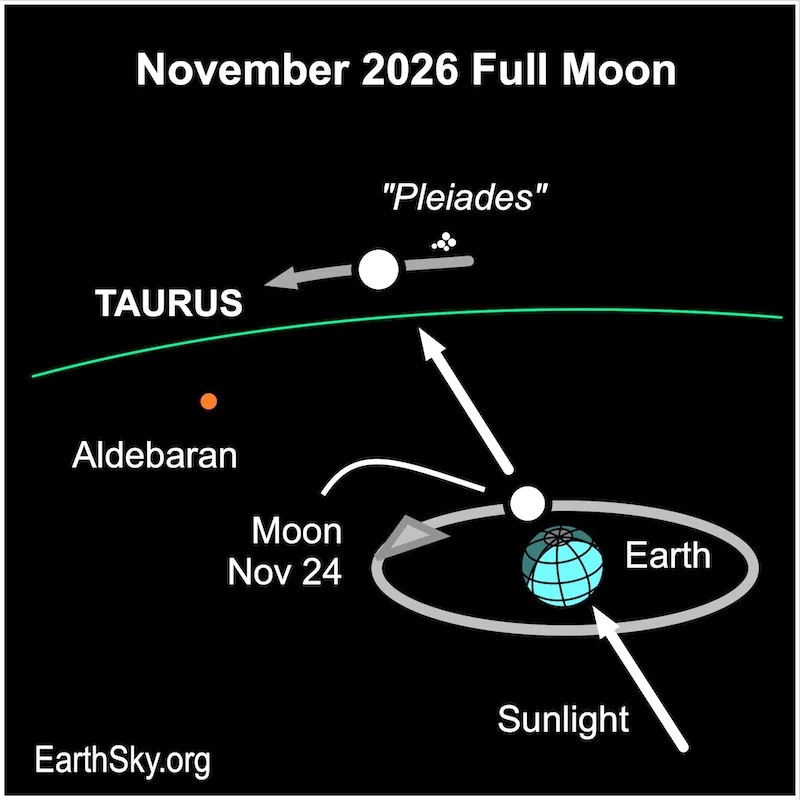
The celestial path of the November full moon carries it through the sky in a long, high arc that mirrors the daytime trajectory of the May sun. Because the lunar disk sits opposite the sun, it climbs high into southern skies near midnight for viewers across mid-northern latitudes while the autumn sun follows a brief, low arc. Most years, observers spot the moon positioned against the background stars of Taurus the Bull, although subtle orbital shifts can occasionally place it inside Aries the Ram or Cetus the Whale [3].
Skywatchers viewing Beaver Moon 2026 can locate the glowing disk less than 10 degrees from the Pleiades star cluster near Aldebaran. Anthony Wood of Space.com said this distance equals a clenched fist held at arm’s length. Blocking the disk behind a building helps. Low on the eastern horizon, the disk takes on an orange-yellow tint through Rayleigh scattering as thick air filters blue wavelengths [2].
Horizon views also trigger the well-known moon illusion, an optical perception where the human brain interprets the rising disk as unusually massive when framed by trees, houses, and distant hillsides [2]. The physical size of the disk remains constant all night. Similar sky conditions discussed in coverage of the autumn supermoon sequence illustrate how seasonal horizons enhance telescope viewing.
The Sequence of Consecutive Winter Supermoons
The November perigean full moon does not occur in isolation. Instead, it opens a series of three consecutive supermoons that will dominate night skies through late January 2027, according to calculations reported by Jamie Carter in Live Science. Because the lunar orbital ellipse slowly precesses in space, perigee alignments often cluster across three or four successive lunar cycles. Winter skywatchers across North America will have multiple opportunities to view these bright events [4].
Each event in this orbital series presents slightly different physical parameters as the moon draws progressively closer to Earth. During Beaver Moon 2026, the moon settles at an orbital separation of 224,170 miles (360,768 kilometers), making it the smallest of the three approaching perigee full moons. The sequence reaches its climax on December 24, 2026, with the arrival of the full Cold Moon at a distance of 221,667 miles (356,740 kilometers). Late astrophysicist Fred Espenak said that this Christmas Eve supermoon will bring the lunar disk closer to Earth than any full moon since January 2, 2018. The trio concludes on January 22, 2027, when the full Wolf Moon peaks at 222,229 miles (357,644 kilometers) [4].
Livestream Coverage and Viewing Conditions
The crest of the full moon officially occurred at 14:54 UTC (9:53 a.m. EST / 8:54 a.m. CST) on Tuesday, November 24, positioning the lunar disk below local horizons for stargazers throughout the United States and North America [3]. Data from TimeandDate indicated that dusk offered the best viewing window as the moon climbed over eastern horizons while the sun dipped below western skylines. The disk appears full to the casual eye across several successive evenings, allowing flexible observation sessions even if overcast skies block the peak date [2].
Global astronomy networks coordinated online broadcasts to deliver live telescopic feeds to international audiences. The Virtual Telescope Project scheduled a livestream from its robotic facility in Manciano, Italy, featuring commentary from astrophysicist Gianluca Masi alongside lunar views above Rome. Cloud cover disrupted the broadcast. Overcast skies over central Italy forced organizers to cancel the stream shortly before airtime [1]. For local observers using portable equipment such as a 4-inch Celestron NexStar 4SE telescope, clear sky windows still provide detailed views of impact basins and volcanic plains as the winter sky show begins [2].
- ONLINE NEWS Wood, A. (2026, November 24). Watch November’s full Beaver Moon live online today with supermoon livestream. Space.com. [Article Link]
- ONLINE NEWS Wood, A. (2026, November 24). November’s full moon rises tonight! Here’s how to see the Beaver Moon supermoon. Space.com. [Article Link]
- ONLINE NEWS Goss, J. J. (2026, November 24). The full SUPER Beaver Moon will be near 2 TRUE star clusters. EarthSky. [Article Link]
- ONLINE NEWS Carter, J. (2026, November 22). Beaver Moon 2026: See a bright, full ‘supermoon’ rise tonight, and another on Christmas Eve. Live Science. [Article Link]
APA 7: PerEXP Teamworks. (2026, November 25). Taurus Hosts Beaver Moon 2026 as Winter Supermoons Begin. PerEXP Teamworks. https://perexpteamworks.com/en/beaver-moon-2026-supermoon-guide/


