




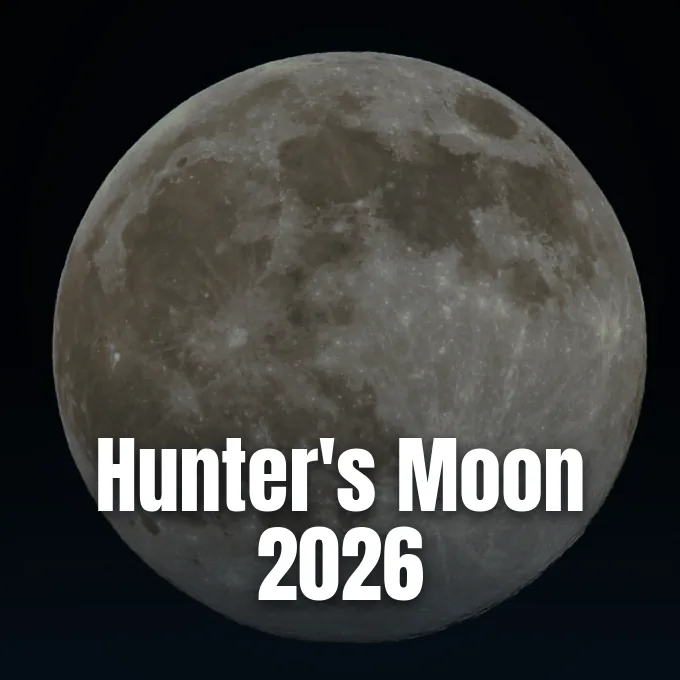
The Hunter’s Moon 2026 lights up autumn skies on Sunday, October 25, and continues through Monday morning, October 26. It serves as the eleventh full moon among 13 lunar phases in 2026, marking the last standard full moon before four straight supermoons arrive to close out the year and extend into early 2027. Observers across both hemispheres will get clear views of the fully illuminated lunar surface over two consecutive evenings as the Sun and Moon line up on opposite sides of Earth [1].
Timing the Hunter’s Moon 2026 Across Global Skies
Viewing times shift with local geography. In the United Kingdom, moonrise begins in the east just after 16:00 GMT on Sunday, October 25, while moonset follows in the west between 07:00 and 08:00 GMT on Monday morning as the lunar disk crosses the sky. Official full phase occurs at 04:11 GMT on Monday morning. Syzygy marks this orbital alignment. The Sun, Earth, and Moon line up in space, providing complete solar illumination over the lunar nearside [1].
Skywatchers in North America will follow their own local schedules for the Hunter’s Moon 2026 as the event unfolds. Astronomy Magazine writer Alison Klesman reported that the exact moment of full Moon falls at 12:12 A.M. EDT on Monday, October 26. Because the lunar disk stays 98 percent illuminated on Saturday night and holds at 99 percent through Monday night, observers get two full nights of prime skywatching without losing visible brightness [2]. Storm Boelo brings rain to northern Scotland. The storm produces strong gusts early Sunday night before clouds clear, while the rest of the British Isles and clear regions of North America should see calmer skies with unobstructed views of the lunar disk [1].
Optical Illusions and Atmosphere Near the Horizon
Low altitude shifts lunar coloration. When the Moon sits close to the horizon during moonrise or moonset, it often displays an orange hue because incoming light travels through a dense atmospheric blanket. Air molecules scatter short blue light waves away from the eye. In contrast, longer red and orange light waves pass through the air with less scattering and reach ground observers, tinting the lunar surface as it climbs into the evening sky [1].
Horizon views also trigger the “Moon Illusion”. The human brain tricks observers into thinking that the rising Moon looks unusually large when seen near trees, houses, and distant hills along the horizon, even though photographs prove its angular size never changes. The apparent enlargement stems entirely from visual depth cues rather than actual proximity. Once the Moon climbs away from skyline landmarks, it seems to shrink back to its familiar proportions [1].
Autumn skies host seasonal meteors. Skygazers can also watch for shooting stars from the Orionid meteor shower as it passes its peak. Bright light from the full Moon will wash out fainter streaks, so observers need dark skies and patient eyes to catch the brightest meteors as they flash across the upper atmosphere [1].
Cultural Origins of the Hunter’s Moon 2026
Customary names for seasonal full moons come from centuries of observation tied to agricultural tasks and animal habits. The title given to the Hunter’s Moon 2026 originates in Native American traditions that marked each lunar cycle by seasonal shifts. Following right after September’s Harvest Moon, October brought bare fields and falling leaves, giving hunters a clear view of wild game preparing for cold winter weather [1].
A distinct orbital geometry gives autumn full moons an important practical advantage over moons seen in other seasons. In mid-northern latitudes during late October, the ecliptic meets the eastern horizon at a shallow angle around sunset. Because of that shallow angle, the Moon rises only thirty to thirty-five minutes later each evening, compared to the normal average delay of fifty minutes. This tight sequence provided early farming communities with several successive evenings of strong moonlight right after twilight ended. Hunters in past centuries took full advantage of the bright evening skies to track deer and small game through cleared crop rows, which firmly cemented the name Hunter’s Moon in folk calendars [1].


Viewing Lunar Features Through Binoculars or Telescopes
Full moons challenge telescope observers. When sunlight falls straight down onto the nearside, the lack of long shadows leaves mountains and crater rims looking flat against the bright plains. Annual astronomy gatherings like Observe the Moon Night remind observers that neutral density filters or sunglasses can cut harsh glare and make fine details visible at the eyepiece [2].
Higher magnifications allow observers to study massive ray systems formed by prehistoric asteroidal impacts. Tycho’s ray system extends hundreds of miles. The southern crater Tycho anchors a vast network that stretches over lunar plains, formed when impact forces threw pulverised rock into orbit. Observers can also scan for bright rays around craters Copernicus, Proclus, Aristarchus, Stevinus, and Byrgius as harsh sunlight illuminates their high-albedo dust layers [2].
Nearby constellations offer alternative targets. In the constellation Camelopardalis, open cluster NGC 1502 shines at magnitude 6 roughly 9 degrees south of Gamma Camelopardalis. Father Lucian Kemble described the asterism. The open cluster sits at the base of Kemble’s Cascade, a straight chain of nearly two dozen stars spanning 2.5 degrees, named by astronomy writer Walter Scott Houston after Kemble shared his observations [2].
Planetary Alignments with Saturn and Distant Worlds
Late October skies provide several chances to watch planets align with the passing Moon as it tracks eastward through the zodiac. On Friday, October 23, the waxing gibbous Moon passed 5 degrees north of the ice giant Neptune in Pisces, while Saturn appeared in the southwest just below the Great Square of Pegasus. Neptune needs binoculars or telescopes. The four bright stars forming the Great Square include Markab, Scheat, Algenib, and Alpheratz. Alpheratz officially belongs to the neighboring constellation Andromeda as Alpha Andromedae, but older star catalogs also listed it as Delta Pegasi because it anchors the northeastern corner of the winged horse figure. Venus reached inferior conjunction at midnight [2].
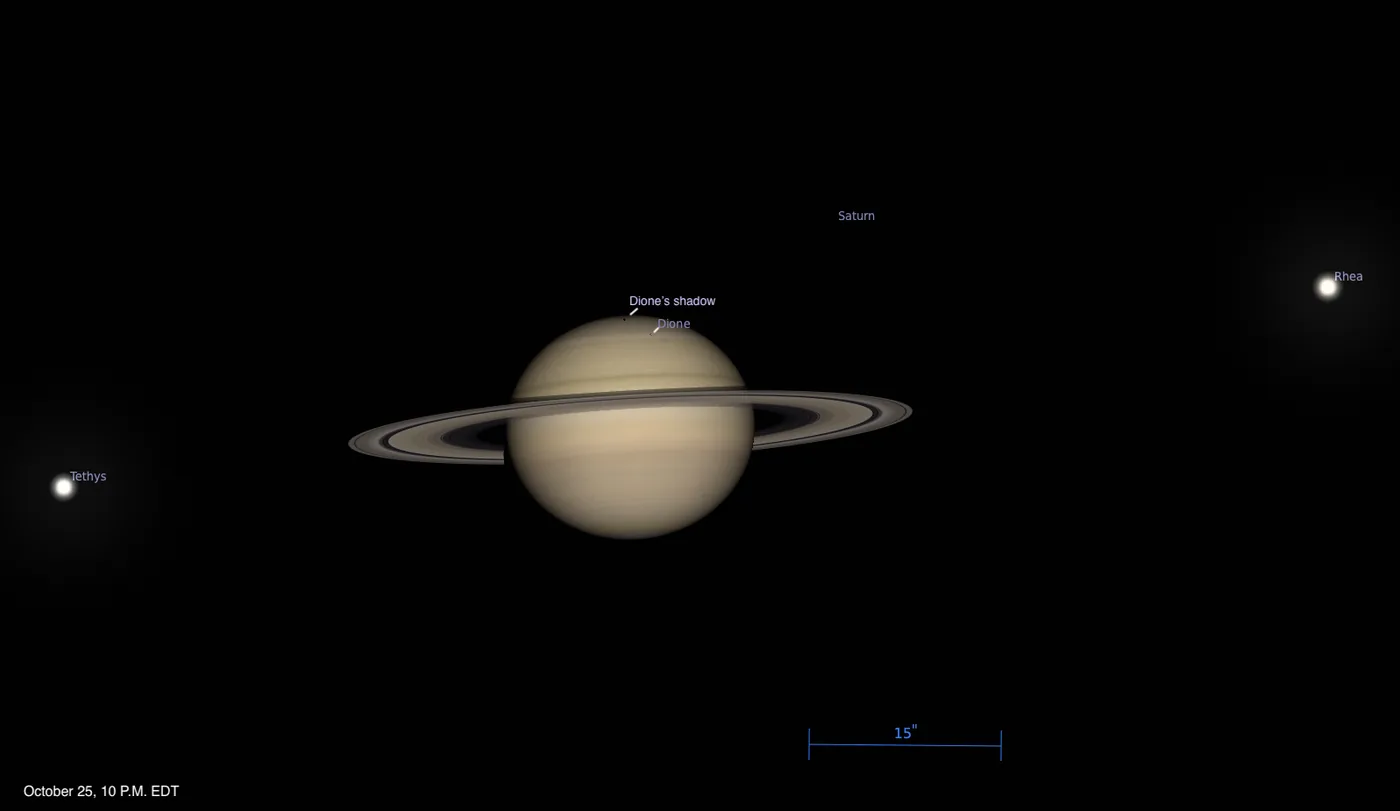
Saturn offers prime telescopic viewing. The planet’s small icy moon Dione transits the planetary disk on Sunday evening, October 25, starting at 8:43 P.M. EDT. Video setups can record Dione’s shadow slipping over Saturn’s northern polar region between 9:40 P.M. and roughly 10:10 P.M. EDT, before the moon exits the disk around 10:40 P.M. EDT. Small telescopes can also reveal bright moon Titan shining at magnitude 8.5 far to the west, with Tethys to the east and Rhea to the west of Saturn’s ring system [2].

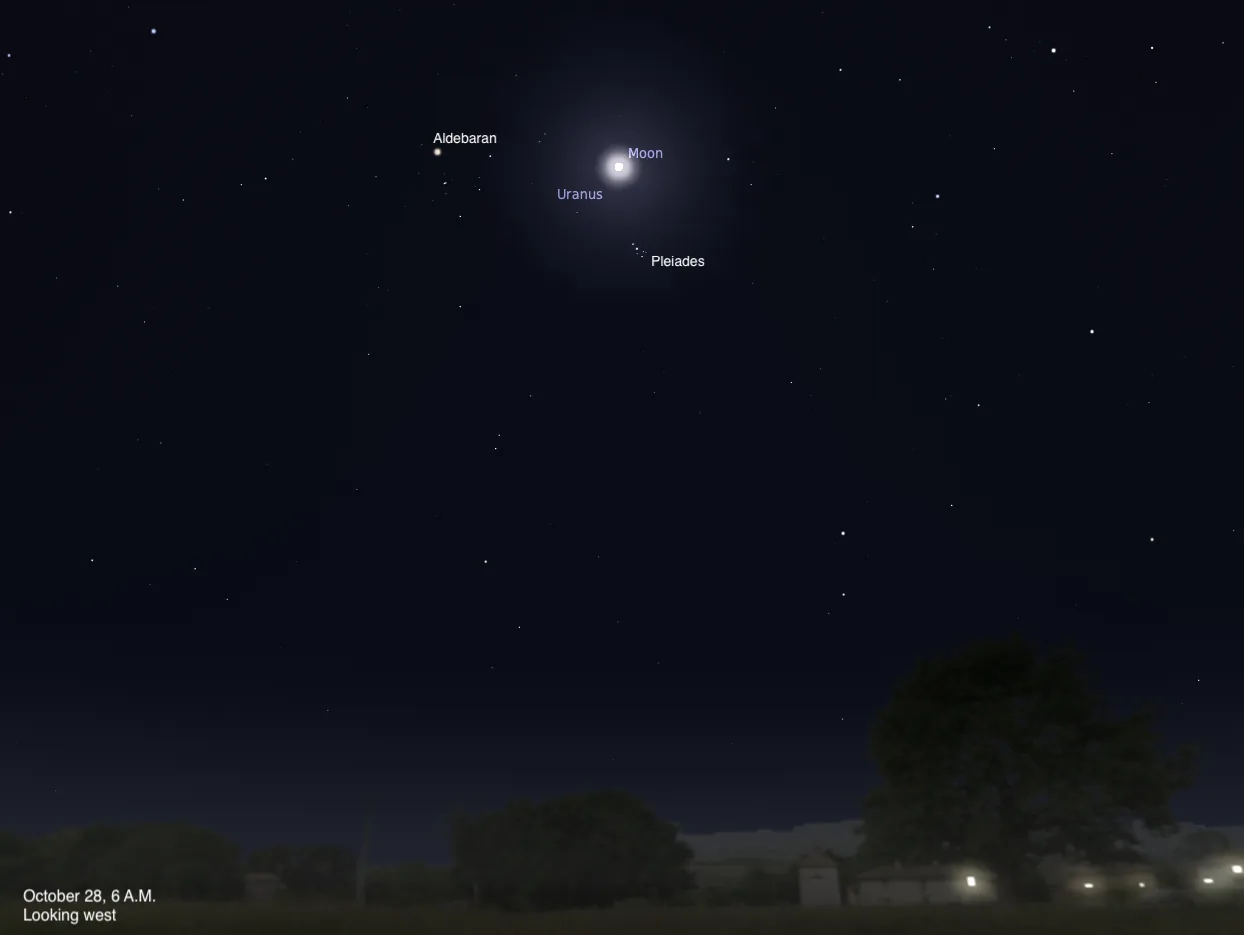
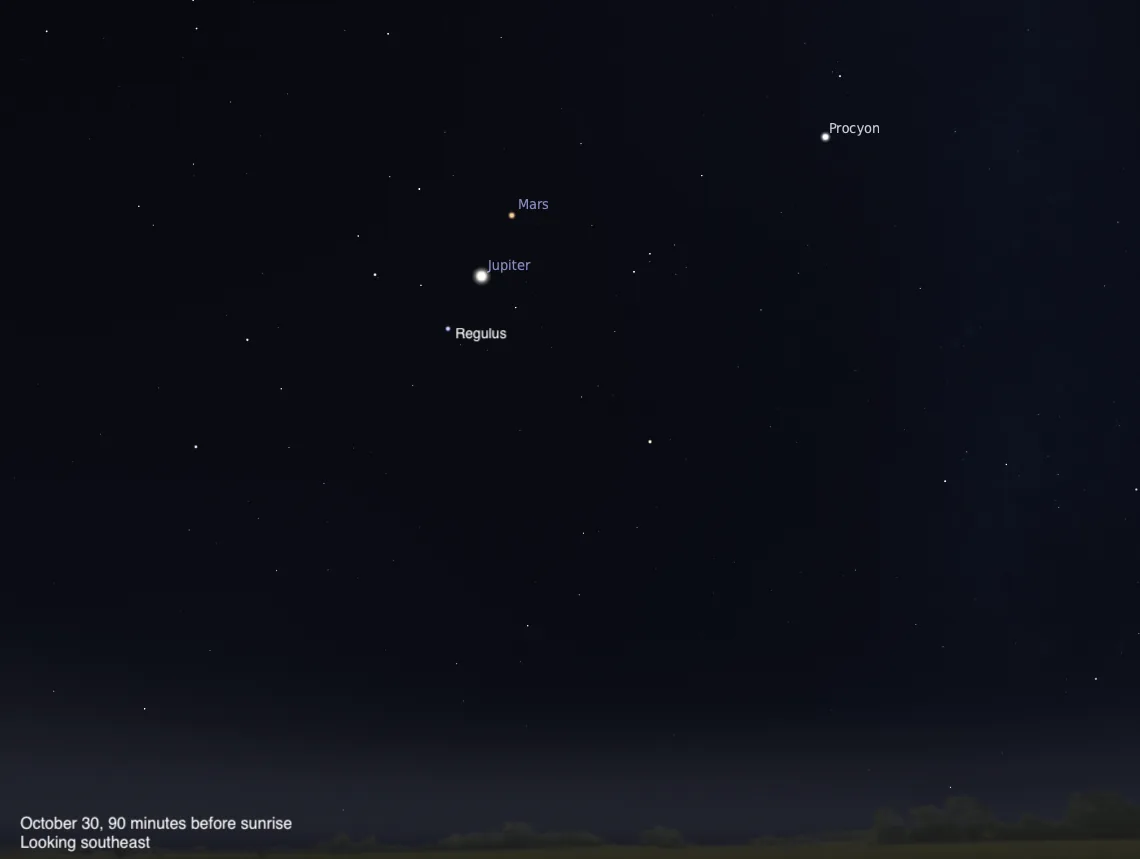
Later in the week, the waning lunar disk moves closer to Earth and passes another distant neighbor. On Wednesday, October 28, the Moon passes 5 degrees north of Uranus near the Pleiades cluster in Taurus at 6 A.M. EDT. Perigee brings the Moon within 226,433 miles. That orbital point occurs at 2:06 P.M. EDT as our satellite closes to 226,433 miles (364,409 kilometers) from Earth. Observers awake before dawn on Friday, October 30, can also spot magnitude 0.8 Mars and bright Jupiter aligned above the star Regulus in the constellation Leo [2].
Upcoming Supermoons Closing Out the Year
The October full moon acts as a transition point in the lunar calendar. The 2026 full moons schedule counts 13 full phases over the year, and this event stands as the final standard full moon of that sequence. Starting in late November, the Moon will begin a rare four-month stretch of consecutive supermoons that will run well into the coming year [1].
The Beaver Supermoon arrives on November 24. That event brings the lunar disk closer to perigee during full phase, initiating a long winter run of prominent supermoons. A second supermoon follows on December 24, creating a Christmas Eve Cold Supermoon that will dominate winter skies. The supermoon sequence will then stretch into early 2027, with both the January and February full moons qualifying as supermoons under astronomical standards. Observers tracking the sky following the Hunter’s Moon 2026 can anticipate four consecutive months of unusually large and brilliant full disks as Earth and its satellite draw closer together [1].
- ONLINE NEWS BBC Weather. (2026, October 23). October full Moon: How and when to see the Hunter’s Moon. [Article Link]
- ONLINE NEWS Klesman, A. (2026, October 23). The Sky This Week from October 23 to 30: Gaze at the Full Hunter’s Moon. Astronomy Magazine. [Article Link]
APA 7: PerEXP Teamworks. (2026, October 24). Hunter’s Moon 2026 Rises in October Skies Ahead of Supermoons. PerEXP Teamworks. https://perexpteamworks.com/en/hunters-moon-2026-october-sky/


