





How loud can a wild bird call become before reaching the natural limits of avian biology? While birdsong is commonly linked with soft morning melodies, the world’s loudest birds produce sound levels that easily rival chainsaws and jet aircraft taking off. A field study published on September 29, 2026, by biologists from the University of Massachusetts Amherst evaluated 123 species in their natural habitats. The team recorded calls reaching 131 decibels from the Amazon and eastern South America [1].
- Which Species Rank as the World’s Loudest Birds?
- How Researchers Measure Avian Volume in the Wild
- Why Wider Beaks and Muscular Bodies Boost Amplitude
- White Bellbird and the Search for the World’s Loudest Birds
- Which Physical Traits Drive the Loudest Bird Calls?
- Why Extreme Volume Defies Simple Evolutionary Explanations
Which Species Rank as the World’s Loudest Birds?
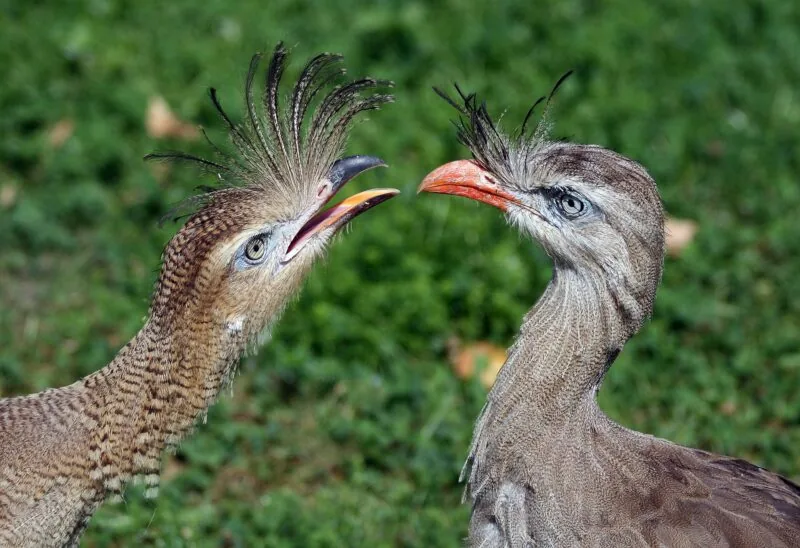
The bare-throated bellbird and the red-legged seriema currently compete for top honors among the world’s loudest birds. Living high in the canopy of the Amazon, the male bare-throated bellbird produces a ringing mating call that registers at approximately 131 decibels in field recordings [2]. Down on the ground in eastern South America, the red-legged seriema unleashes shrieking territorial cries that exceed 120 peak decibels over open grasslands. Both species produce sounds louder than chainsaws or jackhammers. These explosive cries forced biologists to investigate how relatively small creatures manage to generate such enormous acoustic power in the wild [1].
To put that volume into perspective, a roaring chainsaw or a jet engine operating nearby generates between 120 and 130 decibels. Sounds in that range cause pain to human ears. Brief exposure can trigger lasting hearing damage. By comparison, ordinary human conversation measures around 64 decibels, a level matched by the quietest species in the study, the hummingbird. Understanding how wild animals reach such thresholds connects closely with the physics of breaking the acoustic sound barrier and managing intense sound waves [2].
Birdsong often acts as gentle background noise. Bellbirds and seriemas sound like sirens. Researchers João C. T. Menezes and Jeff Podos wanted to know why bird calls vary so much across species, and whether differences in skeletal anatomy, dense forest habitats, or competitive mating habits could adequately explain those dramatic vocal gaps [3].

How Researchers Measure Avian Volume in the Wild
Measuring call volume in the wild is far harder than it sounds. Distance changes everything. Sound weakens rapidly as it travels over open ground, meaning a bird shouting from a tall branch can sound deafening to an observer standing directly underneath the tree, while that same call seems faint several hundred meters away in dense woods. Bringing wild birds into an indoor laboratory would make sound level tracking much simpler, but captivity changes vocal habits and would prove completely impractical for a broad survey covering dozens of species in different countries [3].
To gather accurate data in the field, Menezes and Podos worked outdoors in Massachusetts and Brazil with portable sound meters and laser rangefinders. These rangefinders, devices commonly used by golfers to gauge distance on fairways, operate like binoculars with a laser. By recording both the sound level and the distance to the bird, the team calculated true source amplitude. Their findings appeared in the journal Evolution [1].
Together, these field tools enabled the researchers to collect reliable loudness measurements for 123 bird species in total. Remarkably, 113 of those species had never undergone acoustic amplitude logging until this field campaign. The resulting catalog gave science its first systematic comparison of avian sound levels in the wild [2].
Why Wider Beaks and Muscular Bodies Boost Amplitude
Body size helped explain some of the huge volume variation documented among the surveyed species, with larger birds generally making much louder calls than their smaller relatives. Biologists think big birds with bulky muscles may compress air more powerfully inside their respiratory tracts, allowing them to expel bursts of sound with explosive force. This pattern shows how anatomical scale shapes biological performance, mirroring the evolutionary advantages of larger body size seen in many animal lineages over deep evolutionary time. Without strong muscular support, small birds simply cannot build up enough internal air pressure to reach industrial noise levels [3].
Beak shape also mattered. Birds with wider beak openings produced louder calls than species with narrow bills. The researchers compared a wide beak opening to the flared bell of a brass trumpet, which helps sound travel out into the open air instead of bouncing back into the throat and losing acoustic energy [3].
Anatomy explains the mechanism. It leaves the evolutionary purpose unresolved. “We now know some of the hows. Bigger bodies and wider beaks, but we’ve yet to discover the whys,” Menezes said about the unanswered questions surrounding their findings [2].


White Bellbird and the Search for the World’s Loudest Birds
Jeff Podos was already well acquainted with record-setting vocalists long before completing this newest survey in South America. During an earlier expedition in 2019, Podos recorded male white bellbirds in Brazilian forests whose deafening vocalizations earned official recognition from Guinness World Records as the most piercing calls documented in nature. That remarkable find demonstrated that a modest canopy percher weighing barely a quarter of a kilogram can easily outshout heavy industrial machinery [3].
The latest measurements confirm that the white bellbird is not alone at the top of the volume charts. Its close relative, the bare-throated bellbird, reaches around 131 decibels in the forest canopy. At the same time, the red-legged seriema shouts at more than 120 decibels in eastern South America, showing that extreme amplitude evolved in more than one avian family [2].

Yet the scientists wanted to do more than find another world record holder. They designed this study to understand whether an animal’s ecological niche, social structure, or daily habits could predict why some birds sing quietly while others shout like sirens [3].
Which Physical Traits Drive the Loudest Bird Calls?
Body mass and beak width stand as the only traits in the study that clearly correlated with vocal volume in the wild. The softest birds in the study, such as the hummingbird, produced quiet songs measuring around 64 decibels. That matches ordinary human speech. In contrast, heavier species equipped with wide beaks pushed their vocal organs to levels that rival power tools. Outside of body mass and bill dimensions, other anatomical features failed to show any reliable link with call volume across the 123 species [1].
Habitat conditions also offered fewer answers than the researchers had expected before beginning their field trips. The team thought that living in dense forests might force birds to call louder to cut through thick leaves and branches that absorb sound energy. Yet the field data did not support this idea, as forest birds were not systematically louder than species living in open savannas like the red-legged seriema [3].
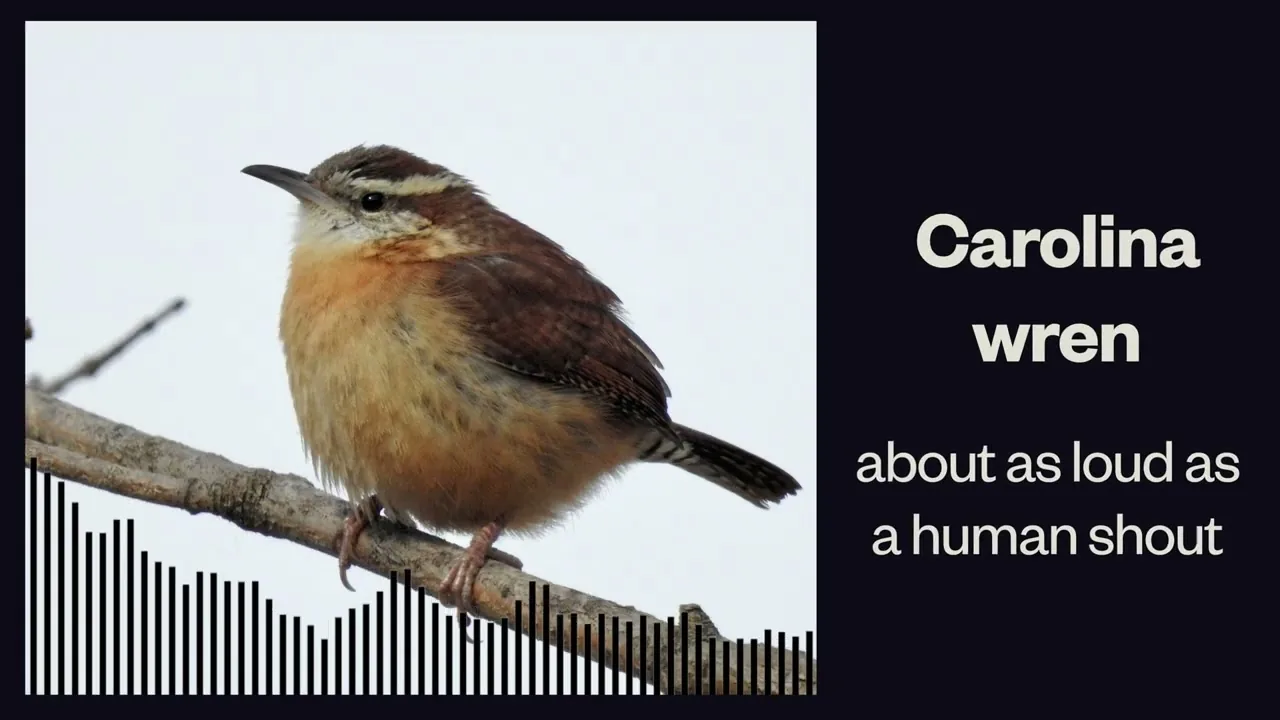
Flight ability also failed to explain call volume. The scientists wondered whether weaker flyers shouted louder to defend territories without flying, but field measurements revealed no link between flight skills and call amplitude [3].
Why Extreme Volume Defies Simple Evolutionary Explanations
Mating behavior also failed to provide a simple explanation for why these two species shout so loudly in the wild. The researchers had predicted that species with multiple mating partners would develop louder calls to attract mates across wide distances. When Menezes and Podos examined mating patterns across all 123 species, however, the data showed no link between mating systems and sound amplitude. Some species with multiple partners called softly, while others with single partners shouted loudly, leaving the evolutionary drivers of extreme volume an unresolved puzzle [1].
This puzzle highlights why in-person field observation remains essential for biological discovery. “You can’t do this kind of work in the lab, or by scraping data from the internet. You have to get out into the world, you have to pay careful attention to what you’re seeing and hearing,” Podos said [2].
For now, the bare-throated bellbird and the red-legged seriema stand out as the two most powerful vocalists known in the avian kingdom. Gathering loudness data on many more species will be needed before biologists can explain why these particular birds evolved calls that rival heavy machinery. Until new field expeditions collect those measurements, the origins of these deafening cries remain an open mystery in nature [1].
- ACADEMIC JOURNAL Menezes, J. C. T., & Podos, J. (2026). Evolutionary drivers of vocal amplitude in birds. Evolution. [Article Link]
- ONLINE NEWS Whitt, K. K. (2026, October 4). What are the world’s loudest birds? Here are 2 contenders. EarthSky. [Article Link]
- ONLINE NEWS Knowridge Science Report. (2026, October 4). Louder Than a Chainsaw: Two Birds Join the Race for the World’s Loudest Call. Knowridge Science Report. [Article Link]
APA 7: TWs Editor. (2026, October 5). What Are the World’s Loudest Birds? Two Contenders Take the Lead. PerEXP Teamworks. https://perexpteamworks.com/en/worlds-loudest-birds-two-contenders/


