





Can adapting ordinary conversational styles help reliable facts penetrate hostile online echo chambers? When public health authorities attempt countering misinformation on social media, their posts often rely on neutral, detached announcements that skeptical audiences dismiss without reading. Researchers exploring digital communication have found that the manner in which evidence is phrased alters whether people interact with it. In controlled tests in Australian Facebook communities, factual advertisements written in personal community language were about 52% more likely to be clicked than standard institutional notices [1].
- Why Language Style Matters in Countering Misinformation
- Lessons from Australian Facebook Community Experiments
- How Persona Messaging Helps in Combating Misinformation
- What Surveys Reveal About User Intervention Norms
- Can Social Proximity Prompt Users to Counter Misinformation?
- Practical Lessons for Future Public Health Campaigns
Why Language Style Matters in Countering Misinformation
Public agencies have spent years delivering health advisories to curb false rumors online. Yet dry institutional prose often fails to connect with skeptical audiences. Evidence alone gets ignored [2]. In a study published in the Journal of Computational Social Science, researchers Jooyoung Lee, Emily Booth, Hany Farid, and Marian-Andrei Rizoiu examined how message tone influences reader engagement in polarized spaces [1]. The research team discovered that false narratives thrive partly because fringe groups offer members emotional connection, shared identity, and mutual reassurance. When institutions counter false narratives with sterile bulletins, readers who distrust mainstream channels rarely bother to open the linked evidence [2].
User behavior on digital networks shows that people rarely consume online content as detached fact-checkers evaluating pure logic. Instead, individuals evaluate messages through existing social bonds and shared group concerns. A nationwide survey by Catherine King, Samantha Phillips, and Kathleen Carley in Scientific Reports surveyed 1,010 American social media users to examine how individuals encounter and react to misleading claims on their feeds. Their data revealed that people regularly encounter false claims on platforms like Facebook and Twitter, but emotional framing often prevents readers from seeking out corrections. Adapting the style of factual messages helps bridge this divide without altering the underlying evidence, offering a practical path for countering misinformation in polarized networks [3].
Lessons from Australian Facebook Community Experiments
To evaluate how message design alters public attention, researchers spent months observing Australian Facebook groups focused on anti-vaccination arguments and far-right discussions where members shared daily personal concerns [1]. These closed communities offered participants companionship, where messages sounded like an everyday friend sharing worries about a child rather than an aloof press office. Earlier findings by the same research group indicated that members also shared articles from moderate news sources, selectively picking specific themes that fit their worldview [2]. Meta Platforms attempted to regulate these spaces during recent health crises, yet community members adapted by adopting coded language and routing conversations to less moderated platforms. Outside fact-checking on Meta ended in the United States in April 2025 [4].
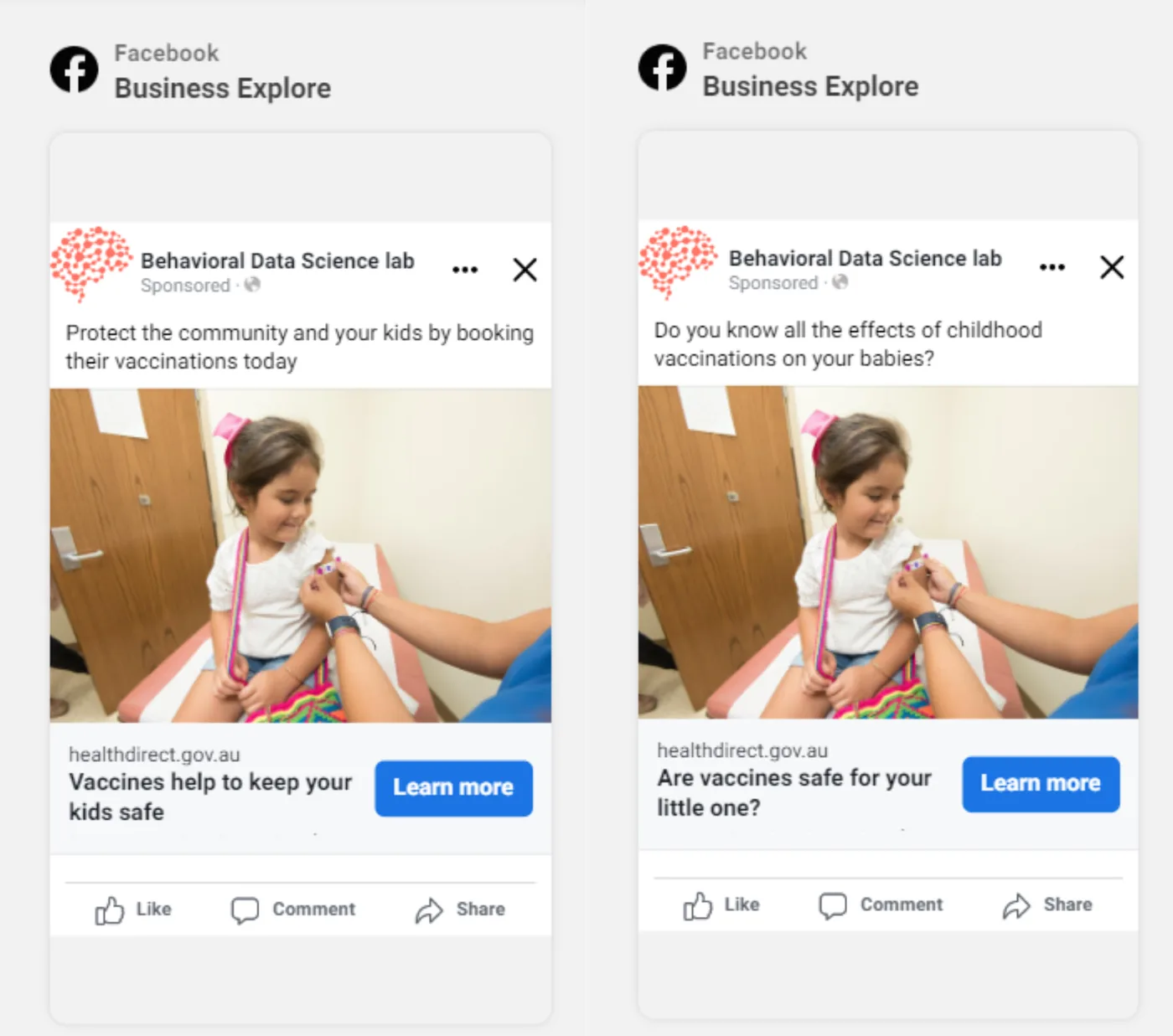
The research team constructed three audience personas (fictional audience profiles representing different community mindsets) based on these real-world observations [1]. Jennifer represented a young mother concerned about infant health. Patrick was a retired teacher. Aaron focused on physical fitness. For Jennifer, the team crafted caring, personal text that sounded like a peer asking: “Do you know all the effects of childhood vaccinations on your babies?”. This stood in sharp contrast to the standard institutional advertisement: “Protect the community and your kids by booking their vaccinations today.” [2].
How Persona Messaging Helps in Combating Misinformation
The experimental results showed a clear difference when public health campaigns tailored their tone to specific audiences. In 12 separate comparisons, the ads written in community-informed styles beat neutral institutional phrasing in 11 cases [1]. Style opens the door. Ads related to school education that used familiar language achieved a 6% click-through rate, whereas identical ads using neutral wording recorded only 1.1% [2]. The familiar phrasing produced roughly a fivefold surge in reader interest, proving that tone alters whether people click to read official evidence [1]. Fact-checking helps only when readers pause to inspect the explanation [2].
Childhood vaccination advertisements mirrored this pattern. Ads with familiar wording drew clicks on 0.98% of impressions. Neutral versions drew 0.65% [2]. While this difference might look small in raw percentages, it amounts to an increase of about 52% in public engagement with reliable medical facts [1]. In earlier platform investigations, similar dynamics appeared when an OpenAI research system exposed user data online, illustrating how design choices shape user interaction on digital platforms. Adapting communication style does not compromise factual integrity, but it determines whether skeptical readers ever encounter the data [2].


What Surveys Reveal About User Intervention Norms
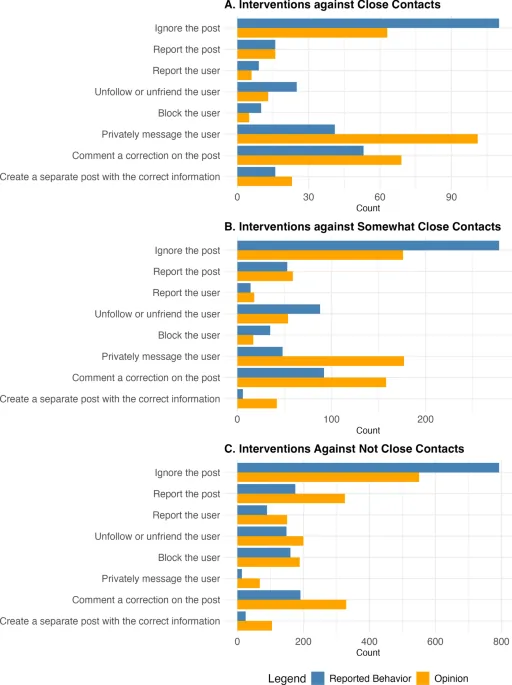
While tailored institutional messages can attract attention, stopping false rumors on social platforms also depends on how ordinary users intervene when seeing questionable posts. In the registered report published in Scientific Reports, Catherine King and colleagues examined what 1,010 American social media users do when encountering false information online while evaluating the influence of social proximity. The authors said that prior literature has disproportionately evaluated institutional fact-checking and debunking experiments, while overlooking spontaneous user interventions (such as reporting false content or writing direct replies). A review of 223 countermeasure studies conducted since 1972 by Courchesne et al. confirmed that user-level responses remain understudied because private platforms rarely share engagement data with independent scientists [3].
The survey results uncovered a widespread gap between personal expectations and actual behavior, creating what the researchers described as failing to practice what one preaches. Participants stated that other users should spend considerable effort countering misinformation by debunking false claims or submitting platform reports. Yet when asked about their own online conduct, respondents admitted they rarely expend the time or social capital needed to confront misleading posts. Talk does not equal action. This psychological tension points to the reality that moral expectations alone do not translate into peer corrections on daily feeds [3].
Can Social Proximity Prompt Users to Counter Misinformation?
The likelihood of an individual challenging false claims depends on personal ties rather than objective truth. Personal relationships decide the outcome. Catherine King and her co-authors discovered that social media users are far more willing to intervene when questionable content is posted by a close friend or family member than by an acquaintance or a stranger. Correcting an unfamiliar user feels risky, unrewarding, and socially uncomfortable, whereas correcting a loved one feels like a worthwhile effort to protect someone from genuine harm. The survey highlights that social proximity is essential when countering misinformation, because personal trust lowers the emotional cost of hearing a correction from a peer [3].
Interpersonal constraints explain why so many misleading claims circulate without pushback. Users worry about damaging friendships. Many fear losing credibility. Research on related platform behavior, such as studies tracking how Twitter conversations surged after extreme hurricanes, shows that digital spaces quickly turn combative when strangers confront one another over disputed facts. Rather than entering hostile arguments with strangers over disputed claims, most users simply scroll past false assertions on their feeds, leaving fringe narratives unchecked unless close contacts step forward to speak up [3].
Practical Lessons for Future Public Health Campaigns
The combined findings from Australian ad trials and American survey data offer clear guidance for teams working to counter misinformation online [1]. Communication specialists do not need to impersonate community members or invent sensational claims to capture attention. Plain honesty works better. Public health workers can listen to how community members describe their fears, then test factual explanations that address those specific questions without medical jargon. A vaccination message might ask: “You want to keep your little one safe. Wondering what vaccinations will mean for your baby?”. This simple shift acknowledges parental love while pointing readers to trustworthy clinical guidance without judgment [2].
Researchers also stress key caveats about these findings, noting that higher click rates do not guarantee that readers changed their beliefs [1]. Jooyoung Lee and colleagues said that their experiments measured first clicks rather than long-term comprehension or behavioral changes [2]. Platform delivery algorithms and user psychology shape who sees each post, reminding educators that style is only one component of a wider strategy [1]. Shifting public attention to accuracy, as Gordon Pennycook and collaborators reported in Nature, is a valuable counterpart to community-informed outreach designed to help people evaluate evidence before sharing it online [5]. By combining accurate data with familiar community framing, public agencies can build more effective strategies for countering misinformation in different demographic groups [1].
- ACADEMIC JOURNAL Lee, J., Booth, E., Farid, H., & Rizoiu, M. (2026). Popping misinformation bubbles: persona-informed style-based messaging in Facebook ad experiments. Journal of Computational Social Science, 9(4). [Article Link]
- ONLINE NEWS Booth, E., Lee, J., & Rizoiu, M. (2026). A new study finds that to counter misinformation online, we need to copy its style. The Conversation. [Article Link]
- ACADEMIC JOURNAL King, C., Phillips, S. C., & Carley, K. M. (2025). A path forward on online misinformation mitigation based on current user behavior. Scientific Reports, 15(1). [Article Link]
- ACADEMIC JOURNAL Johns, A., Bailo, F., Booth, E., & Rizoiu, M. (2025). Labelling, shadow bans and community resistance: Did Meta’s strategy to suppress rather than remove COVID misinformation and conspiracy theory on Facebook slow the spread?. Media International Australia, 197(1), 222-241. [Article Link]
- ACADEMIC JOURNAL Pennycook, G., Epstein, Z., Mosleh, M., Arechar, A. A., Eckles, D., & Rand, D. G. (2021). Shifting attention to accuracy can reduce misinformation online. Nature, 592(7855), 590-595. [Article Link]
APA 7: TWs Editor. (2026, October 5). Why Matching Community Language Helps in Countering Misinformation. PerEXP Teamworks. https://perexpteamworks.com/en/countering-misinformation-familiar-language-style/


