






Tech firms such as Anthropic and OpenAI are meeting with faith leaders, clergy, and philosophers on AI and religion to teach chatbots right from wrong as software reaches millions of people [1]. Tech leaders want moral ideas to steer machine answers when users ask for ethical help. In reporting from Los Angeles, The Korea Times detailed how scholars warn that turning living faiths into code is never simple because world traditions often clash [2].
Why Tech Firms Study AI and Religion
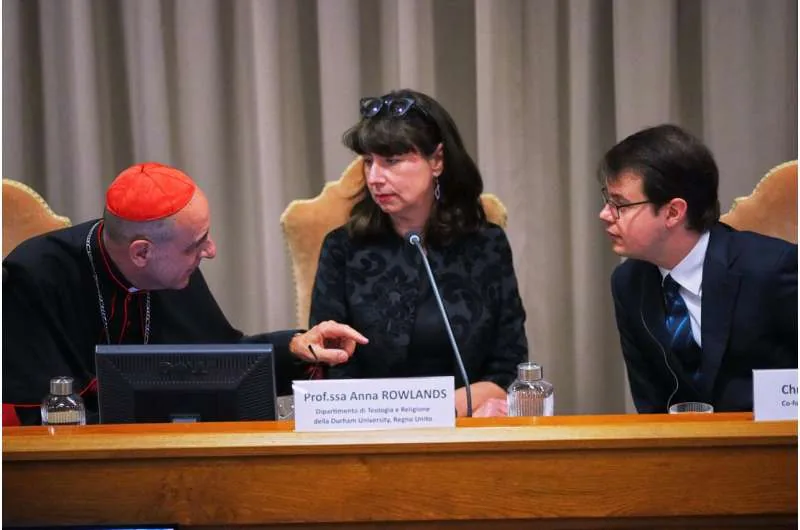
Silicon Valley executives seek advice from church scholars because they worry about social harms if chatbots deliver toxic advice as artificial intelligence models take on bigger roles in work and home life. Earlier this year in Rome, Anthropic co-founder Chris Olah spoke at the Vatican during the presentation of Pope Leo XIV’s encyclical on artificial intelligence. “These are not questions a lab can answer,” Olah said. “They are questions traditions like yours have carried for millennia.” His speech showed how engineering groups hope ancient moral heritage can keep models from spreading harmful bias when users ask them to help with sensitive life decisions [1].
OpenAI chief executive Sam Altman voiced a similar goal in San Francisco when discussing how models should resolve tough ethical dilemmas during product development. Altman said he believes ChatGPT should reflect the weighted average of humanity’s moral view. Yet scholars say averaging diverse worldviews erases the deep contradictions between distinct faith traditions [3].
The push for moral guidance reaches well beyond California, as representatives from Google, Meta, and Amazon have also visited the Vatican to discuss safety with Catholic leaders and ethicists [2]. Microsoft has likewise set up outreach talks with varied faith groups. These companies belong to no single church. They hope gathering viewpoints from multiple groups protects them from public anger, but faith scholars say collecting lists of virtues can’t fix fundamental flaws in chatbot reasoning [5].
Inside the Closed Meetings at Anthropic
Anthropic has turned faith outreach into a regular safety program. In a May blog post, the company said staff held talks with scholars, clergy, and ethicists from more than 15 religious and cross-cultural groups [1]. The firm wants to expand that group as it updates its core machine models [4].
Meghan Sullivan, a philosopher of religion who leads an ethics and technology initiative at the University of Notre Dame, took part in an Anthropic meeting that brought together Christians from different church denominations. Sullivan said the session was split into two parts so guests could examine technical details before debating deeper questions of belief. Staff first explained how their language software works in plain words. Faith leaders then asked questions ranging from whether humans have souls to whether third graders should use chatbots for reading practice. “The culture inside the company is similar to that on a good college campus in the sense that you’ve got a collection of very intellectually curious people,” Sullivan said. “These meetings are pretty nerdy — I don’t know if that’s the best way to put it — in a good way” [2].
Anthropic said its goal is not to align models with any single tradition. The company stated that its Claude system should draw from religious, secular, and political views with equal depth and care [1]. “What we’re after in these conversations is careful, accumulated thinking on how good character actually forms,” Anthropic wrote. Yet turning philosophical debates into mathematical code remains an open problem [4].



Treating Faith as a Rule Book
Anthropologists argue that treating faith as a collection of tidy rules misjudges how human beings live out their spiritual convictions across centuries of messy social history and shared community life. Anthropologist Webb Keane of the University of Michigan said scholars have spent decades pushing back against the idea that religion can be separated from culture and politics. Faith is tied to daily custom. When software teams ask clergy for ethical answers to train algorithms, they risk spreading a false view that ignores the living rituals of real believers [1]. Keane said this rule-book model reduces living cultures to mechanical checklists [3].
Keane warned that exploring AI and religion through extractable rules risks favoring certain traditions while distorting others. “There’s a very conventional way of thinking of religion as a rule book,” Keane said. “It is certainly very tied to scriptural religion, and the scriptural religions at the end of the day really turn out to be the Abrahamic religions” [1].
Scriptural traditions like Christianity, Judaism, and Islam rely on written texts that software engineers can catalog into clear ethical guidelines, but many world traditions do not define themselves through written ethics. Many faiths focus on rites and kinship. When tech firms enforce a rule-based model on AI, they unintentionally favor Abrahamic religions while misrepresenting traditions that center on temple worship or ancestor veneration [5].
Historical Roots of Modern World Faiths
The belief that global faiths exist as distinct, comparable units is itself a modern product of nineteenth-century European scholarship. The late religious studies scholar Jonathan Z. Smith showed that comparing religions as separate systems has a relatively short history. In 1982, Smith wrote: “Man has had his entire history in which to imagine deities and modes of interaction with them. But man, more precisely Western man, has had only the last few centuries in which to imagine religion” [1]. Smith pointed out that while human beings prayed and built shrines across millennia, Western writers invented the academic framework of world religions to sort diverse human cultures into neat, rival categories [2]. Silicon Valley firms now adopt these modern categories without questioning their origin.
Tomoko Masuzawa, a religious studies scholar who wrote The Invention of World Religions, pointed out that many Asian traditions were never viewed as closed systems until European scholars categorized them. Masuzawa said Buddhism and Hinduism were not recognized as bounded traditions by practitioners before Western academics arrived. “All these categories were not native,” Masuzawa said [1].
Tech companies seeking broad diversity often turn to world religions as a convenient way to represent global cultures. “Somehow, religion becomes a way of kind of mapping out the world,” Masuzawa said. “It’s as if the whole world has kind of bought into it.” Yet by relying on nineteenth-century academic boxes, tech developers risk building tools that reflect old European theories instead of the living realities of diverse believers [4].
Risks of AI and Religion in Language Models
The mechanical design of large language models adds fresh problems when developers attempt to instill spiritual wisdom into chatbots. These automated models work by predicting the next word in a sequence after ingesting huge digital libraries of human books, sermons, and scriptures. Paolo Carozza, a member of the independent Meta Oversight Board and a legal scholar who studies Catholic social thought, warned that this statistical mixing threatens the unique wisdom of each tradition [1]. Instead of allowing faiths to grow through genuine human dialogue, machine learning flattens distinct beliefs into a single bland compromise [3]. He said this automated blending pushes systems toward generic Western values [2].
Carozza pointed out that living traditions evolve over centuries by absorbing new ideas through genuine human relationships. “Any living, sophisticated tradition over time is capable of interacting with others outside of it and absorbing some new knowledge and growing. But it does so in this organic way,” Carozza said. “What AI, I think, often does and potentially does, is not in an organic way, but in a way that just throws it all together, mixes it all up, making sense of none of it” [1].
As developers build ever more powerful software, tech companies will keep exploring AI and religion to help create moral guideposts for automated systems used worldwide. Scholars say engineers must look past neat rule books and understand that faith cannot become simple training data. True respect for spiritual heritage requires valuing living traditions on their own terms, instead of stripping them down for machine learning models [4].
- ONLINE NEWS Fauria, K. (2026, October 25). To make AI morally good, tech companies are turning to religion. But some say it isn’t that simple. Tech Xplore. [Article Link]
- ONLINE NEWS Associated Press. (2026, October 25). Tech companies turn to religion to make AI moral, but it’s not that simple. The Korea Times. [Article Link]
- ONLINE NEWS The Economic Times. (2026, October 25). AI companies turn to religion for moral guidance, but experts warn of oversimplification. The Economic Times. [Article Link]
- ONLINE NEWS Fauria, K., & Associated Press. (2026, October 25). Tech leaders want to use religion to teach AI right from wrong. But that can prioritize certain traditions and distort others, anthropologist warns. Fortune. [Article Link]
- ONLINE NEWS Associated Press. (2026, October 25). To make AI morally good, tech companies are turning to religion. But some say it isn’t that simple. AFN. [Article Link]


