






Paleontologists studying ancient bones have long assumed that delicate cellular components degrade fully over deep geological time. A chemical study published in the Proceedings of the National Academy of Sciences challenges that consensus by identifying intact traces of dinosaur blood inside fossil bone tissue. Curtin University chemist Kliti Grice and an international team located mineralized red blood cells and oxygen-binding heme chemicals sealed inside vascular canals of a Brazilian theropod. Fragile organic structures endured across 115 million years [1].
Microscopic Evidence of Dinosaur Blood
The fossil specimen belongs to an Early Cretaceous theropod known as Aratasaurus museunacionali, which lived roughly 115 million years ago in northeastern Brazil. Paleontologists recovered an articulated hind limb that kept its fine skeletal architecture. When the team prepared thin polished slices of bone for microscopic study, they spotted tiny ellipsoidal bodies clustered within vascular canals where blood vessels ran during life [1]. The tiny cell-like bodies match the size and arrangement of red blood cells in living animals, but they turned to mineral forms during burial [4]. Nearby host rock lacked these rounded shapes completely. The contrast confirms the microstructures formed inside the living animal and did not seep in from the external soil after death [1].
Earlier claims of fossil cells in Mesozoic reptiles often met with skepticism because intrusive soil microbes can mimic biological shapes inside decaying bones. In this Brazilian limb bone, the tiny ellipsoids sat exclusively inside internal vascular channels, where transmission electron microscopy and Raman spectroscopy confirmed distinct concentrations of iron, carbon, and nitrogen within each cell body. The exact anatomical position proved the cells belonged to the dinosaur itself [1].
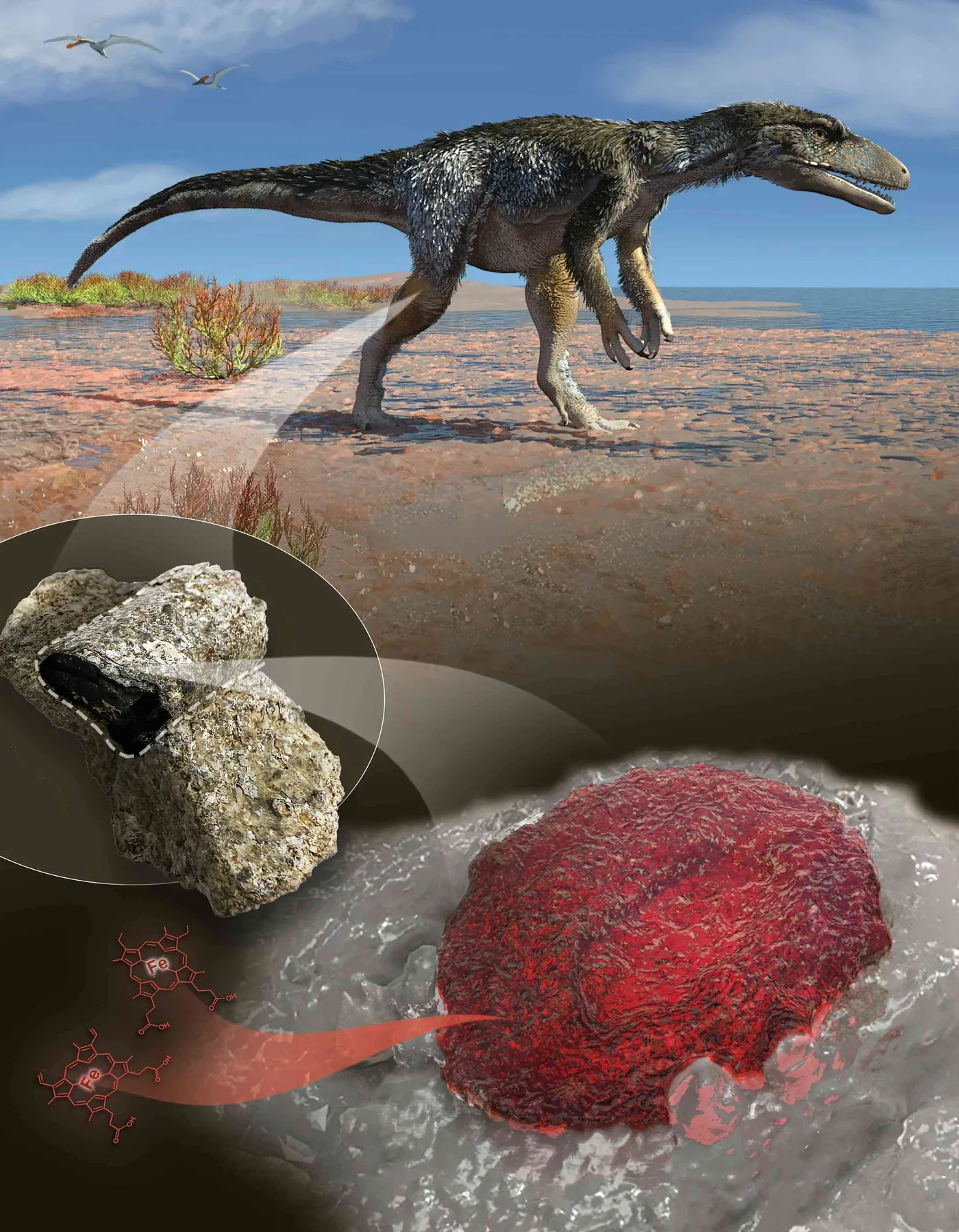
The find marks the first direct physical evidence of dinosaur blood cells sealed inside ancient bone cavities. Previous teams had noticed suggestive spheres in various fossil fragments, but those earlier studies lacked the rigorous chemical verification needed to settle long scientific debates. In the Aratasaurus specimen, the outer walls of the cell bodies survived inside mineral matrices that formed during fossilization. The cells remained locked in rock for over a hundred million years [4].
The Romualdo Formation Specimen
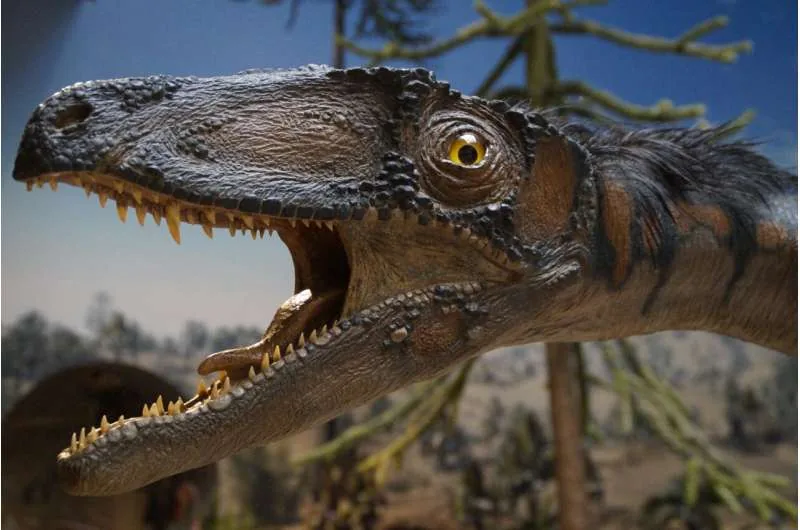
Paleontologists collected the juvenile fossil in 2008 from basal shale layers of the Romualdo Formation in Brazil’s Araripe Basin. The fossil preserves an articulated right hind limb that includes the lower end of the femur, the upper tibia, and parts of the foot, which anatomists classified as a basal coelurosaurian theropod recovered from the formation’s dark shales [2]. The young dinosaur was still growing. Thin bone sections showed that it measured 3.12 meters (over 10 feet) long and weighed about 75 pounds [3]. While the Romualdo Formation in Ceará is known worldwide for well-preserved fossil fish, turtles, and flying pterosaurs, dinosaur skeletal remains are exceptionally scarce throughout the rock unit [2].
The limb bones also survived a major catastrophe in Rio de Janeiro before yielding their microscopic contents. When a fire swept through Brazil’s National Museum in 2018, the specimen escaped destruction because curators stored it in a separate building that remained untouched. The genus name joins the Tupi words ara, meaning born, and atá, meaning fire, with the Greek word sauros for lizard. The species name museunacionali honors the National Museum, translating as the dinosaur born from the National Museum fire. Brazilian paleontologists Renan Bantim and Antônio Saraiva from the Regional University of Cariri, together with Juliana Sayão and Alexander Kellner from the Federal University of Rio de Janeiro, protected the specimen and facilitated access for international testing [4].
Chemical Fingerprints of Ancient Heme
Confirming that petrified microstructures are authentic biological cells requires unambiguous chemical proof beyond microscopic shapes alone. The research team extracted organic molecules from the bone interior and analyzed them using high-performance liquid chromatography coupled with mass spectrometry. The tests identified parent and altered forms of heme B as the main tetrapyrroles present within the bone extract. In living animals, heme B binds oxygen inside hemoglobin and myoglobin. Heme is the iron-bearing porphyrin ring that binds to globin proteins in hemoglobin, enabling red blood cells to transport oxygen through the bloodstream. Chemical tests on the surrounding rock matrix detected plant and bacterial porphyrins derived from chlorophyll, but showed no traces of the animal heme signatures found inside the vascular channels. The chemical contrast proved that the blood signals came from the dinosaur itself [1].
Geochemical tests also found collagen amino acids [3]. Collagen is the main protein that strengthens animal bones and connective tissues throughout life. Earlier geochemical investigations applied molecular techniques to ancient physiology, including how scientists measured Tyrannosaurus rex body temperature by tracking carbonate isotope bonds in fossilized bioapatite. In the Aratasaurus study, collaborative work by Jasmina Wiemann of Johns Hopkins University together with Yuta Isaji, Calum Fox, Nana Ogawa, and Noa Ohkouchi at the Japan Agency for Marine-Earth Science and Technology confirmed that protein residues survived inside the vascular canals [4]. Modern contamination did not affect the results [1].

How Did the Cells Survive?
The cellular structures survived because the young theropod was buried rapidly in an environment rich in microbes but depleted in oxygen. Quick burial stopped scavengers from scattering the carcass and slowed down decay. Under these anoxic conditions, red blood cells did not remain soft, but instead mineralized as dissolved pore fluids entered the vascular canals [4]. The fluids deposited a manganese oxide mineral known as hausmannite, with the chemical formula Mn3O4, directly within and around the blood cell microstructures. Hausmannite formed a solid cast that protected the outer shapes of the cells before organic tissue could rot away. The mineral sealed the cells against groundwater [1].
Hausmannite acted like a chemical time capsule that shielded sensitive molecules from oxygen. The manganese mineral functioned like an antioxidant by stabilizing the reactive iron centers of heme molecules and preventing delicate collagen amino acids from breaking down over geological time [3]. “These findings challenge longstanding assumptions that certain biomolecules such as hemoglobin cannot survive deep time,” said lead study author Kliti Grice, an Australian Research Council laureate fellow at Curtin University [5]. The mineral shield kept the fragile organic compounds safe across 115 million years [4].
Cellular Structure and Metabolism
Microscopic surveys showed that the petrified red blood cells appear slightly larger and more rounded than cells found in living birds and crocodilians. Scientists have proposed two explanations for these shapes. First, the blood cells might have expanded slightly as hausmannite minerals grew inside the vascular canals during petrifaction. Second, non-avian theropod dinosaurs may have naturally possessed red blood cells with distinctive anatomical proportions that differed from those of modern avian relatives [4]. Because blood cell size influences blood flow and oxygen exchange, studying these ancient cells offers fresh clues about dinosaur metabolism. Cell size reflects how quickly an animal uses energy [3].
Studying dinosaur blood helps scientists clarify how juvenile theropods grew so fast in Cretaceous climates [3]. Evolutionary biologists also investigate related questions, such as how the longevity bottleneck hypothesis connects human aging and dinosaurs through shared physiological tradeoffs during the Mesozoic era. Real molecular data from fossil hemoglobin provides a concrete test for metabolic theories. “It not only extends the known fossil record of blood, but also offers a direct molecular window into the physiology of long-extinct animals so we may better understand them and the world they lived in,” Grice said [5].
New Questions for Dinosaur Blood Research
The discovery that intact traces of dinosaur blood survive across 115 million years indicates that global museums hold an extensive, untapped scientific resource. Museums often keep fragmented fossil bones in drawers because they do not look impressive on display. Modern analytical tools like mass spectrometers and micro-Raman probes can now extract biochemical details from these plain specimens without harming their bone structure [4]. Paleontologists can revisit cataloged theropod collections gathered decades ago to establish whether blood preservation represents a rare fluke of taphonomy or a recurrent geochemical process across ancient depositional basins [1]. Old fossil collections may hide many unsuspected biological records [4].
The preservation process seen in Brazil also provides insights for astrobiology and the search for alien biosignatures. If fragile organic cells can withstand deep time inside low-oxygen mineral crusts, similar biological markers could theoretically endure within sedimentary rocks on Mars. “This study exemplifies how coordinated efforts across institutions, continents and scientific disciplines can unlock extraordinary insights into ancient life,” said Martin Van Kranendonk, head of the School of Earth and Planetary Sciences at Curtin University [5]. New geochemical tools will help scientists hunt for ancient biosignatures across our planet and beyond [1].
- ACADEMIC JOURNAL Grice, K., Isaji, Y., Wiemann, J., Greenwood, P. F., Tripp, M., Diaz Mateus, M. A., Poropat, S. F., Sun, X., Fox, C. P., Brosnan, L. M., Bantim, R. A. M., Schwark, L., Visscher, P. T., Ogawa, N. O., Demore, J., Saraiva, A. A. F., Rickard, W. D. A., Ohkouchi, N., Sayão, J. M.,. Rahimpour-Bonab, H. (2026). Heme signatures in mineralized red blood cells within vascular canals of a 115-million-year-old dinosaur bone. Proceedings of the National Academy of Sciences, 123(46). [Article Link]
- ACADEMIC JOURNAL Sayão, J. M., Saraiva, A. Á. F., Brum, A. S., Bantim, R. A. M., de Andrade, R. C. L. P., Cheng, X., de Lima, F. J., de Paula Silva, H., & Kellner, A. W. A. (2020). The first theropod dinosaur (Coelurosauria, Theropoda) from the base of the Romualdo Formation (Albian), Araripe Basin, Northeast Brazil. Scientific Reports, 10(1). [Article Link]
- ONLINE NEWS Paul, A. (2026, November 2). Dinosaur blood found in fossils for the first time. Popular Science. [Article Link]
- ONLINE NEWS Grice, K. (2026, November 2). Traces of dinosaur blood found in world-first discovery. The Conversation. [Article Link]
- ONLINE NEWS Curtin University. (2026, November 2). Dinosaur blood—oldest discovery rewrites what fossils can reveal about the past. Phys.org. [Article Link]
APA 7: PerEXP Teamworks. (2026, November 3). Aratasaurus Fossil Preserves Dinosaur Blood in Ancient Bone. PerEXP Teamworks. https://perexpteamworks.com/en/dinosaur-blood-found-brazil-fossil/


