





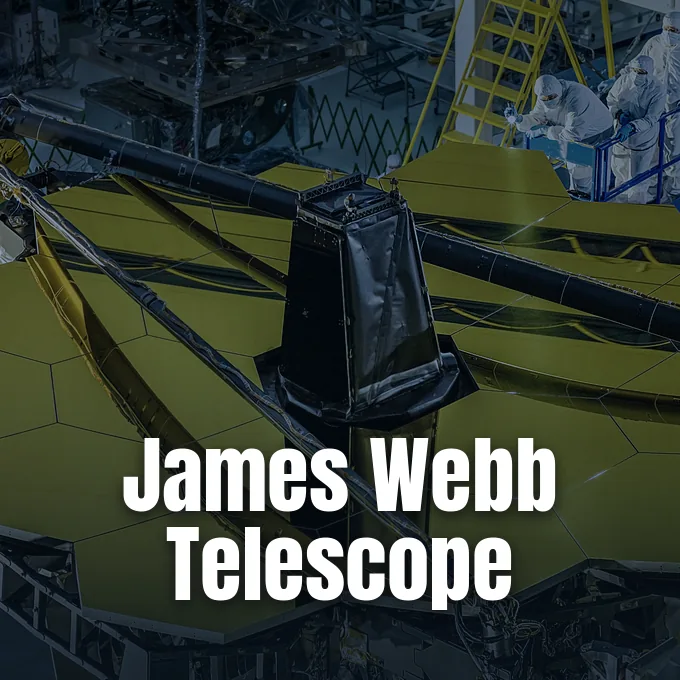
The James Webb Space Telescope (JWST) operates as a general-purpose space observatory built to collect infrared light from the earliest cosmic structures [3]. Astronomers rely on the James Webb Telescope to track faint heat signals that optical telescopes miss, looking across cosmic distances where ancient light has traveled for billions of years. Its segmented gold optics and tennis-court-sized sunshield let researchers examine distant star clusters and exoplanet atmospheres with an optical resolution of ~0.1 arc-seconds [6]. The observatory completed its commissioning phase in 2022 after reaching its orbital outpost 1.5 million kilometers from Earth [1].
- Infrared Light and Cosmological Redshift
- James Webb Telescope Mirror Engineering
- How the Five-Layer Sunshield Blocks Heat
- Why Is the James Webb Telescope Orbiting at L2?
- Instruments in the Integrated Science Module
- Galaxies in Webb’s First Deep Field
- Atmospheric Data from Transiting Exoplanets
- JWST Mission Timeline and Partnership
Infrared Light and Cosmological Redshift
As light travels across expanding space toward Earth over billions of years, cosmological redshift stretches the electromagnetic radiation, pushing ultraviolet and visible emissions from primordial stars into the infrared spectrum between 0.6 and 28.5 microns. While the Hubble Space Telescope reached an observational limit at redshift z≈11.1, Webb detects ancient sources back to redshift z≈20, roughly 180 million years after the Big Bang [9]. That early era remained hidden from older space instruments because optical glass mirrors cannot gather light shifted completely into infrared wavelengths. By gathering these stretched wavelengths, Webb records photons from the first luminous objects. Cosmologists use this data to determine how primordial matter organized into stars [3].
Infrared radiation also pierces cold interstellar dust clouds that scatter visible light in stellar nurseries [3]. Young stars form inside dense gas clouds. Cold cosmic dust blocks optical telescopes, but longer infrared wavelengths pass right through the dust grains with minimal scattering, allowing astronomers to inspect the earliest stages of star birth in detail [9]. Ground observatories cannot capture these bands because atmospheric moisture absorbs them.
Cold cosmic targets emit most of their thermal radiation in infrared bands rather than visible light [5]. Outer planets, dusty debris disks, and icy comets radiate gentle warmth that matches the sensitivity of the craft. Because infrared astronomy requires cold sensors to stop internal heat from drowning out faint cosmic targets, the observatory keeps its optics under 50 kelvins (-370 °F) [6]. That chilling keeps the mirrors clear for distant starlight.
James Webb Telescope Mirror Engineering
Building the main mirror for the James Webb Telescope required a radical departure from traditional single-piece space mirrors [2]. A single 6.5-meter glass mirror would be far too heavy and large for the nose cone of any rocket. Instead, NASA and prime contractor Northrop Grumman built the mirror out of 18 hexagonal segments made of beryllium [6]. Guido Horn d’Arturo first pioneered segmented mirrors in astronomy [9]. Each hexagonal segment measures 1.32 meters from flat to flat [7].
The full mirror provides a collecting area of 25.4 square meters, six times larger than Hubble’s 4.0-square-meter aperture [9]. Each bare beryllium segment weighs 20.1 kilograms. With its mounting frame and actuators, each segment assembly weighs 39.48 kilograms. Total primary mirror mass equals 705 kilograms [6]. The graphite-composite backplane holds the mirrors steady down to 32 nanometers.
Every beryllium segment features a micro-thin coating of gold to maximize reflection across infrared bands. The gold coating measures only 100 nanometers thick, meaning the 25-square-meter mirror surface uses just 48.25 grams of gold, roughly equal to the mass of a golf ball. A thin layer of glass covers the gold to guard against scratches. Behind the segments, 132 tiny actuators move the optics in 10-nanometer steps, phasing the 18 pieces into one continuous optical curve [6]. The three-mirror anastigmat design includes a 0.74-meter secondary mirror that reflects light into the instruments [9].
How the Five-Layer Sunshield Blocks Heat
Direct sunlight would heat the optics and blind the infrared sensors. The craft prevents this with a giant sunshield measuring 21.197 meters by 14.162 meters, roughly the size of a tennis court [6]. This barrier creates a permanent shadow that drops temperatures by 318 kelvins between the hot and cold sides, passing only 23 milliwatts of heat from the 200 kilowatts hitting the sunward side [10]. That extreme temperature drop shields the instruments from solar glare.
The sunshield uses five separate sheets of a polyimide film called Kapton E, separated by vacuum spaces that let absorbed heat escape out the sides into space. The first layer facing the Sun measures 0.05 millimeters thick, while the other four layers measure 0.025 millimeters thick. Both sides of each sheet feature a 100-nanometer aluminum coating, and the outer two layers carry a 50-nanometer doped silicon coating to shed heat and bleed away static charge. Accidental film tears during 2018 ground deployment testing forced engineers to add Thermal Spot Bond grids to stop tears from spreading [10]. Northrop Grumman tested the folded membrane extensively to verify its resilience against micro-meteoroid impacts in deep space.
Unfurling the sunshield was a tense operation in modern spaceflight. Engineers folded the membrane twelve times so it could fit into the 4.57-meter Ariane 5 fairing [9]. On January 4, 2022, ten days after launch, the sunshield tensioned its five sheets more than 0.8 million kilometers (500,000 miles) from Earth [10]. The cold side dropped to 40 kelvins.
Why Is the James Webb Telescope Orbiting at L2?
Instead of circling Earth in low orbit like Hubble, the James Webb Telescope travels around the second Sun-Earth Lagrange point L2, located 1.5 million kilometers away [7]. At this point in space, the gravitational pull of the Sun and Earth balances the orbital motion of the craft. Why is this specific outpost so important for deep-space astronomy? The position keeps the Sun, Earth, and Moon lined up behind the sunshield, so none of those warm bodies ever shine onto the cold mirrors [9].
The observatory does not sit motionless at L2; it traces a wide halo orbit between 250,000 and 832,000 kilometers from the equilibrium point [9]. This wide path keeps the craft out of Earth and Moon shadows, ensuring unbroken power from the solar array. Without day-night temperature swings, the telescope’s structural backplane stays stable [2]. High-gain antennas transmit science data to NASA’s Deep Space Network.
Operating in halo orbit requires occasional thruster burns to keep the craft from drifting away from L2. Because the Ariane 5 rocket provided an exceptionally accurate launch injection, the observatory saved most of its onboard propellant. While NASA project scientist Dr. John C. Mather and team members initially planned for a ten-year mission, current fuel reserves can support operations for up to 20 years [3]. That longevity ensures two decades of deep-space astrophysics.


Instruments in the Integrated Science Module
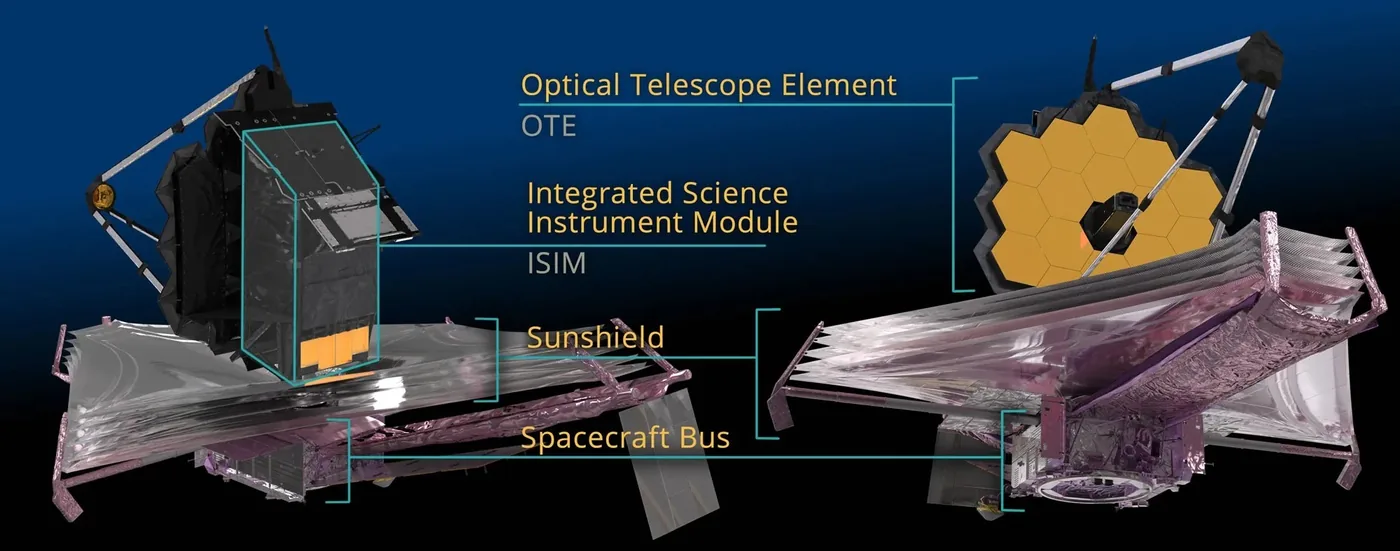
The Integrated Science Instrument Module, positioned behind the main mirror, carries four scientific instruments for infrared imaging and spectroscopy [7]. The Near-Infrared Camera, known as NIRCam, covers wavelengths from 0.6 to 5.0 microns and serves as the main imager. NIRCam detects faint starlight from early galaxies and carries coronagraphic masks to block star glare when imaging exoplanets [6]. Deputy project scientist Dr. Jonathan P. Gardner helped coordinate instrument requirements for these surveys [3].
Near-infrared spectroscopy is handled by the Near-Infrared Spectrograph, designated NIRSpec, which operates over wavelengths between 0.6 and 5.3 microns [4]. To observe hundreds of objects at once across dense star fields, NIRSpec features a microshutter array with roughly 250,000 tiny windows measuring 100 by 200 microns each [6]. Operators open individual shutters to admit light from targeted galaxies while blocking background sky noise [4]. This setup speeds up wide-field galactic surveys that once took months.
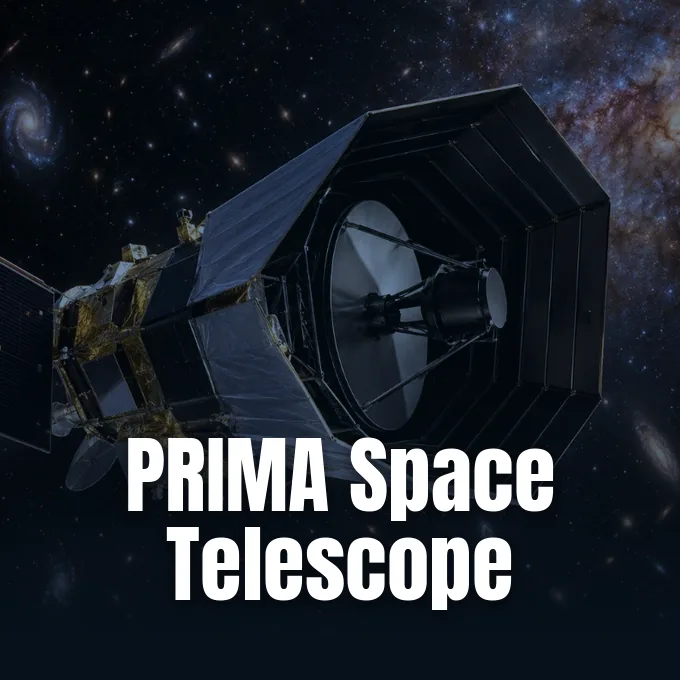
For longer infrared wavelengths, the Mid-Infrared Instrument, or MIRI, provides imaging and spectroscopy from 5.0 to 28.5 microns [5]. Passive cooling drops the instrument module to 40 kelvins, but MIRI’s arsenic-doped silicon detectors must operate below 7 kelvins to prevent internal thermal glow from blinding the sensors. To reach that cryogenic mark, the observatory uses a dedicated closed-cycle helium cryocooler that pumps chilled helium gas to the detectors. While Webb investigates near- and mid-infrared light, astronomers also prepare for complementary observations with the new NASA space telescope PRIMA in the far-infrared regime. The Canadian Space Agency (CSA) provided the Fine Guidance Sensor and NIRISS package to stabilize pointing and provide slitless spectroscopy [6].

Galaxies in Webb’s First Deep Field
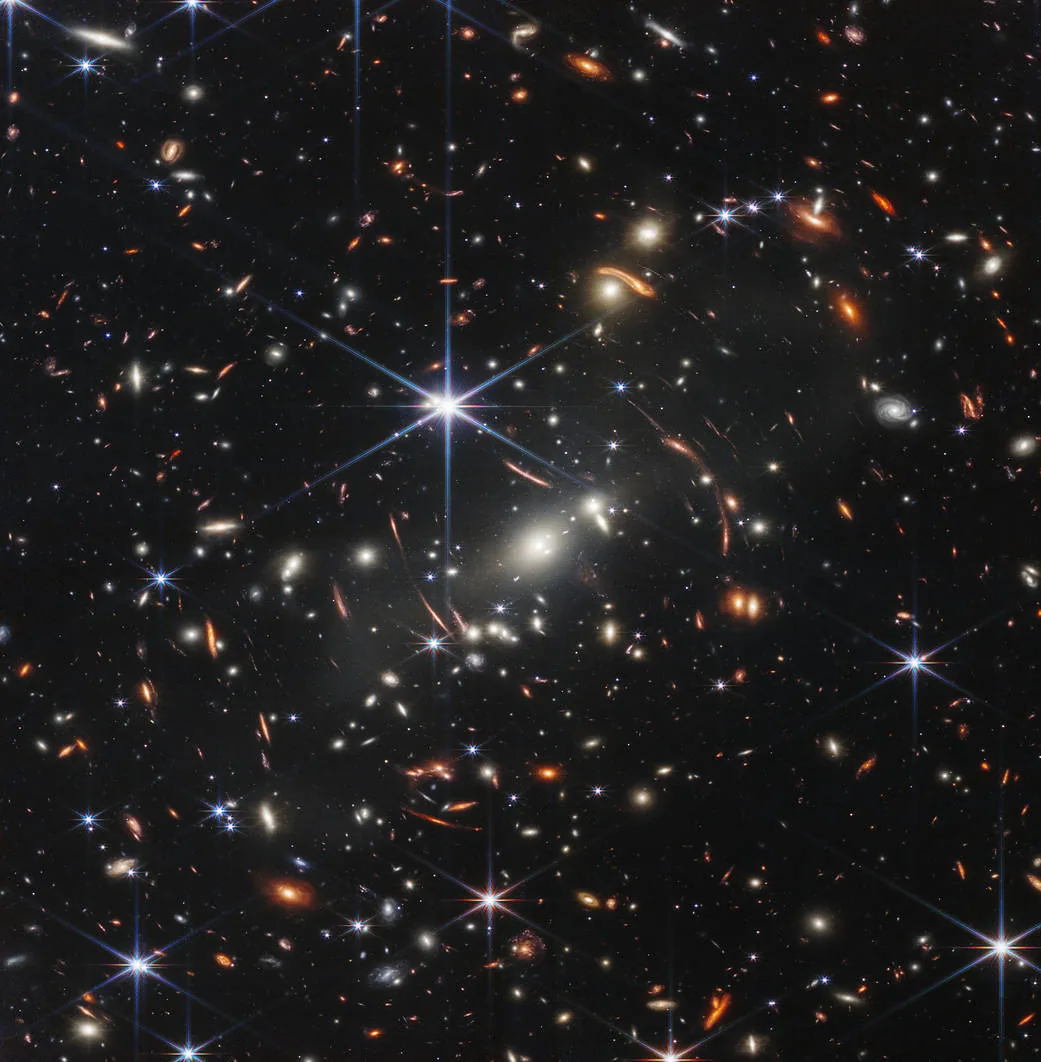
On July 11, 2022, U.S. President Joe Biden unveiled Webb’s First Deep Field during a White House event [8]. The image focused on galaxy cluster SMACS 0723 in the southern constellation Volans [11]. Light from that cluster traveled for 4.6 billion years before reaching the mirrors. By combining multiple NIRCam exposures taken across 12.5 hours of integration time, researchers created the deepest and sharpest infrared portrait of the early cosmos ever produced [8]. The patch of sky shown in the deep-field image covers an area comparable to a tiny sand speck held at arm’s reach by someone on the ground.
The immense mass of the foreground cluster produces a natural gravitational lens that bends and magnifies light from more distant galaxies located behind it. Webb’s optics brought these background objects into sharp relief, revealing clumpy, irregular structures rather than smooth spiral disks. Spectroscopic observations of objects in the field measured redshifts as high as 8.498, dating back to when early galaxies were merging [11]. While Hubble needed 11.3 days of exposure for its deep field, Webb achieved deeper sensitivity in only 0.83 days [6].
Point sources in these deep exposures display eight prominent diffraction spikes created by the telescope’s hardware layout. Six bright spikes arise from light diffracting around the edges of the 18 hexagonal primary mirror segments. Two fainter horizontal spikes originate from diffraction along the three struts holding the secondary mirror above the primary array [11]. In addition to deep fields, Webb’s instruments study exploded stars, complementing ground and space views of targets like the celestial Green Monster within stellar debris to track supernova expansion.
Atmospheric Data from Transiting Exoplanets
Beyond probing early cosmological history, Webb studies atmospheres surrounding worlds in other planetary systems [12]. When an exoplanet crosses in front of its parent star, starlight filters through the planetary atmosphere, leaving absorption signatures in the transmitted infrared spectrum. Astronomers use transit spectroscopy to identify the chemical fingerprints of gases floating in these distant skies. How do researchers tell whether distant worlds possess water or carbon? They identify molecular absorption features across NIRSpec and MIRI wavelength channels [9].
Webb applied transit spectroscopy to investigate sub-Neptune exoplanet K2-18 b, an alien world 8.6 times as massive as Earth located 120 light-years away in its star’s habitable zone. Observations detected spectral lines of carbon dioxide and methane, while showing a scarcity of ammonia in the atmosphere [12]. Because earlier space telescopes lacked the sensitivity to separate faint molecular features from stellar noise, Webb provides the first reliable chemical inventories for planets between Earth and Neptune in mass [1].

Within our solar system, Webb monitors outer planets, moons, and trans-Neptunian objects past Neptune’s orbit. Scientists examined Uranus to study its rings and identify a new orbiting moon, expanding the planet’s known family of satellites to 29 [12]. The instruments also inspect surface ices on Pluto and Eris to understand planetary formation.
JWST Mission Timeline and Partnership
The conceptual foundation of the observatory began in 1996 under the name Next Generation Space Telescope, envisioned as an infrared successor to Hubble. Early proposals in 1999 planned a four-meter mirror launching around 2007 for roughly one billion dollars, but scientific ambitions quickly expanded the project’s scale. A comprehensive redesign in 2005 selected the deployable 6.5-meter segmented beryllium mirror and multilayer sunshield architecture. Construction concluded in 2016, initiating five years of cryogenic vacuum testing that brought total project costs to approximately $10 billion. Prime contractor Northrop Grumman managed spacecraft assembly and mechanical testing before the observatory traveled by ship to French Guiana for launch operations [9].
The spacecraft honors James E. Webb, who led NASA as administrator from 1961 to 1968 during the Mercury, Gemini, and Apollo space programs [9]. The mission represents an international partnership between NASA, the European Space Agency (ESA), and the Canadian Space Agency (CSA) [8]. NASA Goddard Space Flight Center in Greenbelt managed telescope development, while ESA provided the Ariane 5 launcher along with instrument contributions [7]. The Space Telescope Science Institute in Baltimore directs flight science operations and archives all mission data [9].
On the official launch date of December 25, 2021, an Ariane 5 rocket launched the spacecraft from launch site ELA-3 in Kourou, French Guiana, at 07:20 a.m. EST (12:20 UTC) [7]. After a six-month deployment and optical commissioning period in deep space, the observatory entered full science operations with optical resolution outperforming original design baselines [1]. Today, data from Webb helps inform NASA Cosmic Origins mission planning as astrophysicists conceptualize future space observatories. With its 20-year fuel capacity, the telescope will continue revealing cosmic origins for decades [3].
- ACADEMIC JOURNAL Rigby, J., Perrin, M., McElwain, M., Kimble, R., Friedman, S., Lallo, M., Doyon, R., Feinberg, L., Ferruit, P., Glasse, A., Rieke, M., Rieke, G., Wright, G., Willott, C., Colon, K., Milam, S., Neff, S., Stark, C., Valenti, J.,. Adler, D. (2023). The Science Performance of JWST as Characterized in Commissioning. Publications of the Astronomical Society of the Pacific, 135(1046), 048001. [Article Link]
- ACADEMIC JOURNAL McElwain, M. W., Feinberg, L. D., Perrin, M. D., Clampin, M., Mountain, C. M., Lallo, M., Lajoie, C., Kimble, R. A., Bowers, C. W., Stark, C. C., Acton, D. S., Atkinson, C., Barinek, B., Barto, A. A., Basinger, S. A., Beck, T. L., Bergkoetter, M. D., Bluth, M., Boucarut, R. A.,. Carrasquilla, M. C. (2023). The James Webb Space Telescope Mission: Optical Telescope Element Design, Development, and Performance. Publications of the Astronomical Society of the Pacific, 135(1047). [Article Link]
- ACADEMIC JOURNAL Gardner, J. P., Mather, J. C., Abbott, R., Abell, J. S., Abernathy, M., Abney, F., Abraham, J. G., Abraham, R. G., Abul-Huda, Y. M., Acton, S. T., Adams, C. K., Adams, E., Adler, D., Adriaensen, M., Aguilar, J., Ahmed, M., Ahmed, N., Ahmed, T., Albat, R.,. Altenburg, M. (2023). The James Webb Space Telescope Mission. Publications of the Astronomical Society of the Pacific, 135(1048), 068001. [Article Link]
- ACADEMIC JOURNAL Jakobsen, P., Ferruit, P., Oliveira, C. A. d., Arribas, S., Bagnasco, G., Barho, R., Beck, T. L., Birkmann, S. M., Böker, T., Bunker, A. J., Charlot, S., Jong, P. d., Marchi, G. D., Ehrenwinkler, R., Falcolini, M., Fels, R., Franx, M., Franz, D. E., Funke, M.,. Jentsch, M. (2022). The Near-Infrared Spectrograph (NIRSpec) on the James Webb Space Telescope. Astronomy and Astrophysics, 661, A80. [Article Link]
- ACADEMIC JOURNAL Rieke, G. H., Wright, G. S., Böker, T., Bouwman, J., Colina, L., Glasse, A., Gordon, K. D., Greene, T. P., Güdel, M., Henning, T. K., Justtanont, K., Lagage, P., Meixner, M. E., Nørgaard-Nielsen, H. U., Ray, T. P., Ressler, M. E., Dishoeck, E. F. v., & Waelkens, C. (2015). The Mid-Infrared Instrument for the James Webb Space Telescope, I: Introduction. Publications of the Astronomical Society of the Pacific, 127(953), 584-594. [Article Link]
- WEBSITE NASA Science. (2022). Fact Sheet: James Webb Space Telescope. [Article Link]
- WEBSITE National Space Science Data Center. (2021). James Webb Space Telescope (JWST), NSSDCA/COSPAR ID: 2021-130A. NASA Goddard Space Flight Center. [Article Link]
- PRESS RELEASE NASA. (2022). President Biden Reveals First Image from NASA’s Webb Telescope. [Article Link]
- WEBSITE Wikipedia. (2026). James Webb Space Telescope. [Article Link]
- WEBSITE Wikipedia. (2026). James Webb Space Telescope sunshield. [Article Link]
- WEBSITE Wikipedia. (2026). Webb’s First Deep Field. [Article Link]
- WEBSITE NASA Science. (2024). James Webb Space Telescope Archives. [Article Link]


