





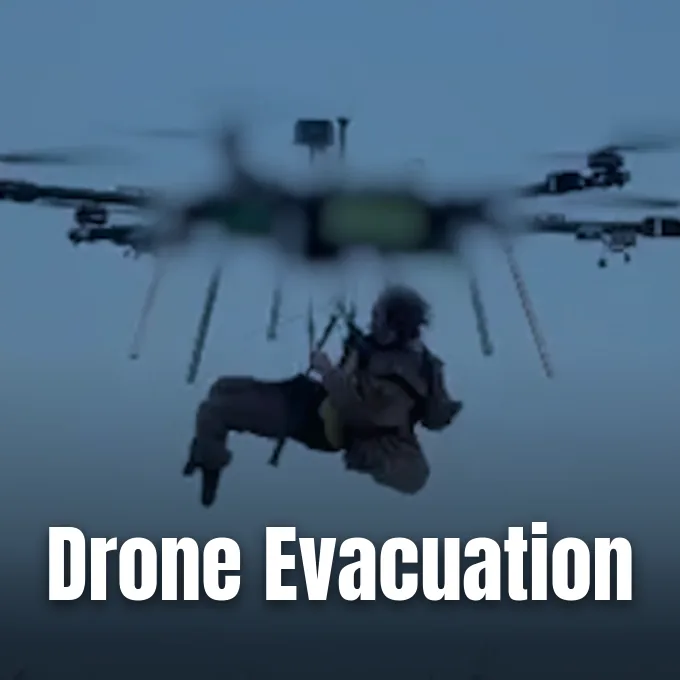
The Ukraine Army carried out a drone rescue of an injured soldier on the eastern Kharkiv front, using a heavy hexacopter to lift the wounded infantryman past Russian minefields and hostile surveillance patrols [1]. Footage released by the Ukraine Army and United24 news on October 19 confirmed that infantryman Kostya reached friendly territory safely and is now in stable condition while recovering in hospital [2].
How the Drone Rescue Unfolded
The mission started after Ukraine Army reconnaissance units spotted a 176-pound (80kg) infantryman known by his callsign Kostya stranded in open ground on the contested Kharkiv front. Media reports indicated Kostya was roughly 11 miles (18km) behind Russian lines, surrounded by active minefields and hunted by hostile kamikaze drones [2]. When hostile Russian loitering munitions watched every dirt path, sending a wheeled medical vehicle or a ground evacuation team into the sector was impossible [1].
Commanders in the Ukraine Army could not send wheeled ground robots because dense belts of anti-personnel and anti-vehicle mines blocked every approach route, a danger that The Kyiv Independent reported while detailing the frontline situation [1]. While earlier military drone operations in the conflict focused on reconnaissance and long-range attacks, such as when Ukrainian drone strikes targeted infrastructure inside Russia, Kharkiv front commanders chose to apply heavy multi-rotor craft to battlefield casualty retrieval instead. Trapped in a shell crater with Russian kamikaze drones circling overhead, Kostya agreed to become the first soldier to test the aerial evacuation system rather than face capture or death in the minefield [2].
Drone operators from the Ukraine Army drew up flight plans to pull Kostya out before Russian infantry found his exact position. The Kharkiv team tracked weather conditions and mapped out a low flight path through gaps in enemy detection nets [2]. Those preparations cleared the way [1]. The crew launched [2].
Harness Setup and Liftoff in the Field
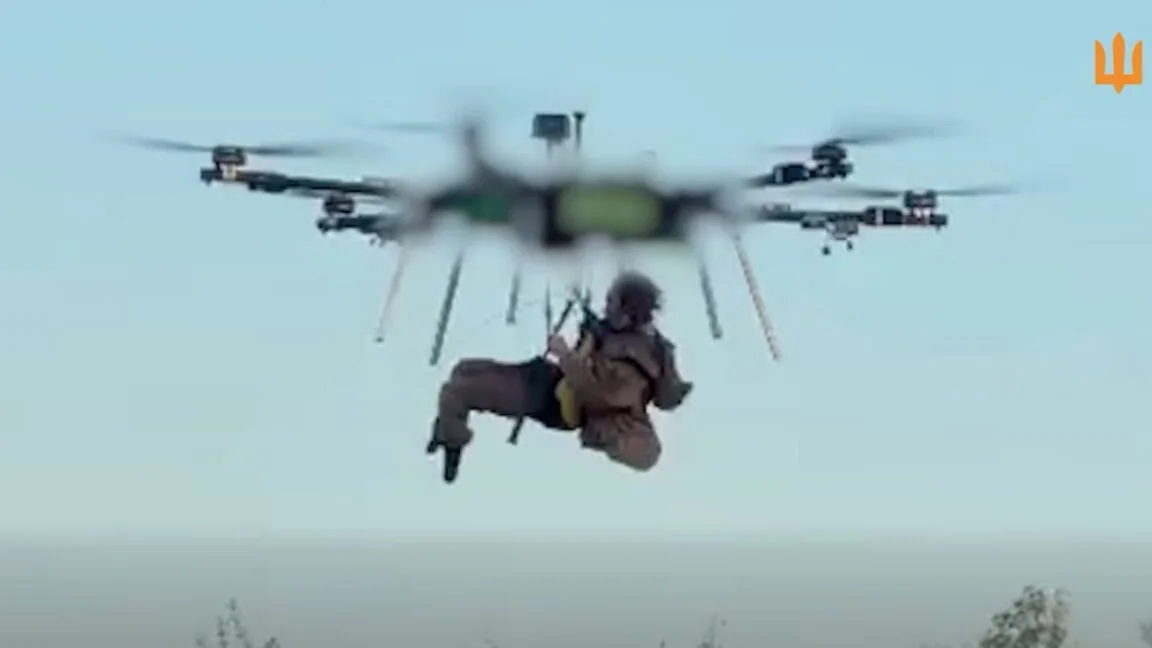
The hexacopter reached Kostya’s coordinates on the Kharkiv front and descended until a basic harness swung just above the grass near his position [2]. Despite his injuries, Kostya pulled the load-bearing straps around his chest and legs beneath the six spinning blades [1]. Once he secured the buckles, Kostya called out over the radio, saying, “That’s it, we can take off,” so the Ukraine Army control team knew he was ready [2].
A remote operator with the callsign Black, based in the 20th Mechanized Battalion of the 30th Infantry Brigade, handled the flight controls and monitored the link. “We were constantly in touch with him,” Black said in the United24 video. The pilot stayed calm. That direct link helped Black guide the craft smoothly off the grass [2].
Lifting a 176-pound (80kg) soldier into the air involved serious risks, including quick shifts in weight from a swinging passenger and the danger of rotor wash throwing Kostya against ground obstacles [2]. Kostya hung suspended beneath the fuselage with no protective cabin or backup parachute, leaving him open to Russian rifle fire during the ascent [1]. The hexacopter held its trim as it climbed above the trees and turned toward Ukrainian lines [2].


Drone Rescue Role of the Gurzuf Hexacopter
The aircraft chosen for this drone rescue was a heavy hexacopter manufactured by Gurzuf Defence, a Ukrainian developer that builds multi-rotor systems for the Ukraine Army. The Gurzuf Defence drone flies using six rotors and can carry up to 130kg (~287 pounds), giving it enough lift to haul an adult fighter carrying combat gear [2].
Before lifting Kostya from the Kharkiv battlefield, the Gurzuf Defence hexacopter had already proven its transport capacity by flying 90kg loads (~198 pounds) over distances of up to 25km (16 miles) during earlier logistics tests. The rescue flight required the Gurzuf Defence aircraft to carry the 176-pound (80kg) infantryman across an extraction distance reported at 8km (11 miles), a route that fell well within the tested operating limits of the machine. That flight margin gave Ukraine Army operators confidence that the battery systems would not fail while Kostya hung over Russian territory. It proved the airframe could manage the heavy load [2].
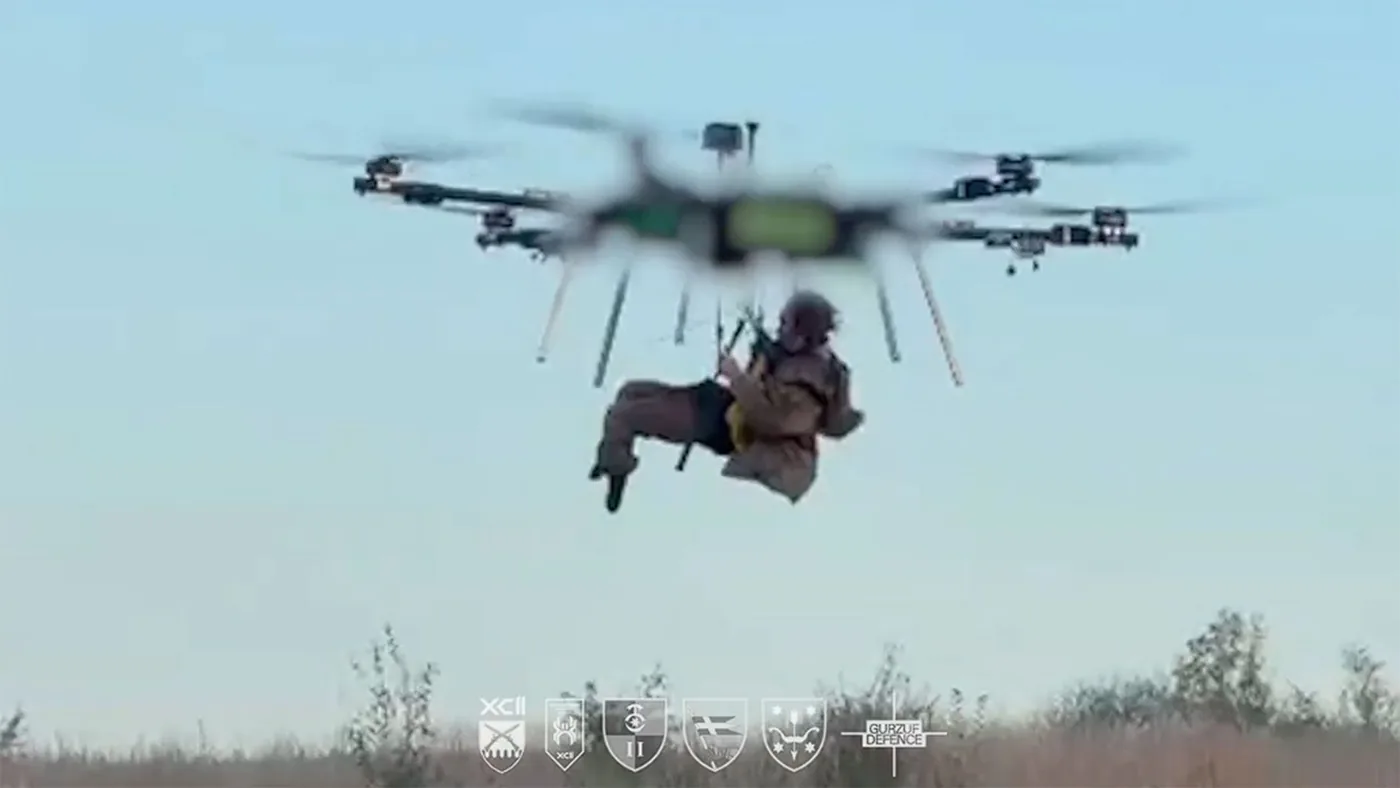
Because Gurzuf Defence designed the heavy aircraft primarily to drop munitions or deliver cargo, using it as an air ambulance was an improvised solution created under pressure [1]. The six rotors kept the Gurzuf Defence airframe stable despite strong crosswinds and the shifting load. It stayed on course [2].
Support UAV Escort and Safe Landing
A slow-flying hexacopter hauling a human passenger across open country is vulnerable to enemy fire, so the Ukraine Army deployed an escort fleet of smaller Ukrainian drones to protect the transport craft. This protective formation included strike models along with interceptor drones equipped with anti-drone nets to stop Russian quadcopters before they could attack. The support drones flew close to Kostya during the flight, watching the surrounding airspace for Russian aircraft [2].
The hexacopter crossed back into Ukrainian territory without taking hits from Russian small arms or interceptor craft, gradually descending toward a farm field behind the Kharkiv defensive line. Ukraine Army command bunker staff watched the live video feed as Kostya touched the ground, and a radio controller told him: “Congratulations, you’re on the ground”. Personnel inside the bunker broke into loud applause as soon as Kostya reached the turf [2].

The team moved quickly. Ukraine Army support teams reached the landing zone right away to unhook Kostya from the harness and move him onto a stretcher. Operator Black praised the collective effort of the pilot crews and ground spotters, saying: “A lot of people were involved, and everything worked out for us”. Kostya was moved to a military hospital, where doctors confirmed he is recovering from his injuries. Kostya survived the flight [2].
Testing Medical UAVs for Frontline Evacuation
Ukraine Army soldiers see this mission as a turning point that proves heavy unmanned aircraft can solve medical evacuation problems under fire. A software specialist and drone operator known by the callsign Napalm, who works in the unmanned ground systems company of the 92nd Separate Assault Brigade, spoke about the flight. “This is a historic event, the next stage of evacuating the wounded, which we will all come to,” Napalm said in an official military statement [1].
The Kharkiv rescue took place just days after separate Ukrainian drones built specifically for medical extraction reached the front for combat testing, showing how urgent battlefield needs turn experimental tech into working gear. For decades, the United States armed forces studied unmanned casualty evacuation concepts, building prototypes and running trial flights in controlled environments, but United States military units never deployed a drone to lift a wounded soldier out of an active combat zone. Wartime necessity pushed Ukraine Army commanders to try what other militaries had kept in testing labs, proving that heavy multi-rotor craft can retrieve trapped fighters when landmines and Russian artillery block ground ambulances [1].
Ukraine Army leaders now aim to expand these emergency flights into a standard evacuation option in active combat sectors. As Napalm said when outlining the next steps for the 92nd Separate Assault Brigade: “Now the serious systematic work begins, so that such missions are carried out constantly”. Frontline units plan to refine flight protocols and harness designs to make every future drone rescue faster and safer [1].
- ONLINE NEWS Ars Technica. (2026). Ukraine’s drone rescue of wounded soldier puts much touted idea into practice. [Article Link]
- ONLINE NEWS Tyson, M. (2026, October 20). Ukraine rescues wounded soldier using drone in daring ‘world’s first’ UAV evacuation of a human. Tom’s Hardware. [Article Link]


