






Ukrainian drone operators struck a major Yandex computing facility in Kaluga on Friday, knocking multiple modules out of service at the largest data center campus in Russia [1]. The site, which opened in the second half of 2023, houses core cloud systems and supercomputers used to train artificial intelligence models for the search company often called Russia’s Google [2]. It’s now the second time in two days that unmanned aircraft have hit Russian server hubs, following an earlier raid on a facility in Sasovo. Russian state media confirmed that several sections stopped running after the UAV strike, leaving online systems disrupted as Ukraine drones strike Russia in a widening air campaign [1].
How Ukraine Drones Attack Russia
The strike hit the Kaluga campus early on Friday morning. That raid followed closely after another drone attack against a Yandex data center in Sasovo, which caused a major outage for millions of web users who depend on search, cloud storage, and mobile payment tools. Although Yandex told the public that its main platforms didn’t shut down, people in Moscow and other cities reported disruption with Yandex Mail, Disk, Documents, Pay, and Market. The tight sequence shows how Ukraine drones attack Russia by focusing on the computing backbone that keeps Russian web services running from day to day [1].
Russian state media acknowledged the impact. The state news agency TASS quoted company representatives who said that several operating sections were taken offline after the drones hit the property. Specifically, TASS reported: “Several modules of the Yandex data center in Kaluga have been completely taken out of operation as a result of a UAV attack, [Yandex] reports.” That admission was unusually blunt for official channels that rarely broadcast industrial damage, and it showed that the impact was far more serious than an ordinary utility failure or brief network glitch [1].
Whether military planners selected the data center intentionally hasn’t been confirmed yet. Drone pilots might have targeted the industrial park deliberately, but it’s also possible that electronic warfare defenses threw the aircraft off course before they hit the server buildings. Oliver Haslam, who reported the incident for Tom’s Hardware, said that more than 3,800 server racks were housed inside the facility, explaining why the campus stood out on navigation maps. When long-range drones fly hundreds of kilometers into defended territory, hitting such a huge target causes serious problems for network engineers who must reroute traffic under emergency conditions [1].
Scale of the Kaluga Campus
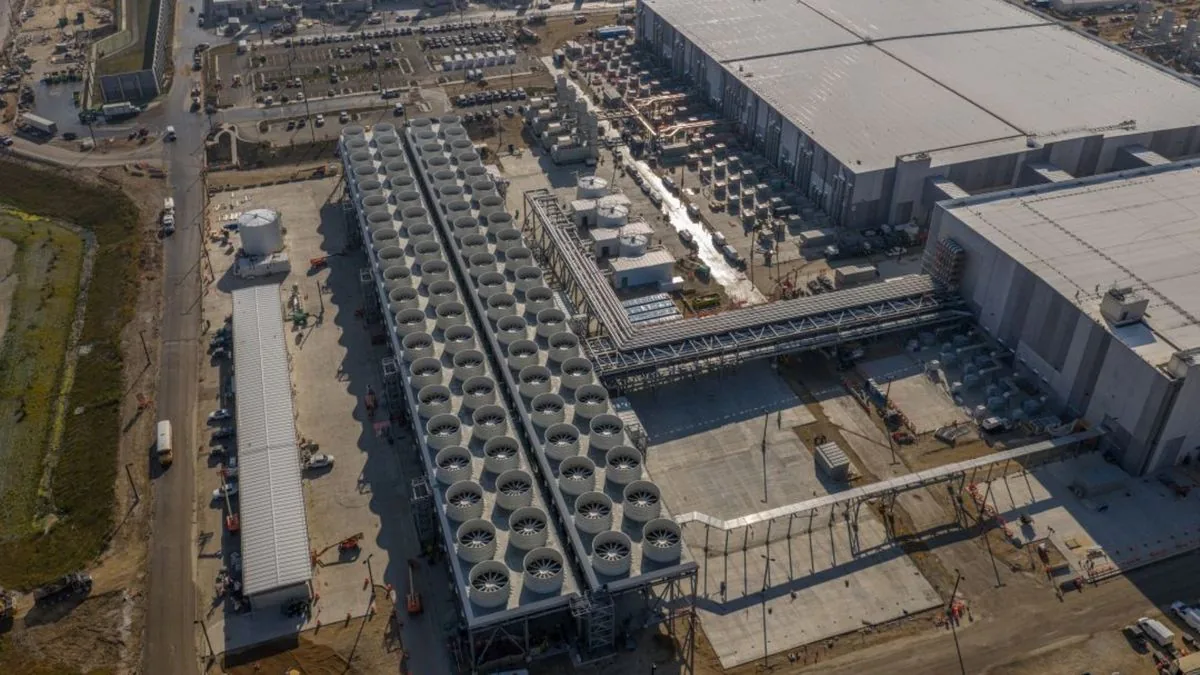
The Kaluga site is vast. It sits inside Grabtsevo industrial park, where engineers constructed the company’s biggest server installation nationwide. Construction wrapped up in late 2023. The site had run for roughly three years before the drones penetrated the perimeter, spreading across around 1.4 million square feet (roughly 130,000 square meters) of building space to give Yandex room for thousands of high-density computers under a single roof [1].
Keeping servers running at Kaluga takes an enormous electrical supply. The facility draws 63 megawatts (63 MW). That power capacity is about 50% higher than older data centers owned by Yandex in Russian cities, generating intense heat from thousands of compute blades that needs heavy cooling loops and backup substations that can fail when explosives detonate nearby. If cooling systems fail or power lines burn, engineers have to shut down entire rows of machinery before excessive heat damages expensive chips [1].
Kaluga holds over 3,800 server racks. Inside the halls, server frames host Yandex cloud infrastructure and in-house digital platforms. While ordinary web servers handle routine page visits, these dense clusters run machine learning jobs and distributed databases that support millions of Russian users every single day. Replacing broken server frames and fried circuit boards won’t be a simple job, especially while foreign trade sanctions restrict Russia’s access to modern semiconductors that technicians need to restore service [1].


When Ukraine Drones Strike Russia
The incident points to an evolving phase of conflict as Ukraine drones strike Russia far from border trenches. Early in the fighting, long-range drone raids hit fuel storage tanks, ammunition dumps, and frontline airfields. Attacking computing centers marks a noticeable change in drone tactics. When server buildings lose power, the disruption can stall delivery tracking, interrupt communications, and freeze automated schedules that factories count on for daily dispatches [1].
Reporting from United24 Media said that the Kaluga facility was built to anchor the growth of Russian cloud systems. Yet defending such a huge compound during wartime brings difficult security challenges, because server campuses can’t be hidden under concrete bunkers or moved when threats appear. Cooling units must stay exposed. If even one drone slips through air defense systems and strikes an electrical substation, the whole site can lose electricity in moments [1].
Beyond regular cloud storage, the Kaluga center also housed high-end hardware for artificial intelligence development. A report from Ars Technica pointed out that one of the damaged data centers had supercomputers used for training Yandex’s AI model. Neural network training takes weeks. Because Russia faces strict trade bans on high-end AI chips, replacing damaged graphic processors will probably prove much harder than buying ordinary storage drives [2].
Cloud Services Face Outage Pressure
The damage in Kaluga quickly created concern about how much trouble Russian consumers and local firms will face in coming weeks. After the Sasovo raid two days earlier, users in western Russia posted thousands of complaints about failed file syncs, rejected card transactions, and frozen mailboxes. Outages spread across western cities. When two major data centers suffer damage within forty-eight hours, even well-planned backup networks struggle to carry the sudden burden [1].
Targeting server centers shows how modern conflict has expanded from software hacking into physical attacks on digital equipment. While peaceful international projects like the UN Data Commons platform unify global statistics for artificial intelligence research, armed conflict turns computing centers into primary military targets. Server clusters aren’t neutral civilian assets. Military planners see them as command infrastructure supporting logistical planning and state communications, making them obvious targets for long-range drone units [1].

Repairing damaged hardware modules at a large data center creates tough problems for on-site engineers. Fine soot can ruin delicate motherboards. Technicians have to inspect blackened wiring, clean delicate motherboard contacts, and ensure that fiber optic cables didn’t crack under the shockwave. With several working sections disabled at Kaluga, Yandex engineers face a lengthy repair effort while worrying that more strikes could follow [1].
Mounting Strikes on Digital Infrastructure
The strikes on Yandex sites in Kaluga and Sasovo belong to a growing exchange of attacks against digital infrastructure in both countries. Earlier this month, Russian missiles hit a Ukrainian communications center, knocking the world’s second-largest torrent tracker offline and snarling web traffic for days. Ukrainian forces answered by flying long-range drones into Russian airspace to strike valuable commercial computing centers. As Ukraine drones strike Russia deep behind front lines, computing hubs that once seemed protected from battle damage are finding themselves squarely in the line of fire [1].
The economic cost of disabled cloud centers goes well beyond temporary software bugs for ordinary web users. Companies depend on cloud databases to manage payroll runs, monitor warehouse stock, handle client inquiries, and run transport schedules throughout each working day. Work halts when databases fail. For Russia, whose economy is already dealing with wartime sanctions and shortages, recurring outages across the internet sector threaten to make existing industrial friction even worse [1].
Looking forward, the destruction inside massive facilities like Kaluga could push Russian tech firms to reconsider how they build their computing networks. Centralized infrastructure creates a fragile single point of failure when long-range loitering drones can fly hundreds of kilometers undetected. Building a distributed network of smaller server hubs takes years. Distributing server capacity across dozens of smaller sites would make digital networks much harder to take down, yet building those decentralized centers takes years of heavy spending and needs microprocessors that Russian firms can’t buy easily under foreign trade restrictions. Until defensive batteries can shield industrial areas with certainty, cloud platforms in Russia will remain exposed to precision strikes [1].
- ONLINE NEWS Haslam, O. (2026, October 10). Ukrainian drones strike largest data center in Russia, multiple parts of 1.4 million square foot campus knocked offline. Tom’s Hardware. [Article Link]
- ONLINE NEWS Ars Technica. (2026, October 11). Ukraine’s drones knock out AI data center belonging to “Russia’s Google”. Ars Technica. [Article Link]


