



APA 7: TWs Editor. (2023, November 17). Exploring the Enigmatic Terrain of Mercury: Salt Glaciers, Ancient Atmosphere, and Astrobiology’s Uncharted Horizons. PerEXP Teamworks. [News Link]
Alexis Rodriguez, the lead author of the paper titled “Mercury’s Hidden Past: Revealing a Volatile-Dominated Layer through Glacier-like Features and Chaotic Terrains” in the Planetary Science Journal, points out that their discovery aligns with recent research indicating nitrogen glaciers on Pluto. This suggests that the glaciation phenomenon spans across the entire temperature spectrum within our solar system, from the hottest to the coldest regions. The significance lies in these locations serving as key markers, identifying areas with rich volatile content across various planetary landscapes.
According to co-author Travis, the glaciers on Mercury, which differ from those on Earth, are traced back to Volatile Rich Layers (VRLs) that lie deeply buried beneath the surface. These layers were brought to light through asteroid impacts. The team’s models strongly support the idea that the glaciers formed due to the flow of salt. Furthermore, after their formation, these glaciers retained volatile substances for a period extending beyond 1 billion years.
The discussion highlights that certain salt compounds on Earth contribute to the creation of habitable environments, even in harsh conditions like the arid Atacama Desert in Chile. This concept prompts consideration of the possibility that subsurface areas on Mercury may offer a more hospitable environment than its challenging surface.
Additionally, Rodriguez introduces the idea of these subsurface areas on Mercury serving as depth-dependent ‘Goldilocks zones.’ This analogy draws parallels to the habitable region around a star where the presence of liquid water could support life, but in this case, the emphasis is on the appropriate depth below the planet’s surface rather than the distance from a star. The groundbreaking discovery of glaciers on Mercury expands our understanding of the environmental factors that could sustain life. This adds a crucial dimension to astrobiology exploration and holds relevance for assessing the potential habitability of exoplanets with characteristics similar to Mercury.
This finding disrupts the conventional notion of Mercury being largely lacking in volatile substances and strengthens the recognition of Volatile Rich Layers (VRLs), possibly concealed in the planet’s subsurface.
The glaciers on Mercury are identified by a intricate arrangement of hollows, forming extensive and relatively recent sublimation pits. These hollows showcase depths that constitute a substantial portion of the overall glacier thickness, indicating a substantial retention of a composition rich in volatile substances.
Significantly, these hollows are notably absent from the adjacent crater floors and walls. This absence provides a coherent explanation for a previously perplexing phenomenon: the correlation between hollows and crater interiors. The proposed solution suggests that groupings of hollows within impact craters may originate from zones of Volatile Rich Layer (VRL) exposures induced by impacts. This hypothesis clarifies a long-standing mystery that has confounded planetary scientists.
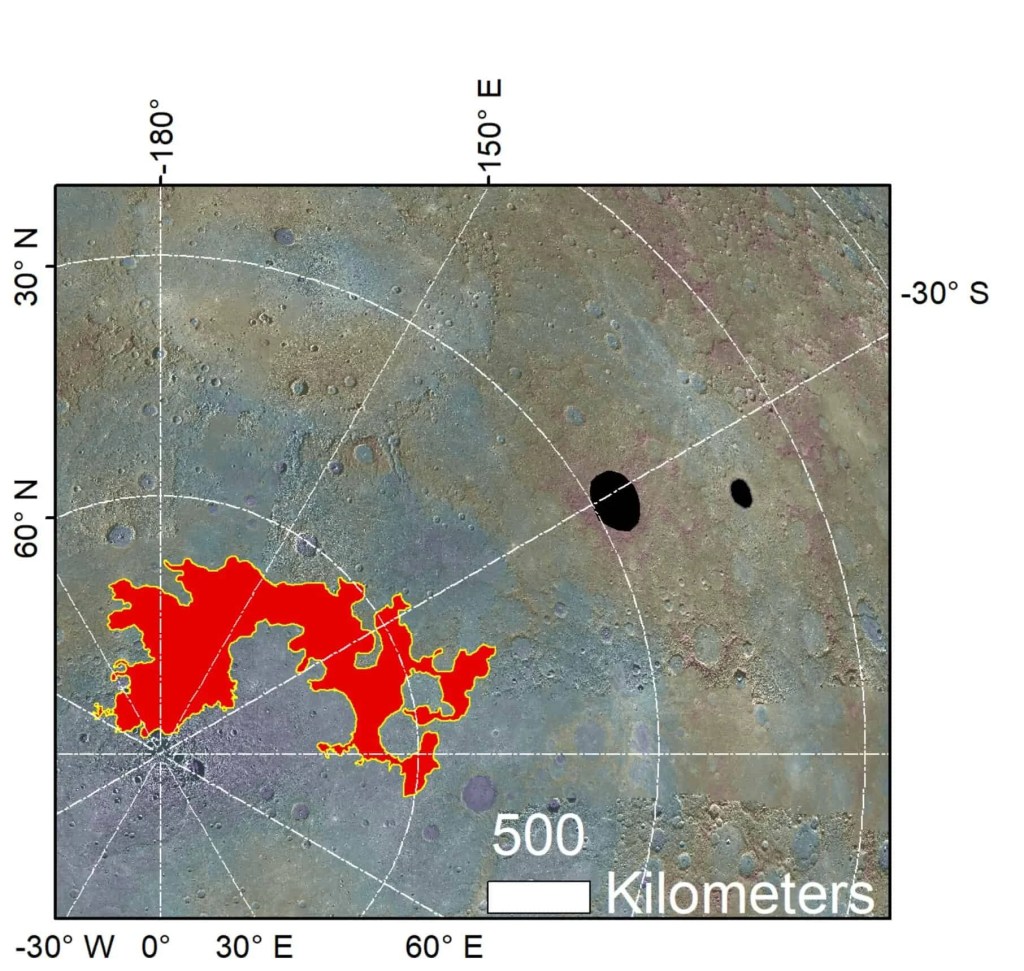
The central mystery surrounding Mercury involves understanding how its glaciers and chaotic terrains originated, particularly the mechanism behind the formation of Volatile Rich Layers (VRLs). The research introduces a model that integrates recent observational data to address this question, focusing on the Borealis Chaos in Mercury’s north polar region.
This specific area, Borealis Chaos, exhibits intricate patterns of disintegration that have erased entire populations of craters, some dating back approximately 4 billion years. Beneath this collapsed layer lies an ancient, cratered paleo-surface, previously identified through gravity studies. The juxtaposition of the fragmented upper crust, now forming chaotic terrain, over this gravity-revealed ancient surface suggests that the VRLs were placed atop an already solidified landscape.
These findings challenge conventional theories of VRL formation, which typically centered on mantle differentiation processes involving the separation of minerals into different layers within the planet’s interior. Instead, the evidence suggests a grand-scale structure, possibly originating from the collapse of a fleeting, hot primordial atmosphere during Mercury’s early history. This atmospheric collapse might have occurred predominantly during extended nighttime periods when the planet’s surface was shielded from the sun’s intense heat.
The proposed idea of underwater deposition challenges previous notions about Mercury’s early geological history. In this scenario, water released through volcanic degassing could have temporarily created pools or shallow seas of liquid or supercritical water, resembling a dense, highly salty steam. This environment would have facilitated the settling of salt deposits, contributing significantly to the formation of a salt-dominated Mercurian VRL.
According to co-author Kargel, the process involved the swift depletion of water into space, coupled with the entrapment of water in hydrated minerals within the crust. This sequence of events would have resulted in the formation of a layer dominated by salt and clay minerals, gradually accumulating into thick deposits over time.
Resources
- NEWSPAPER Fischer, A. & Planetary Science Institute. (2023, November 17). Unveiling Mercury’s geological mysteries: Salt glaciers, primordial atmosphere, and the new frontiers of astrobiology. Phys.org. [Phys.org]
- JOURNAL Rodriguez, J. A. P., Domingue, D., Travis, B., Kargel, J. S., Abramov, O., Zarroca, M., Banks, M. E., Weirich, J., Lopez, A., Castle, N., & diğerleri. (2023). Mercury’s Hidden Past: Revealing a Volatile-dominated Layer through Glacier-like Features and Chaotic Terrains. The Planetary Science Journal, 4(11). [The Planetary Science Journal]


