





Specialized experimental facilities give research teams controlled environments to test aerospace propulsion, advanced materials, and civil infrastructure, filling empirical gaps because computer models cannot fully capture complex fluid turbulence, seismic ground shaking, or neutron damage. Laboratories at major universities and government centers maintain hardware to expose test articles to extreme heat, sound, and mechanical stress. By running physical tests on scale models, engineers gather the empirical baseline data needed to build safer commercial aircraft, resilient bridges, and durable nuclear power systems [1].
- Aeroacoustic Testing at NASA Glenn Research Center
- Propulsion Rigs in Wind Tunnel Experimental Facilities
- Synchrotron Beamlines at Berkeley Lab
- Shared Experimental Facilities for Advanced Materials
- Hazard Simulation Laboratories for Civil Infrastructure
- In-Core Irradiation Capabilities at the MIT Reactor
Aeroacoustic Testing at NASA Glenn Research Center
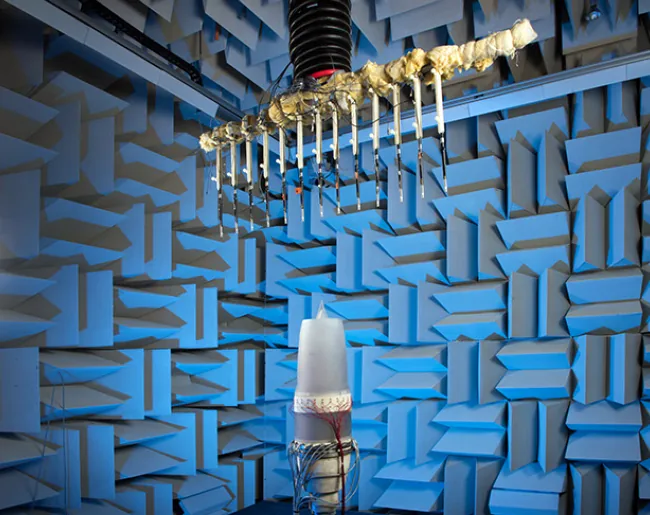
At the NASA Glenn Research Center in Ohio, researchers study aircraft engine aerodynamics and acoustics to cut community noise near busy airports. The 9- by 15-Foot Low-Speed Wind Tunnel simulates takeoff and landing conditions under controlled airflow. Engineers finished major modifications in 2019 to improve flow quality and lower background sound, allowing a new five-sensor traversing microphone rake to measure acoustic output from scale propulsors during landing operations [1].
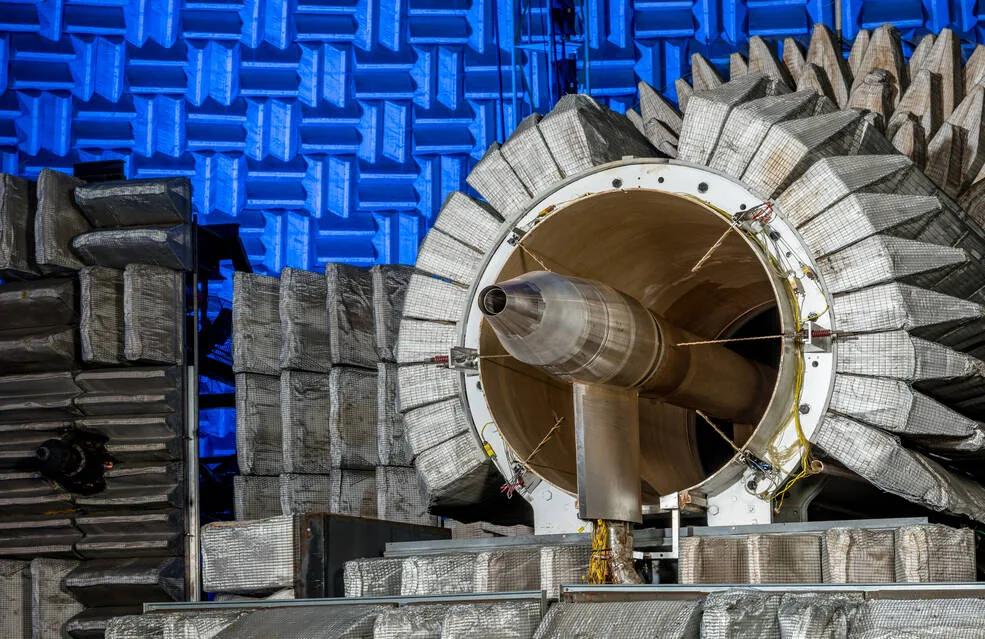
A larger facility at the center is the Aero-Acoustic Propulsion Laboratory, known as AAPL, which features a 65-foot radius geodesic dome built in 1993. It was the first known free-standing dome to use special materials to absorb sound within its structure. Inside the dome, workers mounted 17,000 custom-designed fiberglass wedges, each two feet thick, along the interior walls and floor to absorb acoustic energy and prevent reflections during engine runs. The test floor operates as an anechoic chamber or a hemi-anechoic space. Nearby, the Acoustical Testing Laboratory uses dense rubber walls and 34-inch deep fiberglass wedges that absorb 99% of incident sound above 100 Hz to test space station hardware and cabin fans [1].
The acoustical testing laboratory evaluates scale models of supersonic aircraft engine inlets, electric motors, and acoustic liners, while technicians isolate noisy operating gear in a separate control room during sensitive acoustic runs. Staff at NASA Glenn have used these quiet chambers to calibrate sensitive microphones and evaluate over-the-wing engine placement, an arrangement that shields ground communities from jet exhaust noise during flight [1].

Propulsion Rigs in Wind Tunnel Experimental Facilities
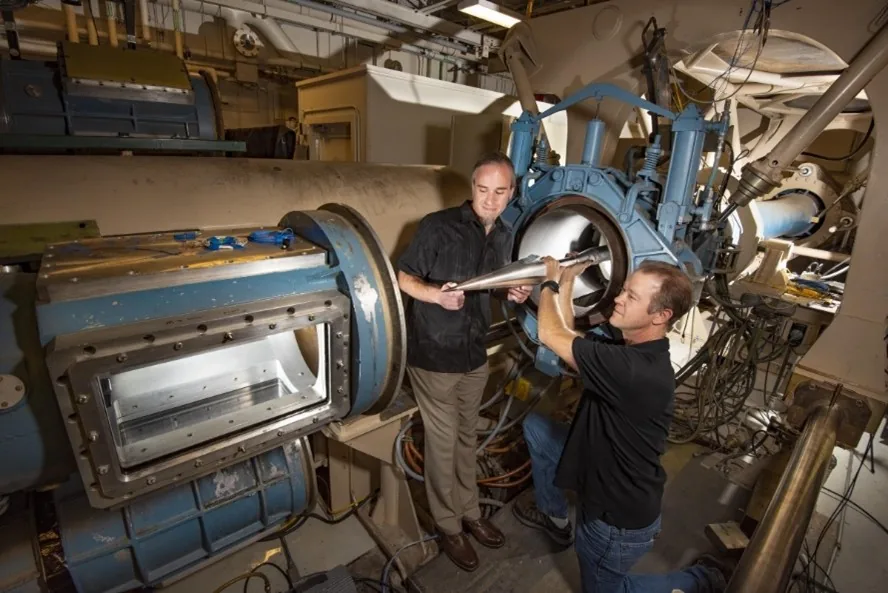
Inside the AAPL dome, engineers rely on the Small Hot Jet Acoustic Rig to link nozzle geometry with exhaust flow and noise. The rig tests single-stream nozzles up to 5 cm in diameter at speeds reaching Mach 2.0 and gas temperatures of 800 K. In 2006, researchers used the first time-resolved particle image velocimetry on this rig to map velocity correlations, unlocking new data on turbulence convection speeds in hot gas streams [1]. Plume interactions with flaps create distinct noise.
The Nozzle Acoustic Test Rig operates as a free-jet wind tunnel that simulates flight speeds up to Mach 0.35 during takeoffs and landings. Over its 30-year testing history, the rig has tested both military and commercial nozzles. Notably, chevron nozzles now seen on modern airliners were first discovered during a NASA test campaign in 1997. Overhead microphone arcs measure acoustic waves at multiple angles, while the nearby DART test bed uses a DGEN 380 Aeropropulsion Research Turbofan to evaluate core-noise propagation with infinite-tube probes during extended test runs [1].
Related aerodynamic research takes place in New Mexico. At Sandia National Laboratories, researchers operate the Engineering Sciences Experimental Facilities to study fluid flow, heat transfer, and aerodynamics under severe flight conditions. These experimental facilities focus on advanced optical diagnostics that help teams understand how air and heat move across high-speed surfaces during atmospheric flight [3].
Synchrotron Beamlines at Berkeley Lab
At Lawrence Berkeley National Laboratory in California, the Engineering Division partners to design, build, and run the Advanced Light Source, a synchrotron light user facility backed by the Department of Energy Basic Energy Sciences Program. Its more than 40 beamlines produce bright X-ray beams that serve over 2,000 users annually across physical and life sciences [4].
Nuclear physics research at the site centers on the 88-Inch Cyclotron. This particle accelerator produces heavy ion beams for research in nuclear structure, astrophysics, heavy element synthesis, and technology testing. Engineering teams design custom magnets, build vacuum components, and upgrade electrical power systems to keep the machine operating around the clock during complex heavy element experiments [4].
Laser-driven acceleration is another focus at Berkeley Lab. The Berkeley Lab Laser Accelerator Center, known as the BELLA Center, develops laser-plasma electron accelerators for high-energy physics. Engineers at the Engineering Division build custom laser systems, design plasma chambers, and install vacuum beamlines for plasma experiments. By using intense laser pulses to drive wakefields in plasma, researchers accelerate electron bunches to gigaelectronvolt energies in a few centimeters rather than kilometers [4].


Shared Experimental Facilities for Advanced Materials
University campuses also pool complex instrumentation into shared experimental facilities to support multidisciplinary materials science. At Harvard University, the Materials Research Science and Engineering Center operates shared laboratories for academic and industrial researchers. The center maintains a Thermal Analysis Facility with differential scanning calorimeters and thermogravimetric analyzers, as well as mechanical testing frames from Instron and rheological tools. For imaging, investigators use confocal microscopes, wide-field microscopes, and high-speed cameras to inspect structural changes. Such equipment helps scientists examine the microscopic structure of novel substrates like electronic soil that benefits plants under regulated laboratory conditions. Postdoctoral and graduate student super-users train new operators on each machine [2].
Harvard also hosts the Center for Nanoscale Systems, which belongs to the National Nanotechnology Coordinated Infrastructure. The facility offers electron microscopy tools such as scanning transmission electron microscopes, focused ion beam stations, and sample preparation equipment. Cleanroom bays support soft lithography, electron-beam lithography, atomic layer deposition, and reactive ion etching. In analytical labs, staff operate X-ray photoelectron spectroscopy, atomic force microscopy, and atom probe tomography to map elements at atomic scales. When local tools are full, users turn to the Materials Research Facilities Network [2].
At Westlake University, laboratory teams maintain specialized hardware for electrochemical and energy storage research. The university provides shared platforms through the Instrumentation and Service Center for Physical Sciences and the Instrumentation and Service Center for Molecular Sciences. Researchers use battery testing systems, gloveboxes, tube furnaces, and analytical balances with precision down to 0.00001 grams, linking their measurements to the High-Performance Computing Center and broad energy models to forecast battery performance [5].
Hazard Simulation Laboratories for Civil Infrastructure
Civil infrastructure faces rising threats from earthquakes, hurricanes, and coastal flooding. To study these forces, the National Science Foundation funds the Natural Hazards Engineering Research Infrastructure network across seven universities. At Florida International University, the Wall of Wind facility generates hurricane-force airflows to test full-scale building roofs, walls, and cladding panels. Meanwhile, Lehigh University uses cyber-physical simulation to combine large-scale physical testing of building frames with multi-directional computer models of soil-foundation interactions under simulated earthquake stresses [6].
Coastal and seismic hazards require specialized physical simulators. The O.H. Hinsdale Wave Research Laboratory at Oregon State University, established in 1972, operates two large-scale wave flumes to test coastal defenses against tsunami waves and storm surges. For underground soil dynamics, the Center for Geotechnical Modeling at the University of California, Davis provides geotechnical centrifuges that spin soil models under high gravitational loads to simulate earthquake liquefaction. At the University of California, San Diego, investigators use the LHPOST6 outdoor shake table to subject multi-story structures to realistic six-degree-of-freedom earthquake motions. Damping systems tested on such shake tables share design principles with aerospace shock isolators, including a Swiss engineering design developed to cushion spacecraft payloads during violent launches [6].
Wind and ground shaking receive further study in Florida and Texas. The University of Florida operates a boundary layer wind tunnel at the Powell Family Structures and Materials Laboratory to measure wind pressures on varied building shapes. In Texas, researchers at UT Austin operate large mobile dynamic shakers that travel directly to bridges and dams for in situ field testing. Looking ahead, NSF is planning two future facilities: NICHE for full-scale testing against extreme wind, surge, and waves, and NEWRITE for tornado and downburst simulations [6].
In-Core Irradiation Capabilities at the MIT Reactor
Testing materials for extreme radiation environments requires specialized nuclear reactors. The MIT Nuclear Reactor Laboratory operates experimental facilities designed for neutron physics, gamma irradiation, and material testing. In-core experiments fit inside sample capsules within an inert gas-filled irradiation tube at temperatures up to 900 °C. The core also accommodates forced-circulation coolant loops that replicate the pressurized and boiling conditions of commercial power reactors, as well as custom rigs for molten fluoride salts. In-core test spaces measure roughly 1.8 inches in diameter by 24 inches long. These positions deliver a thermal neutron flux of 3.6 × 10¹³ neutrons per square centimeter per second and a fast neutron flux of 1.2 × 10¹⁴ neutrons per square centimeter per second [7].
Beyond the reactor core, surrounding radial beam ports ranging from 4 inches to 12 inches in diameter support neutron scattering and elemental analysis, while two pneumatic tube systems designated 1PH1 and 2PH1 rapidly shuttle small sample capsules into high-flux positions near the fuel elements. For post-irradiation examination, technicians use shielded hot cells, a helium-filled glove box with a high-temperature furnace, and electron microscopy equipment to examine radioactive components safely. Researchers also use the spent fuel pool for gamma irradiation experiments [7].
- WEBSITE Koch, L. D., & Koppitch, A. (2026, October 19). Experimental facilities: Acoustics. NASA Glenn Research Center. [Article Link]
- WEBSITE Harvard Materials Research Science and Engineering Center. (2026). Experimental facilities. Harvard University. [Article Link]
- WEBSITE Sandia National Laboratories. (2023, April 4). Engineering Sciences Experimental Facilities (ESEF). [Article Link]
- WEBSITE Berkeley Lab Engineering Division. (2025, August 1). Experimental facilities. Lawrence Berkeley National Laboratory. [Article Link]
- WEBSITE Westlake University. (2023). Experimental facilities. [Article Link]
- WEBSITE Natural Hazards Engineering Research Infrastructure. (n.d.). NHERI experimental facilities. DesignSafe-CI. [Article Link]
- WEBSITE MIT Nuclear Reactor Laboratory. (2025). Facilities. Massachusetts Institute of Technology. [Article Link]
APA 7: PerEXP Teamworks. (2026, October 20). Research Laboratories Use Experimental Facilities for New Testing.


