






A stream of fast solar wind originating from a solar coronal hole kept geomagnetic activity at unsettled Kp 4 index levels across late September 2026. While charged solar particles stirred high-latitude skies and prompted discussions regarding environmental influences on human vitality, experimental biologists at the University of Nottingham examined how background magnetic forces govern living cells [1]. By shielding genetic animal models inside specialized metal chambers, researchers discovered that removing ambient planetary magnetism directly alters mitochondrial stress and physical lifespan [2].
- How Fast Solar Wind Drives Geomagnetic Activity
- What Happens When High-Speed Solar Wind Hits Earth?
- Can Geomagnetic Disturbances Influence Human Health?
- Laboratory Shielding Isolates Earth’s Natural Magnetic Influence
- Why Did Magnetic Shielding Alter Fly Lifespan?
- Cellular Energy Responds to Vanishing Magnetic Fields
How Fast Solar Wind Drives Geomagnetic Activity
Streams of charged plasma escaping from open solar magnetic field lines create the fast solar wind that travels outward across interplanetary space. Solar observers at the NOAA Space Weather Prediction Center tracked this coronal hole high-speed stream as it accelerated directly toward Earth’s orbital path. Because coronal holes lack closed magnetic loops, the resulting particle flow compresses the interplanetary magnetic field and disturbs planetary magnetospheres over several consecutive days [1].
Active sunspots exhibited minimal flaring over the monitoring window, producing four weak B-class flares and a single C1.2 flare from region AR4534 at 18:30 UTC on September 25. Imagery from the Learmonth Solar Observatory showed five numbered active regions, including AR4536, which decayed from a complex beta-delta configuration to a simpler alpha structure. AR4536 produced two B-class flares. Much like how researchers observed aurora-like radio signals above a sunspot, localized magnetic restructuring dictates how solar energy couples the fast solar wind to Earth’s magnetosphere [1].
Coronagraph images confirmed zero Earth-directed coronal mass ejections during the entire observation interval, and the solar disk showed five numbered active regions without any newcomers [1].

What Happens When High-Speed Solar Wind Hits Earth?
When fast solar wind streams strike the magnetosphere, incoming charged particles compress geomagnetic field lines and generate dynamic auroral displays across polar skies. The total interplanetary magnetic field started at elevated strength before gradually weakening over the synoptic observation window. Crucially, the north-south component, designated as Bz, maintained a prolonged southward orientation for most of the recording interval. Southward magnetic alignment facilitates powerful magnetic coupling between solar plasma and Earth’s protective envelope, channeling energetic particles directly into the upper atmosphere [1].
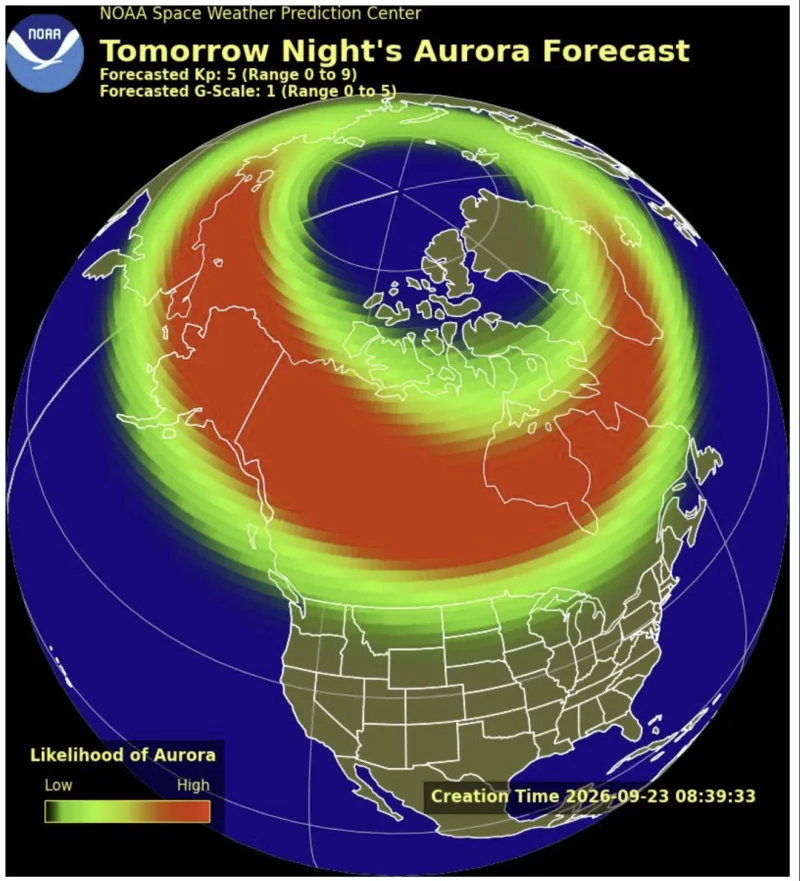
Geomagnetic disturbance levels reached a Kp index of 4 for four distinct three-hour intervals, lingering just beneath the official threshold for a G1 minor geomagnetic storm. Despite falling shy of a storm classification, vivid auroral displays ignited across high northern latitudes. Fairbanks observers recorded vibrant auroras. Heliophysicists noted that auroral visibility received a substantial boost from the Russell-McPherron effect (a geometric alignment where Earth’s dipole axis and the interplanetary magnetic field interact most efficiently near the equinox) following the September 22 equinox [1].
Space weather forecasters projected that active geomagnetic conditions would persist near Kp 4 through September 26 before decaying into quiet, unsettled intervals by September 28 as the fast solar wind stream dissipates. Forecasters notably lowered expectations for strong X-class flares after sunspot AR4536 simplified its magnetic footprint, reducing moderate flare probability down to 10% [1].
Can Geomagnetic Disturbances Influence Human Health?
Direct clinical evidence linking geomagnetic fluctuations to human physiological discomfort remains unverified, although subjective reports of headaches, mood swings, and disrupted sleep patterns frequently surge during active fast solar wind events. Heliophysicist C. Alex Young and editor Deborah Byrd from EarthSky examined these recurring public claims during an in-depth scientific broadcast. Controlled epidemiological investigations have struggled to isolate mild space weather fluctuations from environmental confounders (such as barometric pressure, artificial light exposure, and daily psychological stress) that routinely influence circadian well-being [1].
Geomagnetic fluctuations during a Kp 4 disturbance alter ambient field strength by only tens of nanoteslas at ground level, an increment vastly smaller than fields produced by common household appliances. While migratory birds and certain bacteria utilize specialized magnetoreceptors containing biogenic magnetite or cryptochrome photopigments, human tissues lack verified dedicated geomagnetic sensory organs. Controlled laboratory experimentation remains essential to determine whether ambient magnetic backgrounds exert subtle biochemical effects on cellular machinery [1].

To test whether baseline planetary magnetism alters basic physiology, researchers needed to invert the typical question: rather than exposing subjects to artificial high-power magnetic spikes, what happens when an organism is entirely shielded from Earth’s ambient field? Biologists in England constructed specialized zero-field chambers to isolate living tissues from terrestrial magnetism [2].


Laboratory Shielding Isolates Earth’s Natural Magnetic Influence
At the University of Nottingham‘s School of Veterinary Medicine and Science, professor of mitochondrial biology Lisa Chakrabarti and doctoral candidate Jacob Reed engineered a benchtop chamber with specialized metal walls blocking external magnetic fields. Inside the enclosure, the magnetic environment measured thousands of times weaker than Earth’s natural field. Collaborators from De Montfort University and Nottingham engineering departments standardized ambient light, acoustic noise, and temperature so that magnetic shielding remained the sole experimental variable [2].
The investigators placed male fruit flies into the isolation chambers at either 10 or 20 days of adult life, monitoring cohorts of 40 to 60 insects housed 20 to a vial every two or three days across a 70-day observation window. Half of the test population carried a defective mutation in the Pink1 gene (an inherited condition that impairs cellular mitochondrial recycling), causing damaged mitochondria to accumulate in a pattern mimicking early-onset Parkinson’s disease. The trial spanned 70 days. In nature, organisms evolved beneath an unbroken geomagnetic shield generated by the deep convective dynamo, linking planetary geophysics such as the cycle of Earth’s inner core directly to the daily cellular environment of terrestrial life [2].

“We live our entire lives within the Earth’s magnetic field,” Chakrabarti explained when describing the baseline conditions that govern terrestrial biology. The ambient field penetrates every living tissue, yet whether baseline magnetic removal impairs or reorganizes internal cellular operations had never been systematically resolved in living genetic models. Doctoral candidate Jacob Reed noted that prior investigations focused almost exclusively on avian navigation or deep space missions. “Research in this area is sparse, focusing mainly on how migrating animals sense magnetic fields, or on preparing humans for space travel,” Reed said [2].
Why Did Magnetic Shielding Alter Fly Lifespan?
Shielding altered insect lifespan because removing the ambient geomagnetic background triggered an adaptive metabolic recalibration that favored flies burdened with defective mitochondrial clearance. Genetically impaired flies introduced into the shielding enclosure at 20 days of age experienced a 20% lifespan extension compared to identical mutant controls living in the unshielded room. At any given measurement point during the 70-day trial, the mortality risk for these shielded mutant flies was approximately half as high as their unshielded peers. Flies placed into the enclosure at 10 days exhibited a smaller divergence indistinguishable from random chance [2].
While mutant flies survived significantly longer inside the shielded chamber, their physical climbing performance deteriorated during standardized mobility trials. Healthy flies displayed the reverse pattern, demonstrating superior climbing velocity inside the box across 20, 30, and 40 days while sustaining slightly shorter lifespans. Only male flies were tested. “I think the fact that lifespan and climbing ability are decoupled was surprising,” Chakrabarti stated, emphasizing that physical vitality and longevity followed divergent biological trajectories under hypomagnetic conditions [2].
Chakrabarti emphasized that this functional divergence reveals an active compensatory response rather than passive structural decay. “This seemed surprising initially, but actually it is very interesting because it suggests an adaptive physiological response to the magnetic field or shielding,” Chakrabarti remarked [2].
Cellular Energy Responds to Vanishing Magnetic Fields
Biochemical assays targeting mitochondrial respiration revealed that shielded healthy tissues accelerated oxygen consumption through complex II, an electron transport protein complex operating as an emergency reserve during physiological strain. Shielded specimens also generated elevated quantities of reactive oxygen species (commonly known as free radicals), which the Nottingham team measured with atomic precision using fluorescent nanodiamond sensors. The surge in free radical signaling manifested most clearly in the Pink1 mutant strain. In healthy cells, this upregulation might induce unnecessary wear, whereas in diseased cells, it bypasses bottlenecks in compromised respiratory pathways [2].
These biochemical adjustments align with broader investigations into environmental magnetism, such as a 2022 study by Song and colleagues in Scientific Reports demonstrating that moderate static magnetic fields extend longevity in roundworms through cytochrome P450 enzymatic pathways [3]. Other fly experiments noted that weakened magnetic exposure impaired cognitive learning, underscoring that biological reactions depend heavily on baseline fitness. When asked whether magnetic surroundings hold tangible relevance for human health, Chakrabarti affirmed: “Yes, I think so. It is an environmental pressure that mitochondrial physiology appears to be acutely sensitive to” [2].
The Nottingham laboratory is finalizing manuscripts analyzing non-mammalian vertebrate models and preparing trials on cultured human cells to determine whether mammalian bioenergetics mirrors the insect findings. Until human cellular studies reach completion, scientists cannot assume that geomagnetic disturbances driven by fast solar wind will directly influence human well-being. The convergence of space weather monitoring and bioenergetic shielding experiments confirms that Earth’s magnetic envelope serves as an enduring environmental backdrop woven into cellular evolution [2].
- ONLINE NEWS Young, C. A. (2026, September 26). Sun news: Fast solar wind still stirring Earth’s magnetic field. EarthSky. [Article Link]
- ONLINE NEWS Arrais, L., & Ralls, E. (2026, September 26). Earth’s magnetic field may be doing more to cells than we realize. Earth.com. [Article Link]
- ACADEMIC JOURNAL Song, M., Dong, S., Zhang, X., Dai, Y., Zhang, X., & Shen, Y. (2022). A moderate static magnetic field promotes C. elegans longevity through cytochrome P450s. Scientific Reports, 12(1). [Article Link]
APA 7: TWs Editor. (2026, September 27). Fast Solar Wind Buffets Earth’s Field as Lab Probes Cell Ties. PerEXP Teamworks.


