






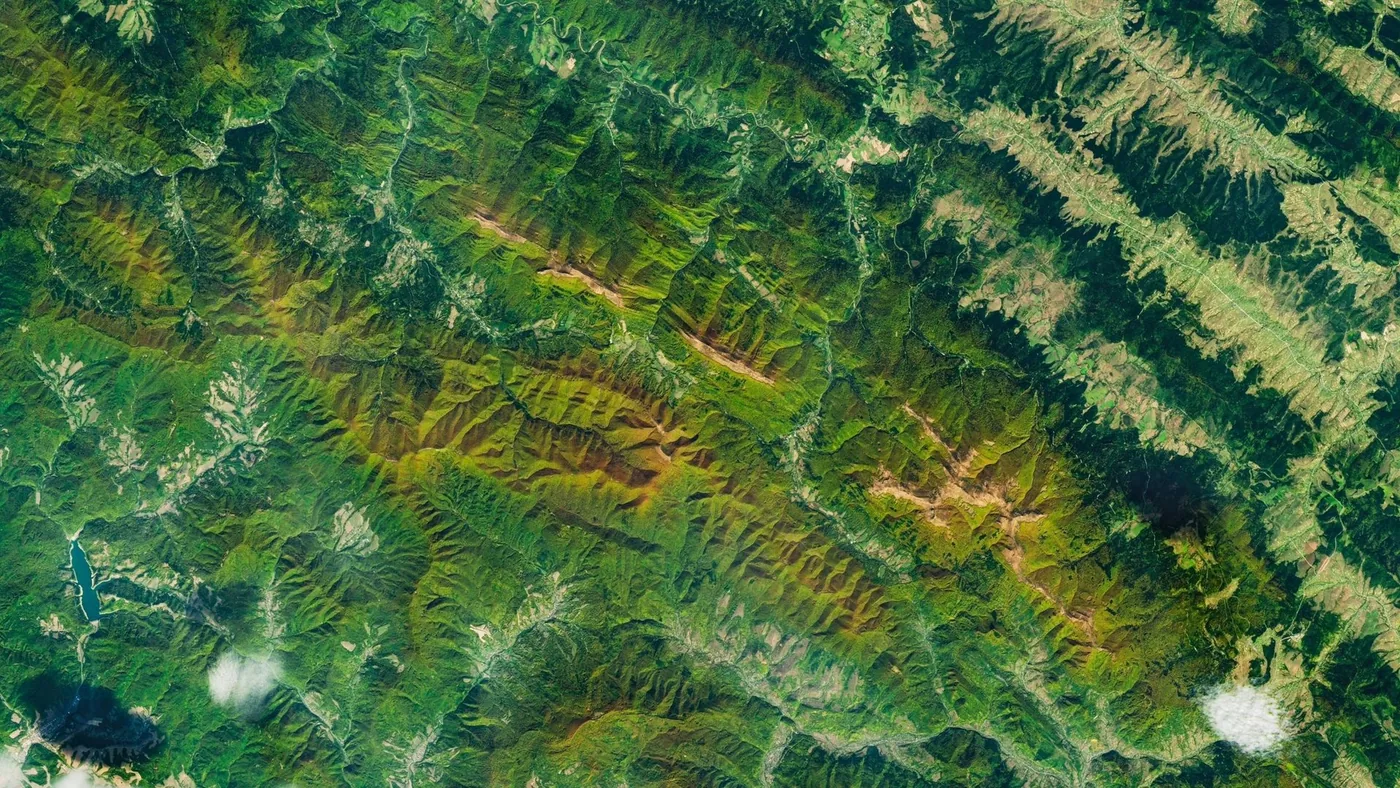
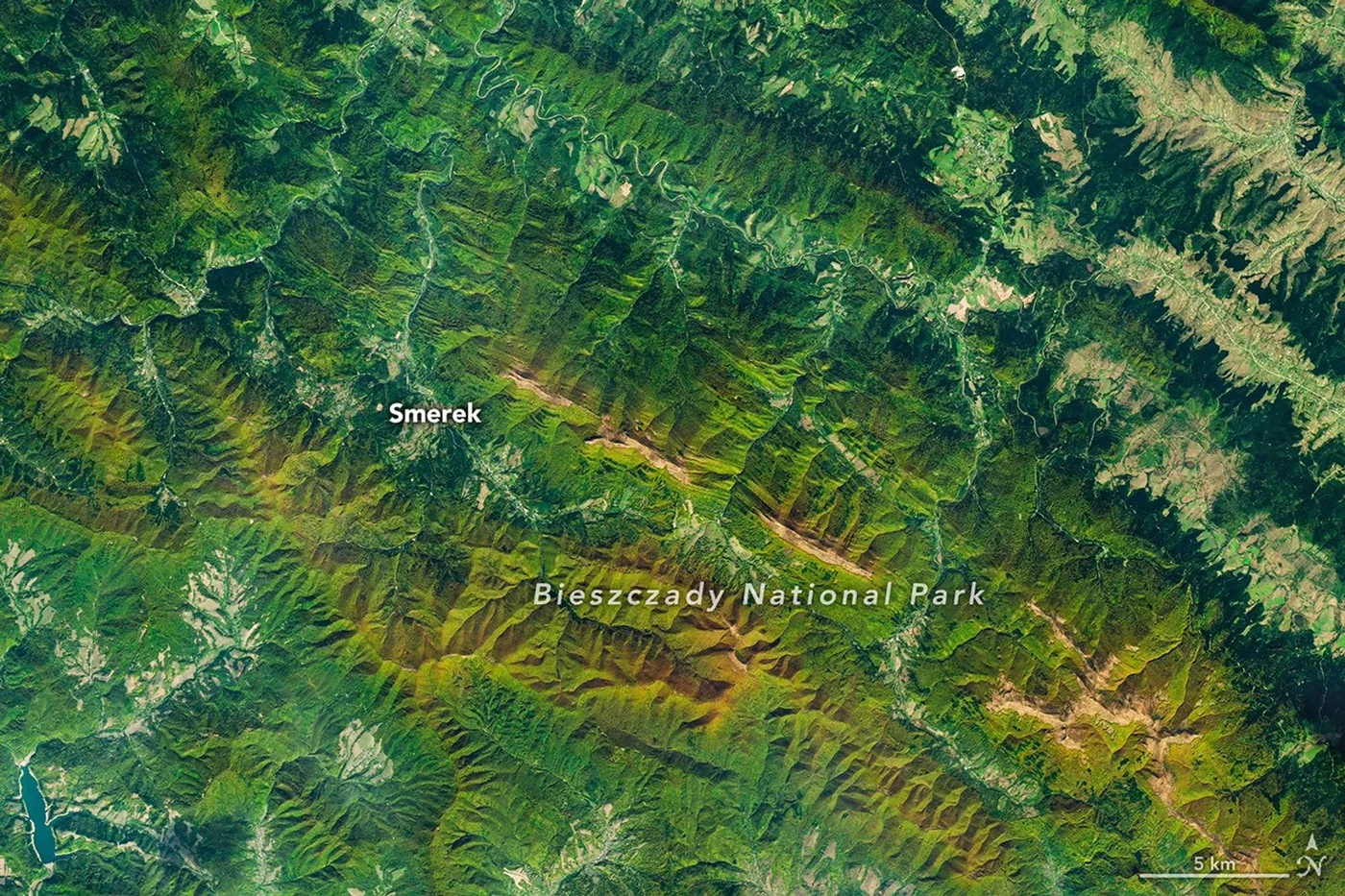
On October 8, 2026, the Landsat 9 satellite passed over southeastern Poland, recording how autumn spreads through the rolling ridges of the Bieszczady Mountains [2]. Writing for Earth.com and its nature platform EarthSnap, science journalists Chrissy Sexton and founder Eric Ralls noted that the seasonal shift turns the Poland Carpathian Mountains into a vibrant patchwork of color. The Operational Land Imager OLI aboard the spacecraft captured this transition within Bieszczady National Park as an Image of the Day feature for the NASA Earth Observatory [1, 2]. Falling temperatures and shorter daylight hours now prompt plant life and wildlife in Poland to prepare for the coming winter freeze [2].
Mapping Bieszczady Mountains Forests From Space
The Carpathian Mountains form a sweeping arc through Central and Eastern Europe, passing through Poland, Slovakia, and Ukraine while holding expansive natural woodlands across the continent. In southeastern Poland, the landscape takes on a softer shape than the jagged peaks found in other parts of the range, with long parallel ridges that stretch toward neighboring borders. Deep river valleys separate these rounded summits, which rise beneath thick vegetation rather than bare granite cliffs [1]. From orbit, this topography creates visible bands of plant life that change in tone as cooler autumn weather settles into the Carpathian mountain passes [2].
Data from the Operational Land Imager OLI on Landsat 9 reveals sharp contrasts between low valleys and high ridges in Bieszczadzki Park Narodowy [2]. Lower slopes stay green, but hillsides already glow with gold and copper [1]. Frost coats summits in the Polish Carpathians weeks before freezing air reaches lower valleys [2].
NASA and the U.S. Geological Survey operate Landsat 9 together to record land cover changes across global ecosystems [1]. NASA Earth Observatory specialist Michala Garrison processed the October scene during a brief sunny window between late summer warmth and early winter snow in Central Europe [2]. Ground teams use these space images to track tree health without disturbing sensitive wildlife habitats in the Carpathian Mountains. A single satellite pass maps thousands of square kilometers in seconds, helping scientists compare annual color patterns across Poland from season to season [1].
Why Autumn Leaves Change Color
During warm months, deciduous trees across the Carpathian Mountains make large amounts of chlorophyll to carry out photosynthesis inside their leaves. This green pigment absorbs blue and red sunlight, reflecting green wavelengths back into the sky. Leaves turn water and carbon dioxide into sugars that feed branches, trunks, and roots under summer sunlight. Chlorophyll absorbs blue and red wavelengths [1].
Why do leaves change color when autumn arrives? Shorter days and cooler nighttime temperatures alter chemical signals within leaf stems, signaling the tree to cut chlorophyll production. As green pigment fades, other compounds that lay hidden all summer begin to show through the leaf surface. Carotenoids produce bright yellow and orange tones, while some trees also synthesize red pigments known as anthocyanins to protect leaf cells while nutrients move into woody stems. While geologists study mineral formations and how researchers analyze dolomite crystal structures in laboratory settings, forest canopies across Poland rely on this organic pigment cycle to prepare for cold weather [1].
In the Bieszczady Mountains, this chemical shift turns entire mountain slopes into a patchwork of warm color [1]. Deciduous trees drop their leaves to conserve moisture and avoid broken limbs from heavy winter snows in Central Europe. Frost coats Smerek first [2]. Bare branches also help trees withstand freezing sub-zero cold throughout the winter months [1].
European Beech Dominance in Local Forests
European beech, known in science as Fagus sylvatica, dominates the slopes of southeastern Poland and forms the bulk of the tree canopy captured by Landsat 9. Sycamore maple, or Acer pseudoplatanus, grows among beech stands at middle elevations, adding golden tones to hillsides. Beech leaves turn bronze and copper before falling, creating deep autumn colors in NASA satellite images [1, 2]. These European broadleaf species thrive in cool mountain air, crowding out other tree types along lower ridges in the Carpathians [2]. As their canopies thin, sunlight warms the forest floor and dries the fallen leaf litter before winter freezes the soil [1].
The presence of these beech stands connects directly to Europe’s botanical survival during the last ice age, when continental glaciers covered northern lands under ice [1]. Harsh freezing wiped out broadleaf trees across northern Europe, but sheltered pockets in the Carpathians and the Alps provided refuges where beech endured. When ice sheets retreated, beech forests spread outward from these mountain sanctuaries to recolonize the European continent. Today, beech woodlands in Germany, France, and southern Scandinavia trace their ancestry back to populations that held out within these sheltered Polish valleys [2].
Because parts of these woodlands in Bieszczadzki Park Narodowy grew without large logging cuts, they offer scientists a clear look at natural forest growth in Central Europe. Old trees die and fall, leaving room for young saplings to sprout under open light gaps. UNESCO protects these Polish reserves [1, 2]. Fallen wood rots on the ground, enriching mountain soils across the Carpathian reserve [1].


Ancient Bieszczady National Park Beech Reserves
Selected sections of Bieszczady National Park belong to a UNESCO World Heritage network that protects ancient and primeval beech forests in 18 countries. This international status honors woodlands that have maintained their natural development since the retreat of ice age glaciers across Europe. In Poland, the protected reserve safeguards old-growth stands where living cycles carry on without timber cutting. Known locally as Bieszczadzki Park Narodowy, the park preserves both plant species and ecological history in the country’s southeastern corner [2]. Scientists visit these sites to study how undisturbed forests respond to long-term climate variations over decades of careful observation in Eastern Europe [1].
Park managers in Poland work to balance habitat protection with field study and outdoor visits [1]. Polish park staff from Bieszczadzki Park Narodowy track tree health, ground cover, and wildlife paths across steep slopes to keep the Carpathian ecosystem intact. Bieszczadzki Park Narodowy borders Slovakia [2]. Keeping commercial logging out of core zones ensures these hills hold onto traits lost in managed timberlands across Europe [1].
High Polonina Meadows Above the Treeline
In the Bieszczady Mountains, European beech forests climb slopes until reaching an upper boundary between 1,000 and 1,260 meters, or 3,300 to 4,100 feet in elevation. Above this treeline lies the open subalpine zone known as the polonina, a Slavic word for high mountain grasslands and meadows. These grassy ridges run in long tan stripes east-southeast of Smerek, standing out clearly from the darker wooded hills below. During summer months, these meadows in southeastern Poland show lush green grasses, but by early October, cold mountain air and frost turn the open crests to dry shades of tan and brown [1, 2].
Near the forest boundary, thickets of rowan (mountain ash), willows, and green alder form a patchy transition zone between woods and meadows [2]. In a botanical study published in Scientific Reports, researchers J. Mitka, S. Kucharzyk, J. Capelo, and A. Stachurska-Swakoń examined how subalpine woody vegetation recolonizes these Eastern Carpathian ridges. The team documented that shrubs and dwarf trees steadily move into the polonina once sheep and cattle grazing stops in Poland. As agropastoral pressure ended in the twentieth century, native rowan and green alder reclaimed portions of the upper slopes, changing how high ridges look from the ground and from NASA Landsat orbit [2, 3].
Satellite sensors on Landsat 9 clearly pick up the line dividing the golden beech forest from the tan grasslands in Bieszczady National Park [1, 2]. Beech stands end near 1,260 meters [2]. Grassy summits dry out quickly in autumn winds, losing green color weeks before sheltered woods change in southeastern Poland. This visual contrast shows how elevation and wind exposure shape mountain plant life across the Polish Carpathians [1].
Wildlife Habitats Across Mountain Slopes
The Bieszczady Mountains give wild animals ample space to prepare for cold weather in southeastern Poland. Writer Lindsey Doermann reported for the NASA Earth Observatory that brown bears roam the Carpathian Mountains of southern Poland “with the goal of fattening up ahead of winter hibernation”. Dense beech woods provide fallen nuts and sheltered dens, while Eurasian lynx populations find refuge and ample food across the slopes of Bieszczadzki Park Narodowy [2].
European bison provide another sign of conservation health in southeastern Poland, roaming the hills by the hundreds after being reintroduced in the 1960s following their extinction in the wild [2]. Grazing animals, songbirds, and small rodents all depend on the autumn seed crops dropped by beech and maple trees before winter sets in across Poland [1]. Just as research shows how summit terrain influences the ascent in mountain clouds around elevated ridges, local weather directs where mountain wildlife feeds during cold seasons in the Carpathians. European bison returned during the 1960s. When heavy winter snow coats the open polonina, bison and red deer herds move down from high ridges into protected beech valleys where twigs, bark, and dried foliage remain within reach beneath the forest canopy [2].
- ONLINE NEWS Sexton, C., & Ralls, E. (2026, October 19). Autumn transforms Poland’s Carpathian Mountains into a sea of color. Earth.com. [Article Link]
- ONLINE NEWS Doermann, L., & Garrison, M. (2026, October 19). Autumn paints Poland’s Bieszczady Mountains. NASA Earth Observatory. [Article Link]
- ACADEMIC JOURNAL Mitka, J., Kucharzyk, S., Capelo, J., & Stachurska-Swakoń, A. (2022). Subalpine woody vegetation in the Eastern Carpathians after release from agropastoral pressure. Scientific Reports, 12(1), Article 17897. [Article Link]
APA 7: PerEXP Teamworks. (2026, October 20). Landsat 9 Captures Autumn Colors in Bieszczady Mountains. PerEXP Teamworks.


