






Astronomers searching for gamma-ray pulsars face a daunting signal problem: NASA’s Fermi Gamma-ray Space Telescope detects only a tiny fraction of incoming photons among massive amounts of cosmic background radiation. An international research team has now solved this bottleneck by adapting a mathematical algorithm developed for cryptography, discovering a spinning neutron star about a million times faster than prior techniques allowed. The work, published in Physical Review Letters, opens access to hidden signals buried in fifteen years of publicly available space data [1].
The Physics of Rotating Neutron Stars
A pulsar forms when a massive star exhausts its nuclear fuel and collapses into an extremely dense stellar remnant known as a neutron star. These compact objects pack greater mass than our Sun into a sphere spanning roughly twenty kilometers in diameter. As the star contracts, conservation of angular momentum causes it to spin hundreds of times every second while channeling high-energy particles along strong magnetic axes. Beams of radiation sweep through space, producing regular pulses whenever an emission beam points in the direction of Earth [1].
Observing these objects in radio frequencies has historically provided astronomers with straightforward timing measurements, as cataloged during the first detection of a pulsar in the GLIMPSE-C01 cluster. Gamma rays present far steeper hurdles. Gamma-ray photons carry extreme energy but arrive infrequently at orbital detectors, with Fermi recording only about one photon for every one hundred million pulsar rotations. Isolating that single signal calls for sorting individual photon arrival times from a heavy fog of diffuse cosmic background light. Because the pulses repeat with clockwork regularity, missing even a few orbital phase intervals scrambles the timing model completely [2].

Computational Limits in Gamma-Ray Pulsars Searches
Standard blind searches for unknown gamma-ray pulsars stumble against an exponential computational wall. To find a pulsating source, researchers must guess several independent physical variables without any advance clues. They must determine the exact rotation rate of the star, the spindown rate as it sheds rotational energy, and two precise sky coordinates locating its position in space. Combining these unknown variables creates a massive four-dimensional grid holding millions of potential signal trajectories for every sky location [1].
“We don’t see every rotation from the pulsar, and we can’t just count the rotations to work out where the photon came from,” said lead author Daniel Pook-Kolb, a researcher at the Max Planck Institute for Gravitational Physics, also known as the Albert Einstein Institute, in Germany. “We have a four-dimensional grid, and we must search each direction with millions of trials in it. There’s just not enough computing power on Earth to do it.” To mitigate this constraint, astronomers previously split Fermi records into small windows and distributed the processing workload to volunteers through the Einstein@Home project. Even with distributed networks pooling thousands of idle home computers, resolving a single candidate often consumed hundreds of CPU years [1].
Borrowing Geometry Tools From Cryptography
The breakthrough arrived from an unexpected mathematical connection forged outside standard astrophysics. Study co-authors Dotan Gazith and Barak Zackay at the Weizmann Institute of Science in Israel realized that finding periodic signals in sparse photon data is equivalent to finding the shortest vector in a high-dimensional lattice. In mathematics, a lattice forms a regular geometric array of points arranged in multidimensional space. Cryptographers have studied lattice geometry for decades to build post-quantum encryption protocols capable of resisting quantum computers, while engineers use similar lattice reduction tools to optimize satellite navigation systems [1].
“We have nothing to do with cryptography in our analysis here, but those algorithms can help us solve the problem of searching for pulsars in our data,” Gazith said. By applying lattice vector identification, the algorithm searches vast parameter volumes without testing every discrete frequency step one by one. Individual trials execute in about five minutes on a single standard computer core. That speed allows researchers to complete preliminary candidate sweeps on ordinary laptops with two to eight processor cores [1].


Detection of Isolated Pulsar PSR J1622-7204
The research group validated their mathematical framework by analyzing fifteen years of archival observations collected by Fermi. Running the lattice algorithm across standard processing hardware pinpointed a previously undetected source: PSR J1622−7204. The pulsar completes 261 full rotations every second, classifying it as an isolated millisecond pulsar spinning at 261 hertz. Uncovering the signal took roughly ten CPU hours on standard hardware, a minuscule fraction of the computational effort previously expended on blind gamma-ray searches [2].
The performance gap between old and new computational methods is striking when tested on identical observational data. Earlier semicoherent search techniques failed to uncover PSR J1622−7204, even after consuming computing allocations equivalent to six hundred CPU years, expending five hundred thousand times more processing time without detecting the faint gamma-ray signature. Once the lattice code identified the candidate coordinates, researchers fed the complete fifteen-year Fermi dataset into a verification pass. The resulting statistical signal emerged so distinct from random background fluctuations that chance occurrence was ruled out [1].
Extending Search Methods to Binary Gamma-Ray Pulsars
Following the successful isolation of PSR J1622−7204, the science team set its sights on finding binary systems where a pulsar orbits a companion star. These paired systems provide natural laboratories for testing gravitational theories, much like the discovery of a pulsar and its surrounding nebula offers clues about stellar evolution. Binary gamma-ray pulsars have eluded blind orbital searches because the companion star’s gravitational pull accelerates the pulsar along its orbital path. That orbital motion introduces Doppler shifts into photon arrival times, warping regular pulsation cadences into complex, variable signals [1].
“We know that there are probably tens or maybe even hundreds of these pulsars in the data set that we just couldn’t find,” said Colin Clark, an astrophysicist at the Max Planck Institute who co-authored the paper. “The next goal is to extend the searches and use the combination of the new algorithm and the crowdsourced computing power from volunteers in our Einstein@Home program to hopefully find many new pulsars that we think should be there.” By coupling lattice algorithms with volunteer computing arrays, astronomers can test complex orbital models across multi-dimensional search spaces without exhausting computational resources [1].
Open Data Access Behind the Discovery
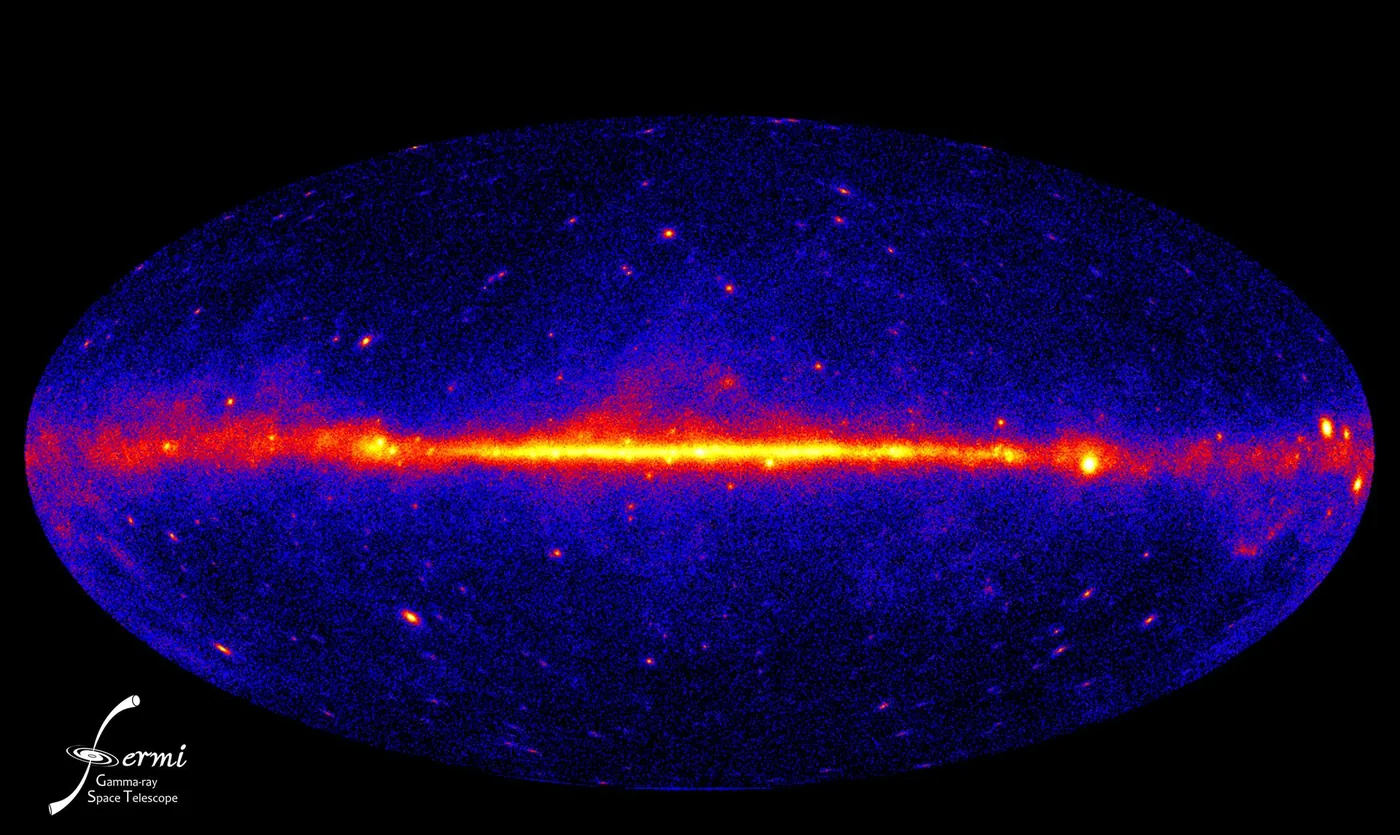
Open science policies made this computational advance possible. NASA launched the Fermi Gamma-ray Space Telescope in 2008 to map high-energy light across the cosmos, and the spacecraft scans the whole sky every three hours. Under NASA’s Gold Standard Science policy, sky survey data became open to the global public following a first one-year calibration period. Researchers also used open-source utilities such as NASA’s Fermitools software to prepare raw data tables before running lattice algorithms [1].
“The nice thing about NASA data is it’s all open,” Clark said. “All 18 years of Fermi data have been made public, and the data just keeps growing.” That transparency allows independent research teams to test alternative mathematical formulations against cataloged observations. Elizabeth Hays, Fermi project scientist at NASA’s Goddard Space Flight Center in Greenbelt, Maryland, pointed out that shared access improves reproducibility across the scientific community. “Any search that one team is doing, another team can just go and do that and check the search,” Hays said. “It’s made all of the science better.” With decades of archival sky maps freely available, faster mathematical tools allow cataloged high-energy observations to yield new stellar discoveries [1].
- ONLINE NEWS Leese, L., & Adams, A. M. (2026). NASA Science Data Powers New Method to Discover Hard-to-Find Pulsars. NASA Science. [Article Link]
- ACADEMIC JOURNAL Pook-Kolb, D., Gazith, D., Clark, C. J., Agrell, E., Zackay, B., & Allen, B. (2026). Gamma-Ray Pulsar Discovery Using a Lattice-Based Method. Physical Review Letters, 137(21). [Article Link]
APA 7: PerEXP Teamworks. (2026, November 20). Fermi Space Telescope Data Speeds Search for Gamma-Ray Pulsars. PerEXP Teamworks. https://perexpteamworks.com/en/gamma-ray-pulsars-fermi-data/


