



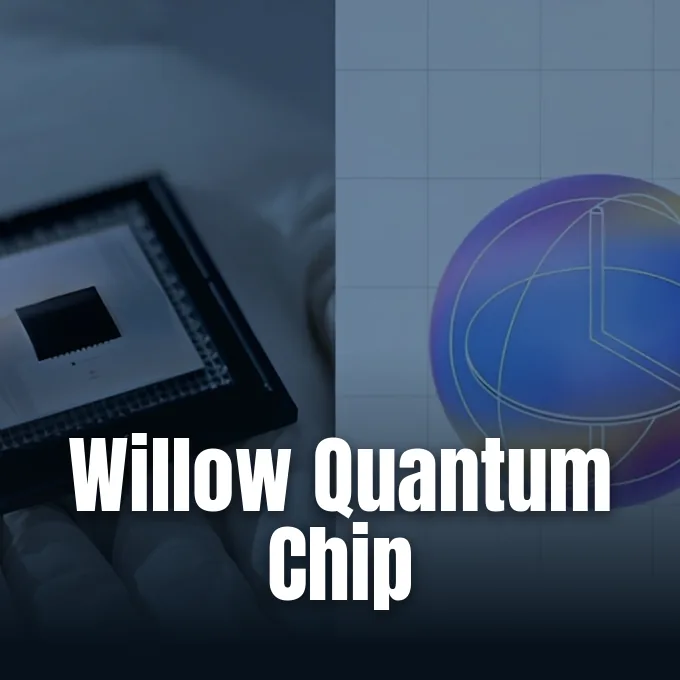
Building a working quantum computer needs a solution to hardware noise and fragile quantum bits. The Google quantum Willow chip tackles this hurdle by filtering errors out of quantum states before they can spread through a circuit [3]. In a study published in Science, lead author Emma Rosenfeld and her colleagues at Google Quantum AI reported that magic state cultivation reduced error rates fortyfold on superconducting hardware [1]. The experimental trial achieved 99.99 percent logical fidelity. This result gives hardware designers at Google Research a fresh way to prepare the states that complex quantum algorithms need to run [4].
What Is the Google Willow Quantum Chip?
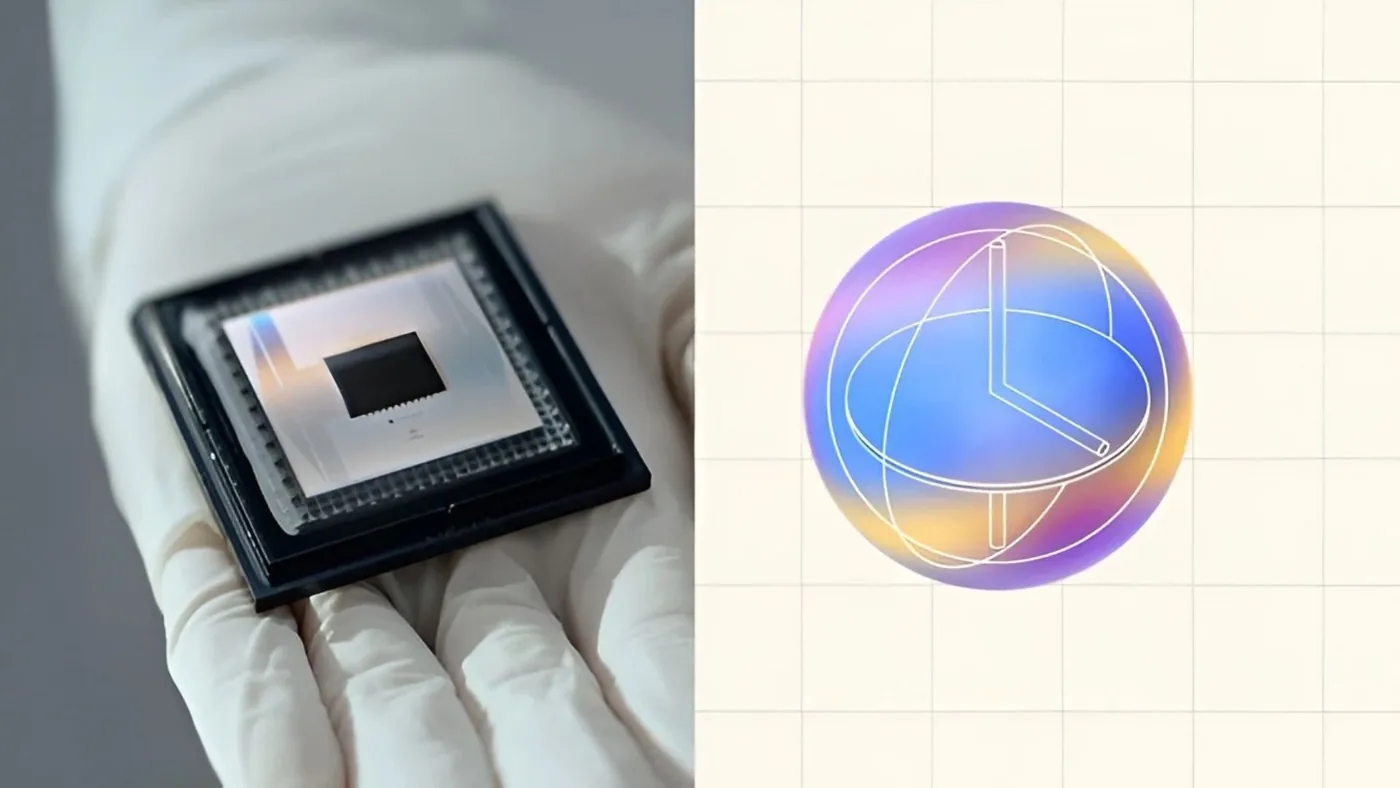
The Willow Processor is a superconducting device created by Google Quantum AI to test error suppression techniques at physical hardware scales [3]. The chip holds 105 physical qubits. To keep noise under control and isolate interactions, the Google Research team ran their magic state cultivation trials on a selected grid of 54 physical qubits [4]. Qubits are prone to stray electrical interference and tiny temperature swings that cause calculations to fail. Classical computers process binary information using familiar transistor circuits, but quantum processors manipulate delicate superpositions of zero and one that collapse into errors whenever ambient heat or voltage drift disturbs the Google Willow architecture during an active calculation [1].
Hardware developers have spent years scaling systems up without letting errors swamp processors. When IBM unveiled its first 1,000-qubit chip, the announcement focused on raw chip size [3]. Raw qubit count means little if gates fail too often. The Willow Chip pursues cleaner logical gates [4].
Early trials showed how sensitive superconducting hardware was to ambient lab conditions. Emma Rosenfeld and her team at Google Quantum AI found that electrical equipment drift and room temperature shifts corrupted baseline measurements [3]. The team spent months running simulations to refine control wiring. They also built a benchmarking routine that used the cultivation sequence itself to evaluate performance, creating a cleaner testbed on the 54-qubit array of the Willow Processor [1].
Why Quantum Logic Needs Magic States
Every digital computer builds complex software out of basic logic gates such as AND, OR, and NOT. Quantum hardware relies on its own set of standard operations known as Clifford Gates, which can manipulate quantum states while keeping error correction manageable. However, an ordinary classical computer can simulate these Clifford Gates with ease, meaning they cannot provide the computational speedups that make quantum devices valuable. As Emma Rosenfeld explained to Scientific American, “quantum computers have their own analogy of these operations called the Clifford gates,” but those gates alone do not unlock exponential computational power [4].
To calculate beyond classical limits, a quantum computer needs a non-Clifford gate, most often called a T gate [4]. Applying it directly causes severe errors. Engineers at Google Research synthesize it by consuming a specially prepared magic state [1]. The state is used up during one operation [3].
Generating these resources cleanly has long been a steep barrier in quantum computing. The conventional recipe, called distillation, takes multiple noisy states and combines them to produce fewer, purer states [4]. Distillation consumes heavy hardware capacity. Estimates suggest up to 95 percent of a quantum machine could be spent just making magic states, leaving only 5 percent for actual calculation [3]. Reporting in Interesting Engineering and Scientific American highlighted this bottleneck, with Emma Rosenfeld noting that “you can have up to 95 percent of your quantum computer being spent just generating these high-fidelity magic states” [4].
How the Google Willow Quantum Processor Filters Noise
In 2024, Google Quantum AI researchers Craig Gidney, Noah Shutty, and Cody Jones introduced magic state cultivation to bypass the heavy costs of distillation [3]. Their proposal appeared in a 2024 preprint on arXiv that has not undergone peer review, showing that processors could grow clean states from single noisy seeds rather than pooling dozens of imperfect inputs [2]. Instead of routine multi-state distillation, the cultivation model works like a fine-grained filter on a small cluster of qubits [3]. If hardware can check whether an individual state is healthy before expanding it, the Google Research team saves valuable physical capacity for broader algorithmic routines [4].
Putting this idea onto physical hardware meant solving unexpected disturbances inside the refrigeration system. When the Google Research team attempted early cultivation runs on the Willow Chip, unexpected measurement outcomes puzzled researchers for months [3]. Electrical drift warped phase relationships between qubits. By upgrading control line stability, the team enabled the Google willow quantum processor to filter noise reliably [1].
Cultivation treats state preparation much like gardening. The system encodes a rough magic state in a small patch of qubits, performs parity checks, and verifies quality before allowing the state to grow [4]. States with detectable flaws get discarded immediately. Clean states pass forward to be enlarged into robust logical units [3]. Craig Gidney, Noah Shutty, and Cody Jones designed this filter to avoid the cascading penalties that make conventional distillation routines so demanding on the Willow Processor [1].


Can the Willow Quantum Chip Grow Magic States?
Tests on the Google quantum Willow chip proved that magic state cultivation works on physical qubits by using an unconventional measurement strategy. Normal quantum measurements ask whether a qubit is zero or one, which immediately collapses superpositions into classical bits. To avoid destroying the delicate resource, the Google Quantum AI team programmed their circuits to ask a different question: “Are you the right magic state: yes or no?” [4] This selective parity check detects phase corruptions without forcing the state into a definite computational base state [1]. States that answer yes are preserved for processing, while those that fail the test are discarded before they can introduce noise into subsequent gates on the Willow Processor [3].
This quality check comes with a high rejection rate, but the surviving states exhibit high purity. The Willow Chip discards roughly 92 percent of its initial attempts because they fail the quality check [4]. The 8 percent of attempts that survive yield logical T-states with a reported fidelity of 99.99 percent [3]. Without cultivation, about 4 attempts in 1,000 produced a faulty state on the hardware. Errors fell fortyfold to roughly one faulty state in 10,000 attempts [4].

External researchers greeted the demonstration with cautious optimism. Duke University physicist Kenneth Brown, who directs the Duke Quantum Center and was outside the study team, said that “the Google experiment shows that cultivation works in practice”. Kenneth Brown pointed out that discarding 92 percent of candidate states is a necessary tradeoff to reach near-faultless logical gates on current devices [4]. For the willow quantum chip, growing magic states in hardware bridges theoretical error models with physical superconducting processors [1].
Moving Purified States Across Error Codes
Creating a clean magic state inside a small region of a chip is only half the battle. To be useful in a full quantum algorithm, that purified state must move into a larger logical architecture without picking up new errors along the way. The Google Research team showed this transfer through a technique called grafting, moving cultivated states from a distance-3 Color Code into a distance-5 Surface Code. Distance numbers indicate how many physical errors a Color Code or Surface Code can detect and correct, with higher distances providing stronger protection for stored quantum information on the Willow Chip [3].
Grafting succeeded on the Willow Processor because the team kept qubit coherence stable during the handoff between the two code structures. Color Codes offer convenient symmetries for transversal logic gates, while Surface Codes provide superior tolerance against local hardware errors on 2D grids [1]. Successfully transferring magic states between these distinct organizational schemes shows that future processors can combine different code designs to minimize hardware overhead. Cultivated states stayed stable during complex data relocations [3].
Scaling Cultivation Toward Practical Quantum Work
Despite the fortyfold reduction in errors, significant hurdles stand in the way before magic state cultivation can power everyday quantum applications. Current encryption schemes, such as RSA-2048 used in online banking and digital identity cards, demand quantum computers with error rates no higher than one failure in 10 billion operations. Modern web security systems already anticipate these distant threats, which is why Cloudflare introduced Merkle tree certificates for web PKI to develop post-quantum cryptographic defenses well before cryptanalytically relevant quantum computers exist [4].
Near-term scientific goals may arrive much sooner than codebreaking. Emma Rosenfeld noted that simulating complex chemical molecules will need magic states with error rates between one in a million and one in 100 million. The Willow Chip achieved an error rate around one in 10,000. Emma Rosenfeld voiced optimism about closing that gap, stating that “we’re more galvanized than ever to get to these near-term scientific applications” [4].
Scaling this process up will test the limits of superconducting hardware. Researchers running the Google quantum Willow chip acknowledge that cultivation must be shown with hundreds or thousands of physical qubits before it can support fault-tolerant calculations [3]. The 54-qubit demonstration proves the fundamental physics of cultivation on superconducting hardware, but building production-ready quantum computers will depend on integrating larger arrays, faster classical feedback loops, and automated error tracking on the Willow Processor [1].
- ACADEMIC JOURNAL Rosenfeld, E., Gidney, C., Roberts, G., Morvan, A., Lacroix, N., Kafri, D., Marshall, J., Li, M., Sivak, V., Abanin, D., Abbas, A., Acharya, R., Aghababaie Beni, L., Aigeldinger, G., Alcaraz, R., Alcaraz, S., Andersen, T. I., Ansmann, M., Arute, F.,. Ballard, B. (2026). Magic state cultivation on a superconducting quantum processor. Science. [Article Link]
- PREPRINT Gidney, C., Shutty, N., & Jones, C. (2024). Magic state cultivation: growing T states as cheap as CNOT gates. arXiv:2409.17595 [Preprint – not peer reviewed]. [Article Link]
- ONLINE NEWS Walter, N. (2026, October 15). Google Willow cuts magic-state errors 40-fold, reaches 99.99% fidelity. Interesting Engineering. [Article Link]
- ONLINE NEWS Krywko, J. (2026, October 15). Google’s quantum Willow chip may be able to grow ‘magic states’. Scientific American. [Article Link]
APA 7: TWs Editor. (2026, October 16). Can the Willow Quantum Chip Cultivate Magic States? PerEXP Teamworks. https://perexpteamworks.com/en/google-quantum-willow-chip-cultivation/


