





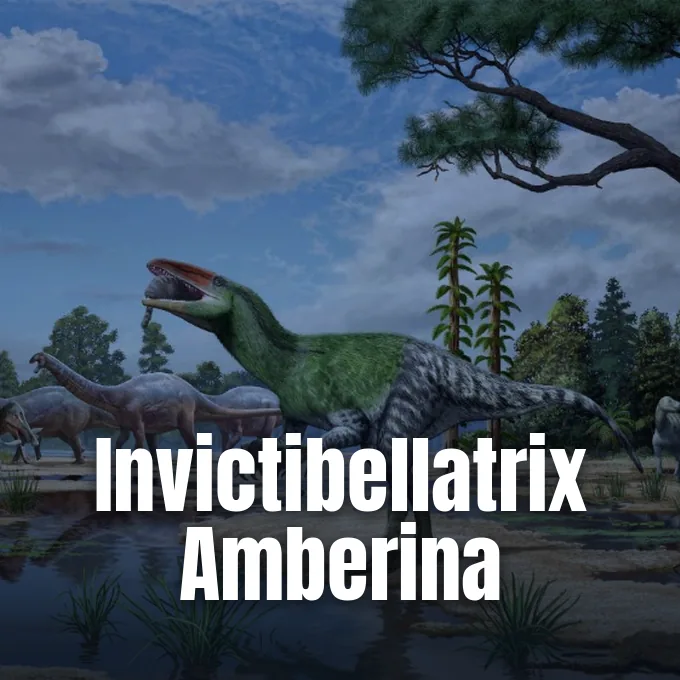
A broken skull bone kept inside a museum cabinet for over a century belongs to Invictibellatrix amberina, the first megaraptor dinosaur ever found in Europe [2]. The fossil animal lived around 120 million years ago on the prehistoric English coast that became the Isle of Wight. The predator walked on two hind legs, carried curved claws on long arms, and filled an evolutionary gap between early Asian carnivores and giant southern hunters [3]. While scientists long tracked these swift meat-eaters through South America and Australia, this single British skull fragment confirms that the predatory group also lived in prehistoric Europe.
A Century in a Drawer
Amateur fossil hunter Reginald Walter Tooley discovered the partial skull bone in 1924 at the foot of an eroding sea cliff on the southwest coast of the Isle of Wight [1]. The specimen soon entered the paleontology collections of the Natural History Museum in London, but curators placed the rock into storage where it sat untouched in a drawer for nearly a hundred years [2]. Because the fossil was only a partial braincase encrusted in hard rock not a complete skeleton, staff members did not recognize its true identity. Similar overlooked finds have occasionally surfaced in British archives, just as a chunky belemnite fossil reveals a Jurassic survivor when modern researchers re-examine older collections.
“It is a real mystery that this fossil was overlooked for so long, sitting in a drawer for nearly 100 years,” said lead author Cassius Morrison, a researcher from the Department of Earth Sciences at University College London [2]. He explained that the Isle of Wight has long yielded valuable bones, yet many older specimens still wait for modern laboratory tools to reveal their secrets.
The coastal cliffs of the Wessex Formation regularly shed Cretaceous rocks into the sea during winter storms, providing amateur collectors with opportunities to rescue fragile bones before waves destroy them [1, 3]. When Tooley picked up the dark, rounded rock in 1924, megaraptors were entirely unknown to science, so workers could only catalog it as an unidentified reptile fragment [1]. The piece stayed safely tucked away in London drawers through World War II and decades of museum reorganizations until a recent research initiative on dinosaur braincases brought it back into the light [2].

Identifying Invictibellatrix Amberina
Researchers at University College London examined the inner structure of the specimen by using micro-computed tomography, a method that stacks X-ray views to build detailed digital 3D models of the space where the brain once sat [1]. They compared these braincase shapes with fossils from other two-legged theropods, including spinosaurs and tyrannosaurs. Two anatomical traits set the fossil apart from known predators: an egg-shaped passage connecting the spinal column to the base of the skull, along with an unusual hourglass ridge sculpted across the rear of the braincase [2]. Computer programs analyzing these traits placed the animal within Megaraptora and confirmed that the bone represented a previously unknown species.
The research team, which included Cassius Morrison, Charlie R. Scherer, Philip Mannion, Laura B. Porro, Brett Clark, Daniel D. Folkes, and Paul M. Barrett, named the species Invictibellatrix amberina. The genus name combines Latin words for unconquered and female warrior to honor its predatory nature, while the species tag refers to amber found within the surrounding rocks of the Wessex Formation [3]. The formal description appeared in the journal Royal Society Open Science under the direction of University College London and the Natural History Museum.
Hunting Role of the Isle of Wight Predator
Although the fossil preserves only the back of the skull, comparisons with closely related megaraptors suggest that the animal measured between 3 and 4 meters (10 to 13 feet) in length and stood roughly 1.5 meters (5 feet) tall at the hip. With an estimated body weight between 200 and 300 kilograms (440 to 660 pounds), it was one of the smaller members of its lineage [2]. The dinosaur hunted small lizards, early mammals, and juvenile plant-eaters across Early Cretaceous floodplains, filling a predatory role comparable to that of a modern hyena instead of reigning as an apex hunter [1]. Its curved hand claws likely reached 10 to 20 centimeters in length, and relatives indicate it probably bore a coat of primitive feathers.
“It was not the apex predator of its time, but for humans this dinosaur would have been more dangerous than a T. rex,” Morrison said [2]. “We would have been perfectly sized prey, about a third of their body weight. They definitely would have chased us.” While tyrannosaurs relied on crushing jaw bites, megaraptors attacked with their grasping arms and hooked talons. Direct predatory traces remain rare in the fossil record, much like how a leg bone in a tyrannosaur’s belly provides rare physical evidence of theropod feeding choices.
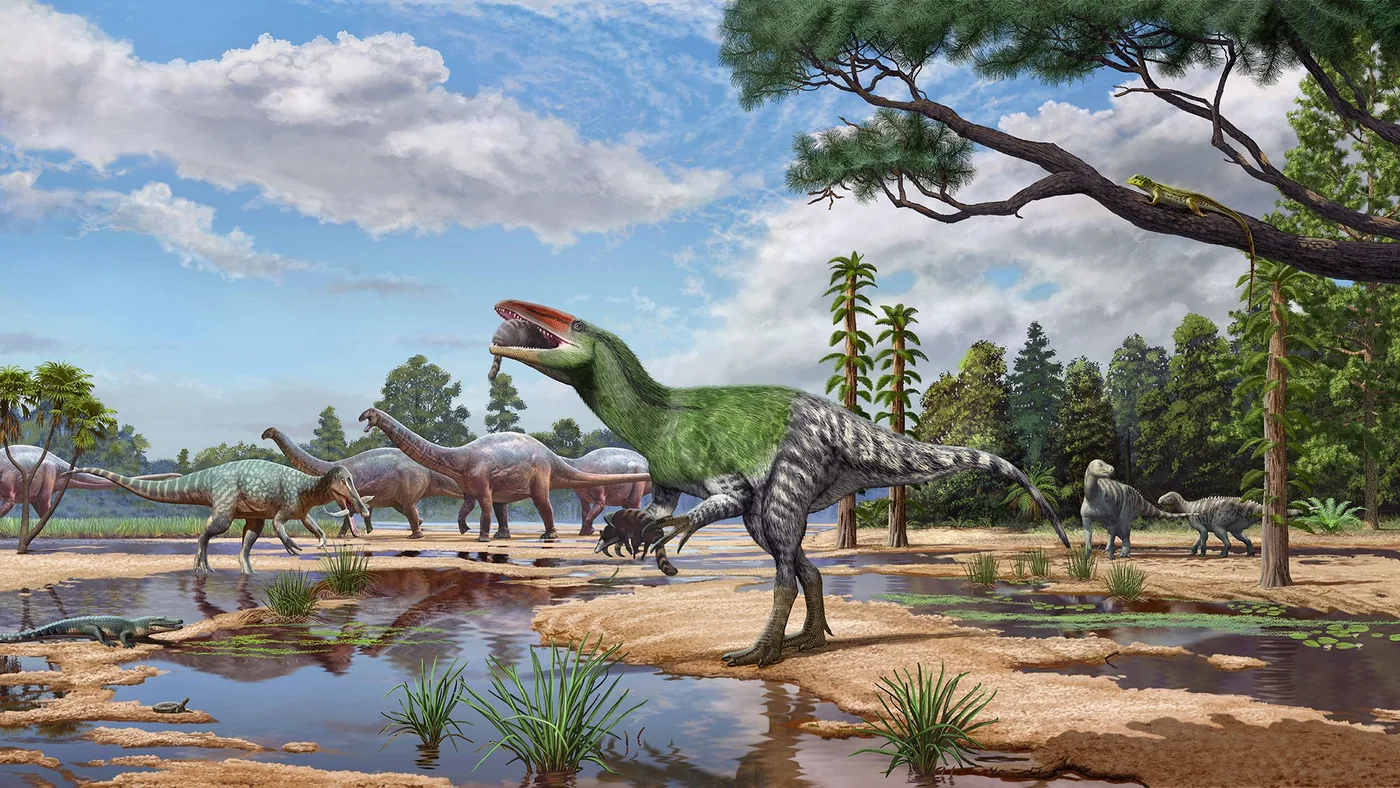
Larger theropods dominated the Isle of Wight during the Early Cretaceous, leaving Invictibellatrix to rely on speed and agile maneuvering [2, 3]. By hunting in dense river valleys and scavenging carcasses left by giant carnivores, the predator carved out a stable lifestyle without coming into direct conflict with massive competitors [1]. Its long arms allowed it to pin down struggling prey while sharp teeth delivered quick slicing bites.


Dispersal of Invictibellatrix in Europe
Evolutionary models suggest that early megaraptors originated in Asia before spreading across other landmasses, but the lack of European fossils previously left a confusing gap along their suspected migration trail. The discovery of Invictibellatrix amberina confirms that these fleet-footed predators dispersed into western Europe around 130 million years ago during the Early Cretaceous [2]. Their presence on the ancient land that became the Isle of Wight shows that the European landmass served as a stepping stone not an isolated dead end. Similar Asian links appear in other theropod lineages, such as when a feathered winged dinosaur in China showed how early carnivores shared traits across wide geographic ranges.
The animals moved through what is now mainland Europe and traveled toward Africa and the southern supercontinent of Gondwana by crossing temporary land connections exposed across the shallow Tethys Ocean [2]. Because sea levels shifted and shifting tectonic plates pushed landmasses together, these land corridors opened briefly, letting small, agile theropods expand their hunting territories into southern regions without needing to cross open ocean.
The Route Toward Gondwana
“This new species is the first proof we have that megaraptorans were also present in Europe and that they reached Gondwana this way rather than island-hopping further south,” said study co-author Charlie Scherer, a doctoral researcher at UCL Earth Sciences. After entering the southern landmasses, megaraptors flourished between roughly 125 million and 66 million years ago, eventually evolving into massive apex predators. While the European species remained modest in stature, southern descendants such as Maip macrothorax in Argentina reached 10 meters (33 feet) in length and weighed as much as an elephant, brandishing deadly curved claws up to 35 centimeters long [1, 2].
Paleontologists still cannot fully explain why megaraptors vanished from northern continents while their cousins prospered in the south until the end of the Cretaceous period [2]. Shifts in regional climate, changes in coastal habitats, or competition from emerging apex predators may have driven the northern populations to extinction [1]. Because the European fossil record for these agile carnivores is still sparse, discovering additional bones remains essential for mapping their exact timeline of decline.

By the time the asteroid impact ended the age of dinosaurs 66 million years ago, megaraptors in South America had taken over apex hunting roles once held by carcharodontosaurs [2]. Their success in the southern hemisphere stands in sharp contrast to their mysterious disappearance from northern lands like Britain, where fossil evidence drops off after the Early Cretaceous [1, 3]. Further geological surveys on the Isle of Wight could reveal whether changing sea levels cut off the northern lineage or if newer carnivores outcompeted them.
Lessons from Historical Collections
“Work like this shows the exceptional value of working with historical museum collections where there are still many discoveries to be made,” said study co-author Paul Barrett, a paleobiology specialist at the Natural History Museum in London. Countless fossil specimens gathered by Victorian and early twentieth-century collectors still rest in museum drawers without modern anatomical scrutiny [2]. Applying micro-CT scans and advanced computational methods to these century-old bones allows scientists to reconstruct prehistoric ecosystems without needing to mount expensive new field digs.
The identification of Invictibellatrix amberina reminds researchers that even well-explored formations like the cliffs of the Isle of Wight hold surprising treasures [2]. As paleobiology teams continue to rescan cataloged specimens, forgotten fragments will likely yield further clues about how prehistoric hunters crossed ancient continents. For now, this small British fossil stands as clear proof that Europe once sheltered swift, clawed warriors that helped shape the global history of predatory dinosaurs [3].
- ACADEMIC JOURNAL Morrison, C., Scherer, C. R., Mannion, P., Porro, L. B., Clark, B., Folkes, D. D., & Barrett, P. M. (2026). A new megaraptoran dinosaur from the Lower Cretaceous Wessex Formation, UK, and its implications for theropod evolution and biogeography. Royal Society Open Science, 13(10), 260937. [Article Link]
- ONLINE NEWS Hughes-Castleberry, K. (2026, October 16). Fossil of ‘unconquered female warrior’ dinosaur with long claws found in UK museum drawer after 100 years. Live Science. [Article Link]
- ONLINE NEWS Knowridge Science Report. (2026, October 16). Museum Fossil Reveals a Long Clawed Dinosaur Never Before Found in Europe. [Article Link]
APA 7: PerEXP Teamworks. (2026, October 16). Invictibellatrix Amberina Skull Reveals Europe’s First Megaraptor.


