


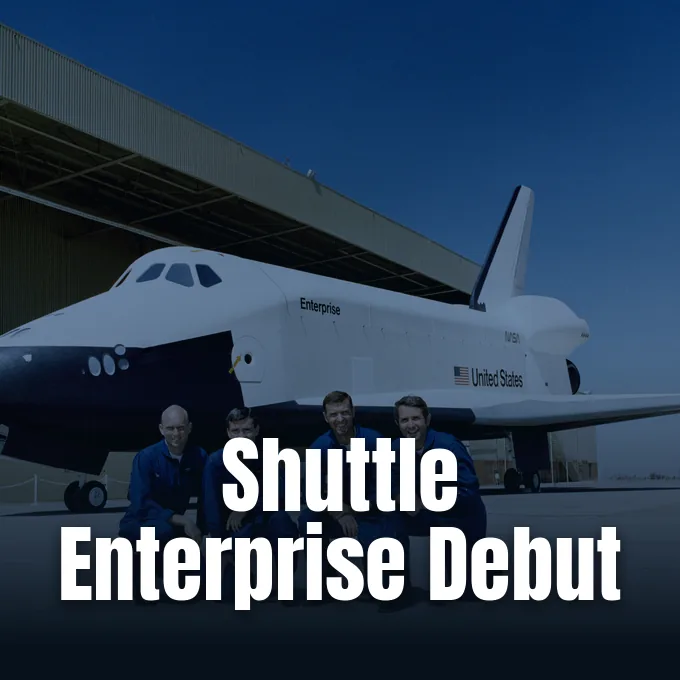
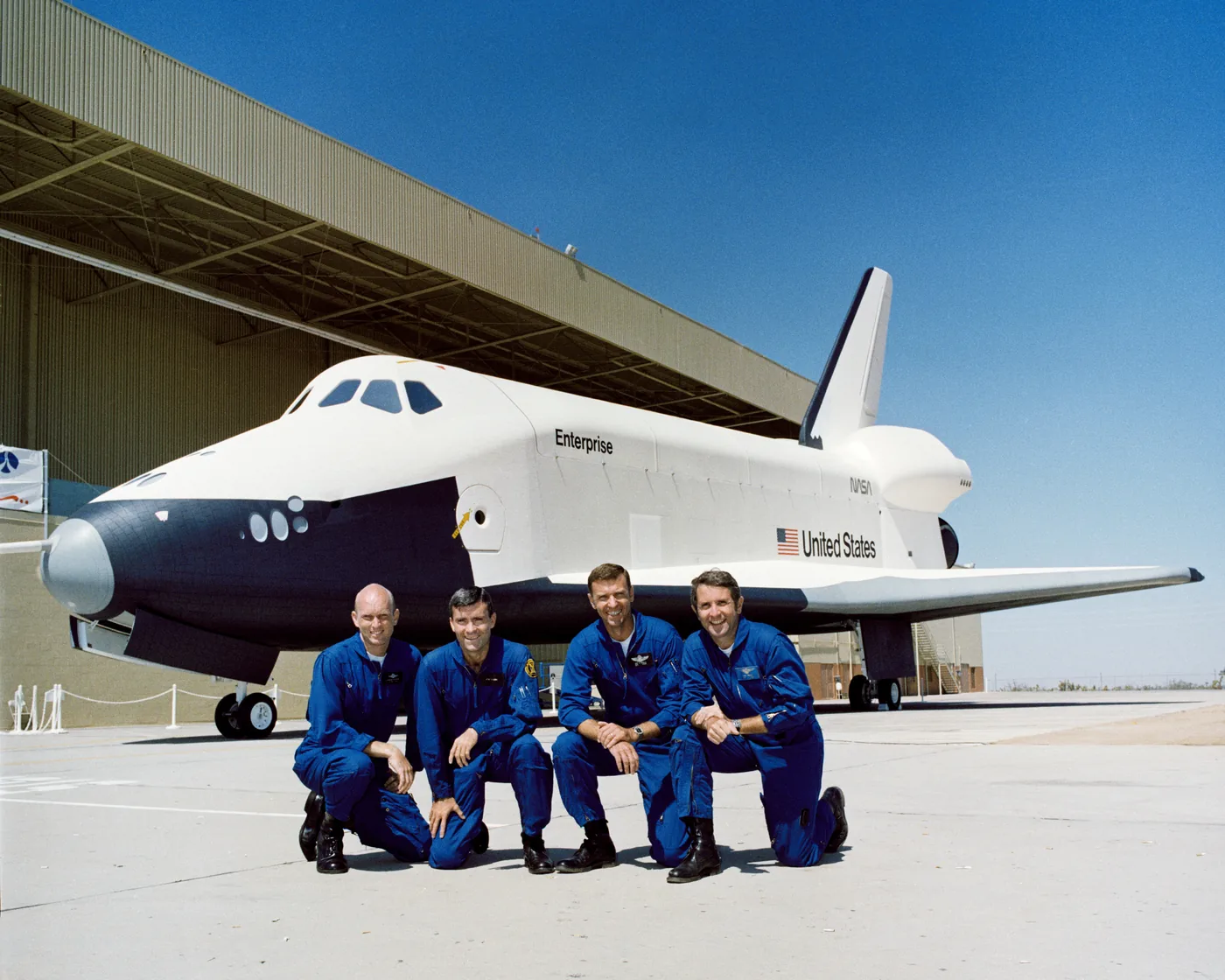
When the United States pursued a reusable path to orbit following the Apollo moon landings, aerospace engineers confronted a fundamental riddle. How could a massive winged vehicle land safely on a runway without propulsion? NASA answered by constructing space shuttle Enterprise (designated Orbiter Vehicle-101 or OV-101) as an atmospheric flight testbed. Originally intended to be named *Constitution*, an intense letter-writing campaign by *Star Trek* fans persuaded the White House to rename the orbiter. On September 17, 1976, NASA rolled out the historic craft at Rockwell International’s assembly facility in Palmdale, California [1].
Palmdale Rollout of Space Shuttle Enterprise
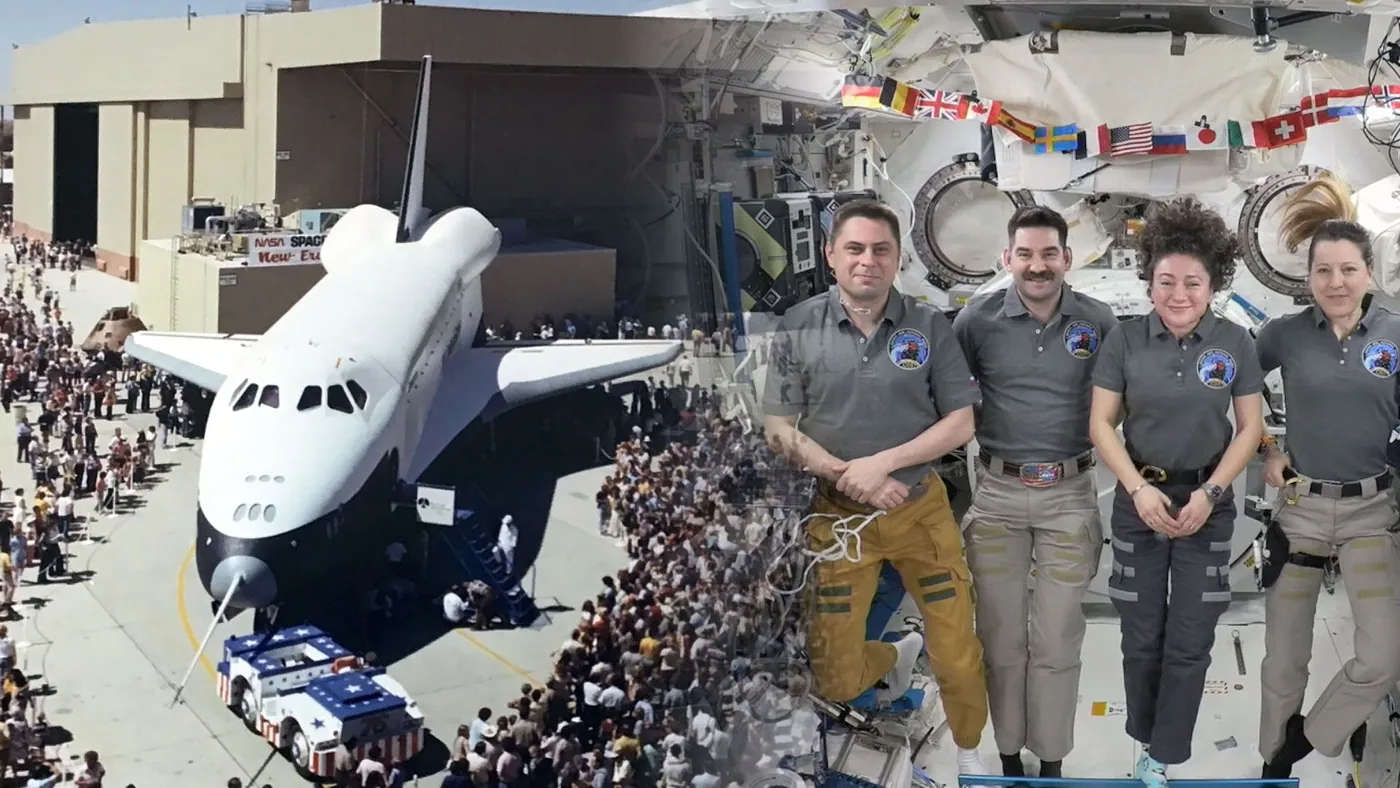
The formal development of the reusable orbiter originated on January 5, 1972, when President Richard M. Nixon directed NASA to build a reusable space transportation system to transform access to near space. NASA Administrator James C. Fletcher called the executive decision an historic step for national space exploration. Six months later, on July 26, 1972, the space agency awarded the prime contract to the Space Division of North American Rockwell Corporation in Downey, California. Assembly of the crew module began in Downey in June 1974 before components shifted to Palmdale for final mating. On September 17, 1976—America’s bicentennial Constitution Day—more than 600 invited dignitaries and 185 media representatives gathered outside the Palmdale hangar. John F. Yardley, NASA associate administrator for the Office of Space Flight, directed proceedings as master of ceremonies [2].
Spectators witnessed aerospace history unfold. As the orbiter emerged into southern California sunlight, the Air Force Band of the Golden West from March Air Force Base performed Alexander Courage’s musical theme from *Star Trek*. NASA Administrator Fletcher ordered the rollout as honored guests applauded the spacecraft. Creator Gene Roddenberry attended the ceremony with cast members Leonard Nimoy, George Takei, James Doohan, Nichelle Nichols, DeForest Kelley, and Walter Koenig. U.S. Representative Don Fuqua also joined the platform guests. The celebration continued beyond official delegations. The following day, Rockwell opened its gates to 35,000 public visitors who inspected the prototype parked next to the Apollo 14 Command Module *Kitty Hawk* [1].
How Star Trek Fans Renamed the Shuttle
NASA leadership originally planned to name the first orbiter *Constitution* in honor of the nation’s founding charter, intending to stage the public rollout on Constitution Day during the bicentennial celebrations of 1976. That proposal sparked immediate public pushback. Dedicated viewers of the science fiction television series *Star Trek* organized a massive grassroots letter-writing campaign before the existence of modern digital networks. Fans dispatched hundreds of thousands of letters to the White House, imploring federal leaders to christen the vessel after the fictional starship USS Enterprise (NCC-1701). An internal White House memorandum described the television enthusiasts as one of the most dedicated constituencies in the country [4].
President Gerald R. Ford endorsed the change during a September 8 White House conference, citing his personal affection for naval vessels bearing the historic name [6].
President Ford noted that his naval unit serviced the aircraft carrier USS Enterprise during World War II, connecting the orbiter to a distinguished maritime tradition that originated with a Revolutionary War vessel and continued through the first nuclear-powered aircraft carrier. The president told Administrator Fletcher that no name better captured the pioneering spirit required to explore frontier realms. Senator Barry Goldwater echoed that ambition during the dedication ceremony, asserting that the winged spacecraft would unlock unprecedented scientific knowledge for all humanity. Actor Leonard Nimoy later recalled the rollout as a monumental day connecting citizens with the frontiers of space exploration [3].
Engineering Differences Across Shuttle Airframes
Because Rockwell International manufactured OV-101 solely as an atmospheric testbed, engineers eliminated complex systems that operational orbiters required for deep space missions. The vehicle possessed no RS-25 main rocket engines, orbital maneuvering pods, or reaction control thrusters. Instead of functional ceramic thermal protection tiles designed to withstand 3,000-degree atmospheric reentry friction, technicians covered the vehicle exterior with simulated polyurethane foam tiles and fiberglass leading edge panels, affixing only select Nomex felt blankets and ceramic sample tiles to evaluate flight airflows. The landing gear lacked hydraulic extension systems. Technicians installed explosive release bolts that allowed landing doors to blow open in midair, permitting the heavy landing gear to swing downward solely through gravitational momentum [4].
Flight testing required specialized diagnostic instrumentation. Aerodynamicists attached a prominent instrument nose probe to the forward nose cap to record uncorrupted pitot-static air data outside turbulent fuselage boundary layers. On the flight deck, technicians installed zero-zero ejection seats manufactured by Lockheed to guarantee emergency escape options for test crews during low-altitude glide maneuvers. Fabrication relied on aerospace subcontractors across the nation: General Dynamics built the mid-fuselage in San Diego, Grumman manufactured the delta wings in New York, and Fairchild Republic assembled the vertical stabilizer in Maryland before final structural mating in California [4].


Approach and Landing Tests at Edwards
In January 1977, ground crews moved space shuttle Enterprise 36 miles overland from Palmdale across California roads to NASA’s Dryden Flight Research Center (now Armstrong Flight Research Center) at Edwards Air Force Base. Technicians mated the 75-ton glider atop a modified Boeing 747 airliner designated the Shuttle Carrier Aircraft. Initial taxi tests in February evaluated structural drag, aerodynamic buffeting, and runway braking dynamics across high-speed runs. Five uncrewed captive flights followed in the spring, verifying airframe flutter characteristics and flight control telemetry before astronauts boarded the orbiter for crewed captive trials in June [2].
Free flight trials commenced that summer. On August 12, 1977, astronauts Fred W. Haise and C. Gordon Fullerton took the controls as the mated combination climbed through desert skies. Released from the Boeing carrier aircraft at an altitude of approximately 25,000 feet, Enterprise separated cleanly and entered an unpowered glide toward Rogers Dry Lake. Haise and Fullerton guided the steep descent, touching down smoothly on lakebed Runway 20 after five minutes of autonomous flight. Joe H. Engle and Richard H. Truly alternated piloting duties on subsequent sorties. Enterprise completed five free approach and landing tests that season, accumulating 20 minutes and 58 seconds of total unpowered flight time above Earth [4].

Engineers adjusted aerodynamic configurations throughout the test campaign. The first three free flights utilized an aerodynamic tailcone over the aft fuselage to minimize drag, whereas the final two flights removed the cone and exposed simulated engine nozzles to mimic real orbital return turbulence. On the fifth flight, pilot-induced oscillation appeared during final flare, forcing control software adjustments before orbital shuttle launches began. Proving aerodynamic flight on unpowered prototypes established fundamental design principles, much as the Ingenuity helicopter concluding its Mars mission demonstrated that experimental testbeds resolve flight dynamics before full-scale operational exploration begins [4].
Vibration Testing and Launch Complex Fit Checks
Following atmospheric flight tests in California, NASA ferried Enterprise across the country on March 13, 1978, delivering the vehicle to Marshall Space Flight Center in Huntsville, Alabama. Technicians hoisted the orbiter inside the Dynamic Test Stand for Mated Vertical Ground Vibration Testing. Engineers attached the orbiter to a vertical test propellant tank and two inert solid rocket boosters, creating the first complete space shuttle launch stack in program history. Hydraulic shakers subjected the mated hardware to punishing acoustic and mechanical oscillations to simulate aerodynamic and thrust loads encountered during ascent. Modern space vehicles validate structural resonance through comparable launch stack tests, as seen during the first Starship orbital flight preparation at coastal launch complexes [4].
In April 1979, Enterprise traveled to Kennedy Space Center in Florida to validate ground handling infrastructure. Workers rolled the vehicle to Launch Complex 39A in June, mating it with an external tank and boilerplate solid rocket boosters on the mobile launcher platform. These fit checks confirmed clearances for service access arms, cryogenic propellant lines, and sound suppression water deluge systems before space-worthy sister ships arrived. Validating physical pad dimensions with full-scale hardware established rigorous operational procedures, showing why Artemis 3 mission crew toured Kennedy booster stacking platforms inside the Vehicle Assembly Building decades later [2].
Why Enterprise Never Reached Earth Orbit
NASA managers initially drew up operational flight plans that included launching Enterprise into low Earth orbit. Scheduled missions called for flight STS-17 in July 1981 to deploy an Intelsat V communications satellite and retrieve the Long Duration Exposure Facility, followed by two orbital Spacelab research missions. Why did agency officials abandon those orbital plans? During construction of sister orbiter *Columbia*, engineers executed extensive structural weight-reduction modifications across the wings and mid-fuselage. Upgrading Enterprise to operational standards would have required dismantling the entire vehicle and shipping components back to dispersed subcontractors at prohibitive cost. NASA determined that converting Structural Test Article STA-099 into the flight-ready orbiter *Challenger* was far more economical [4].
Following the catastrophic loss of *Challenger* in 1986, NASA again evaluated refitting Enterprise for spaceflight, but ultimately built *Endeavour* from spare structural components instead. Officially retired from flight testing in 1985, Enterprise served as an international ambassador for American spaceflight, touring Europe atop the Boeing 747 for the 1983 Paris Air Show and appearing at the 1984 Louisiana World Exposition in New Orleans. The Smithsonian Institution displayed the prototype at the Steven F. Udvar-Hazy Center in Virginia from 2003 until 2012, when the vehicle transferred to the Intrepid Museum in New York City. From aboard the International Space Station, astronaut Jack Hathaway observed during Expedition 74 that Enterprise inspired a generation of explorers who built permanent orbital laboratories, proving that the atmospheric prototype fulfilled its historic mission [3].
- PRESS RELEASE NASA HQ Web Team. (2026, September 17). NASA Unveils Enterprise, the First Space Shuttle. NASA. [Article Link]
- WEBSITE Uri, J., & Mars, K. (2021, September 17). Space Shuttle Enterprise Makes its Public Debut. NASA. [Article Link]
- ONLINE NEWS Pearlman, R. Z. (2026, September 17). 50 years ago, NASA rolled out its 1st space shuttle Enterprise. Space. [Article Link]
- WEBSITE Wikimedia Foundation, Inc. (2001, September 24). Space Shuttle Enterprise. Wikipedia. [Article Link]
- ONLINE NEWS HISTORY com Editors. (2010, February 9). NASA unveils its first space shuttle, the Enterprise. HISTORY. [Article Link]
- ONLINE NEWS Picascio, J. (2026, September 17). How Star Trek Fans Named NASA’s First Space Shuttle. AMAC – Association of Mature American Citizens. [Article Link]
- ONLINE NEWS Mirage News. (2026, September 17). NASA Unveils Enterprise, First Space Shuttle. Mirage News. [Article Link]
APA 7: TWs Editor. (2026, September 18). Space Shuttle Enterprise Debuts as NASA’s First Winged Orbiter. PerEXP Teamworks. https://perexpteamworks.com/en/space-shuttle-enterprise-nasa-rollout/


