




Can deep-space navigators guide a robotic explorer across interplanetary distances to Jupiter without exhausting its limited onboard chemical fuel reserves? The European Space Agency’s Jupiter Icy Moons Explorer (Juice) returns to Earth on September 28, 2026, executing a crucial Juice flyby to adjust its orbital path through the inner Solar System. Mission controllers at Europe’s Spaceport in French Guiana originally launched the spacecraft on April 14, 2023, aboard an Ariane 5 rocket, embarking on an eight-year journey toward the gas giant. Flight specialists will direct the probe over the Indian Ocean at 13:45 CEST, securing essential velocity adjustments for arrival in July 2031 [1].
What Is the Juice Flyby?
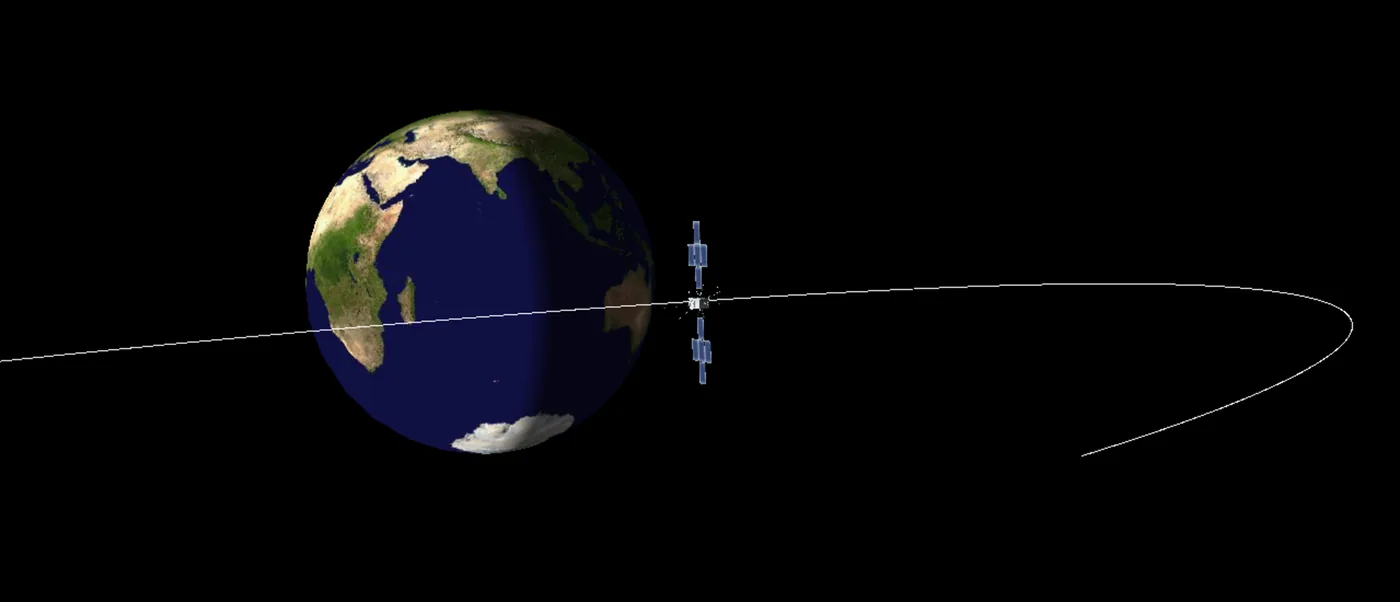
The Juice flyby is a planetary gravity assist maneuver that harnesses Earth’s orbital momentum to alter the flight direction and speed of the European Space Agency spacecraft. By sweeping within 8,640 kilometers of Earth, the probe alters its heliocentric path without firing its main chemical engines. The encounter preserves irreplaceable fuel reserves required for extensive exploration around Jupiter’s icy moons. Flight dynamics calculations confirm that this third gravity assist will deflect the spacecraft’s trajectory by approximately 20 degrees while increasing velocity by about 3.5 kilometers per second relative to the Sun [1].
Closest terrestrial approach will take place over the Indian Ocean at 13:45 CEST (11:45 UTC, corresponding to 6:45 a.m. CDT), following an overland passage across Australia fifteen to thirty minutes earlier [2]. Binocular observers across Australia can spot the craft moving rapidly from northeast to northwest. The European Space Agency published real-time tracking data and countdown clocks on its official portal to support ground observations throughout the flyby [1]. Although ESA does not plan a live video broadcast for this encounter, flight control centers will distribute operational updates across official digital channels [2].
Planetary flybys carry technical risks. Ground navigators have planned every trajectory correction to ensure the spacecraft passes Earth at the prescribed safe altitude [1].
Why Planetary Gravity Assists Enable the Voyage
Flying directly to Jupiter on a straight trajectory remains impossible with current commercial launch vehicle capabilities. Reaching the Jovian system without planetary flybys would demand an enormous rocket carrying prohibitive quantities of propellant, followed by massive deceleration burns to prevent the vehicle from speeding past Jupiter into deep space. Mission designers solved this energetic hurdle by routing Juice through multiple planetary gravity assists, leveraging gravitational momentum transfers from the Moon, Venus, and Earth to gain velocity for free [1].
Onboard fuel preservation remains paramount throughout cruise operations. Tanks must stay filled for Jovian orbital capture in 2031 and subsequent Ganymede insertion in 2034. Scientific initiatives across deep space frequently share operational insights, much as separate agency analyses demonstrate how crop health monitoring guides NASA exploration in refining robotic payloads for long-duration spaceflight deployments across harsh planetary environments. By relying on gravity assists, the spacecraft conserves critical resources while transporting ten sophisticated scientific instruments that will evaluate Jovian moons as potential habitats for life [1].
Astrodynamics specialists continue examining how gravitational fields perturb interplanetary trajectories, comparing empirical telemetry with theoretical predictions developed across decades of planetary flyby navigation [1]. Independent dynamical research, including analyses of physical contributions during historical Earth flybys published as a preprint that has not undergone peer review, indicates that minute orbital perturbations require rigorous modeling to maintain navigational accuracy across close celestial approaches. Precision guidance guarantees mission survival [3].

How Ground Controllers Navigate the Juice Flyby Earth Trajectory
Spacecraft operators initiated the formal Juice flyby Earth navigation campaign on August 17 to guide the spacecraft toward its precise celestial aimpoint. Flight directors scheduled six potential correction slots across the trajectory, establishing opportunities at four weeks, two weeks, one week, and three days prior to closest planetary approach. Because initial orbital injection proved exceptionally accurate, ground teams executed only a single minor trajectory adjustment at minus four weeks to align the spacecraft with its target corridor. Angela Dietz, the Juice Spacecraft Operations Manager, highlighted the precision of the maneuver: “Until now, only one manoeuvre at minus four weeks was needed. It was of relatively small size, but extremely effective. It put Juice in the right spot for the flyby. Our Flight Dynamics Team did an amazing job to prepare it!” [1].
Controllers at mission control will maintain active monitoring at 08:00 CEST on September 28, reserving a final contingency window to address any critical navigation discrepancies or satellite conjunctions. This contingency slot protects the vehicle as it sweeps past thousands of orbital platforms surrounding Planet Earth, though engineers expect that no further thruster firings will be required. The flight path remains stable. Ground tracking stations continuously monitor radiometric range measurements to ensure that entry velocity and deflection angles align perfectly with theoretical flight dynamics models [1].


Instrument Observations Across the Orbital Shadow
An operational complication unfolds hours before closest approach as the spacecraft encounters Earth’s shadow between September 27 and September 28. Entering eclipse from 21:24 CEST on September 27 to 06:03 CEST on September 28 deprives the solar arrays of sunlight, forcing Juice to rely entirely on internal battery power. To prevent depleting onboard batteries, mission engineers established a prioritized schedule that restricts instrument activity to the most critical scientific observations while the vehicle remains enveloped in darkness. Batteries must endure darkness [1].
All ten science instruments will be activated between September 23 and October 3 to calibrate sensors and collect comparative data across the Earth-Moon system. Claire Vallat, the Juice Project Scientist, emphasized that the current single-planet encounter offers distinct operational advantages over earlier maneuvers: “All flybys are risky, requiring very careful planning and continuous monitoring.”. Vallat added that “the upcoming Earth flyby is much simpler from an operational perspective than the 2024 lunar-Earth flyby, where a flyby of the Moon set Juice up for a flyby of Earth the next day. This is great news for science, because it means we will be able to turn Juice in all different directions to point its science instruments at different parts of Earth and the Moon.” [1].
During the flyby, Juice traverses Earth’s magnetotail for several days. Charged solar wind particles stretch this immense magnetic structure like a windsock into deep space. Scientists plan to combine these magnetic field measurements with data from the joint European–Chinese Smile mission to better characterize terrestrial space plasma dynamics. Meanwhile, the optical navigation camera will image the lunar horizon to refine navigation techniques, while two monitoring cameras capture photographic images of Earth through September 29 for public release [1].

Earlier Orbital Milestones Supporting the Juice Flyby
The present Juice flyby succeeds only because mission controllers overcame serious technical crises following the April 2023 launch from Europe’s Spaceport [1]. Shortly after liftoff, the spacecraft’s primary 16-meter RIME antenna (Radar for Icy Moons Exploration) became stuck in its mounting bracket, threatening crucial radar science objectives. Over three weeks of troubleshooting, engineers fired thrusters to vibrate the spacecraft, exposed stuck hinges to direct sunlight for thermal expansion, and deployed a mechanical actuator on May 12, 2023. The actuator freed the boom. Once operational at Jupiter in July 2031, this radar will penetrate beneath the icy crusts of the Galilean moons to a depth of 5.5 miles (9 kilometers) [2].
Navigators completed the historic lunar-Earth double flyby across August 19 and 20, 2024. The intricate braking maneuver diverted the probe directly toward Venus. The spacecraft reached Venus on August 31, 2025, receiving an essential gravity assist that redirected its flight path back toward Earth for the current encounter. European Space Agency teams also engaged the public throughout these phases, hosting space-themed mocktail competitions and celebrating mission art submitted by eight-year-old Yaryna from Ukraine [2]. Her colorful drawing was painted onto the Ariane 5 launcher.
Future Jovian Tour and Ganymede Orbital Insertion
The September 2026 encounter places Juice onto an optimal inner Solar System transfer orbit. Navigators will guide Juice back to Earth for a fourth and final gravity assist in January 2029, providing the final kinetic boost required to intercept Jupiter in July 2031. Led by the European Space Agency with contributions from NASA, JAXA, and the Israel Space Agency, the mission represents the first Large-class undertaking in ESA’s Cosmic Vision programme. The cruise demands eight years [1].
Upon reaching Jupiter in 2031, the spacecraft will perform thirty-five dedicated flybys across the large ocean-bearing moons Europa, Ganymede, and Callisto. Instruments will examine Europa’s ice-covered liquid ocean for organic carbon molecules and potential habitability indicators, establishing Jovian planetary dynamics as an archetype for gas giant systems across the galaxy. The spacecraft will eventually enter dedicated orbit around Ganymede in 2034, descending to an altitude of 125 miles (200 kilometers) for three years of topographical mapping before concluding with a planned surface impact and completing the Ganymede orbital insertion profile [2].
- PRESS RELEASE European Space Agency. (2026, September 21). Juice to fly past Earth for third gravity assist. ESA Science & Exploration. [Article Link]
- ONLINE NEWS Whitt, K. K. (2026, September 22). JUICE mission to fly by Earth next week! Details here. EarthSky. [Article Link]
- PREPRINT Rosetta Earth Flyby Anomaly Revisited: Assessing Physical Contributions through Orbital Dynamics Analysis. (2026). arXiv. [Article Link]
APA 7: PerEXP Teamworks. (2026). Juice Flyby Steers ESA Spacecraft Past Earth Toward Jupiter.


