





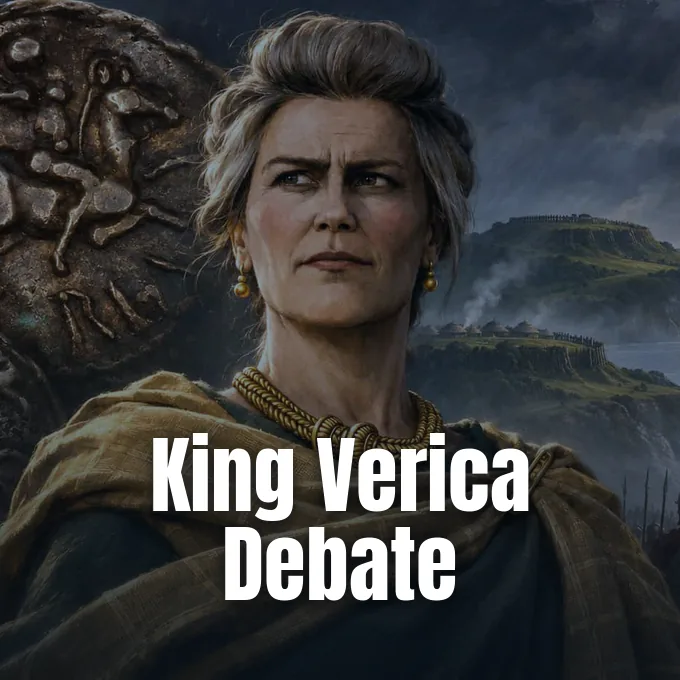
When Emperor Claudius in AD43 launched the Roman conquest of Britain, imperial legions crossed the Channel and landed on the coast of Kent [2]. For generations, classical writers held that an exiled British king sought intervention from Rome after losing land in southern Britain [1]. New research led by Dr. Miles Russell, the director of archaeological fieldwork at Bournemouth University, suggests that the ruler known as King Verica was not a male monarch, but a woman who led the Atrebates tribe as a Romanised Briton. The re-evaluation challenges long-standing assumptions about Iron Age politics and reopens debate about the royal figures who influenced Roman imperial policy [2].
Reassessing King Verica on Ancient Coins
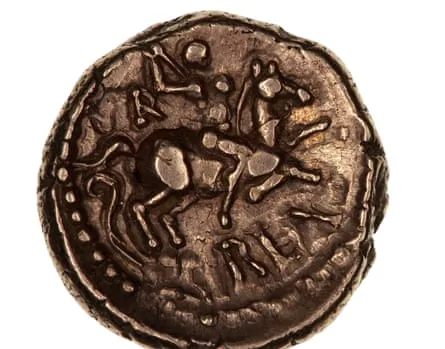
Dr. Miles Russell published his analysis in the journal Current Archaeology, re-examining coins minted in Hampshire and West Sussex before Roman legions arrived [1]. While neighboring British rulers such as Cunobelinus chose to display heavily built male fighters on their money, coins struck under Verica show a slender rider holding a spear [2]. Russell said this bare-breasted figure shows female authority [1].
The lettering stamped onto these coins gave nineteenth-century scholars clues that shaped their view of the ruler’s sex. Early researchers read the Latin abbreviation COM F as Commios filius, translating the phrase as son of Commios to connect the monarch with a Belgic leader known from Julius Caesar. Yet the same letters abbreviate Commios filia, which means daughter of Commios in Latin [1]. The coinage also carries the title rex, a word long read as king. Russell says that unlike the words Regina for queen and Regis for king, the term rex did not imply a particular sex on client coinage [2]. Russell said that “rex is a nongender specific title, both male and female kings were recognised by Rome, Cleopatra of Egypt being the most famous”. He said the word on coins shows that Verica governed with the authorization of the emperor [1].

Grammar Clues in Celtic Names
In Iron Age Britain, personal names followed clear grammatical habits that showed the sex of the person. Male names among Celtic groups usually ended with suffixes like -us or -os, as seen with Caratacus and Commios. Names that ended with an a, like Boudica of the Iceni and Cartimandua of the Brigantes, belonged to women who held sovereign authority. Russell said the name Verica matches this feminine naming pattern [1].
The view of the leader as male stems largely from the Roman historian Cassius Dio, who wrote in Attic Greek two centuries after the invasion took place [1]. Dio referred to the exiled ruler as Bericus. Russell argues that Dio’s text reflects errors from translating and transcribing across multiple generations of scribes, creating a masculine form that never appears on British money. Prof Roger Tomlin, an Oxford University archaeologist who translates Latin texts, said that Latin men’s names ending in a do exist, but the masculine form Vericus gives the best argument that Verica was feminine. He noted that Dio assumed the ruler was male when recording the name Bericus [2].
Debate Surrounding King Verica and Royal Titles
Other researchers remain unconvinced by the claim that King Verica was female. Roger Tomlin told The Guardian that Roman recognition of client queens does not show that officials used the title rex for women. “Of course the Romans recognised client-queens as well as client-kings, but Russell must prove, by finding other examples, that they referred to them both as Rex,” Tomlin said. British Iron Age coin expert Dr. Daphne Nash Briggs also urged doubt about drawing definitive conclusions from the surviving coinage. She pointed out that some coins bearing Verica’s name show male horsemen, while others show a figure in male priestly dress or a neck with an Adam’s apple [2].
Russell counters that coin portraits showing an Adam’s apple may depict the Roman emperor rather than Verica [1]. He also argues that specialists cannot prove the clothing belonged to a male figure or that the drawing was Verica at all. “It reminds me of the argument that Queen Victoria was really a man, because the reverse of her gold coinage depicts her as a male horseman killing a dragon,” Tomlin said. Russell acknowledged that his reading of the coins challenges entrenched views and welcomes the debate. “If it does create debate and argument, I think that’s for the better,” Russell said. “The one-sided story’s been there for so long. We need that to change. We need to have this discussion.” [2]


Matrilocal Communities in Southern Britain
Fieldwork in Dorset provides context for how women held power in southern Britain before the Roman conquest. Since 2009, Russell has co-directed digs at a Late Iron Age cemetery at Winterborne Kingston [1]. In a 2025 genetic investigation published in Nature, a research team analyzing ancient bone samples from 50 skeletons at Dorset burial sites discovered that nearly two dozen related individuals traced their descent through a shared maternal line while male Y chromosomes varied widely across generations. This pattern showed that Iron Age Britons practiced matrilocality, an arrangement where husbands moved to join their wives’ families and land passed down the female line [3]. Similar matrilocal patterns appeared at sites in Somerset, Oxfordshire, Cornwall, and Yorkshire [1].
Women also held the richest graves at Winterborne Kingston, pointing to high standing during life. Roman writers like Tacitus and Julius Caesar wrote with surprise about Celtic women who led troops and held sovereign power. In Rome, laws barred women from holding government posts. Roman biographers like Suetonius and Cassius Dio often mocked Claudius as an emperor easily led by his wives. Russell said Dio framed the invasion as the work of a foreign woman to make fun of Claudius [1].
The Roman Alliance at Fishbourne
Digs near Chichester show that ties between Rome and the Atrebates started well before Roman troops landed in AD43. At Fishbourne, archaeologists found ditch systems, granary buildings, and pottery dating between 10 CE and 30 CE, along with a Coolus-type helmet. These finds show that Roman leaders kept an outpost there under Augustus or Tiberius to guard trade routes [1].
In European Antiquity, client kingdoms acted as buffer states along imperial borders. Rulers paid tribute and sent grain, metals, and enslaved people to Rome; in return, the empire gave military backing and trade goods. But when Roman troops left Fishbourne around 30 CE, leaders from the Catuvellauni tribe moved to take Atrebates land. A rival leader named Epaticcus took Verica’s northern base at Calleva (Silchester). Epaticcus struck coins that gave the wings of the goddess Victory to a male body, a choice Russell sees as mockery of Verica. After tribal king Cunobelinus died, his son Caratacus pushed the fight further and drove King Verica out around 40 CE [1].

Tribal Conflicts Before the AD 43 Invasion
After driving the ruler out, Caratacus minted gold coins that replaced the horse-riding woman with a naked male warrior holding a javelin. Ousted three years before the imperial fleet sailed, King Verica crossed the English Channel to ask Emperor Claudius for military help. Verica gave Claudius intelligence about landing sites, coastal harbors, and the fighting habits of British tribes [1].
Claudius had taken power after the assassination of his predecessor and needed a military victory to secure his position in Rome. Verica’s appeal gave him an excuse to order the invasion of Britain. Russell sets out the case in his book Caratacus: Great King of Britain, published by Bloomsbury in January. History records other British women in power, such as Boudica of the Iceni, who led a rebellion in 60 CE, and Cartimandua of the Brigantes, who handed Caratacus over to Roman agents around 51 CE. Yet Russell argues that Verica had a bigger geopolitical impact because the ruler’s plea brought the Roman army to British shores in AD 43 [1]. While specialists like Roger Tomlin and Daphne Nash Briggs urge caution about coin evidence, the debate over Verica’s identity reopens key questions about who held power in ancient Britain [2].
- ONLINE NEWS Puiu, T. (2026, November 5). The Forgotten King Who Invited Rome to Conquer Britain Might Have Actually Been. A Woman. ZME Science. [Article Link]
- ONLINE NEWS Davis, N. (2026, November 5). Historians say King Verica persuaded Rome to invade Britain. But could Verica actually have been a queen? The Guardian. [Article Link]
- ACADEMIC JOURNAL Cassidy, L. M., Russell, M., Smith, M., Delbarre, G., Cheetham, P., Manley, H., Mattiangeli, V., Breslin, E. M., Jackson, I., McCann, M., Little, H., O’Connor, C. G., Heaslip, B., Lawson, D., Endicott, P., & Bradley, D. G. (2025). Continental influx and pervasive matrilocality in Iron Age Britain. Nature, 637(8048), 1136-1142. [Article Link]
APA 7: PerEXP Teamworks. (2026, November 6). King Verica May Have Ruled Britain as a Queen, Study Argues. PerEXP Teamworks. https://perexpteamworks.com/en/king-verica-female-ruler-roman-invasion/


