






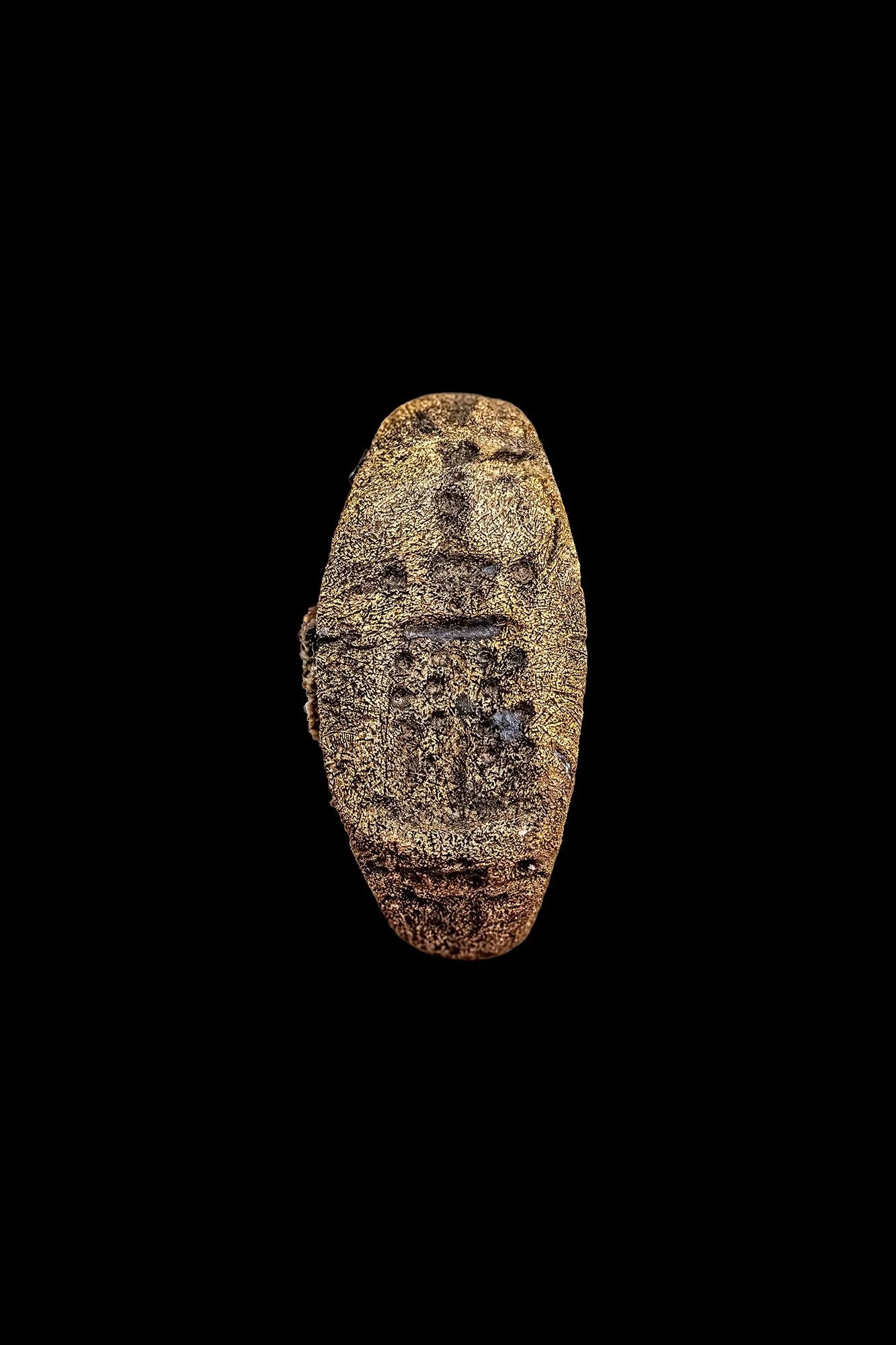
Underwater archaeologists working in Alexandria’s Eastern Harbor have discovered an ancient bronze ring bearing an engraved portrait of the fabled Pharos lighthouse [1]. The rare artifact emerged from submerged palace ruins on the sunken royal island of Antirhodos during excavations conducted by the European Institute for Underwater Archaeology and the Egyptian Ministry of Tourism and Antiquities [2]. Marine corrosion softened its metal face, but the jewel links personal adornment with one of classical antiquity’s lost wonders [6]. Harbor officials likely operated out of the royal precinct well into the Roman era [4].
What Was the Sunken Island of Antirhodos?
Antirhodos was a small royal island in Alexandria’s Eastern Harbor that housed a palace for the Ptolemaic dynasty [1]. Greek geographer Strabo described the island after visiting Egypt between 29 B.C. and 25 B.C., recording that it held a private artificial port alongside fortified royal villas used by Hellenistic monarchs [2]. Earthquakes later submerged the quarter [7].
Today, the royal sanctuary rests several meters below the water line off Alexandria’s seafront. French underwater explorer Franck Goddio, president of the European Institute for Underwater Archaeology, has surveyed the area since 1992. Goddio’s dive teams documented a royal palace linked to Cleopatra VII, recording fallen granite columns, paved courtyards, and wooden quays preserved beneath harbor mud [3]. The mission’s recent season focused on four locations within the old Portus Magnus: the Temple of Isis, the palace on Antirhodos, an ancient obelisk, and the Timonium retreat linked with Mark Antony [2].
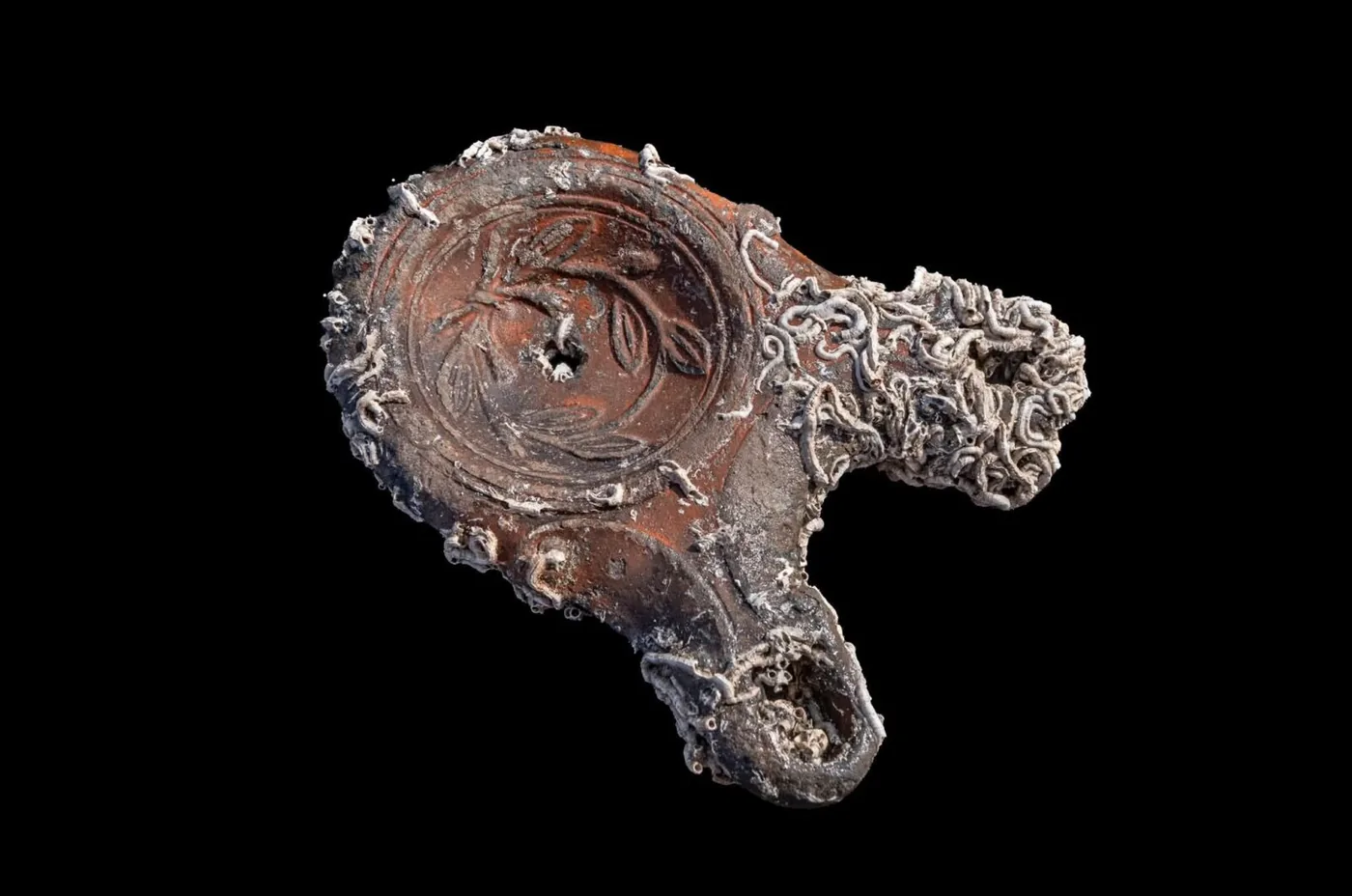
Excavators retrieved abundant household items showing unbroken human activity from the fourth century B.C. through the fourth century A.D.. The ceramic inventory includes tableware, transport amphoras, glass bottles, and decorated oil lamps covered with marine encrustations, proving that Antirhodos supported port personnel rather than deserted royal ruins [2, 6]. Similar discoveries help historians reconstruct everyday Egyptian life, much like findings from ancient Egyptian tombs unearthed in Aswan that reveal provincial trade networks under Roman rule [2].
Ancient Bronze Ring Found in Royal Ruins
Divers searching the palace area on Antirhodos retrieved the small bronze ring from harbor sediment [1]. Hisham El-Leithy, secretary-general of Egypt’s Supreme Council of Antiquities, stated that this find represents the first time the Lighthouse of Alexandria has ever been identified on an engraved seal ring recovered from archaeological excavations [4]. While Roman mints produced thousands of coins with the tower, no personal ring had ever carried that emblem. Franck Goddio said: “The discovery of the ring-signet is even more important as it has been excavated in the legendary palace of the Island of Antirhodos, that once was a centre of power” [1].
The miniature engraving matches coin portraits minted in Alexandria during the second century A.D. [1]. It depicts a three-tiered monument featuring a wide square base, an octagonal middle section, and a cylindrical lantern topped by a divine statue [5]. Independent researcher Andrew Chugg noted that an asymmetrical mark at the tower’s peak “may depict a plume of smoke from the oil lamp in the hand of the crowning statue”. Classical art scholar Margaret Miles from the University of California, Irvine, also recognized that possible smoke plume, explaining that sailors in Mediterranean ports recognized the lighthouse as Alexandria’s defining civic crest [1]. The ancient carver captured fine architectural details, including corner Tritons (mythological sea deities blowing conch shells) that adorned the lower parapet of the monumental beacon [3].
Centuries of immersion produced a green patina across the bronze surface, yet the silhouette stays visible under angled studio light [1]. Submerged harbor silt shielded the metal core from wave abrasion, preserving a rare record of the city’s ancient skyline [3].
Did Officials Wear the Bronze Signet Ring?
Yes, evidence suggests that harbor officials, dock managers, or wealthy sea merchants wore the bronze signet ring to conduct port business [1]. Signet rings in antiquity were practical instruments used to validate property and authenticate letters [3]. A person pressed the engraved bronze face into soft clay or warm wax to seal storage jars, legal deeds, and commercial cargo invoices, assuring distant recipients that shipments had not been tampered with along coastal trade routes. That raised impression provided legal validity in Mediterranean ports [4].
Finding this object inside a royal palace suggests that the island retained an official civic role long after the Ptolemaic dynasty ended and Roman governors took control of Egypt’s maritime trade [1]. Egypt’s antiquities authorities propose that staff on Antirhodos oversaw port operations during the second century A.D., possibly directing activities tied to the lighthouse itself [2]. Margaret Miles observed that an Alexandrian merchant might have worn the tower’s image to advertise his home port during foreign voyages [1]. The owner’s exact rank is unconfirmed. Writer Guillermo Carvajal pointed out: “The statement does not say who wore this ring or what for” [5].

Similar seals survive in museum collections, although wearable finger rings depicting the Pharos are unique to this underwater find. Andrew Chugg documented a Roman seal made of blue glass in Vienna’s Kunsthistorisches Museum and a Byzantine gemstone in the British Museum that both carry tower images. Neither artifact sits inside a finger ring. Researchers study these miniature seals to understand ancient harbor bureaucracy, much as scientists use spectral imaging of charred Herculaneum scrolls to recover lost tax records from antiquity [3].


What Did the Lighthouse of Alexandria Look Like?
The Lighthouse of Alexandria was a monumental three-tiered stone tower that stood between 330 and 430 feet tall above Pharos Island [5]. Construction began under Ptolemy I and finished around 280 B.C. during the reign of Ptolemy II, who ruled Egypt from 284 to 246 B.C.E. [7]. Greek architect Sostratus of Cnidus dedicated the towering beacon to the savior gods on behalf of merchant sailors navigating treacherous offshore shoals along the Mediterranean coast [3]. The tower rose in three sections: a square base, an octagonal middle stage, and a circular lantern level [5].
Sailors relied on the towering structure because Egypt’s flat Mediterranean shoreline lacked natural headlands or cliffs to warn navigators of concealed sandbars approaching the harbor entrance. Greek historian Diodorus Siculus recorded that submerged sandbanks along the coast were “not discernible to any who approach without previous experience of these waters,” causing sudden shipwrecks [5]. An open brazier and oil lamps burned day and night at the summit, casting bright light across the sea. Classical travelers considered the building a masterwork, and Pliny the Elder placed it among the Seven Wonders of the Ancient World [1].
Earthquakes gradually brought down the tower over the Middle Ages. In 956 C.E., powerful tremors cracked the upper walls, and subsequent earthquakes in 1303 and 1323 toppled the remaining masonry into the sea, bringing down the ancient world’s tallest beacon [7]. In the fifteenth century, Sultan Qaitbay built a fort on Pharos Island, reusing fallen granite blocks from the monument’s foundation [5]. The building survived primarily through prints like the Octo Mundi Miracula [4].
Could the Bronze Seal Ring Carry Port Authority?
Yes, archaeologists suggest that the bronze seal ring may have served as an official insignia for magistrates managing Alexandria’s maritime harbor. Analysis published by cultural journal StileArte suggested that an engraved signet could represent delegated authority over port traffic and lighthouse maintenance [6]. Stamped seals proved that shipments met tax standards and passed harbor inspection [4].
The ring also expands historians’ understanding of when the royal quarter functioned. Strabo’s eyewitness account established that Antirhodos functioned as a Ptolemaic royal redoubt during the first century B.C. [2]. However, the ring’s second-century design implies that official administrative activity continued on the island long after Egypt became an imperial Roman province following the fall of Alexandria [4]. Rather than abandoning the island after Cleopatra’s death, Roman administrators likely maintained naval bureaus and customs offices among the former royal villas. The island functioned as a working hub connecting local Egyptian shipping with imperial Mediterranean commerce [2].
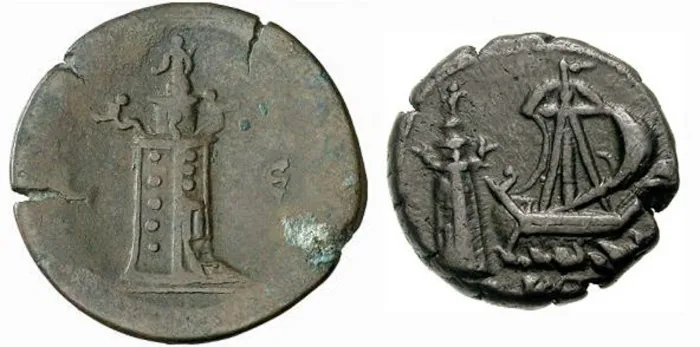
Researchers emphasize that this institutional connection remains an unproven hypothesis until excavators discover stamped papyri or clay sealings bearing the tower’s imprint. No written registry from a lighthouse bureau has been recovered from the seabed [3]. Archaeological context makes the piece valuable regardless of whether its owner held an imperial commission [5].
Lifting Lost Wonder Blocks from the Seabed
Underwater exploration in Alexandria gained momentum in 1994, when French archaeologist Jean-Yves Empereur located the submerged remnants of the lighthouse off Pharos Island [4]. Empereur, who founded the Center for Alexandrian Studies, mapped thousands of masonry blocks scattered across the seabed near Qaitbay Citadel [7]. Today, dive teams record more than 3,000 architectural fragments, including 80-ton granite blocks, shattered columns, and colossal statues of Ptolemaic rulers that tumbled directly into the sea during medieval earthquakes. Jean-Yves Empereur showed that substantial sections of the ancient wonder survived beneath coastal waters [4].
Recent investigations focus on digital reconstruction rather than physical extraction. In 2025, an underwater survey team known as the Pharos Project raised 22 massive stone blocks from the seafloor to support photogrammetric scanning. Divers capture high-resolution imagery to record ancient mortar joints, dowel holes, and carved mouldings [5]. By comparing these digital models with imperial coins and the newly discovered bronze ring, researchers can test structural hypotheses about the tower’s original elevation and exterior decoration [1]. Poor underwater visibility and surge make seafloor surveying demanding, but 3D mapping preserves data that salt erosion slowly degrades [5].
Surveys in Alexandria’s Eastern Harbor continue to provide fresh material evidence from eight centuries of classical history [2]. Once diving concludes at Antirhodos, the expedition will move east toward Abu Qir Bay to survey the submerged classical cities of Canopus and Thonis-Heracleion [3]. Discovering an engraved bronze ring links a massive architectural wonder to the personal belongings of ancient harbor workers [6].
- ONLINE NEWS Jarus, O. (2026, October 9). Bronze ring with Lighthouse of Alexandria engraving discovered at palace on submerged island in Egypt. Live Science. [Article Link]
- ONLINE NEWS Radley, D. (2026, October 6). Ancient Alexandria lighthouse image found on rare bronze seal ring underwater. Archaeology News Online Magazine. [Article Link]
- ONLINE NEWS Manners, G. (2026, October 7). Bronze Seal Ring With Lighthouse of Alexandria Found on Royal Island. Ancient Origins. [Article Link]
- ONLINE NEWS Waters, C. (2026, October 8). Rare Ancient Seal Ring Depicting Lost Lighthouse Of Alexandria Discovered Underwater. Ancient Pages. [Article Link]
- ONLINE NEWS Suresh, A. (2026, October 9). Archaeologists discover rare bronze ring engraved with the lighthouse of Alexandria at Egypt’s sunken royal palace. The Economic Times. [Article Link]
- ONLINE NEWS Buyukyildirim, O. (2026, October 6). First-Ever Seal Ring Showing the Lighthouse of Alexandria Found in the Sunken Royal Quarter. Arkeonews. [Article Link]
- ONLINE NEWS Spitz, E. (2026, October 7). Archaeologists In Egypt Just Found A 1,900-Year-Old Ring Depicting The Lighthouse Of Alexandria. All That’s Interesting. [Article Link]
- ONLINE NEWS Discover Magazine. (2026). Ancient Bronze Ring Engraved with Alexandria’s Famous Lighthouse Found in Sunken Royal Ruins. Discover Magazine. [Article Link]
APA 7: PerEXP Teamworks. (2026, October 10). Ancient Bronze Ring Reveals Lost Lighthouse of Alexandria. PerEXP Teamworks.


