






Chinese hardware maker TOPC has launched the TOPC TXA2, a copper-colored mini PC workstation powered by AMD’s Ryzen AI Max+ PRO 495 processor, on its online store in October 2026. The compact desktop targets demanding offline artificial intelligence workloads. It pairs 16 Zen 5 processing cores with 192GB of LPDDR5X unified memory to let engineers run large models locally without sending private queries to remote cloud servers. Base configurations start at $6,399 for 2TB of storage and climb to $6,799 for 4TB versions before delivery fees and regional sales taxes. The system packs quad solid-state drive slots and simultaneous display feeds for four 8K screens into a 2.5-liter chassis [1] [2].
Hardware Inside the TOPC TXA2
At the heart of the system sits AMD’s Ryzen AI Max+ PRO 495 processor, built on the Gorgon Halo architecture with 16 CPU cores and 32 threads capable of reaching a 5.2GHz boost clock [4]. The silicon uses AMD’s Zen 5 architecture.
Integrated graphics duties fall to the Radeon 8065S GPU, which provides 40 graphics cores based on RDNA 3.5 architecture running at clock speeds up to 3,000MHz. Instead of relying on a discrete desktop graphics card with limited onboard video memory, the processor accesses up to 160GB of the workstation’s pooled system memory for graphical and artificial intelligence calculations. Dedicated neural acceleration comes from an XDNA 2 neural processing unit delivering 55 TOPS of compute. Total platform AI performance reaches 131 TOPS, meeting Microsoft’s Copilot+ PC specification [4] [5].
Memory capacity serves as the machine’s central feature, offering 192GB of LPDDR5X-8533 memory across a 256-bit bus with 273GB/s bandwidth. However, this high-speed memory is soldered directly onto the motherboard, which means buyers can’t upgrade or swap modules later. The hardware maker chose this soldered approach to keep data paths short and preserve signal integrity across the memory bus, but it limits long-term hardware flexibility. Direct access to 160GB of memory lets the system load large neural weights without stalling on storage drives [1] [5].

Storage Slots and Rear Ports
Storage expansion on the TOPC TXA2 includes four M.2 2280 NVMe connectors arranged across the motherboard to support high-capacity solid-state drives for data collections. Two of these connectors run over high-speed PCIe 4.0 x4 interfaces, while the remaining two connectors operate through PCIe 4.0 x2 connections, offering flexibility for pairing boot drives with scratch disks. Buyers can order pre-configured systems loaded with 2TB or 4TB of storage, though TOPC doesn’t specify the exact drive brands or individual read speeds installed in shipping units [1] [2].
The desktop measures 7.8cm thick. Having four independent drive slots inside such a low profile gives data science workers plenty of room to archive local neural weights and dataset caches without external drive bays [1].
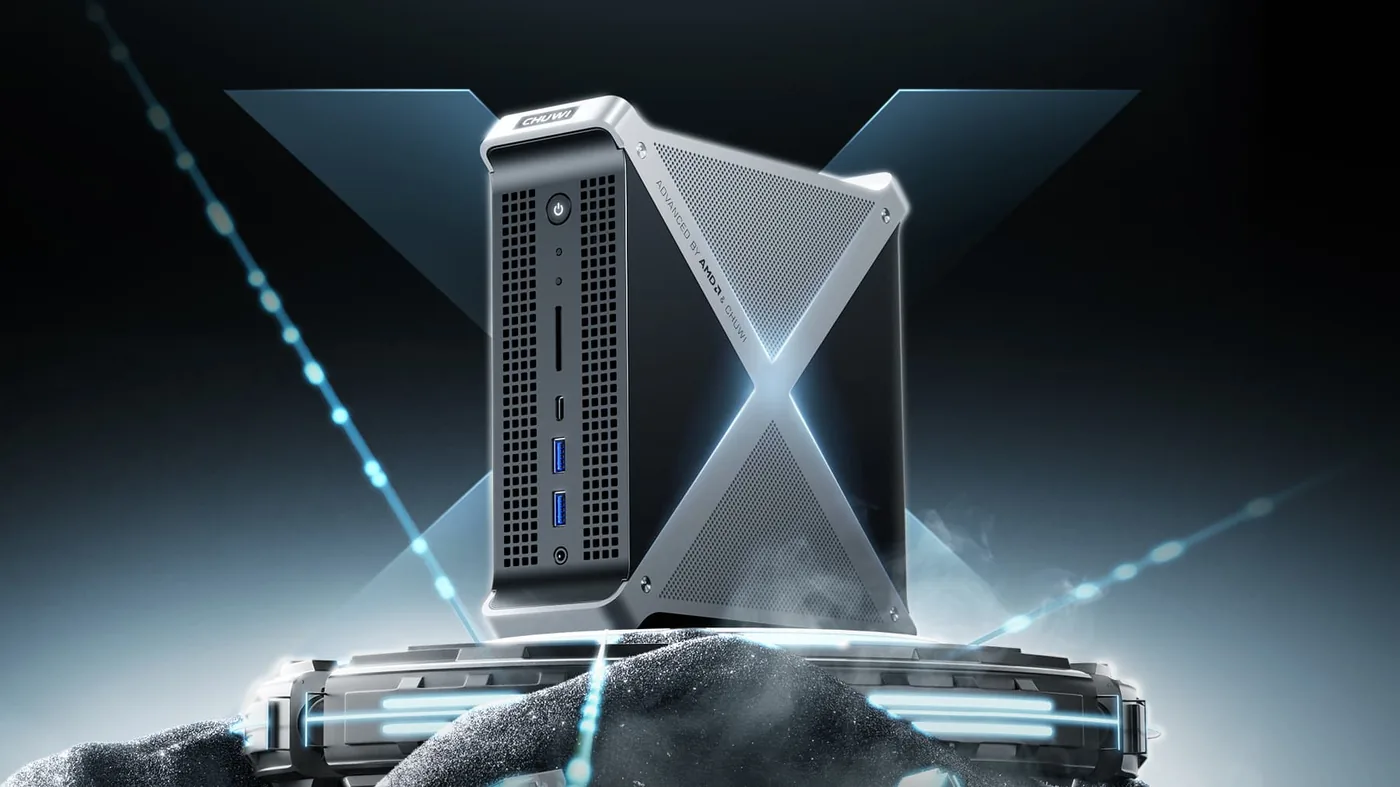
External connectivity is split between front access sockets and a packed rear interface panel. The rear features an AQC113 10GbE network port with a 2.5GbE port, one HDMI 2.1 connector, one DisplayPort 1.4 port, and four USB 3.2 Gen 1 Type-A sockets running at 5Gbps. For external graphics expansion, two USB4 ports support eGPU connections with video transmission, letting the system drive up to four 8K monitors at the same time. The front panel carries an SDXC card slot. Front access also includes three USB 3.2 Gen 2 Type-A ports running at 10Gbps and a 3.5mm combo audio jack, while wireless traffic relies on Wi-Fi 7 and Bluetooth 5.4 [1] [2].



Thermal Design in a Compact Chassis
The TOPC TXA2 fits its hardware into a copper-colored metal enclosure measuring 180mm by 180mm with a height of 78mm, occupying roughly 2.5 liters of total volume. The chassis weighs 2.319 kg. It can sit flat horizontally on a desk or stand vertically on its side [1] [2].
Dissipating heat from a 120W thermal design profile requires active circulation, so TOPC installed four internal fans within the enclosure. Two fans sit directly over the AMD processor heatsink assembly, while the second pair circulates air across the soldered LPDDR5X memory chips and adjacent M.2 solid-state drive bays before venting out an exhaust grill above the rear port array. Cooling engineers designed the multi-fan system to handle 120W during regular continuous operation and up to 140W during bursts of peak processing demand [1] [2].
While four cooling fans help prevent thermal throttling during multi-hour model training or code compiling runs, they could also create noticeable acoustic noise in quiet home offices. TOPC discloses no acoustic decibel data. Compact workstation buyers often work long hours beside their computers, so high-pitched fan whine under sustained load could become a nuisance for developers who keep the chassis close [1].
Comparing the TOPC TXA2 to Rival Systems
AMD categorises systems built on this class of processor as “Agent Computers”, reflecting an industry push toward local AI workloads that run without cloud servers [6]. Inference takes place completely on device.
Coverage from SMBtech noted that Chinese PC maker CHUWI showcased its own UniBox AI495 Pro workstation built around the same 16-core Ryzen AI MAX+ PRO 495 chip and 192GB memory pool at IFA Berlin 2026. CHUWI stated that its machine can run local large language models containing up to 300 billion parameters under 4-bit quantization, giving developers a clear indicator of what AMD’s unified Gorgon Halo silicon achieves in practice. CHUWI also introduced a second model called the UniBox AI395, which uses AMD’s Ryzen AI Max+ 395 processor with 128GB of memory to run 235-billion-parameter mixture-of-experts models [4] [5] [6].
Other compact workstations explored similar unified memory. Earlier systems like the MSI Pro Max Edge AI+ provided 128GB of unified RAM with an offline neural processing setup for desktop developers. But the TOPC TXA2 pushes available graphics memory further by granting up to 160GB directly to the Radeon 8065S GPU, providing extra headroom for large context windows. CHUWI claimed its integrated 40-core GPU can outpace a desktop Nvidia GeForce RTX 4060 in specific gaming workloads, though gaming remains a secondary perk here [4] [5].

Pricing Configurations and Purchase Risks
Retail pricing on TOPC’s online storefront lists the 2TB model for $6,399, while the upgraded 4TB configuration costs $6,699. Coverage from TechRadar noted slightly higher retail estimates of $6,499 for the 2TB version and $6,799 for 4TB, plus a mandatory $69 shipping charge that pushes baseline costs to $6,568 and $6,868 before import taxes [1] [2].
The price tag remains steep. Reporting from TechPowerUp pointed out that the $6,399 price sells for $900 less than AMD’s in-house Ryzen AI Halo Developer platform. In Europe, adding standard 20% value-added taxes and currency conversion fees can push the final checkout price beyond €7,200 for enterprise buyers [1] [2].
Ordering from an obscure hardware startup introduces practical customer service and maintenance questions. TOPC offers a one-year warranty. Payments go through PayPal. While PayPal checkout gives buyers basic fraud protection, warranty repairs could take weeks if units travel back overseas for component servicing. Because the 192GB memory modules are soldered directly to the circuit board, any memory fault requires replacing the entire motherboard rather than swapping a single defective stick. Buyers must decide whether the convenience of running 300-billion-parameter AI models in a small copper box outweighs the risks of buying expensive cutting-edge hardware from a relatively unknown brand [1].
- ONLINE NEWS TechRadar. (2026, October 24). Efosa Udinmwen. [Article Link]
- ONLINE NEWS TechPowerUp. (2026, October 15). Cpt Jank Discuss. [Article Link]
- ONLINE NEWS Yahoo Tech. (2026, October 24). Efosa Udinmwen. [Article Link]
- ONLINE NEWS IGeeKphone. (2026, September 7). Brady Cotton. [Article Link]
- ONLINE NEWS Tech Edition. (2026, September 7). Joby Jean. [Article Link]
- ONLINE NEWS SMBtech. (2026, September 10). Nick Ross. [Article Link]


