



Can artificial intelligence determine whether a military employee is telling the truth without sensors touching their body? The Pentagon wants to answer that question by overhauling its federal vetting apparatus. In its 2027 budget request, the Defense Counterintelligence and Security Agency asked for $30.3 million over five years to modernize credibility assessment technologies. The initiative, officially designated Polygraph+ or Polygraph Next, seeks to transform the traditional lie detector test into a remote, automated screening system [1].
Polygraph Next and Standoff Sensing
Details of the modernization plan first surfaced when Inside Defense published details from the DCSA budget submission. Under the proposed schedule, the agency requests $6.42 million in fiscal year 2027, followed by annual allocations between $5.65 million and $6.45 million through 2031 [1]. Congress has not approved the funding. DCSA handles background checks for millions of federal personnel, though agency officials did not respond to requests for comment regarding operational deployment timelines [2].
The program document outlines a decisive move toward standoff sensing (capturing physiological readings without touching the subject’s body) across federal interview facilities [2]. In addition to remote data capture, the initiative funds machine learning scoring algorithms, automated decision aids, and dedicated cloud storage infrastructure designed to aggregate and refine assessment analytics over time. DCSA explicitly targets two operational missions: vetting prospective federal employees and strengthening internal safeguards through automated insider threat detection [1].
Internal vetting pressures have intensified across the Department of Defense. Under Defense Secretary Pete Hegseth, the Pentagon expanded polygraph examinations to find press leakers [2].

Why the Lie Detector Test Faces Scientific Doubt
Recent workplace tensions illustrate how defense leadership relies on credibility assessments during high-profile national security inquiries. In September, The New York Times reported that roughly 50 military officers on the Joint Staff were subjected to polygraph examinations after news coverage reported on the depletion of American weapons stockpiles in the war with Iran. Department leadership turned to those examinations to uncover confidential media contacts, yet decades of scientific research confirm that physiological fluctuations cannot prove deceit directly [2].
Examiners have relied on mechanical polygraphs since the 1920s to record fluctuations in respiration, pulse, blood pressure, and sweat during structured interviews. While the federal government conducts tens of thousands of these evaluations annually, federal courts rarely admit their findings as reliable evidence. In 1983, the congressional Office of Technology Assessment concluded there was very limited evidence supporting the polygraph for screening personnel, a finding reinforced in 2003 when the US National Research Council (NRC) described empirical support for polygraph accuracy as weak at best [2]. The department employs 2.8 million people. Although the American Polygraph Association asserts accuracy rates between 80% and 94%, applying that margin would inevitably produce tens of thousands of false accusations against loyal personnel [1]. Those systemic vulnerabilities have long troubled researchers examining the operational mechanics of a traditional polygraph lie detector test under strict laboratory conditions [2].
Individual polygraph examiners compound the statistical problem when evaluating identical physiological charts. Research demonstrates that examiners frequently reach contradictory conclusions from the same examination data, while members of minority populations face an elevated likelihood of being categorized as deceptive during screening sessions [2].


What Is a Lie Detector Test Countermeasure?
Trained examinees have long exploited the mechanical predictability of screening interviews by deploying deliberate physical countermeasures. Because polygraph examiners compare physiological fluctuations between baseline control questions, such as asking if the sky is blue, and relevant security questions, subjects can manipulate their comparative readings. By stepping on a small tack hidden inside a shoe during control questions, an interviewee artificially heightens baseline cardiovascular stress, blunting noticeable physiological spikes when answering sensitive questions [2].
Deception researchers emphasize that the utility of physiological testing rests largely on psychological leverage rather than definitive biological measurement. “If you know how it works, you can beat it,” explains Sophie van der Zee, an associate professor who studies deceptive behavior at Erasmus University in Rotterdam. Van der Zee points out that the apparatus functions primarily as an intimidating deterrent that coaxes voluntary confessions before questioning even commences, a psychological gambit that collapses whenever interviewees recognize the systemic limitations of the equipment [2]. Without technological assistance, unassisted humans spot deceptive statements only slightly better than random chance, distinguishing truth from falsehood roughly 54% of the time [4].

Human biology lacks an exclusive biological marker for falsehood. As van der Zee summarizes, “There is still no Pinocchio’s nose” [1].
Machine Learning Scoring and Multi-Modal Tracking
Before DCSA submitted its five-year budget outline, the Defense Innovation Unit (DIU) explored commercial remote sensors through competitive prototype awards in 2023. The military accelerator selected two specialized vendors: Presage Technologies, which claims to extract heart and respiration rates using standard optical cameras, and Altec Research, a biomedical sensor developer [2]. A diagnostic interface released by defense officials demonstrates that Altec’s prototype monitors head movement, localized facial skin temperature variations, and microscopic pore activity across the face without physical touch [1].
Neither commercial developer responded to inquiries. The Defense Innovation Unit declined comment. Proponents argue that machine learning models could process these disparate optical feeds into multi-modal deception detection scores that prove substantially harder for subjects to manipulate during a lie detector test [2]. By aggregating simultaneous readings from skin pores, eye movements, and breathing rhythms, automated software attempts to spot subtle patterns that human examiners inevitably overlook [1].
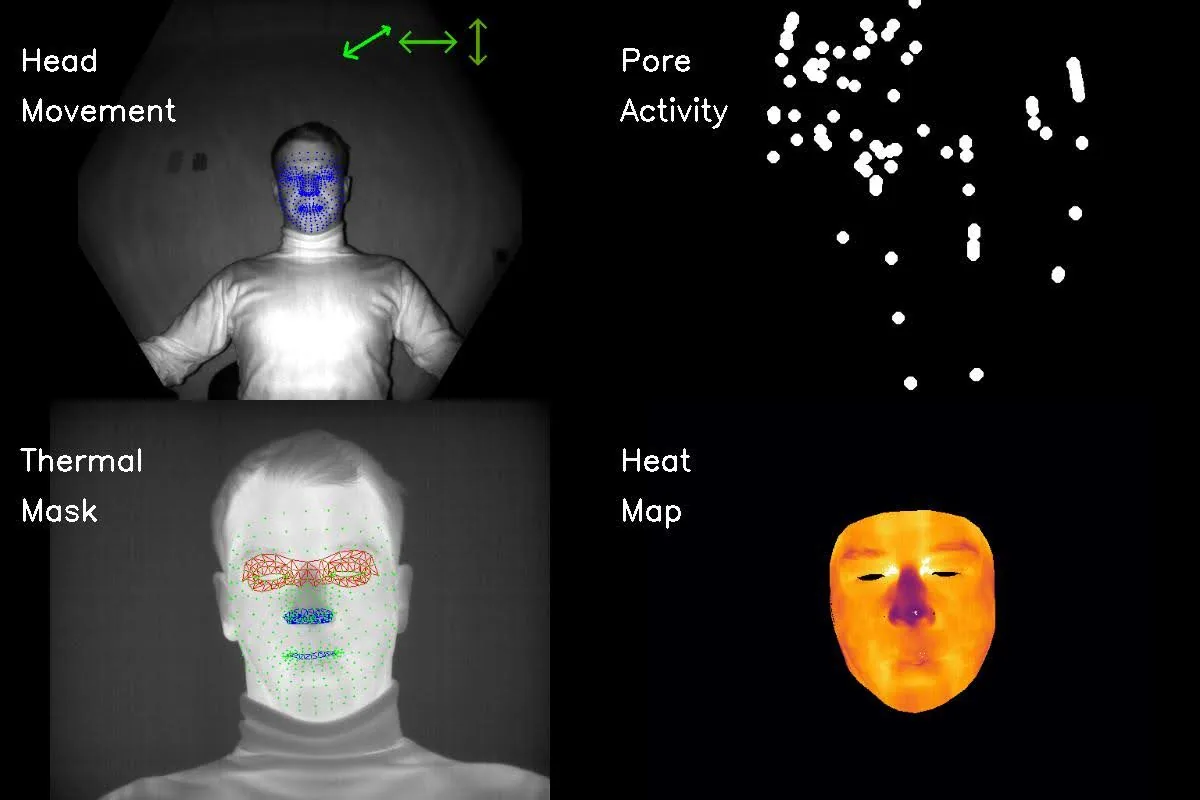
Deceptive behavior activates three distinct operational channels under the surface: autonomic physiological stress, heightened cognitive processing load, and deliberate behavioral concealment strategies. While analog polygraphs monitor only basic autonomic arousal, combining multi-angle sensor streams could theoretically capture how mental effort and suppression interact during questioning [2].
Why Automated Lie Detector Tests Struggle
Legal and scientific scholars argue that layering machine learning algorithms onto unverified physiological metrics introduces profound evidentiary risks. Kyri Kotsoglou, a legal scholar at Northumbria University in the UK, describes the integration of artificial intelligence into federal credibility screening as the worst of both worlds because mathematical algorithms merely amplify existing baseline invalidity [2]. Marion Oswald, a law professor who collaborates with Kotsoglou, emphasizes that algorithmic models lack objective ground truth: “Even if you have all the records in the world from polygraph tests, you don’t know whether those polygraph tests are right or not” [1].
Marion Oswald warns that automated credibility scoring risks degenerating into an administrative threat rather than an objective investigative instrument. Because security clearances determine career survival across the defense establishment, utilizing unvalidated automated screening instruments functions primarily as psychological intimidation to compel admissions during leak investigations [2].
Earlier non-contact deception platforms struggled to deliver verifiable utility once deployed outside laboratory environments. During the 2000s, researchers at Manchester Metropolitan University built Silent Talker to score nonverbal deception from video frames, a concept later adapted into the European Union’s iBorderCtrl border screening trial [2]. Both border trials were discontinued. The Department of Homeland Security’s AVATAR checkpoint project similarly faded after failing to substantiate reliability claims. While agencies continue deploying computer vision tools for prison telephone voice analysis, retail facial recognition, and municipal camera searches, establishing an automated lie detector test remains an elusive goal [1].
- ONLINE NEWS Stanciuc, A.-M. (2026, September 25). Pentagon seeks $30.3m for an AI lie detector to vet its staff. The Next Web. [Article Link]
- ONLINE NEWS Katwala, A. (2026, September 25). The Pentagon wants $30 million to build an AI-powered lie detector. MIT Technology Review. [Article Link]
- ONLINE NEWS Macaulay, T. (2026, September 25). The Download: The Pentagon’s AI-powered lie detector and young organ limits. MIT Technology Review. [Article Link]
- ACADEMIC JOURNAL Bond, C. F., Jr., & DePaulo, B. M. (2006). Accuracy of deception judgments. Personality and Social Psychology Review, 10(3), 214–234. [Article Link]


