






The vocci ring introduces wearable artificial intelligence directly to finger jewelry, abandoning the bulky screens, camera lenses, and chest pendants that previously characterized ambient recording hardware. Developed by Gyges Labs and first demonstrated at CES 2026, the device focuses entirely on workplace transcription rather than tracking heart rates or sleep cycles. Can a miniature titanium band replace traditional notebooks during intensive client negotiations without generating social friction? At a retail price of $249, the hardware began shipping with eight hours of continuous audio recording capacity and onboard offline memory [1].
Hardware Architecture of the Vocci Ring
Physical construction centers on aerospace-grade titanium applied across both inner and outer surfaces to maintain structural durability while keeping total weight between three and five grams across standard sizes (standard US sizes 6 to 15). Width measures 6.8 millimeters with a thickness of 2.85 millimeters. It feels remarkably light. Unlike health-oriented wearables such as the RingConn Gen 3 that pack biometric pulse sensors against the skin, this hardware clears internal cavity space exclusively for voice capture electronics [2].
Audio collection relies on a single MEMS microphone calibrated with an effective acoustic pick-up range reaching five meters. An ingress protection rating of IP67 shields internal wiring against dust and daily handwashing, though the manufacturer warns against submersion in deep water or hot saunas where moisture could degrade the acoustic membrane. Local memory stores a full day of standard conversational audio without requiring an active wireless connection to process speech [3].
Battery life delivers up to eight hours of non-stop recording on a single charge cycle, supported by a dedicated plastic charging case measuring 62 by 58 by 24.5 millimeters. Recharging is straightforward. The case supplies three complete recharges via USB-C. Magnetic fast charging restores 80 percent of battery capacity in 30 minutes, allowing users to replenish power between extended conferences. While Sandbar engineered the Stream Ring with a top control pad and Pebble built the Index 01 for short voice reminders, the Vocci ring prioritizes multi-hour meeting sessions [1].

Physical Controls and Recording Operations
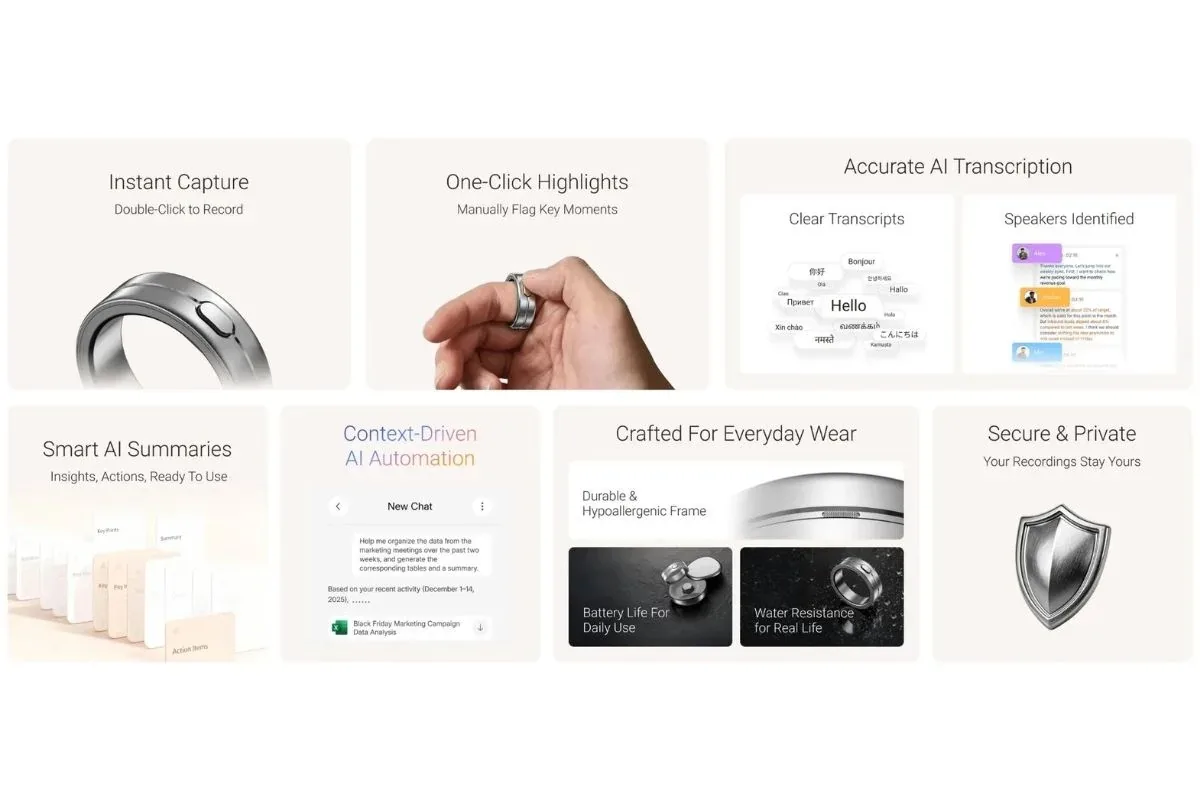
Tactile interaction operates entirely through a discreet physical button embedded along the outer perimeter of the band. Users double-click the button to trigger recording and double-click a second time to conclude the session. A single tap during an active conversation creates an immediate digital bookmark. This bookmark flags critical dialogue segments so the AI system prioritizes them when extracting action items and structured takeaways later [2].
Haptic motor pulses confirm operational changes without requiring visual confirmation. A subtle LED indicator (glowing on the inside band) activates during recording, positioned specifically on the inner edge toward the user’s palm. Pressing and holding the button activates real-time queries through Vocci AI, though this voice interaction functions only when the companion application remains open on a nearby smartphone [1].
Wireless synchronization executes over Bluetooth Low Energy 5.4. The setup takes minutes. Encrypted audio chunks transfer to connected iOS or Android mobile devices seamlessly [3].


Companion App Workflow and Processing Limits
Real-world testing conducted by tech reporter Ivan Mehta confirmed that the vocci ring captures clear dialogue in noisy cafes during hour-long discussions. The companion app sorts recordings into Chat transcripts, Highlights bookmarks, Notes summaries, and an overarching Base archive. Mehta observed that Base introduces unnecessary interface duplication by displaying identical files already categorized elsewhere [1].
Software friction emerges when capturing short personal memos. When wearers record brief one-line thoughts, the automated engine often outputs summaries substantially longer than the original spoken phrases, generating unnecessary text bloat. The platform currently lacks native synchronization with external calendar or reminder applications. Alternative voice devices such as the capsule-shaped Plaud NotePin and the SwitchBot MindClip emphasize rapid workflow automation, turning spoken phrases directly into digital tasks. Although the Vocci processing pipeline provides speaker diarization (differentiating unique voices in a room) and multilingual transcription across 112 languages, its architecture focuses primarily on documentation rather than immediate task delegation [5].
Software features expanded recently through the deployment of a dedicated Model Context Protocol server. This bridge permits technical users to connect conversational records with external language assistants and custom analytical tools. The integration appeared inside mobile builds only recently, demonstrating that third-party workflow automation remains an ongoing development phase [1].
Enterprise teams can export structured meeting summaries into corporate platforms including Notion, Slack, Google Docs, and WhatsApp. Long before automated recording wearables emerged, workplace documentation depended on instruments like the ballpoint pen to preserve critical operational decisions. Digital files now replace handwritten notebooks with encrypted cloud records [3].

Pricing Model and Enterprise Cloud Tiers
The vocci ring retails at $249, positioning it at a premium price point compared to clip-on microphones or smartphone audio accessories [4]. That expenditure reflects the micro-engineering required to fit batteries, wireless antennas, and microphones into a miniature titanium band. Core recording and offline local storage require no mandatory ongoing subscription, allowing buyers to transcribe foundational audio files without committing to recurring monthly software invoices.
Gyges Labs structures cloud expansion across three distinct subscription tiers. The complimentary Starter plan includes 300 transcription minutes per month with two gigabytes of cloud storage and 30 AI agent queries. Heavy corporate users can upgrade to the Plus tier at $15.99 monthly for 1,200 minutes and ten gigabytes of storage, or select the Pro package at $29.99 monthly for unrestricted monthly transcription capacity, twenty gigabytes of cloud space, and 300 agent interactions (covering extensive multi-team documentation workflows) [3].
Orders include a specialized sizing kit, a puck-style charging case, and a USB-C charging cable [2]. Hardware packaging carries a two-year warranty for buyers within the European Union and a one-year warranty across all other international regions. Sizing requires careful measurement.

Workplace Privacy and Consent Debates
Discreet industrial styling represents both the primary technological achievement and the most contentious vulnerability of the vocci ring across corporate and academic settings. Unlike conspicuous chest pins, clip-on recorders, or camera-equipped smart glasses that signal active technology use, a titanium band blends unnoticed into professional attire. Meeting attendees rarely suspect that finger jewelry contains an active microphone capturing spoken dialogue [1].
The recording indicator LED faces toward the user’s hand, meaning colleagues sitting across a conference table cannot see whether the device is listening. While corporate guidelines and regional statutes often enforce two-party consent for audio capture, an invisible recorder leaves compliance entirely to individual user discretion. Will enterprise IT administrators ban undeclared smart jewelry from confidential boardroom strategy sessions? Gyges Labs states that it actively encourages wearers to disclose recording status before initiating meetings, but critics argue that software reminders cannot prevent covert capture [4].
On the data governance side, the company implements bank-grade encryption for local storage and cloud transmission to satisfy GDPR compliance standards. Audio files remain strictly tied to user accounts and are never deployed to train foundational machine learning models without explicit owner authorization. As personal electronics advance toward slim headset designs and miniature body sensors, hardware manufacturers face rising regulatory pressure regarding background workplace surveillance [5].
Productivity wearables are rapidly diversifying into distinct form factors, forcing organizations to establish clear operational boundaries for finger-mounted recorders. The hardware succeeds in eliminating typing distractions during lengthy executive briefings, yet its enterprise adoption ultimately hinges on whether teams can establish transparent consent protocols in shared meeting spaces [4]. Transparent workplace communication remains essential.
- ONLINE NEWS Mehta, I. (2026, September 20). Vocci’s ring adds a new form factor to meeting note-taking. TechCrunch. [Article Link]
- ONLINE NEWS Puri, S. (2026, February 18). Vocci AI Note-Taking Ring Explained: Features, Specs & Price. WearableXP. [Article Link]
- WEBSITE Vocci. (2026, March 14). Vocci AI Context Ring – Wearable Voice Capture and Note-Taking Ring. Vocci. [Article Link]
- ONLINE NEWS AndroGuider Team. (2026, September 21). Vocci $249 AI Ring Reinvents Meeting Notes But Sparks Privacy Concerns. AndroGuider. [Article Link]
- ONLINE NEWS .partofstyle. (2026, September 20). Vocci’s Smart Ring Reimagines Meeting Notes from Your Finger.partofstyle. [Article Link]
- ONLINE NEWS AI Tools Oasis. (2026, September 20). Vocci Ring Adds New Form Factor to AI Meeting Notes. AI Tools Oasis. [Article Link]


