



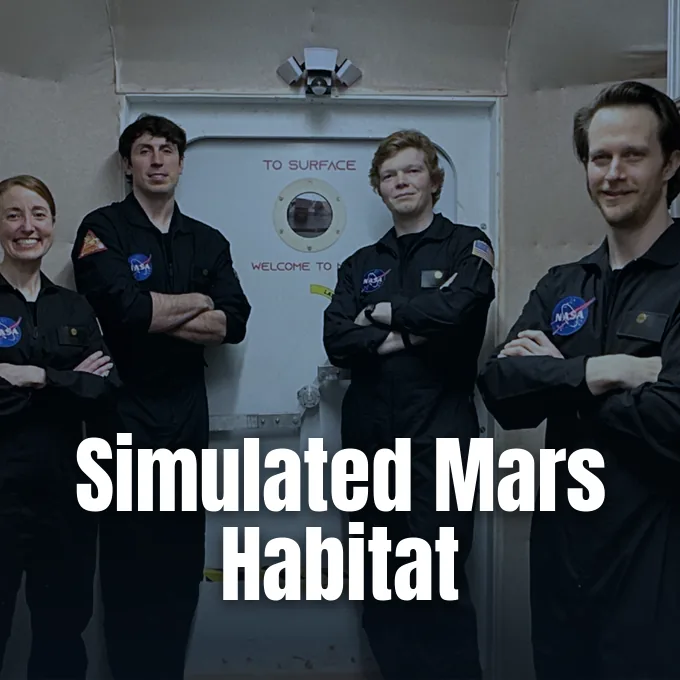
Four researchers living inside a 3D-printed enclosure in Houston have reached 365 days of isolation, completing a full year under simulated planetary constraints. Stationed at NASA Johnson Space Center since October 19, 2025, the team participating in the NASA simulated mars mission works with set food supplies, scheduled maintenance shifts, and planetary signal lags. The four volunteers are entering the final weeks of their 378-day stay [1]. Outside the enclosure, NASA science teams are preparing health logs to evaluate how long confinement alters human performance [5].
Pacing the NASA Simulated Mars Mission Schedule
NASA established the CHAPEA Crew Health and Performance Exploration Analog to collect physiological and psychological data from four volunteers living inside the 3D-printed Houston Habitat at Johnson Space Center. Mission commander Ross Elder oversees daily operations alongside medical specialist Ellen Ellis, science researcher Matthew Montgomery, and systems engineer James Spicer. The four researchers entered the module on October 19, 2025, balancing experimental laboratory tasks with habitat maintenance and plant cultivation. The stay spans 378 days. On October 19, 2026, the team completed 365 days inside the habitat. This milestone leaves the NASA simulated Mars mission within two weeks of its scheduled October 31 egress ceremony [5]. Science teams monitoring the installation from outside say that gathering long-duration data helps agency planners understand how human bodies handle prolonged surface stays [1].
Project leaders praised the crew for their steady operational rhythm. “We are extremely proud of the crew for their commitment and achievements over the last year on such a fast-paced, highly demanding mission,” said Grace Douglas, CHAPEA principal investigator [1]. Douglas said the team looks forward to congratulating the crew in person [5].
Daily Routines Inside the Houston Habitat
Inside the 1,700-square-foot enclosure at Johnson Space Center, the four crew members follow a rigid daily schedule that mirrors the demands of a future surface outpost on Mars. The habitat floor plan includes private quarters, a galley, workstation bays, medical areas, and a plant growth zone. Daily maintenance chores rotate among all four residents [2]. Routine filtration checks, crop care, and sanitation duties share equal standing with primary research protocols. The crew grows fresh greens inside the module to supplement prepackaged shelf-stable provisions.
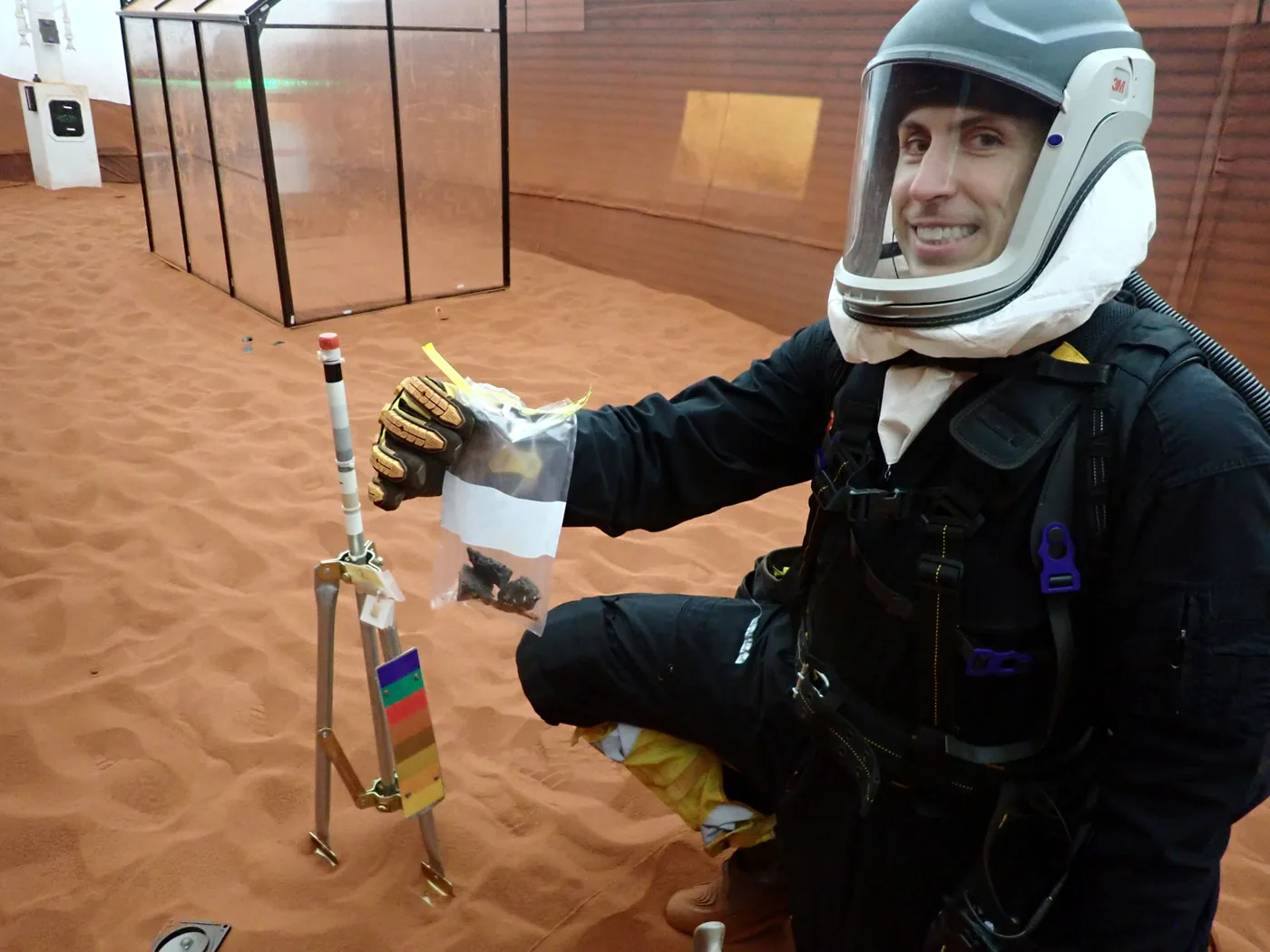
Crew members regularly step into an adjoining sand area filled with red soil to carry out simulated extravehicular activities on a simulated Martian surface. Clad in heavy spacesuits, Ross Elder and Ellen Ellis collect geological samples, while James Spicer and Matthew Montgomery conduct equipment repairs on external test structures. Earlier surface explorations by NASA rovers and the Ingenuity helicopter mission on Mars showed that terrain navigation demands careful route planning. These terrain challenges show why ground testing at Johnson Space Center prepares future planetary explorers. Elder logged geological samples after each traverse, storing specimens for comparative evaluation by science teams outside the airlock. The team documented suited mobility changes across multiple soil compositions to evaluate physical fatigue over time [1].

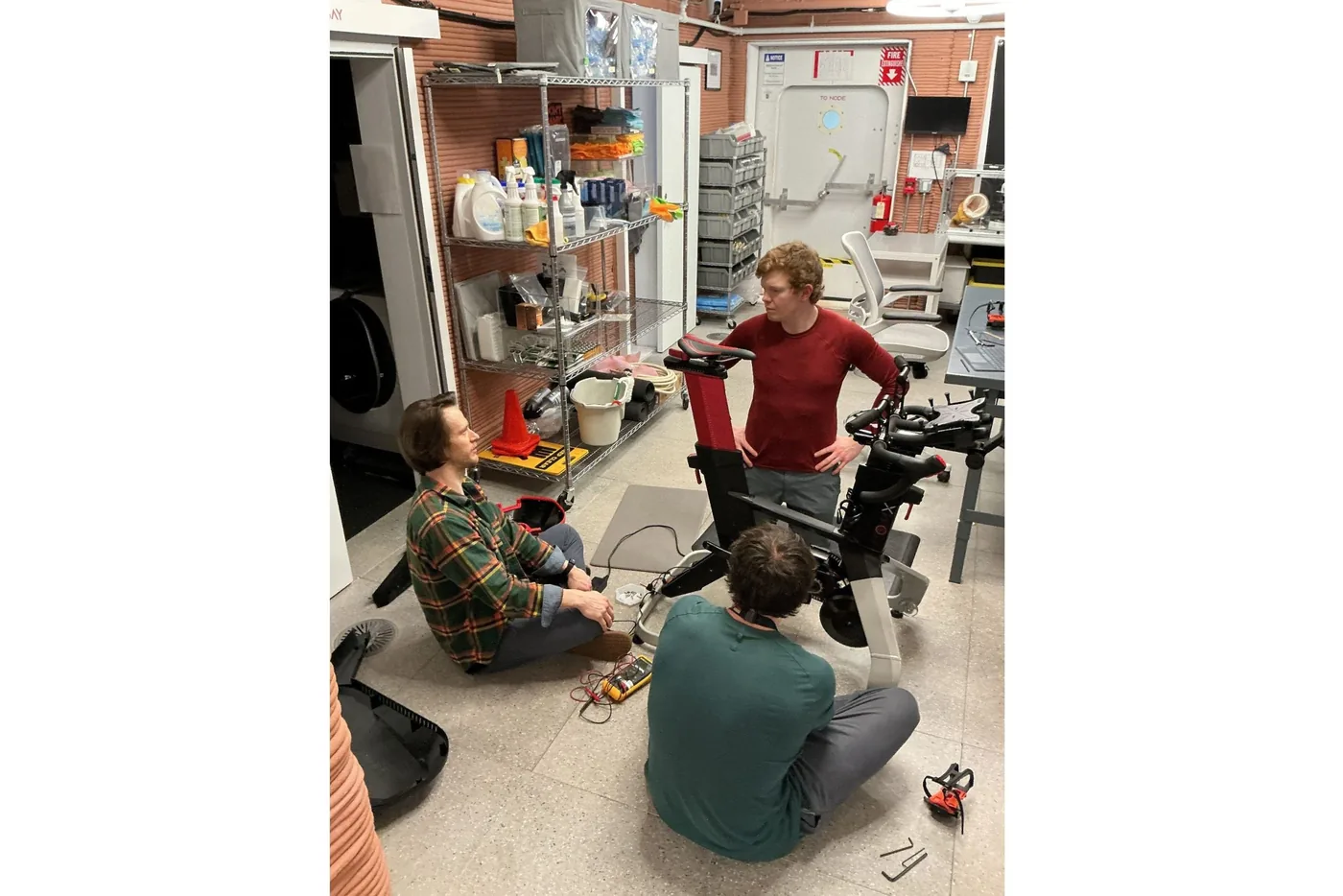
Workouts protect crew members from muscular atrophy during confinement. Ross Elder, Ellen Ellis, Matthew Montgomery, and James Spicer log hours on a stationary bike. “We approach every day committed to doing our best work,” said Spicer during maintenance tasks [2].
Communication Delays and Simulated Blackouts
Operating millions of miles from Earth introduces an unavoidable communication delay, and NASA simulates that barrier by imposing message lags lasting up to 45 minutes each way. Ross Elder and his crew cannot have direct telephone discussions with mission control in Houston or with their families. Instead, the team exchanges text messages and recorded video dispatches. Every complex problem requires patience, as asking a technical question and receiving an answer from flight controllers takes over an hour [1].
The crew experienced complete operational autonomy during a planned two-week communications blackout, designed to simulate solar conjunction when planetary alignment cuts all Mars-Earth communications. Mars moves directly behind the Sun. In celestial mechanics, this recurring geometric alignment is central to the Martian calendar cycle that governs orbital synchrony between both planetary bodies. With all external radio links silenced for fourteen consecutive days, Ross Elder, Ellen Ellis, Matthew Montgomery, and James Spicer resolved maintenance alarms using preloaded procedural handbooks and onboard toolkits without mission control assistance [2].
Spare components were strictly limited. Living without resupply flights forced the four volunteers to treat replacement filters, fasteners, and food rations with extreme care. Science officer Matthew Montgomery said that operating without active internet connectivity or rapid hardware replacements fundamentally reshaped their perspective on technical troubleshooting. “Having limited resources, be it tools, equipment, software, supplies, or no internet, really bounds what you have to solve problems,” said Montgomery [2]. He explained that finding creative solutions proved challenging but rewarding for the isolated crew.


Tracking CHAPEA Mission 2 Health Data
Medical officer Ellen Ellis coordinates health monitoring inside the habitat to evaluate how confinement alters human physiology over hundreds of days. Ellis and her fellow crew members perform regular blood collections, saliva swabs, body mass checks, and sleep evaluations to monitor immune markers, hormonal balances, and cellular metabolism. Tracking biological metrics provides baseline numbers that NASA flight surgeons will use to build health protocols for astronauts bound for Moon Base or Mars [2].
Psychological health under sensory deprivation receives equal attention from researchers monitoring the CHAPEA habitat from Johnson Space Center. Ross Elder, Ellen Ellis, Matthew Montgomery, and James Spicer complete regular cognitive tests and private behavioral questionnaires to record mood shifts and team dynamics. In studies overseen by NASA’s Human Research Program, scientists examine how confinement affects interpersonal cooperation during year-long simulations. The four residents developed mutual respect and shared problem-solving habits to keep cabin tension low [1].

Recreational activities help the team maintain high morale during months of isolation inside the enclosure. When off duty, Ross Elder, Ellen Ellis, Matthew Montgomery, and James Spicer share meals, watch movies, and play musical instruments they brought as part of their personal item allowance. “I’m proud of the crew’s accomplishments over the past 200 days — facing each challenge with fortitude and finding new ways to improve our performance and efficiency daily,” said Ellis [2].
Why NASA Runs Ground Analogs
Why does NASA run long ground analogs before sending humans to deep space? Risk reduction drives the program. Testing human behavioral stamina and equipment durability on Earth costs a tiny fraction of an orbital catastrophe, uncovering systemic engineering vulnerabilities while crews remain safely on the ground [1].
Data from the Houston enclosure feeds into broader planning for human exploration across the solar system. Lessons learned in Houston inform planning for lunar surface outposts, where Artemis crews will face similar isolation inside compact modules. Research teams analyzing this NASA simulated Mars mission evaluate how nutritional variety and schedule pacing protect crew stamina during interplanetary transits. “Extended-duration missions are relatively rare in NASA’s history to date,” said Sara Whiting, who serves as project scientist for the Human Research Program at Johnson [2].
Sara Whiting said that findings from Ross Elder, Ellen Ellis, Matthew Montgomery, and James Spicer provide timely insights for establishing a sustainable lunar presence and preparing for crewed flights to Mars. Whiting emphasized that extended missions remain rare in NASA history, making this detailed dataset vital for mission planning. Michael Stenger, chief scientist for NASA’s Human Research Program, said the mission teaches the agency how to deliver psychological and medical care across long signal lags. “When combining this Mars-realistic mission analog with a suite of physiological, psychological, and performance measures in a rigorously controlled environment, we’ll be able to translate the knowledge from these experiences to Moon Base and beyond,” said Stenger [1].
Egress Plans and Post-Mission Debriefs
Confinement ends on Saturday, October 31, 2026. Ross Elder, Ellen Ellis, Matthew Montgomery, and James Spicer will exit the Houston Habitat after completing 378 days in isolation. The Exit Set for Oct. 31 ceremony will be broadcast live online from Johnson Space Center, allowing the four volunteers to celebrate with family members they reached only through delayed emails [5].
Leaving the habitat will not mean an immediate return home, as the four researchers will enter two weeks of post-mission evaluations and scientific debriefings at Johnson Space Center. NASA medical teams will perform extensive physiological and psychological screenings to study how the volunteers readapt to open environments, natural daylight, and normal movement. NASA applies similar protocols to orbital spaceflights, following established procedures for briefing protocols for returning space crews arriving from the International Space Station [1].
Detailed reports compiled from the two-week debriefing period will help mission planners set realistic food reserves, workload schedules, and psychological support tools for future expeditions to the Red Planet. In tracking how four individuals lived and worked inside 1,700 square feet for 378 days, the NASA simulated Mars mission delivers vital benchmarks for planetary exploration. The scientific data collected from this simulated Mars habitat will guide engineering teams as NASA prepares for future human exploration of the Moon and Mars [1].
- PRESS RELEASE Graf, A., & HRP Communications Team. (2026, October 19). NASA’s Simulated Mars Crew Marks One Year Inside Habitat. NASA. [Article Link]
- PRESS RELEASE Cranford, N., & HRP Communications Team. (2026, May 7). NASA’s Simulated Mars Mission Marks 200 Days Inside Habitat. NASA. [Article Link]
- ONLINE NEWS Mirage News. (2026, October 19). NASA’s Simulated Mars Crew Marks One Year in Habitat. Mirage News. [Article Link]
- ONLINE NEWS Worldnewsdotcom. (2026, October 19). NASA’s Simulated Mars Crew Marks One Year Inside Habitat. Worldnewsdotcom. [Article Link]
- ONLINE NEWS OST Staff. (2026, October 19). NASA’s Simulated Mars Crew Hits One Year in Houston Habitat, Exit Set for Oct. 31. Outer Space Today. [Article Link]
APA 7: PerEXP Teamworks. (2026, October 20). NASA Crew Marks One Year in Simulated Mars Mission. PerEXP Teamworks.


