




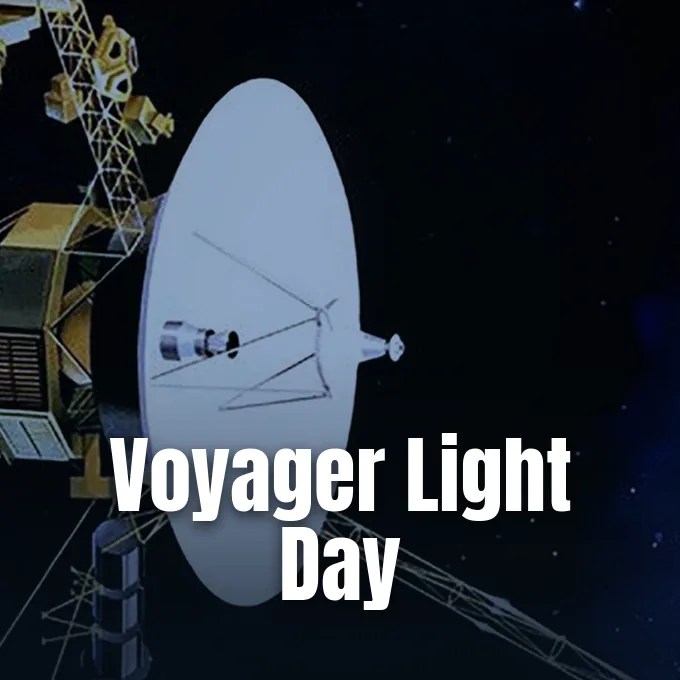
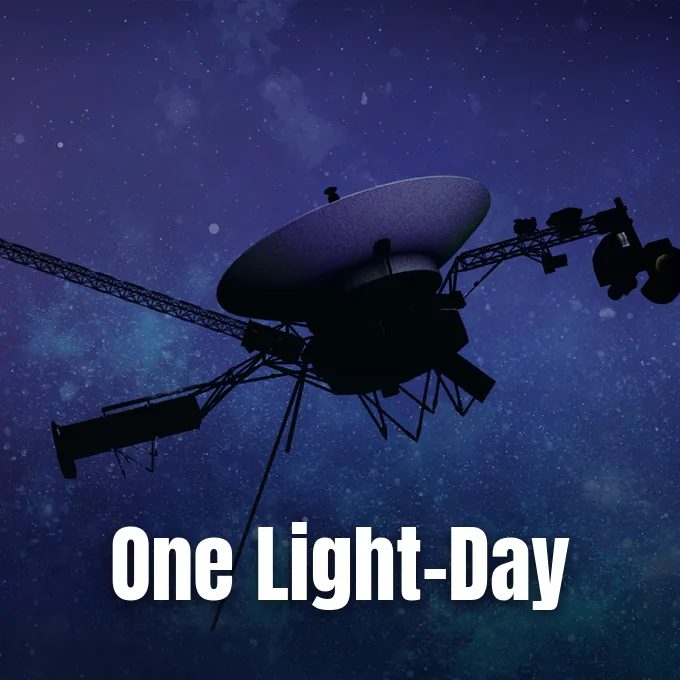
After more than 49 years of steady flight through space, NASA Voyager 1 has reached a distance of one light-day from Earth. A light-day equals the distance that light travels in 24 hours, which spans about 16.1 billion miles (25.9 billion kilometers). The spacecraft crossed that distance mark at 2:16 a.m. PST on November 18, 2026, marking a boundary never before reached by human technology. Mission controllers at NASA’s Jet Propulsion Laboratory in Southern California received the confirming signal 24 hours later, matching the exact time required for radio waves traveling at light speed to cross that gulf [1].
Crossing the Light-Day Boundary
Scientists measure deep space using the speed of light, which moves at about 186,000 miles (299,000 kilometers) each second in a vacuum. Sunlight passing Earth takes roughly 1.3 seconds to reach the Moon and about four hours to pass Neptune, but it needs another 20 hours to reach the current position of the probe. The milestone followed weeks of tracking as NASA monitored the Voyager 1 light day crossing in deep space. By comparison, a full light-year measures 5.88 trillion miles (9.46 trillion kilometers), showing that interstellar distances remain vast even after decades of continuous journeying [1].
Engineers confirmed the distance through trajectory calculations and radio carrier signals. Although the operations team had not received full science and engineering data packets since November 14, the transmitter continued to broadcast its fundamental tone. That carrier tone allowed tracking stations to verify the location of the probe and calculate its outbound speed of about 38,000 mph (61,155 kph) [1]. Public interest also centered on the event on November 17, when NASA invited people to flash the three-letter mission call sign, VGR, in Morse code toward the night sky [3].
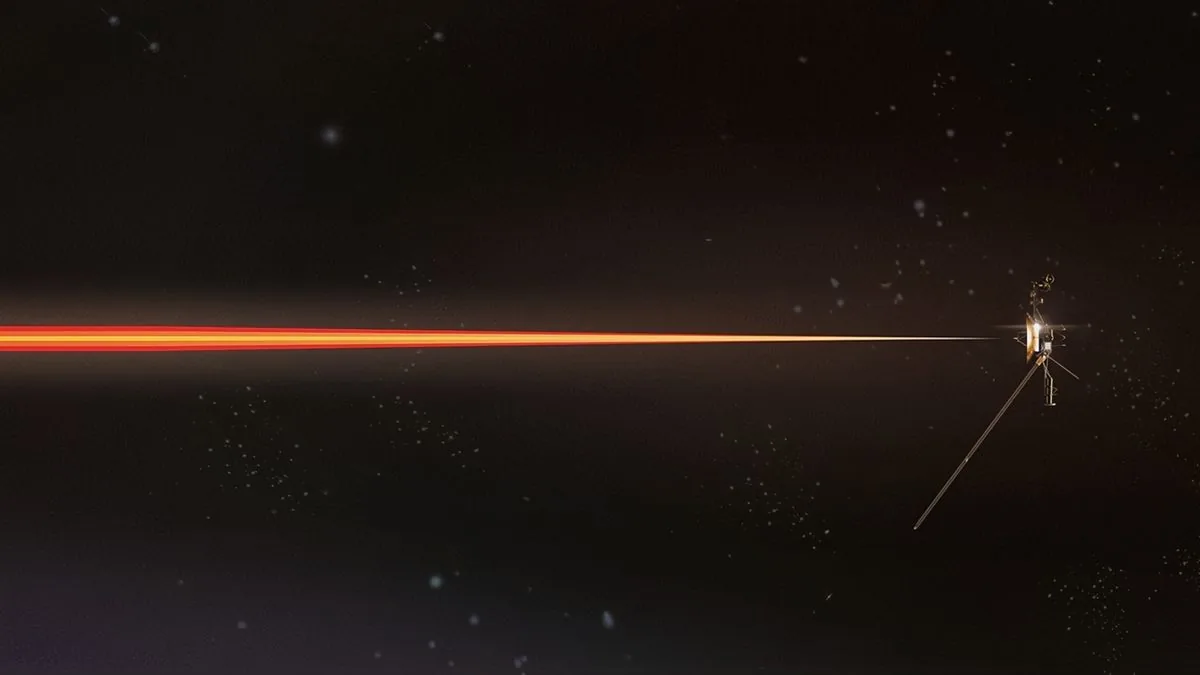
Its twin probe, Voyager 2, follows a separate path through the cosmos and will not cross the same distance until November 2035. The two spacecraft took different trajectories through the solar system after launching in 1977. Voyager 1 visited Jupiter and Saturn before swinging past Saturn’s moon Titan, a path that lifted it above the planetary plane in the early 1980s. Voyager 2 took a longer route to visit Uranus and Neptune, which kept it deeper within the ecliptic plane for several extra years [2].
How NASA Communicates with Voyager 1
NASA communicates with Voyager 1 using the giant radio antennas of the Deep Space Network, located at three ground facilities placed around the globe. These ground dishes send commands on a weekly schedule and listen for incoming signals on a daily basis. Because radio waves travel at the speed of light, every transmission sent from Earth now takes a full 24 hours to reach the spacecraft. A return signal requires another 24 hours to reach ground receivers, creating a two-day round trip for every message exchange [1].
“Even traveling at the speed of light, signals now take 24 hours to reach the spacecraft and 24 hours to reach us,” said Suzanne Dodd, the Voyager project manager at JPL [1]. Ground stations must track the spacecraft across shifting horizons while accounting for atmospheric interference at each facility. Team member Jack Lippincott has helped the operations group interpret radio data and adapt to violent weather near antennas, including heavy storms in Goldstone. His experience with Deep Space Network systems keeps ground teams capable of maintaining contact despite harsh environmental swings [2].

Long signal delays complicate routine maintenance when unexpected hardware issues arise in flight. Last month, Voyager 1 stopped responding to commands during an approximately 48-hour glitch before flight controllers restored normal operations. Flight software specialist Bhavana Gupta has developed procedures to pull operational data from the command systems so controllers can act quickly during emergencies. Meanwhile, Nshan Kazaryan coordinates antenna schedules with Deep Space Network planners to ensure regular listening windows remain open for incoming telemetry [2].
Power Budget in Deep Space
Keeping the robotic explorer operational in the freezing environment of deep space demands careful electrical budgeting [2]. The probe relies on a radioisotope thermoelectric generator, a nuclear battery that turns heat from decaying plutonium into electricity [1]. At launch in 1977, that power source generated 470 watts of electricity [2]. Because the plutonium fuel decays constantly over time, the generator loses about four watts of electrical output every single year [1].
With power margins growing thin, mission planners executed a major energy reorganization earlier this year. Controllers turned off three auxiliary devices aboard Voyager 1 and substituted three lower-power alternatives to stretch remaining reserves [1]. That maneuver, known inside the flight team as a “Big Bang” adjustment, balanced thermal needs against instrument power demands [2]. Mission managers told Space.com that these power adjustments will keep the active science instruments running until after the 50th launch anniversary arrives in the summer of 2027 [1].
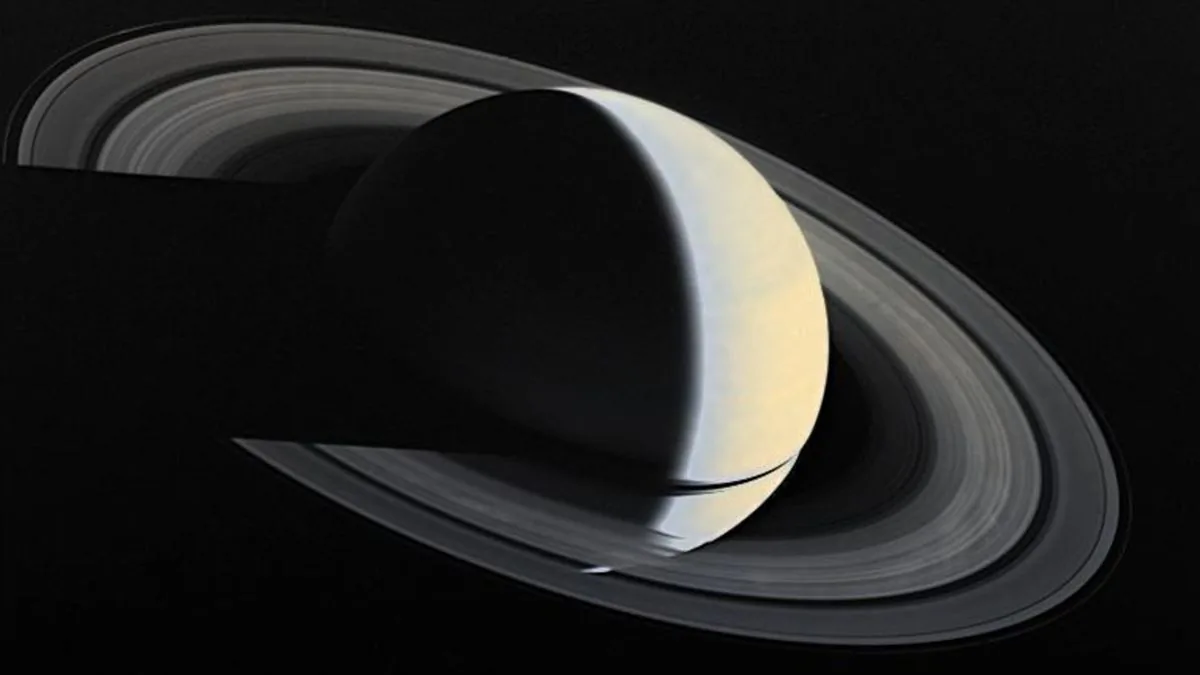
Aging hardware creates physical constraints beyond simple electrical depletion. Fuel lines have experienced thruster clogging over decades of operation, forcing engineers to switch thruster branches to keep the high-gain antenna oriented toward Earth. A malfunctioning computer also caused data formatting errors in previous years, which required custom memory patches written by JPL specialists. Each successful hardware fix allows the distant probe to preserve its scientific payload in an environment where physical repairs are impossible [1].

Scientific Goals for NASA Voyager 1
The primary research goal for NASA Voyager 1 is studying the uncharted realm where the solar wind gives way to the interstellar medium. The probe crossed the outer boundary of the heliosphere in August 2012, while Voyager 2 reached that boundary in November 2018 [1]. Instruments on board still measure magnetic field strength, plasma density, and energetic cosmic ray particles in this border zone [2]. Planetary exploration across the solar system spans varied regimes, from deep space probes to surface rovers where Curiosity chronicles daily conditions on Mars.
Measurements from the probe revealed surprising data about how solar particles interact with surrounding space [1]. “Key Voyager science going forward includes observing the extent to which our sun continues to affect interstellar space, all the way out to Voyager 1,” said JPL project scientist Linda Spilker. “Where does the sun’s influence end and pristine interstellar space begin? Perhaps Voyager may last long enough to answer that question.” The flight team also monitors how the magnetic field changes direction as the probe drifts further away from the sun [2].

Before entering interstellar space, both spacecraft reshaped planetary science during their initial tours of the outer planets. Voyager 1 provided detailed observations of active volcanoes on Jupiter’s moon Io and studied the dense atmosphere of Saturn’s moon Titan. These early flybys showed that moons in the outer solar system possessed dynamic geology and complex weather patterns rather than frozen, inactive surfaces [1]. In an online quiz published by The New York Times, science writer Kenneth Chang highlighted how those early planetary flybys established the foundation for modern outer solar system exploration [4].
Generations of Flight Engineers
Flying a spacecraft across five decades requires passing technical knowledge between successive generations of engineers and scientists. Many of the original team members who designed the spacecraft in the 1970s have retired, but their documentation remains vital for current operations. Mission manager Kareem Badaruddin leads a team where senior specialists work with newer engineers to solve unexpected communication dropouts and command errors. “They have demonstrated their value to the team consistently,” said Badaruddin in an email to Space.com, pointing out that younger engineers have taken on direct responsibility for orbital tracking and emergency documentation. “One of the reasons that one light-day is so special is that it has never happened before that we were in contact with a spacecraft at this distance, and it may never happen again.” [2]
The sustained flight of the mission honors the leadership of Ed Stone, the Caltech physicist who served as project scientist from 1972 until 2022. Stone coordinated eleven scientific instrument teams and guided the probes through changing planetary and interstellar mission phases. Caltech president Ray Jayawardhana noted that the project reflects both Stone’s vision and the curiosity of successive generations of researchers who carried the spacecraft past every initial design goal [1]. By training younger personnel to operate 1970s computing architectures, the team preserves the institutional skills necessary to command humanity’s most distant outpost [2].
The Golden Record and Future Trajectory
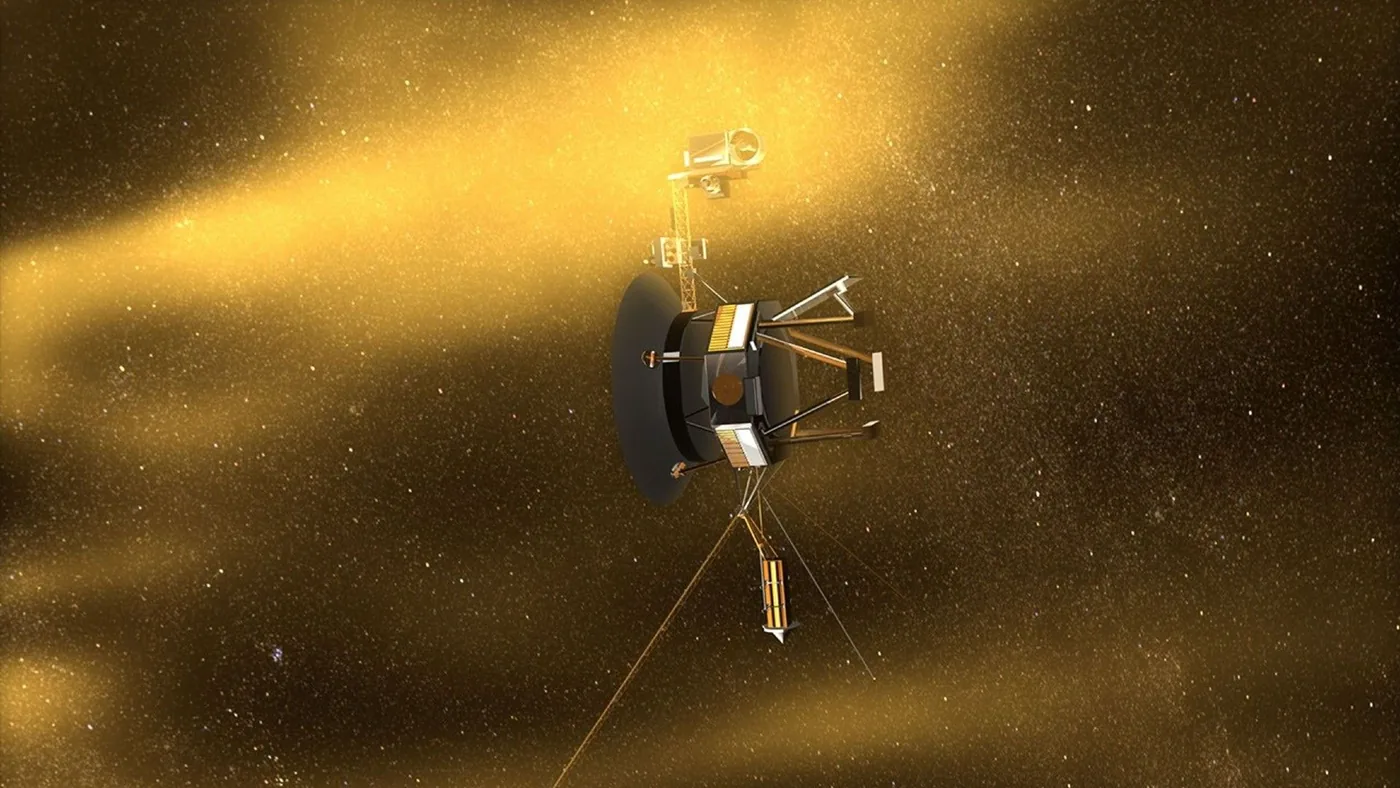
Mounted to the exterior of each probe is a copy of the Golden Record, a gold-plated copper phonograph disc designed to carry sounds and images of Earth to potential civilizations. The record holds musical tracks, greetings spoken in 55 languages, and natural sounds from our biosphere, along with scientific diagrams explaining the origin of the spacecraft [1]. In an essay accompanying the mission quiz in The New York Times, writers noted that the record acts as a cultural time capsule reflecting Earth as it existed in 1977 [4]. Even after the nuclear battery stops supplying electricity, the disc will endure for billions of years as it drifts through interstellar space [1].
Voyager 1 will continue coasting outward into the Milky Way long after its radio transmitter falls silent. Traveling at roughly 38,000 mph, NASA Voyager 1 will wander among the stars of the galaxy without returning to our solar system. JPL director Dave Gallagher said the crossing stands as a testament to the teams who built and managed the mission across five decades of space exploration. As project manager Suzanne Dodd observed, the silent probe will eventually serve as humanity’s permanent ambassador to the stars [1].
- PRESS RELEASE Taveau, J. (2026, November 19). NASA’s Voyager 1 Makes History Reaching One Light-Day From Earth. NASA. [Article Link]
- ONLINE NEWS Howell, E. (2026, November 19). What’s next for NASA interstellar Voyager 1 probe after passing 1 light-day from Earth? Space.com. [Article Link]
- ONLINE NEWS Mathewson, S. (2026, November 17). NASA wants you to ‘shine bright’ today for Voyager 1’s light-day milestone. Here’s how. Space.com. [Article Link]
- ONLINE NEWS Chang, K. (2026, November 18). How Much Do You Know About NASA’s Voyager Mission? The New York Times. [Article Link]
APA 7: PerEXP Teamworks. (2026, November 20). NASA Voyager 1 Reaches One Light-Day Threshold in Deep Space. PerEXP Teamworks. https://perexpteamworks.com/en/nasa-voyager-1-deep-space-milestone/


