






NASA engineering teams completed early post-flight examinations of the Artemis II heat shield after the Orion crew spacecraft returned from the Moon on April 10, 2026 [1]. Four astronauts flew aboard the Orion capsule named Integrity, traveling at 39 times the speed of sound before splashing down into the Pacific Ocean off the coast of San Diego [2]. U.S. Navy divers inspected the thermal protection system shortly after splashdown [1]. NASA data confirmed the heat shield protected Orion throughout descent [2].
Diver Imagery and Ocean Recovery
U.S. Navy divers reached Orion in the Pacific Ocean [1]. Diving teams captured underwater photographs showing that the 16.5-foot-wide Avcoat heat shield remained intact across its entire curved base after enduring high-velocity atmospheric entry [4]. NASA recovery specialists guided Orion into the flooded well deck of the amphibious transport dock ship USS John P. Murtha for detailed structural inspections. Recovery crews secured Orion without delay [6].
Mission commander Reid Wiseman inspected the scorched hardware aboard the USS John P. Murtha. After leaning underneath the capsule to inspect the ablative Avcoat dish with his crewmates, Wiseman said the base looked “wonderful to us” despite minor charring along the conical shoulder. Wiseman observed minimal char loss along that outer ring. The flight crew included NASA astronauts Victor Glover and Christina Koch alongside Canadian Space Agency astronaut Jeremy Hansen. Wiseman reported that Orion provided a smooth ride home [4].
Diver photographs confirmed that the Avcoat material remained largely smooth despite cutting through searing atmospheric plasma at 24,664 mph, equivalent to 39,693 km/h, during entry. Entry velocity matched mission predictions within 1.6 km/h [3]. NASA reported that Orion splashed down in the Pacific Ocean just 0.59 miles from its targeted landing coordinates off California [2]. News reports noted that earlier tracking placed splashdown roughly 2.9 miles (4.7 kilometers) from the mark [3].

Why the Artemis II Heat Shield Trajectory Was Modified
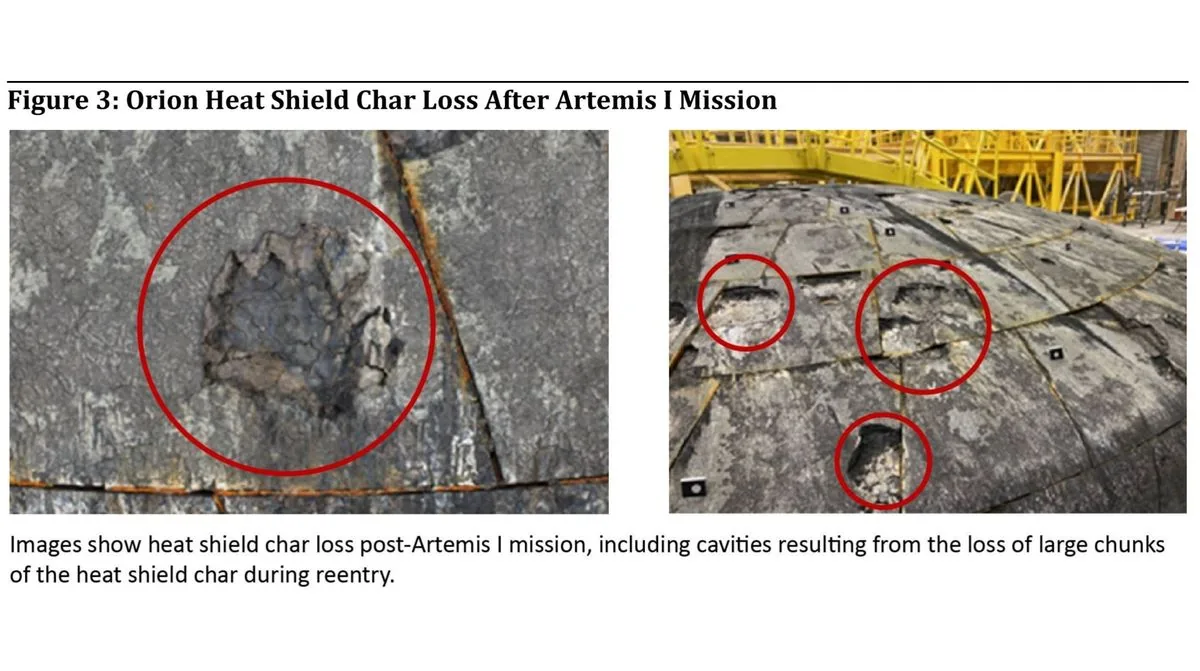
The Artemis I mission experienced serious shield cracking. During that uncrewed test flight in 2022, Orion’s heat shield suffered unexpected loss of protective coating during high-speed return from the Moon. Post-flight reviews showed that 103 spots of char loss pitted the dish as the capsule skipped off Earth’s atmosphere [2]. The skip entry maneuver was designed to extend glide distance and reduce deceleration loads, but hot gases built up inside the material and chipped away surface layers [3].
Technicians ran arc jet heating tests at NASA Ames Research Center in California’s Silicon Valley to reproduce the exact conditions of reentry [2]. Ground test teams determined that volatile gases generated inside the Avcoat resin could not vent quickly enough through the dense matrix. Former NASA astronaut and thermal engineer Charles Camarda warned that flying the same shield design without changes was like “playing Russian roulette” with the lives of the Artemis II crew [3]. NASA steepened the atmospheric entry angle instead of building a new shield, limiting heat soak on the Orion spacecraft [2].
Flight dynamics engineers modified Orion’s descent profile by shortening the maximum downrange distance the capsule flew after reaching the atmospheric entry interface. This steeper descent trajectory kept the spacecraft from lingering in the specific temperature range where gas pockets form, reducing cracking and char loss by a factor of ten on Artemis II. While orbital sensors like EarthCARE volcanic plume tracking monitor atmospheric aerosols, Orion followed this steep descent corridor into the Pacific Ocean. Orion crossed the entry interface within 192 feet of its target altitude [2].
Post-Flight Artemis II Heat Shield Evaluation
Ground teams transported Orion from San Diego to NASA’s Kennedy Space Center in Florida for post-flight evaluation. Thermal protection experts removed outer panels and examined the 186 unique Avcoat blocks that covered the base. Post-flight laser scans mapped the surface contour of the dish to calculate material recession against computer models. Visual checks found only nine small spots of char loss on the Artemis II shield [2].
In August 2026, NASA shipped the heat shield dish to NASA’s Marshall Space Flight Center in Huntsville, Alabama, for core sampling. Marshall technicians performed non-destructive three-dimensional x-ray scans on Avcoat blocks to inspect internal bonding and look for subsurface voids beneath the charred outer skin. These scans confirmed that Avcoat blocks and separation bolt seals held their integrity under peak temperatures exceeding 4,000 degrees Fahrenheit during descent. NASA confirmed that “no unusual conditions identified” occurred during the testing, validating the durability of the modified entry profile [2], [3]. Technicians extracted core samples for laboratory analysis to evaluate material recession across the dish [2].
Core samples pulled from the base are undergoing heating tests at Marshall Space Flight Center to measure chemical changes and remaining density. The material tests help NASA refine aerothermal models for future Orion flights returning from lunar orbit [2]. An ablative heat shield allows outer resin layers to char and slowly burn away, dissipating atmospheric heat into the plasma flow. The Artemis II heat shield successfully prevented heat from penetrating inward toward the Orion pressure vessel [7].



Backshell Tiles and Cabin Conditions
The upper crew module used a different thermal barrier. While the bottom heat shield absorbed direct compression heating, the conical upper backshell of Orion was protected by 1,300 ceramic tiles. Inspections at Kennedy Space Center showed that the backshell ceramic tiles completed the flight without cracks or missing segments. Protective seals around the Orion side hatch, windows, thruster nozzles, and atmospheric vents showed zero evidence of hot plasma leakage into the spacecraft structure [2]. Reflective thermal tape applied over outer joints also survived the entry undamaged [7].
Cabin temperatures stayed in the mid-70 degree Fahrenheit range. Inside the Orion living module, insulation and fluid loops protected the four astronauts in their flight suits, preventing heat spikes even as atmospheric friction pushed exterior temperatures past 4,000 degrees Fahrenheit during reentry. Flight surgeons tracked risks of decompression sickness during lunar spaceflight to verify cabin barometric pressure [2]. Although a frozen line temporarily disabled the Orion toilet during lunar flyby, life support systems performed reliably during the descent phase [7]. Reid Wiseman confirmed that Orion provided a smooth ride through Earth’s atmosphere [4]. The crew remained healthy through ocean recovery [2].
Manufacturing Adjustments for Upcoming Missions
NASA will not fly this specific shield design again [4]. The Artemis II shield was produced by filling individual fiberglass honeycomb cells with Avcoat resin by hand, creating slight density variations across the curved surface. For subsequent Orion crew capsules, NASA developed molded Avcoat blocks featuring uniform permeability, allowing pyrolysis gases to vent smoothly through the material during atmospheric heating. This manufacturing revision prevents the internal pressure spikes that caused Artemis I spalling [2].
Technicians at NASA’s Kennedy Space Center in Florida attached the newly manufactured, uniform-permeability heat shield to the Artemis III Orion crew module in early July 2026. In late July 2026, assembly teams joined the Artemis III crew module to its European Service Module and successfully powered up the combined spacecraft for the first time. Electrical checks confirmed that power and data links functioned as designed [2].

The mission profile for Artemis III will not subject Orion to the blistering 24,000 mph entry speeds of a direct lunar return [4], [6]. The flight will remain in low Earth orbit to conduct docking and rendezvous demonstrations with commercial lunar landers before NASA commits astronauts to lunar surface descents on Artemis IV [2], [4]. Artemis IV hardware will incorporate core analysis from Marshall Space Flight Center [2].
Flight Schedules Leading to Lunar Landings
NASA assigned astronauts Randy Bresnik, Frank Rubio, Andre Douglas, and European Space Agency astronaut Luca Parmitano to crew the upcoming Artemis III test mission. The crew will conduct docking trials with human landing system test articles built for SpaceX Starship and Blue Origin Blue Moon lunar landers. Artemis III will launch aboard the Space Launch System rocket, setting the stage for Artemis IV to attempt a crewed landing near the lunar south pole in 2028 [2],. Timeline success depends on timely delivery of commercial landers and spacesuits [3].
Orion demonstrated that its thermal protection works. Post-flight analysis of the Artemis II heat shield provides NASA with empirical confirmation that Orion can reliably protect crews returning from deep space. Trajectory adjustments successfully eliminated severe char loss during a 39-Mach atmospheric plunge into the Pacific Ocean. Testing on recovered core samples will continue in Alabama as NASA prepares for future missions [2].
- WEBSITE NASA. (2026, October 16). Artemis II Heat Shield After Splashdown. NASA. [Article Link]
- PRESS RELEASE Niles-Carnes, E. (2026, October 15). Rigorous Analysis Confirms NASA’s Artemis II Heat Shield Performance. NASA. [Article Link]
- ONLINE NEWS Turner, B. (2026, April 23). Artemis II heat shield aced its blistering reentry, ghostly underwater photo reveals. Live Science. [Article Link]
- ONLINE NEWS Wall, M. (2026, April 17). Artemis 2’s heat shield seems to have aced its trial by fire. Space.com. [Article Link]
- ONLINE NEWS Mirage News. (2026, October 16). Artemis II Heat Shield After Splashdown. Mirage News. [Article Link]
- ONLINE NEWS NASA Space News. (2026, April 20). The heat shield of Artemis 2 aced a wonderful test. NASA Space News. [Article Link]
- ONLINE NEWS Alaieva, L. (2026, April 22). How the Orion heat shield saved the Artemis II crew from death. The Universe Space Tech. [Article Link]
APA 7: PerEXP Teamworks. (2026, October 17). NASA Examines Artemis II Heat Shield After Pacific Splashdown.


